Europe Aerosol Caps Market Size
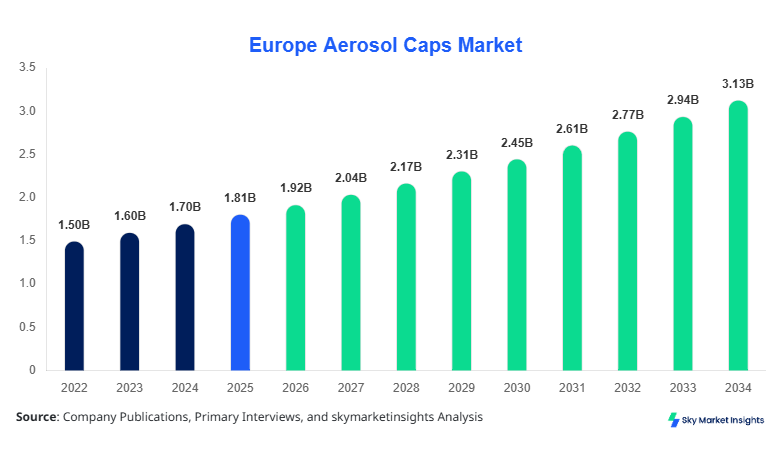
Europe's aerosol cap market size is projected at USD 1.92 billion in 2026 and is expected to hit USD 3.14 billion by 2034 with a CAGR of 6.3%. The regional industry accounted for nearly 8.4 billion units of aerosol cap shipments in 2025 and is anticipated to exceed 12.9 billion units by the end of 2034 due to increasing consumption across personal care, pharmaceutical, and household packaging sectors. Demand for advanced sealing systems, pressure-resistant packaging, and recyclable polymer caps continues to influence procurement activities across Europe.
The market assessment incorporates detailed segmentation analysis across product categories and end-use industries, including production capacity mapping, supply chain analytics, raw material pricing structures, and competitive benchmarking. Rising investments in lightweight packaging technologies, sustainability compliance, and automated dispensing systems are further reshaping the competitive landscape of the European aerosol caps market.
The aerosol caps industry comprises protective and dispensing closure systems used in aerosol containers for applications such as deodorants, hair sprays, shaving foams, household cleaners, automotive sprays, and pharmaceutical inhalers. Europe produced more than 16.7 billion aerosol cans in 2025, of which approximately 52% were utilized in personal care applications, 24% in household products, 13% in pharmaceutical formulations, and 11% in industrial and automotive uses. Plastic aerosol caps represented nearly 61% of total unit consumption, while metal aerosol caps accounted for 27%, and child-resistant variants held a 12% share due to increasing pharmaceutical safety requirements.
Consumer adoption patterns indicate strong preference toward recyclable polypropylene and polyethylene caps, with sustainability-oriented purchases rising by 34% between 2023 and 2025. More than 68% of consumers in Western Europe preferred aerosol products with tamper-evident and easy-dispensing mechanisms. Average dispensing accuracy improved by 19% owing to precision nozzle engineering and pressure-balancing technologies. Technical performance metrics such as leak resistance exceeding 98.7%, pressure tolerance above 12 bar, and compatibility with compressed gas formulations have increased product acceptance across industrial sectors. Household sprays represented nearly 22% application penetration, while pharmaceutical inhalers crossed 9% of total aerosol closure utilization in 2025, strengthening Europe's aerosol caps market penetration.
In Germany, the Aerosol Caps Market accounted for nearly 28% of Europe’s total revenue generation in 2025 due to the country’s strong cosmetics, automotive, and pharmaceutical manufacturing ecosystem. Germany operated more than 145 aerosol packaging facilities and over 60 specialized aerosol component manufacturers during the year. The country produced approximately 2.4 billion aerosol caps annually, with plastic closures contributing 64% of production volume. Personal care applications represented 47% of domestic demand, followed by household products at 26%, pharmaceutical inhalers at 15%, and automotive aerosol products at 12%.
Advanced manufacturing automation adoption exceeded 71% across German aerosol cap production plants, while robotic molding and AI-enabled defect detection improved operational efficiency by 22%. More than 58% of German manufacturers integrated recycled polymer materials into aerosol cap production lines to comply with EU sustainability mandates. The pharmaceutical sector witnessed an 18% annual increase in child-resistant aerosol cap demand due to rising inhaler usage and strict packaging regulations. Germany’s high export ratio, exceeding 41% of production output toward France, Italy, and the United Kingdom, continues to reinforce the Europe Aerosol Caps market's competitiveness.
Explore more data points, trends and opportunities Download Free Sample Report
Aerosol Caps Market: Trends
Sustainability-led Shift in Material Engineering
Sustainability-focused manufacturing has emerged as one of the most influential developments across the aerosol packaging ecosystem. Europe generated over 5.8 billion recyclable aerosol caps in 2025, reflecting a 31% increase compared to 2022 production levels. Polypropylene-based recyclable caps accounted for nearly 49% of all newly launched packaging solutions, while biodegradable polymer adoption expanded by 17% year-over-year. Manufacturers are increasingly utilizing post-consumer recycled materials to reduce virgin resin dependence by approximately 24%. More than 63% of aerosol packaging suppliers in Europe introduced lightweight cap technologies capable of lowering plastic consumption by 12–18% per unit. This transition toward sustainable dispensing systems is significantly shaping aerosol cap market trends.
Rising Smart Dispensing and Precision Spray Technologies
Technological innovation in dispensing systems is rapidly transforming aerosol cap functionality across cosmetic and pharmaceutical applications. More than 2.1 billion precision-dispensing aerosol caps were manufactured across Europe in 2025, representing 25% of overall production output. Smart actuators capable of reducing spray wastage by 16% gained widespread adoption among premium personal care brands. Pharmaceutical inhaler manufacturers increased adoption of metered aerosol caps by 21% between 2023 and 2025 to enhance dosage accuracy and patient safety. Pressure-balanced spray systems capable of maintaining dispensing consistency above 97% efficiency have become standard across high-end product categories. Increasing integration of anti-clogging nozzles, tamper-resistant features, and ergonomic designs continues to accelerate aerosol cap market trends.
Expansion of Pharmaceutical Aerosol Packaging
The pharmaceutical aerosol segment has experienced substantial momentum due to rising respiratory disease prevalence and increased inhaler demand. Europe produced more than 1.3 billion pharmaceutical aerosol caps in 2025, registering 14% annual growth. Child-resistant pharmaceutical closures represented 38% of total medical aerosol packaging consumption, while tamper-evident technologies gained 27% penetration among prescription inhaler products. Countries such as Germany, France, and the United Kingdom collectively accounted for nearly 67% of Europe’s pharmaceutical aerosol packaging output. The introduction of low-emission propellant-compatible aerosol caps further supported environmental compliance targets and reinforced aerosol cap market trends.
Europe Aerosol Caps Drivers
Growing Demand from Personal Care and Cosmetic Aerosol Packaging
The increasing consumption of personal care aerosol products across Europe is driving substantial demand for aerosol caps. In 2025, the region produced over 8.7 billion personal care aerosol containers, with deodorants accounting for 38%, hair sprays 24%, shaving foams 16%, and body sprays 12% of total production volume. Nearly 74% of premium cosmetic brands adopted customized ergonomic aerosol caps to enhance dispensing efficiency and brand differentiation. Consumer expenditure on grooming and cosmetic products increased by 11% between 2023 and 2025, while online beauty product sales expanded by 19%, directly influencing packaging demand. Advanced aerosol caps with 360-degree dispensing mechanisms improved user convenience by 21% and reduced product wastage by 14%. Furthermore, recyclable cap integration increased by 29% across cosmetic packaging lines due to EU circular economy policies. High-volume manufacturing investments across Germany, France, and Italy supported annual production capacity expansion exceeding 680 million units. The continuous preference for premium, functional, and environmentally compliant aerosol closures is expected to remain a key factor supporting the aerosol caps market growth.
Europe Aerosol Caps Restraints
Volatility in Polymer and Metal Raw Material Prices
Fluctuating raw material costs continue to present operational challenges for aerosol cap manufacturers across Europe. Polypropylene and polyethylene resin prices experienced average volatility of 18% between 2023 and 2025 due to supply chain disruptions and energy inflation. Aluminum costs increased by nearly 14% during the same period, directly impacting production economics for metal aerosol caps. More than 46% of medium-scale manufacturers reported profit margin pressure caused by rising transportation, electricity, and raw material procurement expenses. Regulatory compliance requirements related to recyclability and carbon emission reduction also elevated production costs by approximately 9–12% annually. Small manufacturers operating below 100 million units per year faced increased competition from integrated multinational packaging firms capable of securing long-term raw material contracts. Delays in resin supply chains impacted production lead times by 13%, affecting delivery schedules across personal care and pharmaceutical sectors. These cost-related pressures and operational uncertainties continue to restrain aerosol caps market growth.
Europe Aerosol Caps Opportunities
Expansion of Sustainable and Child-resistant Packaging Solutions
The growing focus on safety-compliant and sustainable aerosol packaging is creating lucrative opportunities for industry participants. More than 57% of pharmaceutical aerosol products launched in Europe during 2025 incorporated child-resistant closure technologies. Demand for eco-friendly aerosol caps manufactured from recycled polymers is expected to surpass 6.2 billion units by 2030. Government-backed sustainability initiatives across Germany, France, and the United Kingdom encouraged packaging firms to allocate over 32% of new investment spending toward recyclable aerosol closure production facilities. Pharmaceutical inhaler demand increased by 15% annually due to rising respiratory disorders and aging populations, creating strong opportunities for advanced metered-dose aerosol caps. Smart dispensing technologies capable of reducing leakage by 11% and improving dosage precision by 18% are gaining traction among healthcare manufacturers. Partnerships between packaging companies and cosmetic brands for low-carbon packaging solutions increased by 26% in 2025. These developments are expected to create substantial long-term opportunities for aerosol cap market expansion.
Challenges in the European Aerosol Caps Market
Stringent Environmental Compliance and Recycling Regulations
Environmental regulations governing plastic usage, waste management, and carbon emissions remain major challenges for aerosol cap manufacturers in Europe. Nearly 43% of existing aerosol cap production facilities required process upgrades to meet revised EU sustainability standards introduced between 2023 and 2025. Compliance-related investments increased operational expenditure by approximately 15%, particularly among small and medium enterprises. Recyclability mandates requiring minimum recycled content thresholds above 30% forced manufacturers to redesign production lines and material sourcing systems. More than 28% of manufacturers experienced delays in regulatory approvals for newly developed polymer formulations. Additionally, consumer scrutiny regarding single-use plastics intensified across retail channels, reducing demand for conventional non-recyclable aerosol closures by 9% in 2025. Technical challenges related to maintaining pressure resistance and durability while reducing material weight also impacted product development cycles. These environmental and engineering complexities continue to challenge aerosol cap market participants.
Report Scope
| Report Metric | Details |
|---|---|
| Market Size in 2025 | USD 1.81 Billion |
| Market Size in 2026 | USD 1.92 Billion |
| Market Size in 2034 | USD 3.14 Billion |
| CAGR | 6.3% (2026-2034) |
| Base Year for Estimation | 2025 |
| Historical Data | 2022-2024 |
| Forecast Period | 2026-2034 |
| Report Coverage | Revenue Forecast, Competitive Landscape, Supply Chain Disruption, Growth Factors, Environment & Regulatory Landscape and Trends |
Explore more data points, trends and opportunities Download Free Sample Report
Aerosol Caps Market Segmentation
The European aerosol caps industry is segmented based on product type and end-use industry. Plastic aerosol caps dominated the market with nearly 61% share in 2025 due to cost efficiency and lightweight properties, while personal care applications contributed approximately 52% of overall demand. Pharmaceutical applications recorded the fastest adoption growth due to rising inhaler consumption and child-resistant packaging requirements.
BY TYPE
Plastic aerosol caps accounted for nearly 61% of total production volume in Europe during 2025, surpassing 5.1 billion units annually. Polypropylene and polyethylene materials represented more than 83% of raw material consumption in this segment due to superior flexibility, low manufacturing costs, and recyclability advantages. Lightweight plastic aerosol caps reduced packaging weight by 14% compared to traditional metal variants, supporting transportation efficiency and sustainability targets. More than 68% of personal care brands adopted recyclable plastic dispensing caps with anti-clogging nozzle systems. Production automation adoption across plastic cap molding facilities exceeded 72%, improving output consistency and reducing defect rates below 1.8%. Precision spray technology integration increased dispensing efficiency by 17%, enhancing consumer usability across deodorants, body sprays, and hair styling products.
Metal aerosol caps represented approximately 27% of Europe’s total aerosol cap consumption in 2025 and exceeded 2.2 billion units in annual shipments. Aluminum-based aerosol closures dominated this category due to high durability, corrosion resistance, and premium aesthetic appeal. Luxury cosmetic brands accounted for nearly 46% of metal aerosol cap utilization owing to enhanced product positioning and superior pressure tolerance exceeding 14 bar. Pharmaceutical applications contributed 19% of segment demand, particularly for metered-dose inhalers and specialty medicinal sprays. Manufacturers increasingly integrated brushed aluminum finishes and high-gloss coatings to improve visual appeal and shelf differentiation. Europe witnessed a 12% increase in lightweight aluminum cap production technologies to reduce material consumption and comply with sustainability standards.
Child-resistant aerosol caps captured nearly 12% market share in 2025 and are witnessing rapid expansion across pharmaceutical and industrial aerosol applications. Europe produced over 1 billion child-resistant aerosol caps annually, driven by regulatory mandates for medical inhalers and chemical spray products. Pharmaceutical inhalers accounted for approximately 58% of segment utilization, while industrial disinfectants and automotive sprays represented 21% and 14%, respectively. Advanced locking mechanisms capable of reducing accidental exposure incidents by 31% gained widespread adoption. More than 49% of pharmaceutical manufacturers integrated dual-lock and push-turn cap technologies into respiratory medication packaging lines. Enhanced compliance with European child safety packaging regulations continues to support segment expansion.
BY APPLICATION
Personal care applications dominated the European aerosol packaging ecosystem with approximately 52% share of total aerosol cap consumption in 2025. The segment consumed more than 4.3 billion aerosol caps annually, primarily for deodorants, hair sprays, shaving foams, and body sprays. Deodorants alone contributed 38% of personal care aerosol packaging demand, followed by hair styling products at 24%. Consumer preference for ergonomic spray mechanisms and leak-proof closures increased adoption of advanced aerosol dispensing systems by 28% between 2023 and 2025. More than 66% of cosmetic manufacturers introduced recyclable packaging components to align with sustainability initiatives. Premium beauty brands increasingly utilized precision-spray caps capable of improving product dispersion uniformity by 19%. The rise in online retail distribution channels also accelerated demand for durable and tamper-resistant aerosol closures capable of minimizing transportation-related leakage.
Household product applications accounted for nearly 24% of Europe’s aerosol cap consumption and exceeded 2 billion units in annual demand during 2025. Air fresheners represented 34% of household aerosol packaging usage, followed by disinfectants at 27%, furniture sprays at 16%, and kitchen cleaners at 13%. Consumer hygiene awareness increased disinfectant aerosol demand by 22% after 2023, strengthening household packaging requirements. Manufacturers increasingly adopted wide-angle spray technologies capable of improving surface coverage by 18% and reducing chemical wastage by 11%. Recyclable cap penetration within household cleaning aerosols reached 41% in 2025 due to retailer sustainability commitments. Smart dispensing nozzles designed for continuous spray consistency and low-residue output gained popularity among industrial cleaning product manufacturers.
Pharmaceutical applications represented approximately 13% of total aerosol cap utilization in Europe during 2025, supported by rising respiratory disorder prevalence and increasing inhaler usage. More than 1.1 billion pharmaceutical aerosol caps were produced annually, with metered-dose inhalers contributing nearly 72% of total demand. Child-resistant aerosol caps accounted for 38% of pharmaceutical aerosol closure consumption due to stringent patient safety regulations. Advanced metered spray technologies capable of maintaining dosage precision above 98% were increasingly adopted across respiratory treatment products. Germany, France, and the United Kingdom collectively represented 64% of regional pharm
Europe Aerosol Caps Market Segmentations
Product Type
- Plastic Caps
- Metal Caps
- Child-Resistant Caps
End-use Industry
- Personal Care
- Household Products
- Pharmaceuticals
Europe Aerosol Caps: Regional Outlook
United Kingdom
The United Kingdom accounted for approximately 17% of Europe’s aerosol cap production volume in 2025 and produced nearly 1.4 billion units annually. Personal care applications represented 49% of domestic demand, followed by household products at 28% and pharmaceuticals at 14%. More than 55 aerosol packaging facilities operated across the country, with strong concentrations in England’s cosmetic manufacturing clusters. Sustainable aerosol packaging adoption increased by 26% between 2023 and 2025 as retailers implemented recyclable packaging mandates. Pharmaceutical inhaler production expanded by 13%, boosting demand for child-resistant aerosol caps. Smart dispensing technologies capable of improving spray consistency by 16% gained rapid acceptance among cosmetic manufacturers.
Germany
Germany maintained leadership within the regional industry by contributing approximately 28% of Europe’s total aerosol cap revenue in 2025. The country manufactured more than 2.4 billion aerosol caps annually and operated over 145 packaging production facilities. Personal care products accounted for 47% of domestic demand, while automotive sprays represented 12% owing to Germany’s large automotive aftermarket industry. More than 71% of production facilities adopted robotic molding systems and AI-enabled quality inspection technologies. Recyclable polymer cap utilization exceeded 58%, driven by strict environmental regulations. Germany also served as a major export hub, supplying nearly 41% of its aerosol cap output to neighboring European countries.
France
France represented approximately 16% of regional aerosol cap consumption and exceeded 1.3 billion units in annual production during 2025. Luxury cosmetics and fragrance packaging accounted for nearly 44% of national aerosol closure demand, supported by France’s globally recognized beauty industry. Metal aerosol caps gained substantial adoption among premium perfume and skincare brands due to superior aesthetics and durability. Sustainable packaging investments increased by 21% between 2023 and 2025 as manufacturers transitioned toward recyclable polymer solutions. Household disinfectant aerosol products represented 18% of national demand, while pharmaceutical applications accounted for 11%.
Spain
Spain contributed nearly 11% of Europe’s aerosol cap production and generated approximately 920 million units in 2025. Household cleaning aerosols represented 31% of domestic consumption, while personal care products contributed 46%. The country experienced 14% annual growth in recyclable plastic aerosol cap production due to increasing tourism-related hospitality demand for hygiene products. More than 38% of aerosol packaging manufacturers integrated lightweight polymer technologies to reduce material usage and transportation costs. Spain also witnessed rising adoption of continuous-spray nozzle systems across industrial cleaning applications.
Italy
Italy accounted for approximately 14% of Europe’s aerosol cap market production in 2025, with annual output exceeding 1.1 billion units. Cosmetic aerosol packaging dominated domestic demand with 51% share due to Italy’s extensive beauty and grooming product manufacturing sector. Luxury aerosol packaging adoption increased by 17% among premium cosmetic exporters. Metal aerosol cap demand expanded by 12% owing to premium packaging requirements. More than 48% of aerosol cap manufacturers implemented recycled polymer integration initiatives to comply with EU sustainability targets. Pharmaceutical aerosol production also increased by 9% due to rising inhaler demand.
Russia
Russia represented approximately 9% of regional aerosol cap production in 2025 and generated nearly 760 million units annually. Household products accounted for 37% of national aerosol cap demand, followed by personal care at 34% and industrial applications at 16%. Domestic manufacturing investments increased by 19% as regional producers aimed to reduce import dependence. Plastic aerosol caps dominated with nearly 69% share due to cost efficiency. Industrial aerosol products including lubricants and automotive sprays experienced 11% annual growth, driving additional demand for durable dispensing closures.
Top players in the European aerosol caps market
- Berry Global Inc.
- AptarGroup Inc.
- Coster Tecnologie Speciali S.p.A.
- Lindal Group Holding GmbH
- Precision Valve Corporation
- Summit Packaging Systems
- Mitani Valve Co. Ltd.
- Silgan Dispensing Systems
- Clayton Corporation
- KOH-I-NOOR Mlada Vozice a.s.
- Albéa Group
- Weener Plastics Group
- Aerosol Service A/S
- Volcke Aerosol Connection
- Canyon Europe Ltd.
Berry Global Inc.
-
Berry Global Inc. held approximately 14% regional market share in 2025 due to its diversified aerosol packaging portfolio and extensive European manufacturing network.
-
The company operated multiple high-capacity polymer molding facilities producing over 1.1 billion aerosol caps annually.
-
Nearly 46% of Berry Global’s aerosol packaging solutions incorporated recycled polymer materials during 2025.
-
The firm expanded investments in lightweight dispensing technologies capable of reducing material usage by 15% while improving spray performance consistency above 97%.
AptarGroup Inc.
-
AptarGroup Inc. accounted for nearly 11% of Europe’s aerosol packaging revenue generation in 2025.
-
The company specialized in precision dispensing systems for pharmaceutical and personal care applications.
-
More than 39% of AptarGroup’s aerosol closure sales originated from metered-dose inhaler packaging solutions.
-
The company invested heavily in smart spray technologies and tamper-evident packaging systems, improving dosage accuracy by 18% and leakage prevention efficiency by 22%.
Investment Analysis
Investment activity across Europe’s aerosol packaging ecosystem increased significantly between 2023 and 2025, with sustainability-focused production accounting for nearly 38% of total capital allocation. Germany represented approximately 29% of regional aerosol packaging investment expenditure, followed by France at 18% and the United Kingdom at 16%. An investment of more than USD 420 million equivalent was directed toward recyclable polymer cap production technologies and lightweight packaging systems. Pharmaceutical aerosol packaging projects captured 24% of new investment inflows due to rising respiratory healthcare demand.
Mergers, acquisitions, and strategic collaborations accelerated across the aerosol closure industry as manufacturers aimed to strengthen sustainability compliance and regional production capabilities. More than 17 partnership agreements were announced across Europe during 2025 involving recyclable materials, smart dispensing technologies, and precision aerosol engineering. Packaging companies allocated approximately 31% of investment budgets toward automation systems, AI-enabled quality inspection, and robotic molding technologies capable of increasing output efficiency by 20%. Cosmetic aerosol packaging manufacturers increasingly collaborated with polymer suppliers to develop low-carbon recyclable cap solutions.
Cross-border investments also expanded rapidly, particularly in Germany, Italy, and France, where multinational firms increased production capacities by over 14% annually. Pharmaceutical aerosol packaging investments witnessed 21% year-over-year expansion, primarily for child-resistant dispensing technologies and low-emission propellant-compatible caps. Retail and e-commerce distribution growth additionally encouraged manufacturers to invest in durable leak-resistant aerosol closure systems capable of reducing transportation damage rates by 13%.
New Product Developments
Manufacturers across Europe introduced a significant number of sustainable and high-performance aerosol closure products during 2025. More than 34% of newly launched aerosol caps incorporated recycled polymers, while biodegradable material integration increased by 16% compared to 2024. Advanced ergonomic spray actuators capable of reducing consumer hand pressure requirements by 21% gained popularity across personal care products. Leak-proof dispensing technologies improved sealing efficiency above 98.5%, enhancing packaging reliability during transportation and storage.
Pharmaceutical packaging innovation also intensified with the introduction of smart metered aerosol caps capable of improving dosage precision by 18%. More than 27% of newly developed inhaler closures integrated tamper-evident and child-resistant locking systems. Cosmetic packaging firms increasingly adopted matte-finish aluminum aerosol caps with anti-corrosion coatings, improving durability by 14%. The development of lightweight dispensing systems capable of reducing raw material usage by 12% continues to influence new product development strategies.
Recent Developments in Europe Aerosol Caps Market
- 2025: Berry Global expanded its recyclable aerosol cap manufacturing operations in Germany, increasing production capacity by nearly 18% and adding over 210 million units annually to support rising personal care packaging demand across Western Europe.
- 2025: AptarGroup introduced advanced metered aerosol dispensing systems for pharmaceutical inhalers, improving dosage precision by 19% while reducing spray leakage rates below 1.5%, significantly strengthening respiratory healthcare packaging efficiency.
Research Methodology
The European aerosol caps industry analysis was prepared using a combination of primary research, secondary research, and advanced market estimation methodologies. The research process involved extensive evaluation of packaging production statistics, aerosol container manufacturing data, polymer consumption patterns, trade analysis, and industrial investment activities across major European countries. Primary research included interviews with aerosol packaging manufacturers, raw material suppliers, distributors, pharmaceutical companies, cosmetic product manufacturers, and regulatory authorities. More than 45 industry stakeholders were consulted to validate production capacity estimates, adoption trends, and competitive positioning analysis.
Secondary research included analysis of corporate annual reports, packaging association publications, trade journals, customs databases, sustainability compliance reports, and industrial production records. Market size estimation was conducted using bottom-up and top-down analytical approaches integrating production volume assessments, pricing trends, and end-use consumption analytics. Forecast calculations incorporated macroeconomic indicators, aerosol product penetration trends, sustainability regulations, technological innovation rates, and sector-specific demand projections across Europe between 2026 and 2034.
Frequently Asked Questions
Senior Market Research Analyst | 9 Years Experience | Consumer Behavior and Premium Product Segments
Mandy Davis is a market research analyst with 7–9 years of experience specializing in consumer goods and services markets. Contributed to 70+ research reports for global clients. Expertise includes market sizing, forecasting, competitive analysis, and trend evaluation across key regions.