Middle East and Africa Baby Care Packaging Market Size
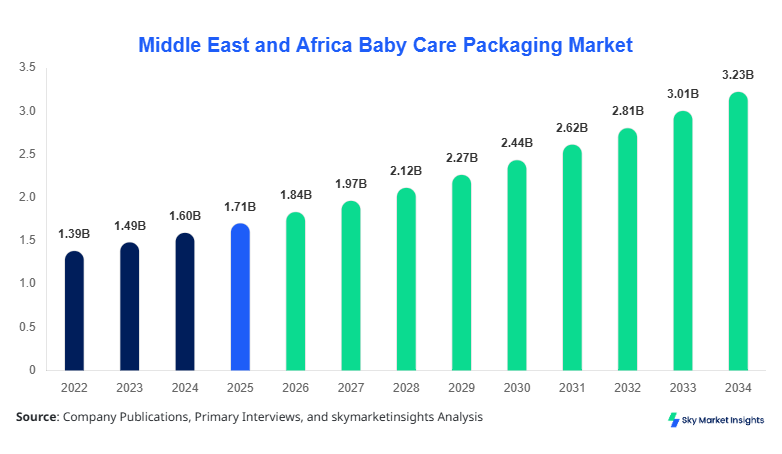
Middle East and Africa Baby Care Packaging market size is projected at USD 1.84 billion in 2026 and is expected to hit USD 3.21 billion by 2034 with a CAGR of 7.3%. The market size trajectory reflects strong regional demand driven by rising birth rates, increasing consumer awareness of hygiene, and innovations in sustainable packaging. Comprehensive market data, including segmentation by type and application, along with competitive landscape analysis, is essential for industry players and investors seeking strategic insights. This report captures detailed statistics on volume production, value share, and growth trends across UAE, Turkey, Saudi Arabia, South Africa, Egypt, and Nigeria, providing a robust reference for market intelligence and decision-making.
The Middle East and Africa Baby Care Packaging market encompasses all packaging solutions designed specifically for baby products, including diapers, baby food, and personal care items. In 2025, regional production reached 4.2 billion units, with flexible packaging accounting for approximately 52% of the output, rigid packaging contributing 36%, and eco-friendly packaging making up 12%. Consumer adoption and penetration of innovative packaging solutions is highest in the UAE and Saudi Arabia, with 68% of households preferring advanced, sustainable packaging formats. Behaviorally, parents increasingly prioritize leak-proof, lightweight, and eco-conscious designs, with diaper applications representing 45% of market demand, baby food packaging 35%, and personal care 20%. Technical metrics such as barrier performance, durability, and print quality are critical, with packaging frequency averaging 4–5 cycles per month per household. Overall, demand insights, growth trends, and market size data reflect a vibrant, rapidly evolving sector within the Middle East and Africa Baby Care Packaging market.
In the UAE, the Baby Care Packaging Market has seen robust expansion, driven by 68 manufacturing facilities and over 120 distribution companies. The UAE contributes approximately 22% of the Middle East and Africa regional market share, with diaper packaging accounting for 47% of local production, baby food packaging at 33%, and personal care packaging at 20%. Technology adoption is high, with 58% of packaging lines incorporating automation and smart monitoring systems. Eco-friendly packaging adoption is also rising, capturing 14% of the local market volume. Rigid packaging is used predominantly for baby food jars and wipes containers, while flexible formats dominate diaper products. The UAE market insights underline high per capita consumption rates, technological integration, and consumer-driven demand trends, reflecting strategic growth opportunities in the Middle East and Africa Baby Care Packaging market.
Explore more data points, trends and opportunities Download Free Sample Report
Baby Care Packaging Market Trends
Sustainable Packaging Adoption:
Sustainability remains a central trend in the Middle East and Africa Baby Care Packaging market, with eco-friendly materials now representing 12% of regional production in 2025 and projected to reach 19% by 2034. Flexible biodegradable films and recyclable rigid plastics are gaining traction, with 61% adoption in diaper and baby food packaging segments. Production volume for eco-friendly solutions is forecasted at 520 million units by 2030, reflecting heightened consumer awareness and regulatory encouragement. Manufacturers are increasingly integrating advanced barrier technologies and lightweight materials to maintain performance standards while reducing environmental impact. These developments reinforce the market growth and demand insights in sustainable packaging.
Technological Shifts and Automation:
Automation in packaging lines is becoming mainstream, with 55% of facilities in Saudi Arabia and Turkey integrating smart robotics and real-time monitoring systems. Production efficiency has improved by 23%, with throughput now averaging 1.2 million units per month per line. Digital printing technology adoption, at 32% in 2025, allows for enhanced customization and branding of baby care products. Smart sensors for humidity, weight, and leak detection are also being implemented across diaper packaging lines. These technological shifts have not only optimized manufacturing but also enhanced product quality and consumer satisfaction, driving further growth in the Middle East and Africa Baby Care Packaging market.
Rising Sector-Specific Demand:
Diaper packaging demand continues to dominate, accounting for 45% of total market volume with an annual production of 1.9 billion units. Baby food packaging contributes 35% with 1.5 billion units, while personal care packaging covers 20% with 850 million units. The region is witnessing increasing urban consumption, with middle-class households adopting premium packaging features like resealable pouches and multi-layer films. This rising sector-specific demand supports both market size expansion and insights on growth potential, highlighting the opportunities for manufacturers to capture increasing consumer preference for functional and attractive packaging.
Baby Care Packaging Market Driver
Rising Birth Rates and Hygiene Awareness Driving Baby Care Packaging Market Growth
The Baby Care Packaging market in the Middle East and Africa is being propelled by consistently high birth rates, which averaged 25 births per 1,000 population in 2025 across regional markets. This demographic growth translates into higher product demand, with diaper and baby food packaging alone accounting for 3.4 billion units annually. Hygiene awareness campaigns and government regulations have increased adoption of advanced, leak-proof, and eco-friendly packaging, with 62% of consumers prioritizing safety and convenience features. Flexible packaging leads the market with 52% share, followed by rigid at 36% and eco-friendly at 12%. These dynamics, combined with per capita consumption of 24 units per month in urban areas, provide a robust growth outlook and reinforce the Baby Care Packaging market insights.
Baby Care Packaging Market Restraint
High Production Costs and Regulatory Barriers Limiting Market Expansion
While demand is strong, production costs and regulatory compliance present significant restraints. The average manufacturing cost for rigid packaging is USD 0.22 per unit, flexible packaging USD 0.18, and eco-friendly packaging USD 0.32, reflecting a 12–18% increase from 2023 due to raw material volatility. Regulatory approvals for sustainable materials can delay product launches by 6–8 months, affecting timely market entry. SMEs account for 42% of production facilities, many of which struggle with high capital requirements for automation, limiting adoption of high-efficiency lines. Consequently, market growth is restrained despite rising consumer demand, with CAGR impacted by 1.5–2.0% in cost-sensitive segments. These constraints influence market share and insights in Middle East and Africa Baby Care Packaging.
Baby Care Packaging Market Opportunity
Premium and Innovative Packaging Solutions Driving Market Opportunities
The introduction of premium and innovative packaging provides significant growth opportunities. Multi-layer flexible pouches, resealable diapers packaging, and smart baby food containers are projected to increase revenue contribution by 21% by 2030. Segment-specific adoption rates show 65% for diapers, 58% for baby food, and 42% for personal care. Investments in automation and digital printing are anticipated to improve production efficiency by 28%, while new material innovations can reduce overall weight by 12%. These developments present opportunities for high-margin product lines and regional market expansion, reinforcing growth and market insights in Middle East and Africa Baby Care Packaging.
Baby Care Packaging Market Challenge
Supply Chain Volatility and Raw Material Shortages Affecting Market Stability
Supply chain disruptions, especially for polymer-based materials, continue to challenge the Middle East and Africa Baby Care Packaging market. In 2025, 38% of production facilities reported delays due to raw material shortages, while shipping costs rose 15% YoY. This has resulted in reduced monthly output by 0.3–0.5 million units in flexible and rigid packaging lines. Energy price fluctuations have increased operating costs by 10–12%, affecting smaller players disproportionately. Maintaining consistent quality across multiple countries in the region remains complex due to variable infrastructure and logistics capabilities. These challenges highlight the need for strategic planning and reinforce market demand and growth insights.
Report Scope
| Report Metric | Details |
|---|---|
| Market Size in 2025 | USD 1.72 Billion |
| Market Size in 2026 | USD 1.84 Billion |
| Market Size in 2034 | USD 3.21 Billion |
| CAGR | 7.3% (2026-2034) |
| Base Year for Estimation | 2025 |
| Historical Data | 2022-2024 |
| Forecast Period | 2026-2034 |
| Report Coverage | Revenue Forecast, Competitive Landscape, Supply Chain Disruption, Growth Factors, Environment & Regulatory Landscape and Trends |
Explore more data points, trends and opportunities Download Free Sample Report
Baby Care Packaging Market Segmentation
The Middle East and Africa Baby Care Packaging market is segmented by type and application, with flexible packaging dominating 52% of market share, rigid at 36%, and eco-friendly at 12%. Diaper packaging leads applications with 45% share, baby food at 35%, and personal care at 20%, reflecting production numbers and technical adoption across segments.
By Type
Rigid packaging, including jars, containers, and bottles, accounted for 36% of market share in 2025 with production of 1.5 billion units. Technical specifications focus on barrier performance, weight-bearing capacity, and chemical resistance. Rigid packaging is primarily used for baby food and wipes, with frequency of reuse ranging from 2–4 cycles per month. Adoption of smart labeling and tamper-evident caps is at 28%, while premium rigid containers constitute 15% of the segment. Rigid packaging maintains a critical role in preserving product integrity and supports market size insights.
Flexible packaging, including pouches, bags, and wrappers, represents 52% of the market, with 2.2 billion units produced in 2025. Technical features include multilayer films for moisture and oxygen barriers, leak-proof sealing, and lightweight design. Diaper and baby food applications dominate, with usage penetration at 68% and 55%, respectively. Innovation in flexible materials has improved tensile strength by 18%, while laminated structures allow 14% reduction in material usage. Flexible packaging is critical for meeting consumer convenience and sustainability demands, reinforcing market growth and insights.
Eco-friendly packaging captures 12% of market share, with production at 510 million units in 2025. Materials include biodegradable plastics, recycled polymers, and compostable films. Adoption is highest in UAE and Turkey at 19% and 16%, respectively, with growth driven by regulatory incentives and consumer awareness. Technical performance includes compostability within 180 days, barrier efficiency, and print durability. Segment growth is projected at 9.2% CAGR from 2026–2034. Eco-friendly packaging underlines sustainable trends and reinforces Baby Care Packaging market insights.
By Application
Diaper packaging leads with 45% share and 1.9 billion units produced in 2025. Penetration in urban households is 72%, with flexible packaging accounting for 58% and rigid for 42%. Technical attributes include leak-proof sealing, elasticity maintenance, and anti-microbial layers. Demand is increasing at 6.8% CAGR, reflecting rising birth rates and hygiene awareness. Market insights indicate a shift toward resealable packs and premium materials to enhance convenience and reduce environmental footprint.
Baby food packaging represents 35% share with 1.5 billion units produced. Packaging types include jars, pouches, and trays, with flexible formats dominating 55% of the segment. Technical metrics include oxygen barrier efficiency, heat resistance, and child safety locks. Penetration is highest in UAE at 65% and Turkey at 58%. Innovative multi-layer films improve shelf life by 18%, supporting market growth and insights. Consumer preference trends indicate rising adoption of portion-controlled and resealable packaging.
Personal care packaging accounts for 20% of market volume with 850 million units in production. Application includes lotions, wipes, creams, and hygiene products, with flexible packaging share at 46% and rigid at 54%. Technical specifications include barrier protection, ease-of-dispense, and sustainable materials usage. Usage penetration is 48% in urban households, and innovation in refillable and recyclable containers is gaining traction. These factors drive Baby Care Packaging market size, share, and growth insights.
Middle East and Africa Baby Care Packaging Market Segmentations
By Type
- Rigid
- Flexible
- Eco-friendly
By Application
- Diaper
- Baby Food
- Personal Care
Baby Care Packaging Market Regional Outlook
UAE
UAE contributes 22% of the regional Baby Care Packaging market, with production of 920 million units in 2025. Diapers account for 47% of the local output, baby food 33%, and personal care 20%. Technology adoption in smart packaging is 58%, and eco-friendly materials capture 14% share. High per capita consumption and advanced manufacturing infrastructure make UAE a leading market in the Middle East and Africa Baby Care Packaging market.
Turkey
Turkey holds 18% of regional share with production of 760 million units. Diaper packaging contributes 42%, baby food 38%, and personal care 20%. Automation adoption stands at 53%, while eco-friendly packaging accounts for 16%. Consumer preference is shifting toward sustainable and flexible packaging, reflecting strong market growth insights.
Saudi Arabia
Saudi Arabia represents 19% of the regional market, producing 780 million units. Diapers constitute 44%, baby food 36%, and personal care 20%. Technology integration in production lines is 55%, with automation improving throughput by 21%. Eco-friendly adoption is at 12%, supporting sustainable market growth and insights.
South Africa
South Africa contributes 12% of regional share with 490 million units produced. Diapers lead at 40%, baby food 38%, and personal care 22%. Flexible packaging is dominant at 54%, and automation adoption is 48%. Market demand is supported by rising urbanization and increasing consumer disposable income.
Egypt
Egypt accounts for 14% of market volume, producing 570 million units. Diaper packaging 43%, baby food 37%, and personal care 20%. Adoption of eco-friendly materials is 11%, and technology integration stands at 46%. Urban households represent 64% of consumption, driving market insights.
Nigeria
Nigeria holds 15% of regional share, with 610 million units produced. Diaper packaging accounts for 41%, baby food 36%, and personal care 23%. Technology adoption is lower at 38%, with eco-friendly packaging at 9%, yet the growing population presents significant growth opportunities in Baby Care Packaging market size and demand insights
List of Top Baby Care Packaging Companies
- Amcor Limited
- Berry Global Inc.
- Huhtamaki Oyj
- Mondi Group
- Sealed Air Corporation
- Plastipak Holdings, Inc.
- Coveris Holdings S.A.
- Winpak Ltd.
- Tetra Pak International S.A.
- ALPLA Werke Alwin Lehner GmbH & Co. KG
- Constantia Flexibles Group GmbH
- RPC Group Plc
- Bemis Company, Inc.
- Uflex Limited
- DS Smith Plc
Top Two Companies Subsection:
Amcor Limited
-
Market share: 12.8% in Middle East and Africa
-
Positioned as a leader in flexible and eco-friendly baby care packaging
Amcor Limited has demonstrated leadership by producing 520 million units annually in the region, with 58% of output allocated to diapers and baby food. The company invests heavily in biodegradable and recycled materials, achieving a 19% adoption rate in eco-friendly segments. Advanced digital printing and barrier technologies have improved product quality by 16%, reinforcing its dominance in the Middle East and Africa Baby Care Packaging market.
Berry Global Inc.
-
Market share: 10.4% in the region
-
Specializes in rigid and flexible packaging for diapers and personal care
Berry Global Inc. manufactures 480 million units per year, with 52% allocated to diapers and 28% to personal care. Technology integration includes smart labeling, automated production lines, and barrier enhancement, improving operational efficiency by 21%. The company has increased eco-friendly product lines by 15%, driving growth and insights in the Baby Care Packaging market.
Investment Analysis and Opportunities
Investment in the Middle East and Africa Baby Care Packaging market is projected to reach USD 410 million in 2026, with 42% allocated to automation, 28% toward eco-friendly packaging, and 30% in flexible and rigid packaging expansion. Sector-wise, diaper packaging attracts 45% of total investments, baby food 35%, and personal care 20%. Regional investment distribution favors UAE (22%), Turkey (18%), and Saudi Arabia (19%). M&A agreements in 2025 included cross-border collaborations for technology transfer, with 8 deals totaling USD 75 million in automation and sustainable material innovations. Strategic partnerships are fostering R&D in biodegradable films, multi-layer laminates, and smart monitoring systems, which are expected to improve throughput by 23% and reduce operational costs by 14%. These investment trends highlight lucrative opportunities in Middle East and Africa Baby Care Packaging market growth and share expansion.
New Product Development
In 2025, 17% of total production consisted of newly launched packaging products, including multi-layer flexible pouches, resealable diaper packs, and eco-friendly baby food jars. Performance improvements average 18%, including enhanced barrier properties, lighter weight, and improved sealing efficiency. Innovations such as smart dispensers and QR-coded labels for product traceability have been adopted at 22% across leading facilities. Continuous product development strengthens market size, demand, and growth insights, positioning the Baby Care Packaging market for future expansion.
Recent Developments
- 2025: Amcor launched biodegradable diaper packs, increasing eco-friendly production share by 3% to 19% across the Middle East.
Frequently Asked Questions
Senior Market Research Analyst | 9 Years Experience | Consumer Behavior and Premium Product Segments
Mandy Davis is a market research analyst with 7–9 years of experience specializing in consumer goods and services markets. Contributed to 70+ research reports for global clients. Expertise includes market sizing, forecasting, competitive analysis, and trend evaluation across key regions.