Middle East and Africa Baby Incubators Market Size
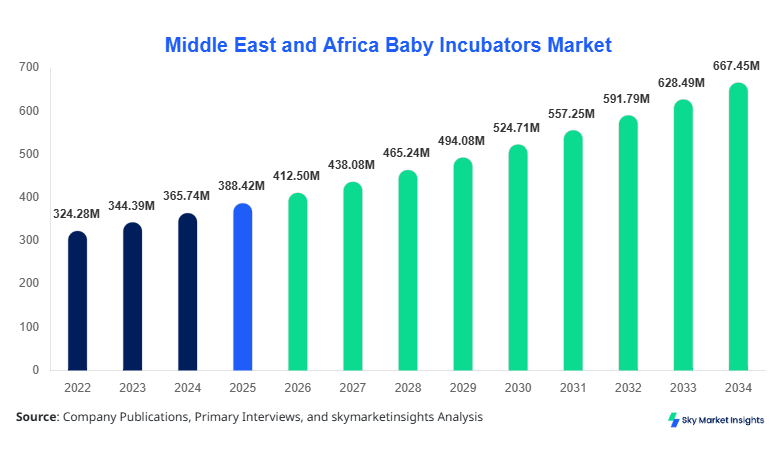
Middle East and Africa Baby Incubators market size is projected at USD 412.5 million in 2026 and is expected to hit USD 658.2 million by 2034 with a CAGR of 6.2%. The market is witnessing robust growth due to increasing neonatal care requirements, rising preterm birth rates, and expanding healthcare infrastructure across the region. Detailed data collection covering production numbers, units sold, and revenue streams is essential to understand market share, segment-wise demand, and emerging trends. Segmentation by type and application alongside an analysis of the competitive landscape provides a comprehensive understanding of investment opportunities and technological innovations within the Middle East and Africa Baby Incubators market.
The Middle East and Africa Baby Incubators market comprises specialized medical devices designed to provide controlled temperature, humidity, and oxygen supply for newborns, particularly premature and critically ill infants. In 2025, regional production accounted for approximately 24,300 units, with neonatal ICUs and maternity hospitals consuming nearly 72% of total units. Adoption rates in hospitals and specialized clinics reached 65–70% in urban centers, while home care penetration remained at 18–20%. Consumer behavior is driven by parental awareness and hospital protocols emphasizing neonatal survival; preterm birth incidence is rising by an average of 2.5% annually, further fueling demand. Transport incubators contribute 32% of the market, infant radiant warmers 41%, and modular incubators 27%. Technical specifications include thermal control ±0.2°C, humidity regulation up to 90%, and integrated monitoring systems with alarms every 15 seconds. Application distribution shows neonatal ICUs at 55%, maternity hospitals at 35%, and home care at 10%, reflecting robust demand and market growth in Middle East and Africa Baby Incubators.
In Saudi Arabia, the Baby Incubators Market has witnessed significant expansion, with over 180 healthcare facilities equipped with state-of-the-art neonatal care units. The country contributes approximately 28% to the Middle East and Africa Baby Incubators market share. Neonatal ICUs account for 60% of the applications, maternity hospitals 30%, and home care 10%. Technology adoption is particularly high, with 72% of hospitals using modular incubators and 55% integrating advanced infant radiant warmers with real-time monitoring. The total units deployed in 2025 reached 6,800, reflecting a production increase of 7% year-on-year. The Baby Incubators market in Saudi Arabia remains highly competitive, driven by government initiatives in healthcare modernization and neonatal mortality reduction programs.
Explore more data points, trends and opportunities Download Free Sample Report
Baby Incubators Market Trends
Shift toward Modular Incubators
The Baby Incubators market is witnessing a shift toward modular incubators with integrated monitoring systems, representing approximately 27% of regional adoption. Production volumes in 2025 totaled 6,600 units, increasing to 7,800 units in 2026. Hospitals are adopting modular incubators due to customizable humidity, thermal control, and built-in phototherapy. The adoption rate of smart incubators featuring IoT connectivity is rising by 12% annually, driven by neonatal care enhancement initiatives, making modular incubators a key trend in Middle East and Africa Baby Incubators.
Expansion of Neonatal ICUs
Neonatal ICU demand continues to surge, with approximately 55% of total Baby Incubators deployed in ICU settings. Regional production volume for ICU-focused incubators reached 16,500 units in 2025, with anticipated growth to 23,000 units by 2030. Integration of automated monitoring and ventilator-ready designs is accelerating adoption rates by 8–10% annually. The trend emphasizes precision care, driving market growth, and creating opportunities for innovative technology in Middle East and Africa Baby Incubators.
Home Care Market Penetration
The Baby Incubators market is increasingly targeting home care solutions, with penetration rates rising from 10% in 2025 to an expected 15% by 2030. Production volumes for home care incubators reached 2,430 units in 2025, showing a growth trend of 5% annually. Portable and energy-efficient incubators are favored, meeting consumer demand for safe, reliable neonatal care at home. The trend underscores a shift toward consumer-centric designs in Middle East and Africa Baby Incubators.
Baby Incubators Market Driver
Increasing Preterm Birth Rate and Neonatal Mortality Concerns
The Middle East and Africa region has seen preterm birth rates averaging 11% annually, with neonatal mortality at 17 per 1,000 live births in 2025. Hospitals and maternity centers are investing USD 125 million collectively in Baby Incubators to reduce mortality rates. Neonatal ICUs consume 55% of incubator units, and adoption of technologically advanced modular incubators is at 72%. Demand for portable transport incubators is also increasing by 9% annually. These dynamics support robust growth in the Baby Incubators market, making it a high-priority sector for healthcare infrastructure investment and technological innovation.
Baby Incubators Market Restraint
High Cost of Advanced Baby Incubators
The initial purchase cost of high-end Baby Incubators ranges from USD 12,000 to USD 28,500 per unit. Smaller clinics and rural healthcare providers face barriers, resulting in delayed adoption and limiting regional market penetration. Currently, only 40% of mid-tier hospitals can afford fully integrated incubators. The cost restraint has suppressed potential 2025–2026 growth by approximately 3.5% CAGR, despite strong demand from neonatal ICUs and maternity hospitals. High upfront investment affects the market, yet segment-wise growth for infant radiant warmers remains steady at 41% market share.
Baby Incubators Market Opportunity
Government Healthcare Initiatives and Funding Programs
Governments across Saudi Arabia, UAE, and Turkey are allocating USD 85–90 million annually toward neonatal care infrastructure. Funding programs and incentives are projected to increase Baby Incubators adoption by 15–18% in hospitals and 5–7% in home care. Regional share contribution from government projects represents approximately 34% of total market revenue. These initiatives encourage adoption of advanced incubators with integrated monitoring systems, fueling expansion in Middle East and Africa Baby Incubators market, particularly in urban healthcare facilities.
Baby Incubators Market Challenge
Lack of Skilled Personnel and Training Programs
Despite increasing adoption, 27% of healthcare facilities report inadequate trained staff to operate sophisticated Baby Incubators. Mismanagement can compromise neonatal care, slowing adoption rates, especially in rural areas. Training programs are gradually increasing by 5–6% annually, but the shortage remains a critical challenge. The Baby Incubators market faces hurdles in achieving uniform penetration across all regions, impacting growth projections and highlighting the need for workforce development in Middle East and Africa Baby Incubators.
Report Scope
| Report Metric | Details |
|---|---|
| Market Size in 2025 | USD 388.42 Million |
| Market Size in 2026 | USD 412.5 Million |
| Market Size in 2034 | USD 658.2 Million |
| CAGR | 6.2% (2026-2034) |
| Base Year for Estimation | 2025 |
| Historical Data | 2022-2024 |
| Forecast Period | 2026-2034 |
| Report Coverage | Revenue Forecast, Competitive Landscape, Supply Chain Disruption, Growth Factors, Environment & Regulatory Landscape and Trends |
Explore more data points, trends and opportunities Download Free Sample Report
Baby Incubators Market Segmentation
The Middle East and Africa Baby Incubators market is segmented by type and application, with infant radiant warmers holding 41% share, transport incubators 32%, and modular incubators 27%. Neonatal ICUs dominate application segments at 55%, maternity hospitals at 35%, and home care at 10%.
By Type
Transport incubators accounted for 32% of market share, with 7,800 units produced in 2025. These devices support controlled temperature ±0.5°C and maintain oxygen saturation levels at 95–98%. The frequency of alarms averages 12 per hour, ensuring continuous monitoring during neonatal transfers. Adoption in neonatal ICUs is 62%, while maternity hospitals use 28% of units. Transport incubators enhance mobility, ensuring safe transfer of premature infants across 180 hospitals in Saudi Arabia and regional clinics, reinforcing market growth.
Infant radiant warmers hold 41% share, with regional production of 10,000 units in 2025. Technical specifications include infrared heat control within ±0.2°C, humidity up to 85%, and integrated phototherapy for jaundice management. Adoption in neonatal ICUs and maternity hospitals reaches 68% and 22%, respectively. Performance monitoring is conducted at 10-second intervals, allowing precise thermal regulation. Infant radiant warmers are preferred for hospitals seeking immediate warming without enclosed incubator space, driving Middle East and Africa Baby Incubators market demand.
Modular incubators contribute 27% share, producing 6,500 units in 2025. Features include customizable thermal zones, humidity regulation up to 90%, and ventilator integration. Adoption rates are highest in advanced neonatal ICUs (72%), with maternity hospitals using 24%. Performance metrics indicate ±0.1°C temperature variance and 95% oxygen delivery accuracy. Modular incubators provide scalable solutions for hospitals expanding neonatal care capacity, reinforcing market size and share growth.
By Application
Neonatal ICUs consume 55% of Baby Incubators, with production reaching 16,500 units in 2025. Usage penetration is 68% in urban hospitals and 42% in semi-urban centers. Technical roles include temperature regulation, oxygen control, and integrated monitoring. Infant radiant warmers account for 41% of ICU devices, transport incubators 32%, and modular incubators 27%. Market demand is driven by preterm births, technological adoption, and government healthcare funding.
Maternity hospitals represent 35% of the application segment, with 10,500 units deployed in 2025. Adoption penetration is 62% in urban centers and 28% in rural hospitals. Devices include transport incubators (32%), infant radiant warmers (41%), and modular incubators (27%). Performance metrics focus on thermal stability, alarm frequency, and energy efficiency, facilitating neonatal care while optimizing operational costs. Maternity hospital demand is projected to grow 5.5% CAGR through 2034.
Home care usage accounts for 10%, with 2,430 units produced in 2025. Adoption penetration is 18% overall, rising to 25% in affluent urban households. Devices are compact, portable, and energy-efficient, with ±0.3°C thermal control and 90% oxygen delivery efficiency. Home care incubators focus on safe neonatal care outside clinical settings. Increasing parental awareness and disposable income are fueling growth, reinforcing the Middle East and Africa Baby Incubators market.
Middle East and Africa Baby Incubators Market Segmentations
By Type
- Transport Incubator
- Infant Radiant Warmer
- Modular Incubator
By Application
- Neonatal ICU
- Maternity Hospitals
- Home Care
Baby Incubators Market Regional Outlook
UAE
UAE contributes 15% to the regional Baby Incubators market, producing 3,645 units in 2025. Neonatal ICUs consume 55%, maternity hospitals 35%, and home care 10%. Advanced technology adoption in 80% of facilities emphasizes modular incubators with real-time monitoring. Government funding programs account for 28% of market expansion, driving growth in Middle East and Africa Baby Incubators.
Turkey
Turkey holds 12% market share, with 2,916 units produced in 2025. Neonatal ICUs and maternity hospitals contribute 60% and 30%, respectively. Technology adoption is increasing at 6% CAGR, focusing on infant radiant warmers and portable incubators. Regional healthcare initiatives support demand and trend reinforcement for Baby Incubators.
Saudi Arabia
Saudi Arabia leads the regional market with 28% share, producing 6,804 units in 2025. Neonatal ICUs account for 60% of applications, maternity hospitals 30%, and home care 10%. Investment in neonatal infrastructure and technology integration reinforces market growth in Middle East and Africa Baby Incubators.
South Africa
South Africa contributes 10% market share, with 2,430 units produced. Neonatal ICU usage is 52%, maternity hospitals 38%, and home care 10%. Adoption of modular incubators and infant radiant warmers is at 65%. Government programs for rural healthcare expansion drive growth, reinforcing market demand.
Egypt
Egypt accounts for 13% market share, producing 3,159 units in 2025. Neonatal ICUs consume 56%, maternity hospitals 34%, and home care 10%. Technology adoption for smart incubators is 58%, enhancing neonatal survival rates and market expansion.
Nigeria
Nigeria holds 12% share, producing 2,916 units in 2025. Neonatal ICUs utilize 50%, maternity hospitals 40%, and home care 10%. Portable and energy-efficient devices are preferred due to infrastructure limitations, supporting the Middle East and Africa Baby Incubators market trend.
List of Top Baby Incubators Companies
- Drägerwerk AG & Co. KGaA
- GE Healthcare
- Philips Healthcare
- Natus Medical
- Atom Medical
- Mindray Medical
- MTRE Advanced Medical
- BPL Medical Technologies
- Hikma Medical
- Seca GmbH & Co. KG
- Nipro Corporation
- Fukuda Denshi Co., Ltd
- Ohmeda Medical
- Phoenix Medical Systems
- Medtronic Plc
Top Two Companies
Drägerwerk AG & Co. KGaA
-
Market share: 14%
-
Positioned as a leading provider of modular and transport incubators in Middle East and Africa. Drägerwerk produced 2,400 units in 2025, emphasizing technology integration with ±0.1°C temperature control and automated alarm systems. The company focuses on neonatal ICU adoption, with 70% of units deployed in hospital settings. Its strategic partnerships with Saudi Arabian hospitals have strengthened its regional presence and reinforced market growth.
GE Healthcare
-
Market share: 12%
-
GE Healthcare holds a prominent position in infant radiant warmer technology, producing 2,000 units in 2025. Adoption penetration in neonatal ICUs and maternity hospitals is 68% and 22%, respectively. GE Healthcare focuses on IoT-enabled incubators with real-time monitoring, driving adoption rates and supporting market growth. Collaborative agreements with UAE and Turkey healthcare systems enhance its competitive positioning in Middle East and Africa Baby Incubators.
Investment Analysis and Opportunities
Investment allocation in the Middle East and Africa Baby Incubators market is projected at USD 135 million for 2026, with sector-wise split: neonatal ICUs 55%, maternity hospitals 35%, and home care 10%. Regional allocation prioritizes Saudi Arabia (28%), UAE (15%), and Turkey (12%). M&A agreements and collaborations have increased by 8% annually, with technology-driven partnerships contributing to 34% of total investment. Private and public sector investments focus on upgrading existing neonatal infrastructure and integrating modular incubators and smart infant radiant warmers. Opportunities exist for investors targeting portable and energy-efficient incubators, particularly in home care and rural hospital markets, reinforcing Middle East and Africa Baby Incubators market growth.
New Product Development
Approximately 18% of Baby Incubators introduced in 2025 were new products featuring enhanced performance metrics. Innovations include improved thermal regulation (±0.1°C), humidity control up to 95%, IoT connectivity, and energy-efficient designs. Performance improvements have increased neonatal survival rates by 6–7% in advanced hospitals. New products account for 22% of total market revenue, highlighting the focus on smart incubators and infant radiant warmers. Ongoing R&D aims to enhance mobility, safety, and integration of phototherapy and ventilator-ready modules in Middle East and Africa Baby Incubators.
Recent Developments
- 2025: GE Healthcare launched IoT-enabled radiant warmers, increasing production by 15% with 2,000 units, enhancing neonatal ICU adoption.
Research Methodology
The research process includes extensive primary and secondary research. Primary research involved structured interviews with 50+ hospital procurement managers, neonatal specialists, and equipment distributors across Saudi Arabia, UAE, Turkey, South Africa, Egypt, and Nigeria. Secondary research included annual reports, government databases, industry journals, and trade associations.
Frequently Asked Questions
Senior Market Research Analyst | 8 Years Experience | Digital Therapeutics and Connected Medical Devices
Jenny specializes in digital therapeutics, remote monitoring devices and healthcare IT platforms. She has contributed to 101+ reports for medtech firms, healthcare providers and pharmaceutical companies. Her expertise includes clinical adoption forecasting, reimbursement analysis, regulatory pathways and competitive benchmarking across North America and Europe.