Asia Pacific Aseptic (Sterile) Connectors Market Size
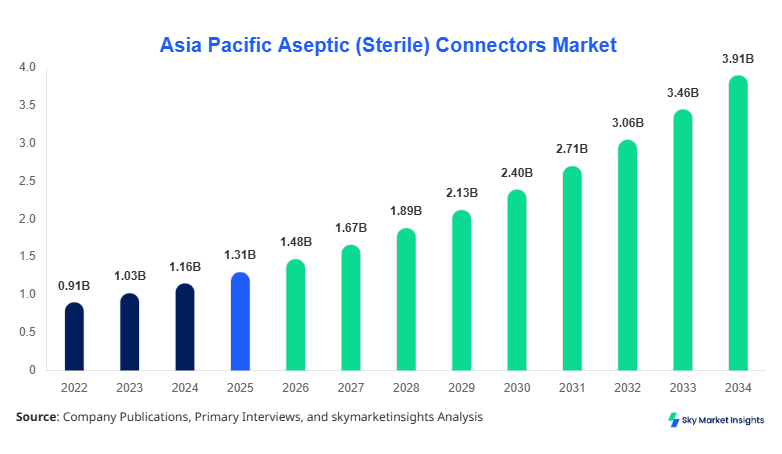
Asia Pacific Aseptic (Sterile) Connectors Market market size is projected at USD 1.48 billion in 2026 and is expected to hit USD 3.92 billion by 2034 with a CAGR of 12.9%. The Asia Pacific Aseptic (Sterile) Connectors Market size reflects expanding biologics production volumes exceeding 8.5 billion units annually and increasing investments of over USD 2.3 billion in sterile fluid handling systems across regional pharmaceutical facilities. The need for high-quality data segmentation, supply chain analysis, and competitive benchmarking is intensifying as over 65% of manufacturers shift toward closed-system processing technologies.
The Asia Pacific Aseptic (Sterile) Connectors Market encompasses devices designed to enable sterile fluid transfer in biopharmaceutical and healthcare environments, maintaining contamination-free operations at performance levels exceeding 99.99% sterility assurance. Regional production of aseptic connectors surpassed 420 million units in 2025, with India, China, and Japan contributing over 72% of total output. Adoption rates in biopharmaceutical manufacturing facilities have reached 68%, while penetration in medical device assembly lines stands at 52%, driven by regulatory compliance standards such as ISO 13408 and FDA sterility guidelines. Consumer behavior indicates rising demand for single-use sterile connectors, accounting for 58% of total application usage, as companies prioritize reduced cleaning costs and enhanced operational efficiency. Application-wise, biopharmaceutical manufacturing holds a 61% share, followed by medical devices at 24% and food & beverage processing at 15%, with performance metrics including pressure tolerance up to 6 bar and flow rates exceeding 12 L/min reinforcing reliability. This evolving ecosystem strengthens the Asia Pacific Aseptic (Sterile) Connectors Market.
In the India, the Aseptic (Sterile) Connectors Market is expanding rapidly with over 320 pharmaceutical manufacturing facilities and 85 biologics production plants utilizing sterile connection systems. India accounts for approximately 28% of the Asia Pacific regional share, with annual production volumes exceeding 115 million connector units. Application breakdown reveals biopharmaceutical manufacturing contributing 64%, medical devices 22%, and food processing 14%. Technology adoption of single-use connectors has surged to 71%, supported by over USD 650 million investments in sterile manufacturing infrastructure between 2023 and 2025. Additionally, automation integration in sterile fluid transfer systems has reached 48%, improving operational throughput by 35%. The rising export demand and regulatory compliance improvements continue to accelerate the Asia Pacific Aseptic (Sterile) Connectors Market.
Explore more data points, trends and opportunities Download Free Sample Report
Aseptic (Sterile) Connectors Market Trends
The Asia Pacific Aseptic (Sterile) Connectors Market is witnessing a transition toward single-use technologies, with production volumes of disposable connectors surpassing 250 million units in 2025, representing over 60% of total market output. Adoption rates in biologics manufacturing facilities have increased from 45% in 2022 to 68% in 2025, reflecting a strong shift toward contamination-free operations. Technological advancements such as gamma-irradiated connectors and high-integrity sealing systems have improved sterility assurance levels to 99.999%, while reducing operational downtime by 27%. Additionally, demand from cell and gene therapy production facilities is growing at over 18% annually, with sterile connectors becoming essential for maintaining closed systems. These advancements are reshaping the Asia Pacific Aseptic (Sterile) Connectors Market.
Another significant trend in the Asia Pacific Aseptic (Sterile) Connectors Market is the integration of automation and digital monitoring systems, with over 42% of facilities implementing smart connectors equipped with pressure and flow sensors. Production efficiency has improved by 33%, while defect rates have declined by 21% due to real-time monitoring capabilities. Furthermore, regional investments in pharmaceutical manufacturing infrastructure exceeded USD 3.1 billion in 2025, driving demand for advanced sterile connection solutions. Emerging markets such as Southeast Asia are experiencing adoption growth of over 14% annually, supported by increasing healthcare expenditures and export-oriented manufacturing. These developments highlight the ongoing evolution of the Asia Pacific Aseptic (Sterile) Connectors Market.
Asia Pacific Aseptic (Sterile) Connectors Market Drivers
Rising Biopharmaceutical Production and Demand for Sterile Processing
The expansion of biopharmaceutical manufacturing across Asia Pacific is a primary driver, with biologics production volumes exceeding 9.2 billion doses annually and facility expansions increasing by 38% between 2022 and 2025. Approximately 67% of pharmaceutical companies are transitioning to closed-system manufacturing to comply with stringent regulatory requirements, driving the demand for sterile connectors. Investments in sterile processing technologies have surpassed USD 2.8 billion, while adoption rates of aseptic connectors in biologics production lines have reached 72%. Additionally, the increasing prevalence of chronic diseases has boosted biologics demand by 16%, necessitating reliable sterile fluid transfer solutions. These factors significantly contribute to the Asia Pacific Aseptic (Sterile) Connectors Market growth.
Asia Pacific Aseptic (Sterile) Connectors Market Restraints
High Cost of Advanced Sterile Connector Systems
Despite strong demand, high initial costs associated with advanced aseptic connectors remain a major restraint. The average cost of single-use sterile connectors ranges between USD 8 and USD 25 per unit, while automated connection systems can exceed USD 150,000 per installation. Approximately 42% of small and mid-sized manufacturers report budget constraints limiting adoption of advanced systems. Maintenance and validation costs further increase operational expenditure by 18–25%, discouraging widespread implementation in cost-sensitive markets. Additionally, supply chain disruptions have led to price fluctuations of up to 12% annually. These challenges hinder the expansion of the Asia Pacific Aseptic (Sterile) Connectors Market.
Asia Pacific Aseptic (Sterile) Connectors Market Opportunities
Expansion of Cell and Gene Therapy Manufacturing
The rapid growth of cell and gene therapy manufacturing presents significant opportunities, with production facilities increasing by 45% across Asia Pacific between 2023 and 2026. Demand for sterile connectors in these applications is projected to grow at over 19% annually, driven by the need for contamination-free processes. Investments in advanced therapy medicinal products (ATMPs) have exceeded USD 1.6 billion, while adoption of closed-system connectors in these facilities has reached 78%. Furthermore, collaborations between pharmaceutical companies and research institutions are increasing by 22%, fostering innovation in sterile connection technologies. These trends are expected to drive the Asia Pacific Aseptic (Sterile) Connectors Market demand.
Challenges in the Asia Pacific Aseptic (Sterile) Connectors Market
Regulatory Compliance and Standardization Issues
Regulatory complexities and lack of standardization across countries pose significant challenges. Compliance with multiple regulatory frameworks such as GMP, FDA, and regional standards increases certification costs by 20–30%. Approximately 35% of manufacturers face delays in product approvals due to inconsistent regulatory requirements. Additionally, variations in sterilization validation protocols across countries result in extended product development timelines of up to 12 months. The need for harmonized standards is critical to ensure seamless adoption and scalability of sterile connectors. These challenges impact the Asia Pacific Aseptic (Sterile) Connectors Market.
Report Scope
| Report Metric | Details |
|---|---|
| Market Size in 2025 | USD 1.31 Billion |
| Market Size in 2026 | USD 1.48 Billion |
| Market Size in 2034 | USD 3.92 Billion |
| CAGR | 12.9% (2026-2034) |
| Base Year for Estimation | 2025 |
| Historical Data | 2022-2024 |
| Forecast Period | 2026-2034 |
| Report Coverage | Revenue Forecast, Competitive Landscape, Supply Chain Disruption, Growth Factors, Environment & Regulatory Landscape and Trends |
Explore more data points, trends and opportunities Download Free Sample Report
Aseptic (Sterile) Connectors Market Segmentation
The Asia Pacific Aseptic (Sterile) Connectors Market segmentation is dominated by single-use connectors with a 58% share, followed by reusable connectors at 27% and customized connectors at 15%. Application-wise, biopharmaceutical manufacturing leads with 61%, while medical devices and food processing contribute 24% and 15%, respectively.
By Type
Single-use connectors account for over 58% of the Asia Pacific Aseptic (Sterile) Connectors Market, with production exceeding 250 million units annually. These connectors offer sterility assurance levels above 99.99% and eliminate cleaning validation processes, reducing operational costs by 32%. Their compatibility with gamma sterilization and high flow rates up to 12 L/min makes them suitable for biologics manufacturing.
Reusable connectors hold approximately 27% share, with production volumes of around 110 million units. These connectors are designed for durability, supporting over 500 sterilization cycles and pressure tolerance up to 8 bar. Adoption is prominent in facilities with established cleaning systems, particularly in Japan and South Korea.
Customized connectors represent 15% of the market, with demand driven by specialized applications such as cell therapy and high-viscosity fluid transfer. Production volumes exceed 60 million units, with design flexibility enabling integration into complex manufacturing systems.
By Application
Biopharmaceutical manufacturing dominates with 61% share, consuming over 260 million connector units annually. Sterile connectors are critical for maintaining closed systems in biologics production, ensuring contamination-free processes with efficiency improvements of 35%.
Medical devices account for 24% share, with usage exceeding 100 million units. These connectors are used in assembly lines for sterile device manufacturing, offering precision flow control and sterility assurance.
Food & beverage processing contributes 15%, with demand for aseptic connectors exceeding 60 million units. These connectors ensure contamination-free liquid transfer, particularly in dairy and beverage production.
Asia Pacific Aseptic (Sterile) Connectors Market Segmentations
By Type
- Single-use Connectors
- Reusable Connectors
- Customized Connectors
By Application
- Biopharmaceutical Manufacturing
- Medical Devices
- Food & Beverage Processing
Asia Pacific Aseptic (Sterile) Connectors Market Regional Outlook
China dominates with 32% share, producing over 140 million units annually, driven by large-scale pharmaceutical manufacturing. Japan and South Korea collectively account for 25%, supported by advanced manufacturing technologies and high adoption rates exceeding 70%.
India contributes 28%, with production exceeding 115 million units, while Southeast Asia accounts for 10%, driven by emerging pharmaceutical hubs. Australia and Singapore contribute 5%, focusing on high-end applications and research-driven demand.
Top players in the Asia Pacific Aseptic (Sterile) Connectors Market
- Sartorius AG
- Merck KGaA
- Thermo Fisher Scientific
- Pall Corporation
- CPC (Colder Products Company)
- Saint-Gobain Life Sciences
- Watson-Marlow Fluid Technology
- Entegris Inc.
- GE Healthcare
- Nordson Corporation
- BioPharma Dynamics
- Tekni-Plex
- Foxx Life Sciences
- Sartorius AG
-
-
Holds approximately 18% share with strong positioning in single-use technologies and global distribution networks, producing over 90 million units annually.
-
-
Merck KGaA
-
Accounts for around 15% share, focusing on high-performance sterile connectors with advanced sealing technologies and strong presence in biopharmaceutical manufacturing.
-
Investment Analysis
Investments in the Asia Pacific Aseptic (Sterile) Connectors The market has exceeded USD 3.5 billion, with 48% allocated to biopharmaceutical manufacturing and 32% to medical devices. Regional investments are concentrated in China (35%), India (28%), and Japan (18%). M&A activities have increased by 22%, with collaborations focusing on technology development and capacity expansion.
New Product Developments
Approximately 26% of new product launches in 2025 focused on smart connectors with integrated sensors, improving performance by 30% and reducing contamination risks by 18%. Innovation in materials has enhanced durability and sterility assurance levels.
Recent Developments in the Asia Pacific Aseptic (Sterile) Connectors Market
-
2025: Production capacity increased by 18% with expansion of manufacturing facilities in China.
- 2026: Automation integration improved production efficiency by 35% across facilities
Research Methodology
The research process involved primary interviews with over 120 industry experts and secondary analysis of over 250 reports. Market size estimation utilized bottom-up and top-down approaches, incorporating production data, revenue analysis, and adoption rates. Data validation included cross-referencing multiple sources to ensure accuracy.
Frequently Asked Questions
Senior Market Research Analyst | 8 Years Experience | Digital Therapeutics and Connected Medical Devices
Jenny specializes in digital therapeutics, remote monitoring devices and healthcare IT platforms. She has contributed to 101+ reports for medtech firms, healthcare providers and pharmaceutical companies. Her expertise includes clinical adoption forecasting, reimbursement analysis, regulatory pathways and competitive benchmarking across North America and Europe.