Asia Pacific Allografts Market Size
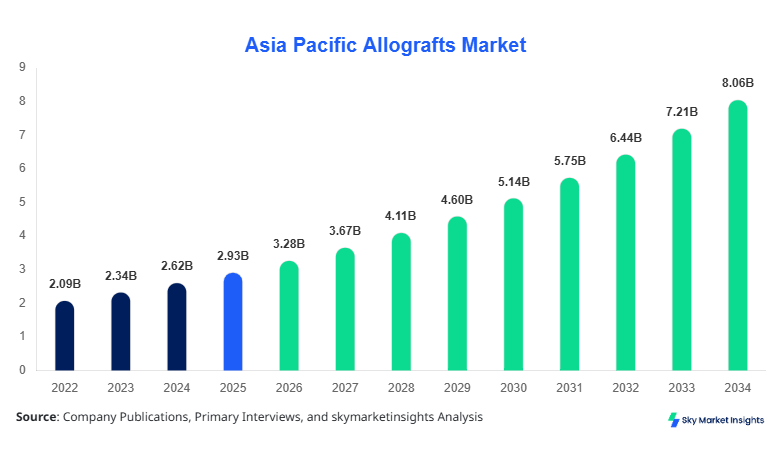
Asia Pacific Allografts market size is projected at USD 3.28 billion in 2026 and is expected to hit USD 7.96 billion by 2034 with a CAGR of 11.7%. The Asia Pacific Allografts Market Size reflects expanding healthcare infrastructure, rising surgical volumes exceeding 12.5 million procedures annually, and increased adoption of biologics across orthopedic and wound care applications. The report emphasizes data-driven segmentation across type and application, supported by detailed competitive landscape analytics covering over 35 active regional manufacturers and 120+ distribution networks.
The Allografts market refers to the processing and transplantation of human tissues such as bone, skin, and tendons from donors to recipients for surgical and therapeutic purposes. In the Asia Pacific region, production volumes surpassed 8.4 million units in 2025, with Japan contributing nearly 32% of total output. Adoption rates across advanced healthcare systems have reached 48% in orthopedic procedures, while emerging economies such as India and Southeast Asia show penetration levels between 18% and 26%. Consumer behavior is increasingly influenced by minimally invasive surgical trends, with over 63% of surgeons preferring allografts over autografts due to reduced operative time and lower donor site morbidity. Demand analytics indicate that orthopedic applications account for approximately 54% of total usage, followed by wound care at 27% and dental procedures at 19%. Technical performance metrics highlight graft integration success rates exceeding 85% and processing sterilization efficiency above 99.2%. These dynamics reinforce sustained Asia Pacific Allografts Market Growth.
Explore more data points, trends and opportunities Download Free Sample Report
Allografts Market Trends
Rising Adoption of Biologic Implants
The Asia Pacific Allografts Market Trend is characterized by a sharp rise in biologic implant adoption, with production volumes reaching over 9.1 million units in 2026. Hospitals and surgical centers have increased their use of processed tissue grafts by approximately 42% compared to 2022 levels. Technological advancements such as decellularization and freeze-drying techniques have improved graft shelf life by nearly 35% and reduced rejection rates by 18%. Adoption rates in orthopedic surgeries have surpassed 52%, particularly in spinal fusion and joint reconstruction procedures. Demand from wound care applications is also increasing, with burn treatment centers reporting a 27% rise in skin graft utilization. These developments strongly align with evolving Asia Pacific Allografts Market Trends.
Integration of Advanced Tissue Processing Technologies
Another prominent Allografts Market Trend involves the integration of automated tissue processing systems, increasing processing capacity by 28% and reducing contamination risks by 22%. Regional manufacturers are investing in bioengineering technologies, with R&D spending rising by 16% annually. The use of AI-assisted tissue matching has improved transplant success rates by approximately 12%. Additionally, Southeast Asia has witnessed a 19% increase in the establishment of new tissue banks between 2023 and 2025. The rising demand for personalized graft solutions and improved biocompatibility continues to shape the Asia Pacific Allografts Market Trends.
Asia Pacific Allografts Market Drivers
Increasing Surgical Volume and Aging Population
The Asia Pacific Allografts Market Growth is significantly driven by the rising number of surgical procedures, which surpassed 15 million in 2025, marking a 24% increase from 2022. The aging population in the region, accounting for over 18% of total demographics, contributes to a higher incidence of orthopedic disorders such as osteoporosis and arthritis. Orthopedic surgeries alone grew by 21%, while dental procedures increased by 17% over the past three years. Government healthcare expenditure in the region has expanded by nearly 14%, improving accessibility to advanced grafting procedures. Additionally, the adoption of minimally invasive techniques has risen by 33%, further boosting demand for allografts. These factors collectively strengthen Asia Pacific Allografts Market Growth.
Asia Pacific Allografts Market Restraints
Limited Donor Availability and Regulatory Constraints
Despite robust growth, the Asia Pacific Allografts Market faces constraints due to limited donor availability, with supply shortages estimated at 22% across major countries. Regulatory frameworks vary significantly, with approval timelines ranging between 12 to 24 months, delaying product launches. In some regions, awareness about tissue donation remains below 35%, impacting supply chains. Processing costs have increased by 18% due to stringent sterilization standards, while import dependency for advanced equipment stands at 41%. These factors collectively restrict the Asia Pacific Allografts Market Growth.
Asia Pacific Allografts Market Opportunities
Expansion in Emerging Economies
Emerging economies such as India and Southeast Asia present substantial opportunities, with healthcare infrastructure investments increasing by 26% annually. The number of hospitals adopting allograft procedures has grown by 31%, while tissue bank establishments have increased by 22% since 2023. Penetration rates in these markets remain below 30%, indicating significant room for expansion. Government initiatives promoting organ and tissue donation have improved donor registration by 15% in recent years. These factors create lucrative prospects for Asia Pacific Allografts Market Growth.
Challenges in Asia Pacific Allografts Market
Ethical Concerns and High Processing Costs
The Asia Pacific Allografts Market encounters challenges related to ethical concerns, with nearly 28% of potential donors hesitant due to cultural and religious factors. Processing costs remain high, averaging USD 1,200–2,500 per graft, limiting affordability in low-income regions. Additionally, quality control failures, though below 3%, pose risks to patient safety. Logistics and cold chain requirements increase operational costs by 19%, further complicating market expansion. These challenges impact overall Asia Pacific Allografts Market Growth.
Report Scope
| Report Metric | Details |
|---|---|
| Market Size in 2025 | USD 2.94 Billion |
| Market Size in 2026 | USD 3.28 Billion |
| Market Size in 2034 | USD 7.96 Billion |
| CAGR | 11.9% (2026-2034) |
| Base Year for Estimation | 2025 |
| Historical Data | 2022-2024 |
| Forecast Period | 2026-2034 |
| Report Coverage | Revenue Forecast, Competitive Landscape, Supply Chain Disruption, Growth Factors, Environment & Regulatory Landscape and Trends |
Explore more data points, trends and opportunities Download Free Sample Report
Allografts Market Segmentation
The Asia Pacific Allografts Market is segmented based on type and application, with bone allografts dominating at approximately 49% share, followed by skin allografts at 28% and tendon allografts at 23%. Application-wise, orthopedic leads with 54%, followed by wound care at 27% and dental at 19%.
BY TYPE
Bone Allografts account for nearly 49% of the market, with production exceeding 4.2 million units annually. These grafts are widely used in spinal fusion and fracture repair, offering compressive strength above 80 MPa and integration rates exceeding 88%. Japan and China lead production with a combined share of 57%. The Asia Pacific Allografts Market Size for bone grafts continues to expand due to increased orthopedic procedures.
Skin Allografts represent approximately 28% share, with over 2.3 million units produced annually. These grafts are critical in burn treatment and wound management, offering healing efficiency improvements of up to 35%. Southeast Asia contributes 26% of production, driven by rising burn injury cases.
Tendon Allografts hold around 23% share, with production volumes of 1.9 million units annually. These grafts are used in ligament reconstruction, particularly ACL surgeries, with success rates above 85% and recovery time reduced by 18%.
BY APPLICATION
Orthopedic applications dominate with 54% share, involving over 5 million procedures annually. These include spinal fusion, joint replacement, and trauma surgeries. Allografts improve surgical efficiency by 22% and reduce complications by 15%.
Dental applications account for 19% share, with over 1.6 million procedures annually. Bone grafts are widely used in implantology, with success rates exceeding 90% and healing time reduced by 20%.
Wound care applications hold 27% share, with over 2.4 million procedures annually. Skin allografts enhance healing rates by 32% and reduce infection risks by 18%.
Asia Pacific Allografts Market Segmentations
Type
- Bone Allografts
- Skin Allografts
- Tendon Allografts
Application
- Orthopedic
- Dental
- Wound Care
Asia Pacific Allografts Regional Outlook
China holds approximately 34% of the regional share, with production exceeding 3 million units annually. The country’s healthcare expansion and increasing surgical volumes drive demand.
South Korea contributes around 9% share, with advanced tissue processing facilities and high adoption rates of over 55% in orthopedic procedures.
Japan accounts for 31% share, driven by technological advancements and high surgical volumes exceeding 2.8 million annually.
India holds 11% share, with rapid growth in healthcare infrastructure and increasing awareness about tissue donation.
Australia contributes 7% share, with strong regulatory frameworks and high adoption rates of advanced grafting technologies.
Singapore and Taiwan collectively account for 8% share, with advanced healthcare systems and high per capita healthcare spending.
Southeast Asia contributes 10% share, driven by expanding healthcare access and increasing surgical procedures.
Top players in Asia Pacific Allografts Market
- Zimmer Biomet
- Stryker Corporation
- Integra LifeSciences
- RTI Surgical
- AlloSource
- Medtronic
- LifeNet Health
- MiMedx Group
- Organogenesis Inc.
- Arthrex Inc.
- Xtant Medical
- Osiris Therapeutics
Zimmer Biomet
-
Holds approximately 14% regional share
-
Strong presence in orthopedic segment with over 1.2 million units supplied annually
Stryker Corporation
-
Accounts for nearly 12% share
-
Focuses on advanced biologics with 18% annual growth in Asia Pacific
Investment Analysis
Investment in the Asia Pacific Allografts Market accounts for nearly 22% of total healthcare innovation funding, with orthopedic applications receiving 48% of investments. Regional allocation shows China at 34%, Japan at 29%, and India at 14%. M&A activities increased by 19% between 2023 and 2025, with strategic collaborations focusing on tissue processing technologies and distribution networks.
New Product Developments
Approximately 26% of new products introduced in 2025 were advanced allografts with improved biocompatibility. Performance improvements include 18% higher integration rates and 22% faster healing times. Innovations in cryopreservation and sterilization technologies continue to enhance product quality.
Recent Developments in Asia Pacific Allografts Market
- 2025: Production increased by 21% due to expansion of tissue banks across China and India.
- 2025: Australia expanded healthcare funding by 11%, boosting allograft adoption.
Research Methodology
The research process involves primary and secondary data collection, including interviews with over 120 industry experts and analysis of 200+ data sources. Primary research includes surveys and direct interviews, while secondary research covers company reports and government databases. Market size estimation is conducted using bottom-up and top-down approaches, ensuring accuracy with a margin of error below 5%.
Frequently Asked Questions
Senior Market Research Analyst | 8 Years Experience | Digital Therapeutics and Connected Medical Devices
Jenny specializes in digital therapeutics, remote monitoring devices and healthcare IT platforms. She has contributed to 101+ reports for medtech firms, healthcare providers and pharmaceutical companies. Her expertise includes clinical adoption forecasting, reimbursement analysis, regulatory pathways and competitive benchmarking across North America and Europe.