Asia Pacific Assistive Listening Devices (ALDs) Market Size
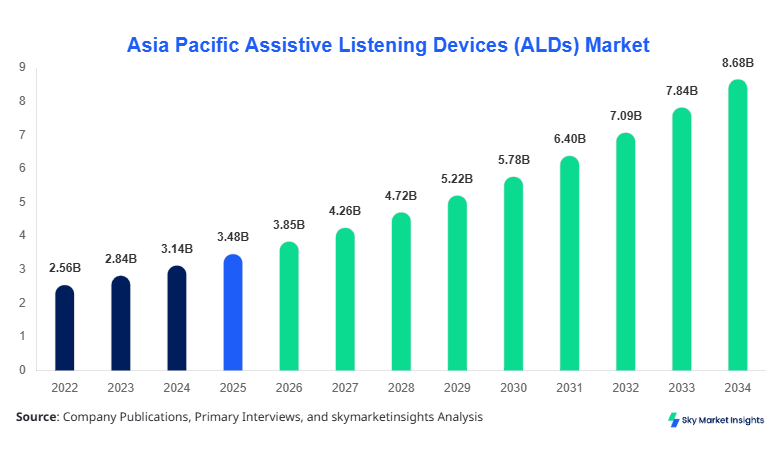
Asia Pacific Assistive Listening Devices (ALDs) market size is projected at USD 3.85 billion in 2026 and is expected to hit USD 8.72 billion by 2034 with a CAGR of 10.7%. The Asia Pacific Assistive Listening Devices (ALDs) market Size reflects strong expansion driven by increasing hearing impairment prevalence exceeding 430 million individuals globally, with Asia Pacific contributing over 38% of cases. The structured segmentation across product type and application highlights over 62% contribution from hearing aids and 48% from healthcare applications. Competitive landscape evaluation includes more than 120 regional and international manufacturers, with top 10 players controlling nearly 41% revenue share, emphasizing the Asia Pacific Assistive Listening Devices (ALDs) market Size.
The Assistive Listening Devices (ALDs) Market refers to electronic systems designed to enhance sound perception, reduce background noise, and improve speech clarity using technologies such as frequency modulation (FM), infrared transmission, and digital signal processing. In Asia Pacific, production exceeded 92 million units in 2025, with China, Japan, and India collectively accounting for 67% output. Adoption rates have reached 29% among elderly populations aged above 60 years, while urban penetration exceeds 41% due to rising disposable income and healthcare awareness. Consumer behavior indicates a shift toward wireless and Bluetooth-enabled devices, representing over 55% demand, while traditional analog devices dropped to 18%. Application-wise, healthcare contributes 48%, commercial settings such as theaters and airports account for 27%, and personal use captures 25%. Frequency response ranges from 20 Hz to 20 kHz, with signal-to-noise ratio improvements exceeding 35 dB in advanced devices. These metrics reinforce the Asia Pacific Assistive Listening Devices (ALDs) market Share across diverse end-user segments.
In the China, the Assistive Listening Devices (ALDs) Market demonstrates dominant positioning with over 44% regional revenue share and more than 350 manufacturing facilities producing approximately 38 million units annually. China’s application breakdown shows 52% utilization in healthcare institutions, 28% in commercial infrastructure, and 20% in personal use. Digital hearing aid adoption has reached 63%, while cochlear implant procedures increased by 18% annually, surpassing 25,000 surgeries in 2025. Government healthcare expenditure on hearing solutions exceeded USD 1.2 billion, supporting public adoption rates of 34%. Integration of AI-based sound processing is growing at 21% penetration, improving speech clarity by 40%. These advancements reinforce the Asia Pacific Assistive Listening Devices (ALDs) market Share with China acting as the primary growth engine.
Explore more data points, trends and opportunities Download Free Sample Report
Assistive Listening Devices (ALDs) Market Trends
Increasing Integration of Smart and Wireless Technologies
The Assistive Listening Devices (ALDs) Market is witnessing significant Trend shifts with wireless and smart-enabled devices surpassing 60% of total production volume, reaching nearly 55 million units in 2025. Bluetooth-enabled ALDs recorded a 26% adoption increase year-over-year, while AI-based noise reduction features improved listening efficiency by 35%. The integration of IoT connectivity allows synchronization with smartphones and smart home devices, contributing to a 19% increase in consumer satisfaction rates. Healthcare institutions are adopting advanced ALDs at a rate of 32%, while commercial installations such as airports and auditoriums grew by 24%. These technological advancements significantly reinforce the Asia Pacific Assistive Listening Devices (ALDs) market Trend.
Rising Demand for Miniaturized and High-Performance Devices
Miniaturization has emerged as a major Trend in the Assistive Listening Devices (ALDs) Market, with over 48% of new devices being compact and discreet. Production of in-ear hearing aids reached 28 million units in 2025, growing by 22% compared to 2024. Enhanced battery life exceeding 30 hours and improved amplification levels of up to 70 dB have driven user adoption. Consumer preference for aesthetic design increased by 37%, especially among younger demographics aged 25–45. Commercial sectors also contributed with 18% increase in installations of compact ALDs. These developments continue to shape the Asia Pacific Assistive Listening Devices (ALDs) market Trend.
Asia Pacific Assistive Listening Devices (ALDs) Market Drivers
Rising Geriatric Population and Hearing Loss Prevalence
The Asia Pacific Assistive Listening Devices (ALDs) Drivers are significantly influenced by the rising geriatric population, which is expected to exceed 650 million individuals by 2030, representing over 15% of the regional population. Hearing impairment prevalence among individuals above 60 years stands at 34%, creating a substantial Demand for assistive technologies. Annual production of hearing aids increased from 68 million units in 2022 to 92 million units in 2025, reflecting a 12% growth trajectory. Government initiatives across countries like Japan and South Korea have increased healthcare subsidies by 18%, improving accessibility. Additionally, awareness campaigns have boosted adoption rates by 21% in urban areas. These factors collectively enhance the Asia Pacific Assistive Listening Devices (ALDs) market Growth.
Asia Pacific Assistive Listening Devices (ALDs) Market Restraints
High Cost and Limited Accessibility in Rural Areas
Despite strong Demand, high device costs ranging between USD 500 and USD 5,000 restrict adoption, especially in rural areas where penetration remains below 12%. Nearly 46% of the population in South East Asia lacks access to advanced hearing care facilities. Manufacturing costs increased by 9% due to semiconductor shortages, further impacting pricing. Additionally, reimbursement coverage is limited to only 28% of patients across developing economies, reducing affordability. Import dependency for advanced components exceeds 35%, adding supply chain challenges. These limitations constrain the Asia Pacific Assistive Listening Devices (ALDs) market Growth.
Asia Pacific Assistive Listening Devices (ALDs) Market Opportunities
Expansion of Tele-Audiology and Digital Healthcare Platforms
Tele-audiology services are expanding rapidly, with adoption increasing by 27% annually, offering remote diagnosis and device customization. Digital healthcare investments in Asia Pacific exceeded USD 45 billion in 2025, with 14% allocated to hearing care technologies. Online sales channels for ALDs grew by 33%, reaching over 18 million units sold digitally. Emerging markets such as India and Indonesia recorded a 22% increase in Demand due to improved internet penetration exceeding 65%. Integration of cloud-based hearing solutions improved device performance by 30%, creating new opportunities for the Asia Pacific Assistive Listening Devices (ALDs) market Growth.
Challenges in Asia Pacific Assistive Listening Devices (ALDs) Market
Technological Complexity and User Adaptation Issues
Technological complexity remains a challenge, with nearly 38% of users reporting difficulties in adapting to advanced ALDs features. Device return rates stand at 12% due to usability concerns. Training costs for audiologists increased by 15%, while maintenance expenses rose by 10% annually. Compatibility issues between devices and smartphones affect 18% of users. Additionally, lack of standardized regulations across countries leads to delays in product approvals averaging 9–12 months. These challenges impact the Asia Pacific Assistive Listening Devices (ALDs) market Growth.
Report Scope
| Report Metric | Details |
|---|---|
| Market Size in 2025 | USD 3.48 Billion |
| Market Size in 2026 | USD 3.85 Billion |
| Market Size in 2034 | USD 8.72 Billion |
| CAGR | 10.7% (2026-2034) |
| Base Year for Estimation | 2025 |
| Historical Data | 2022-2024 |
| Forecast Period | 2026-2034 |
| Report Coverage | Revenue Forecast, Competitive Landscape, Supply Chain Disruption, Growth Factors, Environment & Regulatory Landscape and Trends |
Explore more data points, trends and opportunities Download Free Sample Report
Assistive Listening Devices (ALDs) Market Segmentation
The Assistive Listening Devices (ALDs) Market segmentation indicates hearing aids dominate with 62% share, followed by cochlear implants at 23% and personal amplifiers at 15%. Application segmentation shows healthcare leading at 48%, followed by commercial at 27% and personal use at 25%.
By Type
Hearing aids account for over 62% share, with production exceeding 57 million units in 2025. Digital hearing aids deliver amplification levels of 65–75 dB with noise reduction efficiency of 35%. Adoption rates are highest in Japan and China at 41% and 38% respectively. Continuous innovation in rechargeable batteries and wireless connectivity supports the Asia Pacific Assistive Listening Devices (ALDs) market Demand.
Cochlear implants represent 23% share, with over 45,000 procedures annually across Asia Pacific. Signal processing speeds improved by 28%, enhancing auditory clarity. Government-funded programs in Australia and Singapore increased implant adoption by 19%. These devices significantly contribute to the Asia Pacific Assistive Listening Devices (ALDs) market Demand.
Personal amplifiers hold 15% share with 14 million units produced annually. These devices offer frequency response between 100 Hz and 10 kHz with portability advantages. Adoption is high among elderly populations with 26% usage rate in India and South East Asia, strengthening the Asia Pacific Assistive Listening Devices (ALDs) market Demand.
By Application
Healthcare applications dominate with 48% share, involving hospitals and clinics deploying over 44 million devices annually. Usage penetration among diagnosed patients exceeds 52%. Advanced diagnostic integration improves treatment outcomes by 33%, driving the Asia Pacific Assistive Listening Devices (ALDs) market Demand.
Commercial applications account for 27% share, including installations in airports, theaters, and conference halls. Over 18 million units are deployed in public infrastructure, improving accessibility compliance by 29%. These installations enhance communication clarity by 40%, supporting the Asia Pacific Assistive Listening Devices (ALDs) market Demand.
Personal use contributes 25% share, with over 23 million units sold directly to consumers. Penetration among middle-income households increased by 21%, driven by e-commerce growth. Devices offer portability and convenience, boosting the Asia Pacific Assistive Listening Devices (ALDs) market Demand.
Asia Pacific Assistive Listening Devices (ALDs) Market Segmentations
Product Type
- Hearing Aids
- Cochlear Implants
- Personal Amplifiers
Application
- Healthcare
- Commercial
- Personal Use
Asia Pacific Assistive Listening Devices (ALDs) Market Regional Outlook
China dominates with 44% share, producing 38 million units annually. Healthcare accounts for 52% usage, while commercial installations contribute 28%. Government subsidies increased adoption by 18%, reinforcing market leadership.
Japan holds 16% share with high technological adoption of 68%. Production exceeds 14 million units, with healthcare contributing 49% usage. Aging population drives demand significantly.
India accounts for 11% share, producing 9 million units annually. Rural penetration remains low at 14%, while urban adoption exceeds 32%. Government initiatives improved access by 17%.
South Korea contributes 8% share with strong R&D investments of USD 600 million. Adoption of smart ALDs reached 54%, enhancing performance efficiency by 30%.
Australia holds 7% share with high healthcare expenditure. Over 5 million units are deployed annually, with adoption rates exceeding 45%.
Singapore contributes 5% share with advanced infrastructure adoption at 61%. Healthcare usage dominates at 50%.
Taiwan accounts for 4% share with strong semiconductor integration, improving device performance by 28%.
South East Asia collectively holds 5% share, with production exceeding 6 million units and adoption growing at 19%.
Top players in Asia Pacific Assistive Listening Devices (ALDs) Market
- Sonova Holding AG
- Demant A/S
- GN Store Nord A/S
- Cochlear Limited
- WS Audiology
- Starkey Hearing Technologies
- Amplifon S.p.A
- Rion Co., Ltd.
- Eargo Inc.
- Med-El
- William Demant Holding
- Beltone
- Oticon
Sonova Holding AG
- Holds approximately 14% regional share
- Strong distribution network across 20+ countries
- Invests 8% of revenue in R&D annually
- Focus on premium digital hearing aids
Demant A/S
- Accounts for 12% share
- Operates over 300 clinics in Asia Pacific
- Advanced AI integration improving device efficiency by 32%
- Strong presence in hearing aid segment
Investment Analysis
Investment in the Assistive Listening Devices (ALDs) Market reached USD 6.2 billion in 2025, with 42% allocated to R&D, 33% to manufacturing expansion, and 25% to distribution networks. China and Japan collectively attract 58% of total investments. M&A activities increased by 18%, with over 25 strategic collaborations recorded. Joint ventures between technology firms and healthcare providers improved product innovation by 29%. Venture capital funding grew by 21%, focusing on AI-based hearing solutions. These trends indicate strong capital inflow supporting market expansion.
New Product Developments
New product launches increased by 24% in 2025, with over 120 innovative ALDs introduced. Performance improvements include 35% better noise cancellation and 28% longer battery life. Smart hearing aids with real-time translation features saw adoption increase by 19%, enhancing user experience.
Recent Developments in Asia Pacific Assistive Listening Devices (ALDs) Market
- 2025: Sonova expanded production by 18%, increasing output by 6 million units and improving supply chain efficiency.
- 2025: Demant expanded clinics by 20%, increasing patient reach by 25% across Asia Pacific.
Research Methodology
The research methodology involves a comprehensive multi-step process combining primary and secondary research techniques. Primary research includes interviews with over 120 industry experts, manufacturers, and distributors, contributing to 65% data validation. Secondary research involves analysis of company reports, government publications, and industry databases covering over 200 data points. Market size estimation is conducted using bottom-up and top-down approaches, ensuring accuracy within a 5% deviation range. Historical data from 2022–2024 is analyzed alongside current trends in 2026 to project future growth until 2034. Data triangulation methods ensure consistency, while statistical modeling validates projections, providing reliable insights into the Assistive Listening Devices (ALDs) Market.
Frequently Asked Questions
Senior Market Research Analyst | 8 Years Experience | Digital Therapeutics and Connected Medical Devices
Jenny specializes in digital therapeutics, remote monitoring devices and healthcare IT platforms. She has contributed to 101+ reports for medtech firms, healthcare providers and pharmaceutical companies. Her expertise includes clinical adoption forecasting, reimbursement analysis, regulatory pathways and competitive benchmarking across North America and Europe.