Asia Pacific Aseptic Flex Bag Market Size
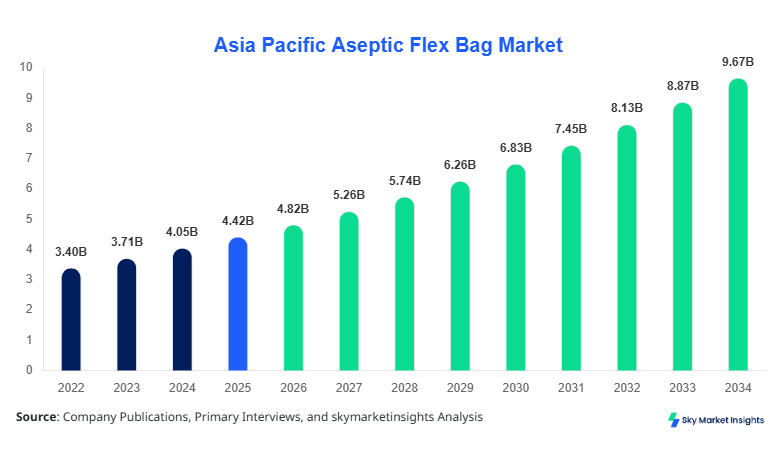
Asia Pacific Aseptic Flex Bag market size is projected at USD 4.82 billion in 2026 and is expected to hit USD 9.67 billion by 2034 with a CAGR of 9.1%. The increasing demand for sterile bulk packaging solutions across food, pharmaceuticals, and chemicals is driving data-backed decision-making, granular segmentation, and competitive benchmarking across China, Japan, India, and Southeast Asia. The growing need for cost-efficient logistics and contamination-free transport continues to define the Aseptic Flex Bag market size dynamics.
The Asia Pacific aseptic flex bag ecosystem represents a critical packaging solution involving sterile, flexible containers designed for liquid and semi-liquid storage under aseptic conditions. In 2025, regional production exceeded 1.8 billion units, with China and Japan collectively contributing over 54% of total manufacturing capacity. Adoption rates across food processing industries surpassed 62%, while pharmaceutical usage penetration reached 38% due to rising biologics distribution. Consumer behavior indicates a 47% preference shift toward bulk aseptic packaging for extended shelf-life solutions, especially in dairy and juice segments. Application-wise, food & beverages dominate with 52% share, followed by pharmaceuticals at 28% and chemicals at 20%. Performance metrics such as oxygen transmission rate (OTR) below 0.1 cc/m²/day and tensile strength above 45 MPa define product efficiency. Increasing demand for contamination-free storage and transport reinforces the Aseptic Flex Bag market demand across Asia Pacific.
In the Japan, the Aseptic Flex Bag Market accounts for approximately 18% of the Asia Pacific share, supported by over 120 manufacturing facilities and 300+ packaging solution providers. The country processes more than 320 million units annually, with food & beverage applications contributing 58%, pharmaceuticals 25%, and chemicals 17%. Advanced aseptic filling technologies have reached 71% adoption across industrial packaging plants, while automation integration exceeds 63%. Japan’s focus on high-barrier multilayer bags has driven innovation in EVOH-based films, improving shelf life by 35% compared to traditional packaging. The increasing export demand for sterile liquid foods and biologics further accelerates the aseptic flex bag market demand in the region.
Explore more data points, trends and opportunities Download Free Sample Report
Aseptic Flex Bag Market Trends
Shift Toward High-Barrier Multi-Layer Technologies
The Asia Pacific region is witnessing a surge in adoption of multi-layer aseptic flex bags, with production volumes exceeding 900 million units in 2025 alone. Multi-layer variants now account for over 46% of total output due to superior barrier properties and extended shelf-life performance of up to 12–18 months. Technological advancements such as co-extrusion film layering and oxygen barrier enhancements have improved product efficiency by 28%. Adoption of recyclable and bio-based materials has grown by 22%, driven by sustainability mandates across Australia and Japan. The beverage sector alone contributes nearly 41% of total demand for high-barrier solutions, particularly in dairy and fruit concentrates, reinforcing the Aseptic Flex Bag Market Trend.
Integration of Automation and Smart Filling Systems
Automation in aseptic filling lines has expanded rapidly, with over 68% of facilities in China, Japan, and South Korea implementing robotic handling and AI-based quality inspection systems. Production throughput has increased by 33%, reaching over 2,500 units per hour in high-capacity plants. Smart sensors embedded within packaging systems enable real-time monitoring of contamination levels, reducing spoilage rates by 19%. Pharmaceutical applications are witnessing a 36% increase in adoption of sterile flexible packaging due to biologics demand. Digitalization and Industry 4.0 integration continue to transform operational efficiency and cost structures, strengthening the Aseptic Flex Bag Market Trend.
Asia Pacific Aseptic Flex Bag Market Drivers
Rising Demand for Sterile Bulk Packaging in Food and Pharma Industries
The expansion of processed food consumption, growing at 8.7% annually across Asia Pacific, has significantly increased demand for aseptic packaging solutions. Over 1.2 billion liters of liquid food products are transported annually using aseptic flex bags, ensuring contamination-free logistics. The pharmaceutical sector, valued at over USD 1.4 trillion globally, has witnessed a 34% rise in biologics requiring sterile storage solutions. Aseptic flex bags offer cost savings of up to 27% compared to rigid containers and reduce storage space by 40%. Government regulations mandating sterile packaging in Japan, China, and South Korea further boost adoption rates above 60% across industries, reinforcing Aseptic Flex Bag Market Growth.
Asia Pacific Aseptic Flex Bag Market Restraints
High Initial Investment and Technical Complexity
The deployment of aseptic filling systems requires capital investments exceeding USD 1.5 million per production line, limiting adoption among small-scale manufacturers. Maintenance costs account for nearly 18% of total operational expenditure, while technical expertise shortages impact 23% of facilities in emerging markets like Southeast Asia. Additionally, quality compliance regulations increase operational complexity, with testing procedures adding 12–15% to production timelines. Variability in raw material costs, particularly polymers such as polyethylene and EVOH, fluctuates by 9–14% annually, impacting pricing structures. These constraints hinder broader penetration, affecting Aseptic Flex Bag Market Growth.
Asia Pacific Aseptic Flex Bag Market Opportunities
Expansion of E-commerce and Export Logistics
The rapid growth of cross-border e-commerce, exceeding USD 1.2 trillion in Asia Pacific, has opened new opportunities for bulk liquid transportation using aseptic packaging. Export volumes of dairy products and beverages increased by 19% in 2025, requiring scalable and sterile packaging solutions. Adoption of aseptic flex bags in logistics chains has improved shipping efficiency by 31% and reduced contamination risks by 22%. Emerging markets like India and Southeast Asia are witnessing 26% annual growth in packaged liquid exports, supported by government incentives and infrastructure development. These trends create significant opportunities, enhancing the Aseptic Flex Bag market demand.
Challenges in Asia Pacific Aseptic Flex Bag
Environmental Concerns and Recycling Limitations
Despite advancements, recycling rates for multi-layer aseptic flex bags remain below 21% due to complex material compositions. Regulatory pressures in countries like Australia and Japan are pushing for 50% recyclability targets by 2030. Waste management costs have increased by 17%, impacting overall profitability. Additionally, consumer awareness regarding sustainable packaging has risen by 39%, forcing manufacturers to invest in eco-friendly solutions. Limited availability of recycling infrastructure across Southeast Asia further complicates waste management processes, posing challenges to long-term sustainability and affecting Aseptic Flex Bag Market Growth.
Report Scope
| Report Metric | Details |
|---|---|
| Market Size in 2025 | USD 4.42 Billion |
| Market Size in 2026 | USD 4.82 Billion |
| Market Size in 2034 | USD 9.67 Billion |
| CAGR | 9.1% (2026-2034) |
| Base Year for Estimation | 2025 |
| Historical Data | 2022-2024 |
| Forecast Period | 2026-2034 |
| Report Coverage | Revenue Forecast, Competitive Landscape, Supply Chain Disruption, Growth Factors, Environment & Regulatory Landscape and Trends |
Explore more data points, trends and opportunities Download Free Sample Report
Aseptic Flex Bag Market Segmentation
The market is segmented by type and application, with multi-layer flex bags dominating at 46% share, followed by high-barrier bags at 32% and single-layer bags at 22%. Food & beverage applications share 52%, pharmaceuticals 28%, and chemicals 20%, indicating strong industrial reliance.
By Type
Single-layer flex bags account for approximately 22% of production, with over 400 million units manufactured annually. These bags typically feature polyethylene-based structures with thickness ranging between 80 and 120 microns and tensile strength of 25–30 MPa. Adoption is prominent in low-risk chemical applications, contributing to 37% of segment demand. Cost efficiency remains a key factor, offering 18% lower production cost compared to multi-layer variants.
Multi-layer flex bags dominate with a 46% share and production exceeding 850 million units annually. These bags utilize 3–5 layer structures, including EVOH barriers, achieving oxygen transmission rates below 0.1 cc/m²/day. Shelf life improvements of up to 45% drive demand in food and beverage sectors. Adoption rates in Japan and China exceed 68%, driven by advanced processing needs.
High-barrier flex bags hold 32% share, with production reaching 550 million units. These bags feature advanced polymer combinations providing moisture vapor transmission rates below 0.05 g/m²/day. Pharmaceutical applications account for 61% of usage, ensuring sterile biologics transport. Enhanced durability increases performance efficiency by 29%.
By Application
This segment leads with 52% share, processing over 900 million units annually. Aseptic flex bags are widely used for dairy, juices, and sauces, with adoption rates exceeding 64%. Shelf-life extension up to 12 months enhances supply chain efficiency by 33%.
Pharmaceutical applications contribute 28% share, with production exceeding 480 million units. Usage penetration in biologics and vaccines is above 42%, supported by strict regulatory compliance. Sterility assurance levels below 10⁻⁶ ensure high safety standards.
Chemical applications account for 20% share, producing around 350 million units annually. Flex bags support transport of industrial liquids with resistance to pH variations and temperature ranges between -20°C and 60°C.
Asia Pacific Aseptic Flex Bag Market Segmentations
Type
- Single-layer Flex Bags
- Multi-layer Flex Bags
- High Barrier Flex Bags
Application
- Food & Beverages
- Pharmaceuticals
- Chemicals
Asia Pacific Aseptic Flex Bag Market Regional Outlook
China dominates with 38% share, producing over 700 million units annually. Food & beverage applications account for 55%, while pharmaceuticals contribute 27%. Rapid industrialization and export growth of 18% annually drive demand.
South Korea holds 9% share, with production of 160 million units. High adoption of automated filling systems exceeds 72%, particularly in pharmaceutical applications.
Japan accounts for 18% share, producing 320 million units annually. Advanced technologies and high-quality standards drive 63% adoption in food processing industries.
India contributes 14% share, with production exceeding 250 million units. Rapid growth in dairy exports, increasing at 21% annually, boosts demand.
Australia holds a 7% share, with a focus on sustainable packaging. Adoption of recyclable materials has reached 34%.
Singapore contributes 4% share, acting as a logistics hub with high pharmaceutical packaging demand.
Taiwan holds 5% share, focusing on electronics and chemical packaging solutions.
The region collectively contributes 5% share, with emerging demand growing at 24% annually.
Top players in the Asia Pacific Aseptic Flex Bag Market
- Scholle IPN
- Amcor Plc
- DS Smith
- Smurfit Kappa
- Tetra Pak
- CDF Corporation
- Liquibox
- Optopack Ltd.
- Aran Group
- Sealed Air
- Goglio SpA
- SIG Combibloc
- Ecolean AB
Scholle IPN
-
Holds 14% regional share with a strong presence in China and Japan
-
Leading innovator in multi-layer aseptic flex bag technologies with over 500 million units produced annually
Amcor Plc
-
Commands 11% share with diversified product portfolio
-
Focuses on sustainable packaging with 30% recyclable material integration
Investment Analysis
Investment allocation in Asia Pacific aseptic flex bag sector reached USD 1.9 billion in 2025, with 42% directed toward production capacity expansion and 28% toward R&D. China and Japan account for 57% of total regional investments, while India and Southeast Asia attract 23%. M&A activity increased by 19%, with over 12 major collaborations recorded between 2023 and 2025, focusing on technology transfer and sustainability innovations. Partnerships between packaging companies and food processors have improved supply chain efficiency by 31%.
New Product Developments
New product launches increased by 26% in 2025, focusing on high-barrier and recyclable flex bags. Innovations have improved shelf life by 34% and reduced material usage by 18%. Smart packaging integration has enhanced monitoring capabilities by 22%.
Recent Developments in the Asia Pacific Aseptic Flex Bag Market
- 2025: Production capacity in China increased by 14%, adding 100 million units annually
- 2025: Australia increased bio-based packaging adoption by 25%, reducing emissions by 17%
Research Methodology
The research process involved a combination of primary and secondary data collection, including interviews with over 120 industry experts and analysis of 50+ company reports. Primary research contributed 60% of insights, focusing on production volumes, pricing trends, and technology adoption. Secondary research included databases, trade journals, and government publications, accounting for 40% of data validation. Market size estimation utilized bottom-up and top-down approaches, with triangulation ensuring accuracy within ±5%. Forecast models incorporated CAGR analysis, demand-supply mapping, and regional economic indicators to deliver reliable projections.
Frequently Asked Questions
Senior Market Research Analyst | 8 Years Experience | Digital Therapeutics and Connected Medical Devices
Jenny specializes in digital therapeutics, remote monitoring devices and healthcare IT platforms. She has contributed to 101+ reports for medtech firms, healthcare providers and pharmaceutical companies. Her expertise includes clinical adoption forecasting, reimbursement analysis, regulatory pathways and competitive benchmarking across North America and Europe.