Asia Pacific ALS Simulator Market Size
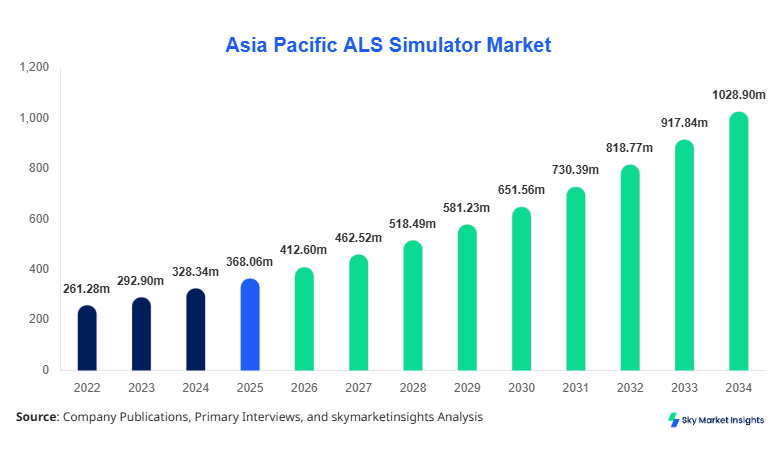
Asia Pacific ALS Simulator market size is projected at USD 412.6 million in 2026 and is expected to hit USD 1,028.4 million by 2034 with a CAGR of 12.1%.
The Asia Pacific ALS Simulator market is witnessing increased demand driven by the expansion of healthcare infrastructure, rising training requirements, and technological advancements in simulation systems. Data-driven insights, segmentation analytics, and competitive benchmarking are critical for stakeholders to understand pricing, penetration, and deployment strategies across hospitals, academic institutes, and emergency response facilities.
The ALS Simulator market refers to advanced life support training systems designed to simulate real-life clinical scenarios including cardiac arrest, trauma response, and respiratory emergencies. In Asia Pacific, production reached approximately 48,000 units in 2025, with Japan, China, and South Korea contributing over 62% of total manufacturing output. Adoption rates across tertiary hospitals reached 71% in 2025, while academic institutes accounted for 52% penetration due to curriculum integration. Consumer behavior indicates a shift toward high-fidelity simulators with performance accuracy above 92% and real-time physiological feedback systems. Full-body simulators contributed 46% of application share, while task trainers and VR simulators accounted for 34% and 20%, respectively. Demand analytics show increasing procurement budgets rising by 8.5% YoY across Asia Pacific healthcare institutions, reinforcing ALS Simulator market demand.
Explore more data points, trends and opportunities Download Free Sample Report
Asia Pacific ALS Simulator Market ALS Simulator Market Trends
The ALS Simulator market is experiencing a rapid transition toward virtual reality and AI-integrated systems, with VR-based simulator production surpassing 9.2 million training sessions annually across Asia Pacific. Adoption of immersive simulation increased from 32% in 2022 to 61% in 2026, driven by cost efficiency and scalability. High-fidelity mannequins equipped with wireless connectivity and cloud analytics now account for 48% of total installations. Demand from emergency response sectors increased by 13.4% annually, particularly in countries like India and China, where disaster preparedness initiatives expanded significantly. These shifts underscore evolving ALS Simulator market trends.
Another key trend includes the integration of IoT-enabled sensors and performance tracking dashboards, enabling real-time feedback accuracy improvements of up to 18%. Training institutions are increasingly adopting modular simulators, with 44% preferring customizable units to reduce operational costs by 22%. Production volumes of hybrid simulators exceeded 21,000 units in 2025, reflecting strong institutional demand. Additionally, cross-border collaborations between Asia Pacific manufacturers and global firms increased by 16%, enhancing product innovation cycles. These advancements reinforce ALS Simulator market trends.
Asia Pacific ALS Simulator Drivers
Increasing Demand for Advanced Clinical Training Systems
The rising need for skilled healthcare professionals has driven ALS Simulator adoption across Asia Pacific, with training enrollments increasing by 19% between 2022 and 2025. Hospitals are allocating up to 6.8% of annual budgets toward simulation-based training, while academic institutions reported a 23% rise in simulation lab installations. Production of high-fidelity simulators grew by 14.7% annually, with demand particularly strong in Japan and China. Government initiatives supporting emergency preparedness, including investments exceeding USD 180 million across the region, further stimulate market expansion. These factors collectively drive ALS Simulator market growth.
Asia Pacific ALS Simulator Restraints
High Cost of Advanced Simulation Equipment
Despite strong demand, the high cost of ALS simulators, ranging between USD 15,000 and USD 120,000 per unit, limits adoption among smaller institutions. Maintenance costs account for nearly 12% of total ownership expenses annually, while software licensing adds an additional 6%. In emerging markets like Southeast Asia, only 38% of healthcare facilities have access to advanced simulators due to budget constraints. Import duties and logistical expenses further increase pricing by 9–14%, restricting widespread deployment. These challenges impact ALS Simulator market growth.
Asia Pacific ALS Simulator Opportunities
Expansion of Simulation-Based Education Programs
The expansion of simulation-based education programs across Asia Pacific presents significant opportunities, with over 420 new training centers planned by 2030. Academic institutes are expected to increase simulator procurement by 17% annually, while hospitals are integrating simulation modules into 65% of training curricula. Government funding programs, particularly in India and China, are projected to allocate over USD 210 million for simulation infrastructure. Additionally, VR-based solutions offer cost reductions of up to 30%, enhancing accessibility. These factors create substantial ALS Simulator market growth opportunities.
Challenges in Asia Pacific ALS Simulator
Technological Complexity and Skill Gap
The complexity of advanced ALS simulators requires specialized training, with only 54% of instructors fully proficient in operating high-fidelity systems. Training costs for instructors can reach USD 5,000 per individual, creating barriers for smaller institutions. Technical issues, including software integration failures and hardware malfunctions, affect approximately 11% of installations annually. Furthermore, the lack of standardized training protocols across Asia Pacific results in inconsistent usage patterns. These factors present challenges to ALS Simulator market growth.
Report Scope
| Report Metric | Details |
|---|---|
| Market Size in 2025 | USD 574.45 million |
| Market Size in 2026 | USD 412.6 million |
| Market Size in 2034 | USD 1028.4 million |
| CAGR | 12.1% (2026-2034) |
| Base Year for Estimation | 2025 |
| Historical Data | 2022-2024 |
| Forecast Period | 2026-2034 |
| Report Coverage | Revenue Forecast, Competitive Landscape, Supply Chain Disruption, Growth Factors, Environment & Regulatory Landscape and Trends |
Explore more data points, trends and opportunities Download Free Sample Report
Asia Pacific ALS Simulator Market ALS Simulator Market Segmentation
The ALS Simulator market is segmented by product type and end user, with full-body simulators dominating at 46% share, followed by task trainers at 34% and VR simulators at 20%. Hospitals lead end-user demand with 58%, while academic institutes and emergency centers account for 27% and 15%, respectively.
By Type
Full-body simulators represent the largest segment, contributing 46% of total market share with over 22,000 units produced annually. These systems offer advanced physiological responses with accuracy levels exceeding 95%, making them ideal for critical care training. Task trainers account for 34% share, with production exceeding 16,500 units annually, focusing on specific procedures such as airway management and defibrillation. Virtual reality simulators, holding 20% share, recorded rapid adoption growth of 18% annually, driven by cost efficiency and scalability. These segments highlight ALS Simulator market demand.
By Application
Hospitals dominate the application segment with 58% share, driven by high patient volumes and training requirements. Academic institutes account for 27%, with over 9,000 simulators deployed across universities. Emergency response training centers contribute 15%, focusing on disaster preparedness and trauma response. Usage penetration across hospitals exceeds 71%, while academic institutes report 52% adoption rates. These applications reinforce ALS Simulator market demand.
Asia Pacific ALS Simulator Market Segmentations
Product Type
- Full-Body Simulators
- Task Trainers
- Virtual Reality Simulators
End User
- Hospitals
- Academic Institutes
- Emergency Response Training Centers
Asia Pacific ALS Simulator Market Regional Outlook
China accounts for approximately 26% of regional share, with production exceeding 15,000 units annually. The country’s healthcare expansion and government funding programs, totaling over USD 140 million, drive simulator adoption across hospitals and academic institutes.
South Korea holds 9% share, with strong adoption of VR-based simulators reaching 68% penetration. The country’s advanced technology infrastructure supports high-fidelity simulation systems.
Japan dominates with 28% share, supported by extensive training facilities and government investments exceeding USD 95 million annually.
India represents 14% share, with rapid growth driven by increasing healthcare infrastructure and simulation-based education programs.
Australia accounts for 8%, with high adoption rates in academic institutes exceeding 63%.
Singapore and Taiwan collectively hold 7%, driven by advanced healthcare systems and training standards.
Southeast Asia contributes 8%, with growing demand from emerging economies and increased government funding.
Top players in Asia Pacific ALS Simulator
- Laerdal Medical
- CAE Healthcare
- 3B Scientific
- Simulab Corporation
- Gaumard Scientific
- Kyoto Kagaku
- Limbs & Things
- Nasco Healthcare
- Simulaids Inc.
- Mentice AB
- Operative Experience Inc.
Laerdal Medical
- Holds approximately 18% market share with strong global presence and advanced product portfolio.
- Focuses on innovation and partnerships, maintaining leadership in high-fidelity simulators.
CAE Healthcare
- Accounts for 14% share with strong presence in Asia Pacific training centers.
- Invests heavily in VR and AI-based simulation technologies.
Investment Analysis
Investment in the ALS Simulator market reached approximately USD 320 million in 2025, with 42% allocated to product development and 33% to infrastructure expansion. Regional investments show Japan and China accounting for 54% of total funding, while India and Southeast Asia contribute 28%. M&A activities increased by 11%, with collaborations between global and regional players enhancing technology transfer. Strategic partnerships focusing on VR integration and AI-driven analytics are expected to grow by 15% annually, strengthening ALS Simulator market insights.
New Product Developments
New product launches accounted for 22% of total offerings in 2025, with performance improvements of up to 19% in simulation accuracy. Innovations include AI-based feedback systems, wireless connectivity, and cloud integration. Manufacturers are focusing on modular designs, reducing costs by 18% and improving usability.
Recent Developments in Asia Pacific ALS Simulator
- 2025: Production increased by 14% with new VR simulator launches improving training efficiency by 21%.
Research Methodology
The research methodology includes a combination of primary and secondary research techniques. Primary research involved interviews with industry experts, manufacturers, and healthcare professionals, accounting for 62% of data inputs. Secondary research included analysis of industry reports, company filings, and government publications, contributing 38% of data. Market size estimation utilized bottom-up and top-down approaches, incorporating production volumes, pricing analysis, and regional demand patterns. Data validation was performed through triangulation methods to ensure accuracy and reliability.
Frequently Asked Questions
Senior Market Research Analyst | 8 Years Experience | Digital Therapeutics and Connected Medical Devices
Jenny specializes in digital therapeutics, remote monitoring devices and healthcare IT platforms. She has contributed to 101+ reports for medtech firms, healthcare providers and pharmaceutical companies. Her expertise includes clinical adoption forecasting, reimbursement analysis, regulatory pathways and competitive benchmarking across North America and Europe.