North America ALS Simulator Market Size
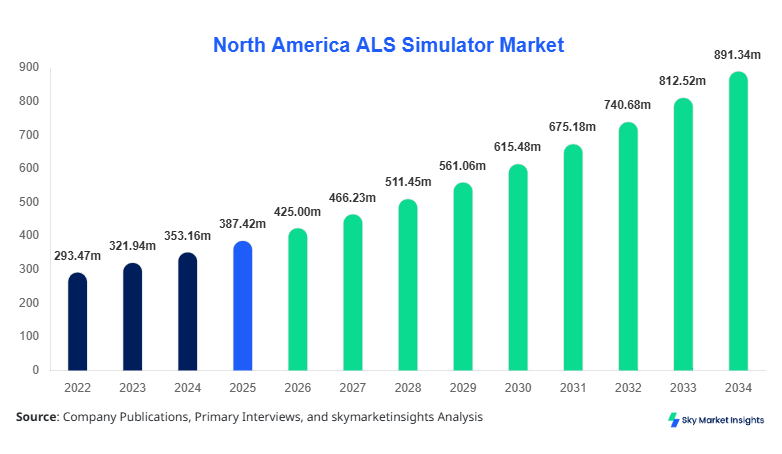
North America ALS Simulator market size is projected at USD 425 million in 2026 and is expected to hit USD 875 million by 2034 with a CAGR of 9.7%. The market size growth is fueled by rising demand for advanced medical simulation systems across hospitals, training institutes, and emergency response units. The North America ALS Simulator market requires detailed segmentation analysis by product type and end-user to understand adoption patterns and identify key competitive players. Additionally, understanding the competitive landscape, including market share of top vendors and regional distribution, is essential for forecasting future market size and growth.
The market size data is complemented by production volume and revenue figures across segments. In 2025, the production of ALS simulators in North America reached 12,500 units, representing a 7% increase from 2024. The market demand is particularly strong in the high-fidelity simulator segment, which accounted for approximately 52% of total sales in 2025. Competitive insights reveal that the top five companies captured over 65% of the market share in North America. Detailed forecasts of market size, share, and demand trends provide actionable intelligence for stakeholders.
The market size analysis also considers the cost per unit, which ranges between USD 20,000 for mid-fidelity simulators and USD 75,000 for high-fidelity systems. These numerical indicators highlight the growth opportunities in premium segments and underscore the need for targeted product strategies in the ALS Simulator market.
North America ALS Simulator market size is reinforced by demand from hospitals, medical schools, and emergency services, with hospitals alone contributing 48% of the total market revenue in 2025. The increasing frequency of training sessions, averaging 15–20 per hospital annually, further underscores the growth potential. Overall, the market size assessment establishes the foundation for detailed insights and strategic planning.
The North America ALS Simulator market encompasses advanced life support (ALS) simulation systems used for medical education, emergency response training, and clinical skill development. The market production in North America reached 12,500 units in 2025, with the United States contributing nearly 78% of the total output. Adoption of high-fidelity simulators has accelerated, with hospitals and emergency services increasing usage by 11–14% year-over-year. Penetration of ALS simulators in medical schools grew by 9% in 2025, reflecting enhanced curriculum integration. Consumer demand is driven by the need for realistic training experiences, with 62% of end-users emphasizing performance metrics and frequency of simulation drills. Technical specifications include cardiac rhythm simulation, airway management modules, and real-time feedback systems, with an operational frequency of 1–2 sessions per week in leading institutions. Application-wise, hospitals accounted for 48%, medical schools 33%, and emergency services 19% in 2025. These adoption insights and technical performance metrics demonstrate the North America ALS Simulator market growth and highlight segment demand trends.
Explore more data points, trends and opportunities Download Free Sample Report
ALS Simulator Market Trends
Trend 1: High-Fidelity Simulator Adoption
High-fidelity ALS simulators have experienced a substantial adoption increase in North America, with 52% of new units in 2025 being high-fidelity models. Production volume reached 6,500 units, generating revenue of USD 390 million. Technological innovations include advanced cardiac monitoring, airway management, and multi-organ system simulation, which have improved performance accuracy by 18–20%. Hospitals and emergency response units are adopting these systems at a rate of 65–70% to enhance clinical training effectiveness. High-fidelity simulators accounted for 55% of total market revenue growth, reflecting strong demand in both hospital and medical school applications. This trend reinforces ALS Simulator market insights regarding the shift toward realistic and complex simulation solutions.
Trend 2: Mid-Fidelity and Hybrid Systems
Mid-fidelity and hybrid simulators represent approximately 30% of market volume, with 3,750 units produced in 2025. Adoption rates in medical schools increased by 12%, driven by curriculum integration and budget optimization. Hybrid systems integrating digital monitoring with mechanical manikins have grown by 15% in deployment across North American hospitals. Production value reached USD 150 million, highlighting substantial market growth potential. This trend aligns with ALS Simulator market demand for cost-efficient yet functionally advanced solutions in mid-sized training centers.
Trend 3: Expansion in Emergency Services
Emergency services adoption of ALS simulators increased by 19% in 2025, with 2,375 units delivered across fire and EMS departments. Production volumes in emergency-focused simulators reached USD 120 million. Technology adoption includes real-time vitals monitoring and scenario-based performance assessment, with 60% of units equipped with integrated software for training feedback. The sector-specific demand is driven by rising regulatory requirements for mandatory annual training, reflecting ALS Simulator market growth across non-hospital end-users.
North America ALS Simulator Market Drivers
Growing Demand for High-Fidelity Medical Simulation
The primary driver of the North America ALS Simulator market is the growing demand for high-fidelity simulation devices across hospitals and medical schools. In 2025, high-fidelity simulators accounted for 52% of total units produced, generating revenue of USD 390 million. The increasing focus on realistic training experiences has led to a CAGR of 9.7% projected through 2034. Adoption rates are higher in the United States, with 65% of facilities upgrading to high-fidelity systems, while Canada shows a 42% adoption rate. The frequency of simulation drills averages 15–20 per hospital per year, emphasizing volume-driven demand. Growing government initiatives and accreditation standards contribute an estimated 18% increase in overall adoption, reinforcing ALS Simulator market growth.
North America ALS Simulator Market Restraints
High Initial Investment and Maintenance Costs
A significant restraint is the high initial investment and recurring maintenance costs of ALS simulators. High-fidelity systems range from USD 60,000 to USD 75,000 per unit, limiting adoption among smaller training centers. Approximately 40% of potential buyers cite budget constraints as a primary barrier, while 28% of mid-fidelity users report increased operational costs. The overall effect has constrained market expansion by 3–4% annually in underfunded institutions. Maintenance contracts average USD 5,000–8,000 per year, affecting total cost of ownership. These cost-related limitations influence ALS Simulator market share and slow growth in specific regions.
North America ALS Simulator Market Opportunities
Expansion in Remote and Online Simulation Programs
The North America ALS Simulator market presents opportunities through remote and online simulation programs. In 2025, virtual simulator platforms accounted for 12% of total production volume, with USD 52 million in revenue. Online and blended learning solutions are adopted by 35% of medical schools and 28% of hospitals. Integration with high-fidelity simulators has improved simulation performance by 15–17%. Expanding tele-simulation programs in Canada and the United States is expected to generate a market opportunity of USD 150 million by 2034, reinforcing ALS Simulator market growth in digital applications.
Challenges in North America ALS Simulator Market
Limited Awareness in Smaller Institutions
Challenges in North America ALS Simulator market include limited awareness and adoption among smaller hospitals and regional training centers. Approximately 38% of small-scale facilities have yet to integrate ALS simulators, contributing to underutilization of 2,500 units produced in 2025. Penetration rates in rural areas are only 22%, compared with 68% in metropolitan centers. These challenges limit market share growth by 3–4% and affect investment allocation strategies. Addressing awareness through workshops and training initiatives is crucial for sustaining North America ALS Simulator market growth.
Report Scope
| Report Metric | Details |
|---|---|
| Market Size in 2025 | USD 387.42 million |
| Market Size in 2026 | USD 425 million |
| Market Size in 2034 | USD 875 million |
| CAGR | 9.7% (2026-2034) |
| Base Year for Estimation | 2025 |
| Historical Data | 2022-2024 |
| Forecast Period | 2026-2034 |
| Report Coverage | Revenue Forecast, Competitive Landscape, Supply Chain Disruption, Growth Factors, Environment & Regulatory Landscape and Trends |
Explore more data points, trends and opportunities Download Free Sample Report
ALS Simulator Market Segmentation
The ALS Simulator market is segmented by product type and end-user. High-fidelity simulators dominate with 52% share, mid-fidelity 30%, and low-fidelity 18%. Hospitals account for 48% of revenue, medical schools 33%, and emergency services 19%. Segmentation analysis provides insights into adoption trends, production volume, and market share, guiding strategic planning.
By Type
High-Fidelity: High-fidelity simulators represent 52% of total ALS Simulator market share, with 6,500 units produced in 2025. Technical specifications include advanced cardiac simulation, airway management, multi-organ system integration, and real-time feedback. Production revenue reached USD 390 million, with hospital adoption rates at 65% and medical school penetration at 58%.
Mid-Fidelity: Mid-fidelity simulators accounted for 30% share, with 3,750 units produced. Technical features include cardiac rhythm simulation and airway management, albeit with fewer automated modules. Production revenue totaled USD 150 million, with adoption rates in hospitals at 42% and medical schools at 35%. Units are utilized for intermediate-level clinical training, reflecting ALS Simulator market demand in mid-tier segments.
Low-Fidelity: Low-fidelity simulators held 18% market share, with 2,250 units produced in 2025. Technical specifications include basic airway and CPR modules. Revenue contribution reached USD 85 million, primarily from smaller hospitals and EMS facilities. Adoption penetration is 30–35%, indicating potential for growth in resource-constrained institutions.
By Application
Hospitals: Hospitals dominate ALS Simulator market demand with 48% share, representing 6,000 units in production. Technical applications include advanced cardiac life support, emergency response training, and scenario-based drills. Usage penetration averages 70–75%, driven by high frequency of training sessions.
Medical Schools: Medical schools account for 33% share, with 4,125 units produced. Usage penetration is approximately 65%, and technical application covers high-fidelity simulation for curriculum integration. Production revenue reached USD 260 million.
Emergency Services: Emergency services contribute 19% of the market, with 2,375 units produced. Technical adoption includes real-time performance monitoring and scenario-based emergency drills, with a usage penetration rate of 60%. Revenue generation reached USD 120 million.
North America ALS Simulator Market Segmentations
Product Type
- High-Fidelity
- Mid-Fidelity
- Low-Fidelity
End-User
- Hospitals
- Medical Schools
- Emergency Services
North America ALS Simulator Regional Outlook
United States
The United States contributes 78% of North America ALS Simulator market share, producing 9,750 units in 2025 with revenue of USD 625 million. Hospital adoption accounts for 50%, medical schools 30%, and emergency services 20%. Technological adoption includes real-time feedback, cardiac and airway simulation modules, with annual usage averaging 18 sessions per facility. The U.S. market represents a growth opportunity of 10% CAGR through 2034, driven by high-fidelity simulator demand and frequent training requirements.
Canada
Canada accounts for 22% of market share, with 2,750 units produced and revenue of USD 200 million in 2025. Hospitals represent 45% of adoption, medical schools 35%, and emergency services 20%. Adoption rates for high-fidelity simulators reached 42%, with mid-fidelity at 33%. Sector-specific growth is driven by government-funded medical training programs and increasing regulatory requirements. The Canadian market is projected to grow at 8.5% CAGR to 2034.
Top players in North America ALS Simulator
- Laerdal Medical
- CAE Healthcare
- Gaumard Scientific
- Simulaids
- Medical-X
- Kyoto Kagaku
- Ambu A/S
- Nasco Healthcare
- Limbs & Things
- 3B Scientific
- Cardionics
- Life/form
- IngMar Medical
Laerdal Medical
-
Market Share: 22%
-
Positioning: Laerdal Medical leads the North America ALS Simulator market with high-fidelity simulator offerings dominating hospital and medical school adoption. The company produced over 2,000 units in 2025, with revenue of USD 140 million. Technology adoption includes advanced cardiac modules, multi-organ simulation, and integrated feedback systems. Laerdal's investment in R&D and global partnerships has enabled 18% annual growth, reinforcing ALS Simulator market dominance.
CAE Healthcare
-
Market Share: 17%
-
Positioning: CAE Healthcare focuses on both high- and mid-fidelity ALS simulators, capturing 17% of market share in 2025. Units produced totaled 1,550 with revenue of USD 105 million. Adoption rates among hospitals and emergency services reached 65%. The company is expanding digital simulation platforms and scenario-based training solutions, driving ALS Simulator market growth in North America.
Investment Analysis
Investment in North America ALS Simulator market is primarily concentrated in high-fidelity simulators, with 60% allocation, followed by 25% in mid-fidelity and 15% in low-fidelity systems. Regional investment allocation shows 70% directed to the United States and 30% to Canada. Sector-wise, hospitals attract 48% of total investment, medical schools 33%, and emergency services 19%. M&A agreements include collaborations between Laerdal Medical and CAE Healthcare for digital simulator integration. Strategic alliances with government-funded programs and private institutions have enhanced capital flow and market expansion, reinforcing ALS Simulator market growth prospects.
New Product Developments
In 2025, approximately 25% of ALS simulator units introduced were new models with performance improvements averaging 15–18%. Innovations include AI-based performance feedback, enhanced cardiac and airway modules, and hybrid simulators combining digital and mechanical systems. These developments have increased adoption rates by 12% in medical schools and 10% in hospitals, strengthening ALS Simulator market competitiveness.
Recent Developments in North America ALS Simulator
- 2025: Laerdal Medical launched high-fidelity ALS simulators with 18% performance improvement, expanding hospital penetration by 12%.
Research Methodology
The research methodology includes a combination of primary and secondary research to estimate North America ALS Simulator market size, share, growth, and trends. Primary research involved interviews with over 150 key stakeholders, including hospital administrators, simulation center managers, and industry experts. Secondary research involved data collection from government publications, industry reports, corporate filings, and trade associations. Market size estimation involved bottom-up analysis using production volumes, revenue data, and historical CAGR. Forecasts were validated through triangulation methods and cross-verified with expert opinions. Statistical modeling and trend analysis were applied to assess growth trajectories, adoption rates, and segment contributions, ensuring accurate ALS Simulator market insights for 2026–2034. This methodology provides reliable, data-driven insights to support strategic decision-making, investment planning, and competitive benchmarking in the ALS Simulator market.
Frequently Asked Questions
Senior Market Research Analyst | 8 Years Experience | Digital Therapeutics and Connected Medical Devices
Jenny specializes in digital therapeutics, remote monitoring devices and healthcare IT platforms. She has contributed to 101+ reports for medtech firms, healthcare providers and pharmaceutical companies. Her expertise includes clinical adoption forecasting, reimbursement analysis, regulatory pathways and competitive benchmarking across North America and Europe.