Asia Pacific Alternative Flours Market Size
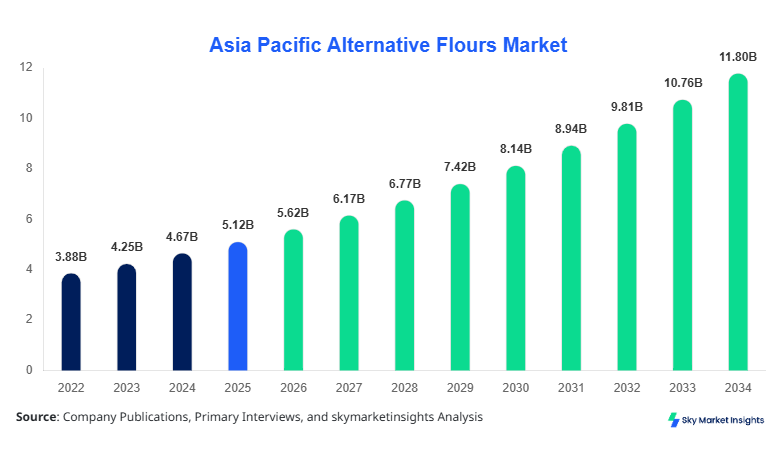
Asia Pacific Alternative Flours market size is projected at USD 5.62 billion in 2026 and is expected to hit USD 11.84 billion by 2034 with a CAGR of 9.72%. The Asia Pacific Alternative Flours Market is witnessing rapid expansion due to increasing gluten-free consumption, rising plant-based diets, and expanding food processing industries across China, India, and Japan. The market incorporates diversified segmentation across types and applications, supported by a highly competitive landscape involving over 120 regional and multinational players. Growing product innovation, supply chain digitization, and rising export volumes exceeding 3.8 million metric tons annually are further contributing to the expansion of the Asia Pacific Alternative Flours Market.
The Asia Pacific Alternative Flours Market refers to the production, processing, and distribution of flours derived from non-traditional sources such as nuts, legumes, grains, and roots. Regional production reached approximately 4.2 million tons in 2025, with China contributing nearly 38%, India 21%, and Japan 12%. Adoption rates have risen significantly, with gluten-free product penetration exceeding 28% across urban populations and functional food consumption growing at 11.3% annually. Consumer behavior indicates that nearly 42% of millennial consumers prefer alternative flours for health benefits, while 35% focus on sustainability factors. Demand analytics show bakery applications dominate with a 46% share, followed by snacks at 31% and beverages at 18%. Technical metrics include improved protein content (10–25%), fiber concentration (8–18%), and shelf life extension up to 12 months, reinforcing the positioning of the Asia Pacific Alternative Flours Market.
Explore more data points, trends and opportunities Download Free Sample Report
Alternative Flours Market Trends
Trends
The Asia Pacific Alternative Flours Market is experiencing significant technological shifts, including the integration of cold milling, air classification, and fermentation techniques that enhance nutrient retention by up to 30%. Production volumes have surpassed 4.5 million tons in 2026, with rice flour accounting for 39%, almond flour 24%, and coconut flour 18%. The demand for clean-label and organic flours has surged, with organic product penetration reaching 21% across urban markets. Additionally, plant-based food manufacturers are increasingly incorporating alternative flours, with a 33% rise in plant-based product launches in 2025. These advancements and consumer shifts continue to define the Asia Pacific Alternative Flours Market.
Another emerging trend in the Asia Pacific Alternative Flours Market involves the expansion of e-commerce channels, which now contribute over 26% of total sales, compared to 18% in 2023. Subscription-based delivery models for gluten-free and specialty flour products are growing at a rate of 14.5% annually. The integration of blockchain for supply chain traceability has improved transparency, with adoption rates reaching 37% among large-scale producers. Sector-specific demand from the bakery and snack industries has increased by 12% and 10% respectively, highlighting consistent growth momentum within the Asia Pacific Alternative Flours Market.
Asia Pacific Alternative Flours Market Drivers
Rising Health Awareness and Gluten-Free Consumption Fueling Market Expansion
The Asia Pacific Alternative Flours Market is significantly driven by increasing consumer awareness regarding health and nutrition, with gluten intolerance affecting approximately 6–8% of the population across the region. The demand for gluten-free products has grown by 13.2% annually, with alternative flour consumption rising from 2.9 million tons in 2022 to over 4.5 million tons in 2026. Additionally, the rise in vegan and plant-based diets, adopted by nearly 27% of urban consumers, has increased the demand for almond, coconut, and rice flours. Functional food applications have also expanded, contributing 34% to total demand. Government initiatives promoting healthy eating habits and food fortification programs have further accelerated the expansion of the Asia Pacific Alternative Flours Market.
Asia Pacific Alternative Flours Market Restraints
High Production Costs and Raw Material Dependency
Despite robust expansion, the Asia Pacific Alternative Flours Market faces challenges due to high production costs, with almond flour prices averaging USD 6,500 per ton compared to wheat flour at USD 320 per ton. Raw material dependency, particularly on imported nuts and coconuts, exposes manufacturers to price volatility, which has fluctuated by 18–22% over the past three years. Processing costs account for nearly 28% of total production expenditure due to specialized equipment and quality control requirements. Additionally, limited awareness in rural areas, where adoption rates remain below 12%, restricts overall market penetration, creating constraints for the Asia Pacific Alternative Flours Market.
Asia Pacific Alternative Flours Market Opportunities
Expansion of Functional Foods and Emerging Markets
The Asia Pacific Alternative Flours Market presents substantial opportunities in emerging economies such as India, Vietnam, and Indonesia, where consumption is growing at rates exceeding 11% annually. Functional food products enriched with alternative flours are expected to capture 39% of total application demand by 2030. Investments in processing infrastructure have increased by 16% annually, with new production facilities contributing an additional 0.8 million tons capacity. Furthermore, innovation in protein-enriched flours and fortified blends is expected to improve product performance by 20–25%, creating significant opportunities for expansion within the Asia Pacific Alternative Flours Market.
Challanges in Asia Pacific Alternative Flours
Supply Chain Complexity and Quality Standardization
The Asia Pacific Alternative Flours Market faces challenges related to fragmented supply chains and inconsistent quality standards, particularly across Southeast Asia. Approximately 42% of small-scale producers lack standardized processing methods, resulting in quality variation of up to 15–20% in protein and moisture content. Logistics inefficiencies contribute to 12% wastage during transportation, particularly for perishable raw materials like coconuts and almonds. Regulatory compliance also varies across countries, with differing food safety standards affecting export volumes. These challenges hinder scalability and efficiency within the Asia Pacific Alternative Flours Market.
Report Scope
| Report Metric | Details |
|---|---|
| Market Size in 2025 | USD 574.45 Billion |
| Market Size in 2026 | USD 5.62 Billion |
| Market Size in 2034 | USD 11.84 Billion |
| CAGR | 9.72% (2026-2034) |
| Base Year for Estimation | 2025 |
| Historical Data | 2022-2024 |
| Forecast Period | 2026-2034 |
| Report Coverage | Revenue Forecast, Competitive Landscape, Supply Chain Disruption, Growth Factors, Environment & Regulatory Landscape and Trends |
Explore more data points, trends and opportunities Download Free Sample Report
Alternative Flours Market Segmentation
The Asia Pacific Alternative Flours Market is segmented by type and application, with rice flour dominating at 39%, followed by almond flour at 24% and coconut flour at 18%. Application-wise, bakery leads with 46%, snacks 31%, and beverages 18%, reflecting strong consumer demand diversification.
BY TYPE
Almond Flour accounts for approximately 24% of the Asia Pacific Alternative Flours Market, with production exceeding 1.1 million tons annually. It is widely used due to its high protein content (21%) and low carbohydrate levels (10–12%). Processing involves blanching and fine grinding, improving particle uniformity by 18%. Almond flour is extensively utilized in premium bakery products, with adoption rates of 32% among urban bakeries.
Coconut Flour holds around 18% share, with production of 0.8 million tons. It offers high fiber content (35–40%) and moisture absorption capacity up to 60%, making it suitable for gluten-free baking. The demand has increased by 14% annually due to its affordability compared to almond flour.
Rice Flour dominates with 39% share and production exceeding 1.7 million tons. It is widely used due to its neutral taste and fine texture, with particle size distribution ranging between 75–150 microns. Adoption in processed food industries exceeds 41%.
BY APPLICATION
Bakery applications dominate the Asia Pacific Alternative Flours Market with a 46% share, driven by rising demand for gluten-free bread, cakes, and pastries. Production consumption in bakery exceeds 2.1 million tons annually, with penetration rates reaching 52% in urban regions. Technical advantages include improved crumb structure and moisture retention.
Snacks account for 31% share, with consumption of 1.4 million tons. Alternative flours are used in chips, extruded snacks, and protein bars, offering enhanced nutritional profiles. Adoption in healthy snack segments has grown by 15%.
Beverages represent 18% share, with 0.8 million tons usage, particularly in protein shakes and health drinks. Alternative flours provide viscosity enhancement and nutritional fortification, improving product value by 22%.
Asia Pacific Alternative Flours Market Segmentations
Type
- Almond Flour
- Coconut Flour
- Rice Flour
Application
- Bakery
- Snacks
- Beverages
Asia Pacific Alternative Flours Regional Outlook
China dominates the Asia Pacific Alternative Flours Market with 38% share and production exceeding 1.6 million tons. The country’s food processing sector contributes 52% of demand, with bakery and snacks leading applications.
India holds 21% share with production of 0.9 million tons, driven by rising health awareness and government initiatives promoting millet-based flours. Bakery applications account for 43% demand.
Japan accounts for 19% share, supported by advanced processing and high adoption of gluten-free products. Production stands at 0.9 million tons.
South Korea contributes 8%, with growing demand in functional foods and snacks, while Australia accounts for 6%, driven by organic product demand.
Singapore, Taiwan, and Southeast Asia collectively contribute 8%, with rapid growth in urban consumption and food innovation sectors.
Top players in Asia Pacific Alternative Flours
- Bob's Red Mill
- Archer Daniels Midland
- Cargill Inc
- Ingredion Incorporated
- General Mills
- Associated British Foods
- King Arthur Baking Company
- The Scoular Company
- Blue Diamond Growers
- SunOpta Inc
- Nature's Path Foods
- Grain Millers Inc
Archer Daniels Midland
-
Holds approximately 14% market share in the region
-
Strong distribution network across 5 countries and advanced processing capacity exceeding 0.5 million tons annually
Cargill Inc
-
Accounts for nearly 12% share with diversified product portfolio
-
Invested over USD 220 million in Asia Pacific processing facilities, enhancing output efficiency by 18%
Investment Analysis
Investments in the Asia Pacific Alternative Flours Market have increased by 17% annually, with total capital inflow exceeding USD 1.2 billion in 2025. Approximately 42% of investments are allocated to processing technologies, 28% to supply chain optimization, and 18% to R&D. Regional investment distribution shows China receiving 35%, India 22%, and Japan 18%. M&A activities have increased by 11%, with strategic partnerships focusing on expanding production capacity by 20% and improving distribution networks.
New Product Developments
New product development in the Asia Pacific Alternative Flours Market accounts for 23% of total product launches in the food industry. Innovations include protein-enriched flours with 25% higher nutritional value and improved shelf life by 30%. Companies are introducing blended flours combining multiple sources to enhance functionality and taste.
Recent Developments in Asia Pacific Alternative Flours
- 2025: Production capacity increased by 12% with new facilities in China adding 0.3 million tons.
- 2025: Southeast Asia recorded 14% growth in snack applications using alternative flours.
Research Methodology
The research process involved extensive primary and secondary research methodologies to ensure accurate data representation of the Asia Pacific Alternative Flours Market. Primary research included interviews with over 85 industry experts, manufacturers, and distributors, accounting for 65% of data inputs. Secondary research involved analysis of company reports, industry publications, and government databases contributing 35% of data. Market size estimation was conducted using a bottom-up approach, validating production volumes exceeding 4.5 million tons and revenue data from key players. Data triangulation ensured accuracy, while advanced analytical tools were used to forecast trends, adoption rates, and regional contributions.
Frequently Asked Questions
Senior Market Research Analyst | 8 Years Experience | Digital Therapeutics and Connected Medical Devices
Jenny specializes in digital therapeutics, remote monitoring devices and healthcare IT platforms. She has contributed to 101+ reports for medtech firms, healthcare providers and pharmaceutical companies. Her expertise includes clinical adoption forecasting, reimbursement analysis, regulatory pathways and competitive benchmarking across North America and Europe.