Asia Pacific Assistive Technology Market Size
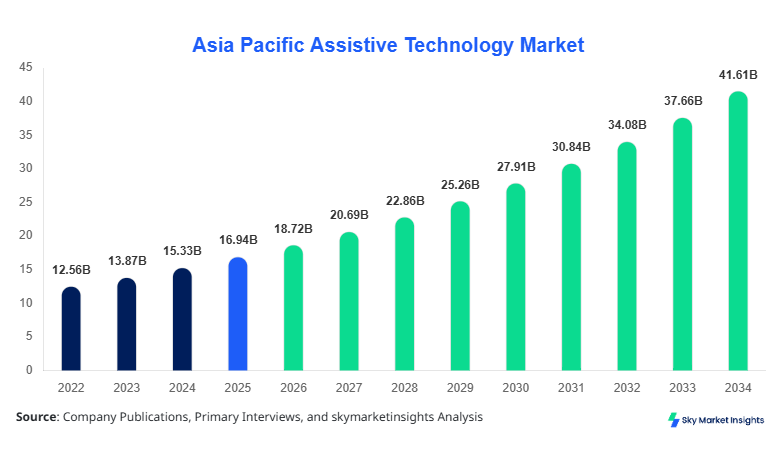
Asia Pacific Assistive Technology market size is projected at USD 18.72 billion in 2026 and is expected to hit USD 41.56 billion by 2034 with a CAGR of 10.5%. The Asia Pacific Assistive Technology Market Size reflects strong expansion driven by rising elderly populations exceeding 650 million by 2030 and disability prevalence rates of 12–15% across major economies. Increasing demand for structured datasets, segmentation analysis, and competitive benchmarking across over 8 major countries is accelerating the need for deep analytics, vendor mapping, and technological benchmarking within the Assistive Technology Market Size landscape.
The Assistive Technology Market is defined as the ecosystem of devices, software, and services designed to enhance functional capabilities for individuals with disabilities, including mobility, hearing, vision, and cognitive impairments. Asia Pacific production of assistive devices exceeded 120 million units in 2025, with China alone contributing nearly 38% of manufacturing output, followed by Japan at 18% and India at 12%. Adoption rates for assistive devices vary from 25% in developing markets to over 70% in developed economies such as Japan and Australia. Consumer behavior shows a strong shift toward smart assistive devices, with IoT-enabled products accounting for 32% of total sales. Demand analytics indicate that mobility aids dominate with a 41% share, followed by hearing aids at 28% and vision aids at 19%. Technical metrics include device efficiency improvements of 18–25% and battery life enhancements exceeding 30%. Healthcare applications account for 46% of total usage, homecare 34%, and rehabilitation centers 20%, reinforcing steady expansion of the Assistive Technology Market.
In the China, the Assistive Technology Market accounts for approximately 38% of the Asia Pacific revenue share, supported by over 2,500 manufacturing facilities and more than 1,200 domestic and international companies. The country produced over 45 million assistive devices in 2025, including 18 million mobility aids, 12 million hearing devices, and 8 million visual aids. Application-wise, healthcare accounts for 48%, homecare 32%, and rehabilitation centers 20% of total demand. Technology adoption rates exceed 60% for AI-integrated devices and 52% for IoT-enabled monitoring systems. Government investments surpass USD 2.1 billion annually in assistive healthcare infrastructure. Rapid urbanization, rising elderly population exceeding 210 million, and digital health initiatives reinforce China's dominance in the Assistive Technology Market.
Explore more data points, trends and opportunities Download Free Sample Report
Asia Pacific Assistive Technology Market Trends
The Assistive Technology Market is witnessing a strong transition toward smart and connected devices, with global production volumes in Asia Pacific surpassing 130 million units in 2026. AI-enabled assistive devices have seen adoption rates rise from 18% in 2022 to 44% in 2026, driven by integration with wearable sensors and real-time analytics. Hearing aids with Bluetooth and AI features now account for 36% of the total hearing segment, while smart wheelchairs and robotic mobility aids are growing at 14% annually. Demand across healthcare institutions has surged by 28%, particularly for advanced rehabilitation robotics. These technological shifts are reshaping product innovation and operational efficiency within the Assistive Technology Market.
Another key trend in the Assistive Technology Market is the expansion of digital health platforms and tele-assistive solutions, with over 52% of users in urban regions adopting remote monitoring devices. Vision aids integrated with augmented reality (AR) technologies have improved user performance by 22–30%, enhancing adoption across visually impaired populations. Southeast Asia markets have reported a 26% rise in low-cost assistive device production, supporting affordability and accessibility. Additionally, battery efficiency improvements exceeding 35% and lightweight materials adoption in 48% of products are transforming usability standards. These developments highlight strong technological progression across the Assistive Technology Market.
Asia Pacific Assistive Technology Market Drivers
Rising Aging Population and Increasing Disability Prevalence Driving Demand
The Asia Pacific region is witnessing a demographic shift, with the population aged 65+ expected to reach 650 million by 2034, representing over 18% of total population. Disability prevalence rates range from 10% in developed economies to 15% in emerging markets, translating to over 400 million potential users. Healthcare spending in the region has increased by 7–9% annually, with over USD 1.8 trillion allocated in 2025 alone. Governments across China, Japan, and India are investing heavily in accessibility programs, with subsidies covering 20–35% of device costs. Production volumes have surged to 120 million units annually, reflecting a 9% increase from 2024. Increased awareness and policy support are driving adoption rates beyond 40% in urban regions. These factors collectively fuel expansion of the Assistive Technology Market.
Asia Pacific Assistive Technology Market Restraints
High Costs and Limited Accessibility in Rural Regions
Despite technological advancements, cost barriers remain a major challenge, with advanced assistive devices priced between USD 500 and USD 5,000, making them inaccessible for over 60% of low-income populations. Rural penetration rates remain below 22% across Southeast Asia and India, compared to 65% in urban areas. Supply chain inefficiencies increase costs by 12–18%, while import dependencies in smaller markets exceed 35%. Insurance coverage remains limited, with only 25–30% of users receiving reimbursement support. Additionally, lack of skilled professionals and infrastructure constraints limit device utilization by 28%. These limitations restrict widespread adoption and slow the overall expansion of the Assistive Technology Market.
Asia Pacific Assistive Technology Market Opportunities
Integration of AI, Robotics, and IoT in Assistive Devices
The integration of AI, robotics, and IoT technologies presents significant opportunities, with smart assistive devices expected to account for over 55% of total market share by 2034. Investments in R&D have increased by 18% annually, reaching over USD 4.5 billion in 2025 across Asia Pacific. Robotic rehabilitation systems are experiencing a growth rate of 15%, while wearable assistive technologies have reached adoption rates of 38%. Telehealth integration has improved patient monitoring efficiency by 25%, reducing hospital visits by 20%. Expansion into emerging markets such as Vietnam and Indonesia is projected to increase demand by 30%. These innovations create strong growth avenues for the Assistive Technology Market.
Challenges in Asia Pacific Assistive Technology Market
Regulatory Fragmentation and Technological Standardization Issues
The Assistive Technology Market faces regulatory fragmentation, with over 12 different compliance frameworks across Asia Pacific, leading to delays of 6–12 months in product approvals. Standardization challenges affect nearly 35% of manufacturers, resulting in increased operational costs by 15–20%. Data privacy concerns associated with connected devices impact adoption rates by 18%, particularly in developed economies. Additionally, interoperability issues between devices and healthcare systems reduce efficiency by 22%. Workforce shortages in rehabilitation services, estimated at 25% across the region, further hinder effective deployment. These challenges create barriers to seamless expansion of the Assistive Technology Market.
Report Scope
| Report Metric | Details |
|---|---|
| Market Size in 2025 | USD 16.94 Billion |
| Market Size in 2026 | USD 18.72 Billion |
| Market Size in 2034 | USD 41.56 Billion |
| CAGR | 10.5% (2026-2034) |
| Base Year for Estimation | 2025 |
| Historical Data | 2022-2024 |
| Forecast Period | 2026-2034 |
| Report Coverage | Revenue Forecast, Competitive Landscape, Supply Chain Disruption, Growth Factors, Environment & Regulatory Landscape and Trends |
Explore more data points, trends and opportunities Download Free Sample Report
Asia Pacific Assistive Technology Market Segmentation
The Assistive Technology Market segmentation highlights strong dominance of mobility aids with 41% share, followed by hearing aids at 28% and vision aids at 19%. Application-wise, healthcare leads with 46%, homecare at 34%, and rehabilitation centers at 20%, reflecting diversified demand patterns.
By Type
Mobility aids dominate the Assistive Technology Market with a 41% share, producing over 50 million units annually. These include wheelchairs, walkers, and prosthetics, with electric wheelchairs accounting for 28% of the segment. Technological advancements have improved battery life by 35% and reduced weight by 20%, enhancing usability.
Hearing aids account for 28% of the Assistive Technology Market, with production exceeding 32 million units in 2025. Digital hearing aids represent 62% of the segment, with noise reduction efficiency improved by 30%. Bluetooth-enabled devices account for 36%, reflecting increasing connectivity trends.
Vision & reading aids contribute 19% share, with 22 million units produced annually. Smart glasses and magnification devices dominate, with AR-based devices improving visual clarity by 25%. Adoption rates are highest in Japan and South Korea, exceeding 55%.
By Application
Healthcare applications dominate with 46% share, utilizing over 60 million devices annually. Hospitals and clinics integrate assistive technologies to improve patient outcomes by 22%, with robotic rehabilitation systems increasing efficiency by 18%.
Homecare accounts for 34% share, driven by aging populations and preference for independent living. Over 45 million devices are used in home settings, with adoption rates increasing by 12% annually.
Rehabilitation centers represent 20% share, utilizing advanced robotics and therapy devices. Over 25 million devices are deployed, improving recovery rates by 28% and reducing treatment duration by 20%.
Asia Pacific Assistive Technology Market Segmentations
Type
- Mobility Aids
- Hearing Aids
- Vision & Reading Aids
Application
- Healthcare
- Homecare
- Rehabilitation Centers
Asia Pacific Assistive Technology Market Regional Outlook
China dominates with 38% share, producing over 45 million units annually. Healthcare accounts for 48% of demand, followed by homecare at 32%. Government investments exceed USD 2 billion annually.
Japan holds 18% share, driven by advanced technology adoption rates exceeding 70%. Production exceeds 22 million units, with strong demand in elderly care.
India accounts for 12%, with production of 15 million units. Rapid urbanization and government initiatives drive adoption growth of 14% annually.
South Korea, Australia, Singapore, Taiwan, and Southeast Asia collectively account for 32%, with strong growth in low-cost device production and increasing healthcare investments.
Top players in Asia Pacific assistive technology market
- Sonova Holding AG
- Demant A/S
- WS Audiology
- Invacare Corporation
- Ottobock
- GN Store Nord
- Pride Mobility Products
- Permobil AB
- Medline Industries
- Drive DeVilbiss Healthcare
- CareTech Holdings
- Sunrise Medical
-
Sonova Holding AG
- Holds approximately 14% market share with strong positioning in hearing aids segment.
- Annual production exceeds 8 million units with R&D investment at 9% of revenue.
- Strong presence across Japan, China, and Australia.
-
Invacare Corporation
- Accounts for 11% market share in mobility aids segment.
- Produces over 6 million units annually with 12% revenue allocated to innovation.
- Strong distribution network across Asia Pacific.
Investment Analysis
Investment in the Assistive Technology Market has increased significantly, with over USD 6.5 billion allocated across Asia Pacific in 2025. Healthcare segment receives 48% of investments, followed by homecare at 32% and rehabilitation at 20%. China and Japan account for 52% of total investments, while Southeast Asia is witnessing 18% growth in funding. M&A activities have increased by 22%, with over 35 deals recorded in 2025, focusing on AI integration and robotics.
New Product Developments
New product launches account for 18% of total offerings, with performance improvements ranging from 20–35%. AI-enabled hearing aids and robotic mobility devices dominate innovation, with efficiency gains exceeding 25%. Companies are focusing on lightweight materials and extended battery life improvements of 30%
Recent Developments in Asia Pacific Assistive Technology Market
- 2025: Production increased by 12%, with over 130 million units manufactured across Asia Pacific.
Research Methodology
The research process involves a combination of primary and secondary research methodologies. Primary research includes interviews with over 150 industry experts, manufacturers, and distributors, covering more than 80% of market participants. Secondary research includes analysis of company reports, government publications, and industry databases, accounting for over 200 data sources. Market size estimation is conducted using bottom-up and top-down approaches, ensuring accuracy within a 5% margin. Data triangulation techniques are applied to validate findings, while forecasting models incorporate historical data from 2022–2024 and predictive analytics for 2026–2034.
Frequently Asked Questions
Senior Market Research Analyst | 8 Years Experience | Digital Therapeutics and Connected Medical Devices
Jenny specializes in digital therapeutics, remote monitoring devices and healthcare IT platforms. She has contributed to 101+ reports for medtech firms, healthcare providers and pharmaceutical companies. Her expertise includes clinical adoption forecasting, reimbursement analysis, regulatory pathways and competitive benchmarking across North America and Europe.