Europe AgTech Ecosystem Market Size
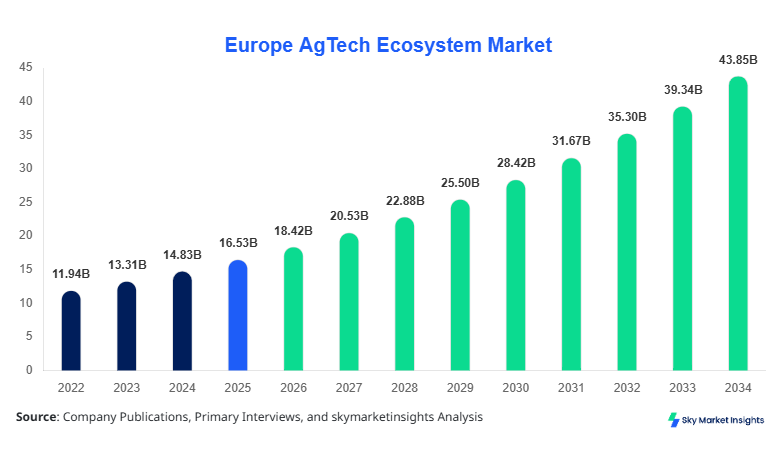
Europe AgTech Ecosystem market size is projected at USD 18.42 billion in 2026 and is expected to hit USD 43.87 billion by 2034 with a CAGR of 11.45%. The market expansion is being supported by rapid digital transformation across the European agricultural sector, increasing deployment of precision farming systems, and higher investments in agricultural automation technologies. The report evaluates extensive data regarding production capacities, deployment volumes, farm digitization rates, technology penetration, supply-chain structures, and competitive benchmarking across Europe. The analysis further highlights segmentation patterns, technology adoption levels, investment flow distribution, and competitive positioning among leading AgTech providers operating across Germany, the United Kingdom, France, Spain, Italy, and Russia.
The AgTech ecosystem refers to the integrated network of digital agriculture technologies, smart farming platforms, AI-enabled crop management systems, IoT sensors, autonomous machinery, agricultural robotics, drone analytics, farm management software, and precision irrigation systems used to optimize agricultural productivity and sustainability. Europe recorded agricultural production exceeding 292 million metric tons in 2025, with Germany, France, and Spain contributing more than 52% of regional output. Precision agriculture solutions accounted for nearly 38% of total smart farming deployments, while smart irrigation systems represented 24% of total installations. Livestock monitoring technologies contributed approximately 18% of overall deployments across Europe. Adoption rates of AI-powered analytics platforms reached 44% among large-scale farms exceeding 500 hectares, while drone-assisted crop monitoring penetration crossed 31% across commercial farms. Consumer demand for traceable food products increased by 27% between 2023 and 2025, accelerating adoption of blockchain-enabled farm tracking systems. Software platforms generated nearly 42% of total technology revenues, while hardware systems represented 46% of total market contribution. Agricultural IoT devices operating frequencies ranged between 433 MHz and 2.4 GHz, supporting real-time monitoring across more than 67 million hectares of cultivated land. Rising demand for productivity optimization and sustainable crop yield management continues to strengthen the Europe AgTech Ecosystem market.
In the Germany, the AgTech Ecosystem Market accounted for nearly 29% of the total Europe regional revenue in 2025, supported by more than 4,800 AgTech companies, technology providers, agricultural cooperatives, and digital farming startups operating across the country. Germany deployed over 1.7 million IoT-enabled agricultural sensors and approximately 42,000 agricultural drones during 2025. Precision farming applications represented nearly 41% of total technology deployments, while livestock monitoring systems contributed 22% and smart irrigation platforms accounted for 19%. More than 56% of commercial farms larger than 250 hectares integrated AI-enabled analytics platforms for yield optimization and disease prediction. Agricultural robotics adoption increased by 18% year-over-year, while autonomous tractor penetration crossed 14% in large-scale cereal production regions. Germany produced more than 44 million metric tons of cereals and grain products in 2025, creating substantial demand for predictive analytics and smart harvesting systems. Government-backed digital farming subsidies exceeded USD 1.8 billion between 2023 and 2025, supporting accelerated modernization across the agricultural value chain. Strong infrastructure investment and advanced technological integration continue to reinforce the AgTech Ecosystem Market across Germany.
Explore more data points, trends and opportunities Download Free Sample Report
AgTech Ecosystem Market Trends
Expansion of AI-driven Precision Agriculture Platforms
Artificial intelligence and machine learning integration within agricultural operations has accelerated significantly across Europe, with AI-based crop management systems witnessing adoption growth of 34% between 2023 and 2025. More than 11.4 million hectares of agricultural land across Europe were managed through AI-assisted analytics platforms during 2025. Precision farming technologies contributed nearly USD 6.9 billion in annual revenues, while satellite-guided farming equipment installations exceeded 420,000 units. Autonomous tractors and robotic harvesters recorded deployment growth of 21% year-over-year, particularly across Germany, France, and the United Kingdom. Data analytics software capable of processing over 2 terabytes of farm-level operational data per month is increasingly being implemented among commercial agricultural enterprises. Cloud-integrated farm management systems accounted for approximately 48% of software deployments, supporting real-time monitoring and predictive maintenance operations. Increasing focus on reducing fertilizer usage by nearly 18% while improving crop yields by 22% continues to strengthen the AgTech Ecosystem Market.
Rapid Adoption of Smart Irrigation and Water Optimization Technologies
Smart irrigation technologies emerged as a major technology trend across Europe due to rising concerns regarding water scarcity and sustainability compliance. More than 3.2 million smart irrigation units were operational across Europe during 2025, representing a 26% increase compared to 2023. IoT-enabled irrigation controllers reduced water consumption by approximately 31% across large-scale agricultural operations. Spain and Italy collectively contributed nearly 37% of smart irrigation system deployments owing to climate-driven water management requirements. Sensor-based irrigation systems operating through low-power wide-area networks achieved operational efficiency improvements of 24% while lowering energy consumption by 16%. Government sustainability incentives allocated over USD 2.3 billion toward water-efficient farming technologies between 2022 and 2025. Automated irrigation analytics platforms capable of monitoring soil moisture levels every 15 minutes are increasingly becoming standard across commercial vineyards and horticulture farms. Expanding water optimization requirements continue to reinforce the AgTech Ecosystem Market.
Rising Integration of Blockchain and Farm Traceability Systems
Blockchain-enabled agricultural traceability systems are gaining significant traction due to rising consumer preference for transparent food supply chains. More than 18% of European food producers integrated blockchain-enabled traceability platforms in 2025 compared to only 9% in 2022. Food retailers across Germany, France, and the United Kingdom increased procurement contracts requiring digital crop traceability by 29%. Agricultural blockchain transactions exceeded 410 million records during 2025, enabling real-time verification of crop origin, pesticide usage, and transportation conditions. Integration of QR-code-based traceability systems expanded by 33% among premium organic food suppliers. Smart contract-enabled procurement systems reduced supply-chain verification time by approximately 41%, improving operational efficiency across agricultural distribution networks. Rising digital compliance requirements and consumer awareness continue supporting the AgTech Ecosystem Market.
Europe AgTech Ecosystem Drivers
Rapid Digitization of European Agricultural Infrastructure
The rapid digitization of agricultural infrastructure across Europe is significantly accelerating adoption of advanced farming technologies. More than 62% of large-scale European farms implemented at least one digital agriculture solution in 2025, compared to 39% in 2022. Agricultural drone deployments surpassed 240,000 units across Europe, while AI-powered crop monitoring systems processed over 9.5 petabytes of agricultural data annually. Precision agriculture technologies reduced fertilizer consumption by nearly 19% and improved yield productivity by approximately 23% across commercial cereal farms. Government-led smart agriculture programs allocated over USD 5.7 billion toward agricultural modernization projects between 2022 and 2025. Germany, France, and the United Kingdom collectively represented more than 58% of total regional AgTech investments. IoT-enabled farm sensors operating on NB-IoT and LoRaWAN networks expanded coverage across nearly 67 million hectares of agricultural land. The increasing focus on productivity optimization, climate resilience, and sustainable farming practices continues to accelerate the AgTech Ecosystem Market.
Europe AgTech Ecosystem Restraints
High Initial Deployment Costs and Technology Integration Complexities
Despite strong technology adoption momentum, high capital expenditure requirements continue to restrain market penetration among small and medium-sized farms. Initial deployment costs for precision farming systems ranged between USD 18,000 and USD 125,000 depending on farm size and operational complexity. Smart irrigation systems required average installation costs exceeding USD 12,000 per hectare for advanced sensor-integrated infrastructure. More than 43% of small-scale European farmers cited financial limitations as a major barrier to adopting agricultural automation technologies. Integration complexities between legacy machinery and modern AI-based platforms increased implementation timelines by approximately 27%. Cybersecurity concerns associated with cloud-based farm management systems also increased, with agricultural cyber incidents rising by nearly 16% between 2023 and 2025. Limited digital literacy among aging farming populations across Southern and Eastern Europe further restricted technology penetration rates. Infrastructure disparities in rural broadband connectivity continue to impact real-time data transmission capabilities, creating operational inefficiencies within the AgTech Ecosystem Market.
Europe AgTech Ecosystem Opportunities
Expansion of Sustainable Farming and Carbon Reduction Initiatives
The growing emphasis on sustainable agriculture and carbon-neutral farming practices presents substantial opportunities for technology providers across Europe. European agricultural emissions reduction programs allocated nearly USD 8.4 billion toward sustainable farming innovation between 2024 and 2025. Carbon monitoring software deployments increased by 38%, while AI-powered fertilizer optimization systems reduced nitrogen emissions by approximately 21%. More than 12 million hectares of farmland across Europe entered carbon-credit-supported agricultural programs in 2025. Smart greenhouse technologies capable of reducing water usage by 34% and energy consumption by 18% are witnessing rapid commercialization across horticulture and vertical farming operations. Renewable-energy-powered agricultural robotics deployments increased by 24% year-over-year. Agricultural carbon tracking platforms generated nearly USD 790 million in annual software revenues during 2025. The increasing transition toward sustainable and regenerative agriculture continues creating long-term opportunities within the AgTech Ecosystem Market.
Europe AgTech Ecosystem Challenge
Fragmented Regulatory Standards and Data Interoperability Issues
One of the major operational challenges within the European agricultural technology sector involves fragmented regulatory standards and interoperability limitations between digital farming systems. More than 34% of agricultural enterprises reported compatibility issues between machinery software and cloud analytics platforms during 2025. Different data governance regulations across Germany, France, Italy, and Spain increased cross-border implementation complexities for multinational agricultural corporations. Data synchronization delays between IoT sensors and farm management systems impacted approximately 22% of automated farming operations. Compliance certification costs for agricultural AI systems increased by 17% between 2023 and 2025 due to evolving digital governance regulations. More than 46% of medium-sized farms faced challenges integrating satellite data, weather analytics, and machine telemetry into unified operational platforms. Limited standardization across agricultural communication protocols further increased infrastructure deployment expenses. Persistent interoperability challenges continue to affect operational scalability and implementation efficiency across the AgTech Ecosystem Market.
Report Scope
| Report Metric | Details |
|---|---|
| Market Size in 2025 | USD 16.53 Billion |
| Market Size in 2026 | USD 18.42 Billion |
| Market Size in 2034 | USD 43.87 Billion |
| CAGR | 11.45% (2026-2034) |
| Base Year for Estimation | 2025 |
| Historical Data | 2022-2024 |
| Forecast Period | 2026-2034 |
| Report Coverage | Revenue Forecast, Competitive Landscape, Supply Chain Disruption, Growth Factors, Environment & Regulatory Landscape and Trends |
Explore more data points, trends and opportunities Download Free Sample Report
AgTech Ecosystem Market Segmentation
The Europe AgTech Ecosystem market is segmented based on component and application. Hardware solutions dominated the market with nearly 46% revenue contribution during 2025 due to widespread deployment of sensors, drones, GPS-guided machinery, and robotics platforms. Software solutions represented approximately 42% share owing to increased utilization of AI-based analytics and farm management systems, while services accounted for nearly 12%. By application, precision farming contributed 41% of total deployments, smart irrigation represented 27%, and livestock monitoring accounted for 18% of total technology integration.
By Type
Hardware solutions accounted for nearly USD 8.1 billion in revenues during 2025, supported by deployment of over 3.8 million IoT agricultural sensors across Europe. Agricultural drones represented approximately 21% of total hardware demand, while autonomous tractors contributed 16%. GPS-guided machinery systems improved planting precision by nearly 28% while reducing fuel consumption by 13%. Germany and France collectively accounted for more than 49% of hardware installations across Europe. Sensor-based crop monitoring platforms achieved operating accuracy levels exceeding 94%, enabling real-time detection of soil moisture, crop disease, and nutrient deficiencies. Hardware deployment volumes exceeded 1.4 million precision farming units during 2025.
Software platforms represented one of the fastest expanding segments due to rising adoption of AI-enabled analytics, predictive crop management systems, and blockchain-based traceability platforms. More than 1.2 million farms across Europe utilized cloud-based farm management software in 2025. Predictive analytics systems improved crop yield forecasting accuracy by approximately 31%, while automated disease detection algorithms reduced crop losses by 18%. Subscription-based agricultural SaaS platforms generated nearly USD 5.9 billion in revenues. Data integration software processed over 11 petabytes of agricultural data annually.
Agricultural technology consulting, maintenance, integration, and managed services witnessed increasing demand due to rising digital transformation projects. Service revenues exceeded USD 2.1 billion during 2025, supported by more than 17,000 active agricultural technology service providers across Europe. Farm integration consulting services represented approximately 39% of service revenues, while predictive maintenance services accounted for 24%. Remote equipment monitoring services reduced machinery downtime by nearly 22%.
By Application
Precision farming remained the dominant application segment with nearly 41% market contribution during 2025. More than 26 million hectares of farmland across Europe utilized GPS-guided crop management systems and variable-rate application technologies. AI-assisted precision farming improved fertilizer efficiency by approximately 19% while increasing crop productivity by 23%. Germany and France contributed nearly 44% of total precision farming deployments. Drone-assisted imaging systems captured over 420 million agricultural images annually for predictive crop analytics and pest monitoring.
Smart irrigation systems generated approximately USD 4.7 billion in revenues during 2025. More than 3.2 million connected irrigation units were installed across Spain, Italy, and Southern France due to rising water management concerns. Automated irrigation systems reduced water consumption by approximately 31% while improving crop hydration efficiency by 26%. Soil moisture sensors capable of transmitting updates every 10 minutes significantly enhanced operational optimization across vineyards and horticulture farms.
Livestock monitoring systems accounted for approximately 18% of total application revenues. More than 14 million connected livestock tracking devices were deployed across Europe during 2025. RFID-enabled cattle monitoring systems improved disease detection rates by 21% while reducing livestock mortality by 11%. Wearable biometric sensors capable of monitoring temperature, heart rate, and movement patterns every 30 seconds became increasingly common among dairy and poultry farms.
Europe AgTech Ecosystem Market Segmentations
Component
- Hardware
- Software
- Services
Application
- Precision Farming
- Smart Irrigation
- Livestock Monitoring
Europe AgTech Ecosystem Regional Outlook
United Kingdom
The United Kingdom accounted for nearly 17% of Europe regional revenues during 2025. More than 2,600 agricultural technology startups and digital farming enterprises operated across the country. Precision farming systems covered approximately 7.4 million hectares of cultivated land. Smart greenhouse deployments increased by 23%, while livestock analytics platforms monitored over 18 million cattle and poultry assets annually. Government agricultural digitization initiatives allocated nearly USD 1.2 billion toward automation infrastructure between 2023 and 2025.
Germany
Germany remained the largest contributor within the regional landscape, representing nearly 29% of Europe market revenues. More than 1.7 million IoT-enabled sensors and 42,000 agricultural drones were operational during 2025. AI-driven crop management systems improved cereal productivity by approximately 18%. Smart irrigation platforms covered over 2.4 million hectares of agricultural land. Germany accounted for nearly 34% of all autonomous farming equipment deployments across Europe.
France
France contributed approximately 19% of total regional revenues due to extensive grain production and vineyard digitization projects. More than 9.3 million hectares utilized precision agriculture technologies during 2025. Agricultural robotics deployments increased by 24% year-over-year. France recorded more than 110,000 connected irrigation systems and 680,000 farm management software subscriptions. Government sustainability incentives exceeded USD 980 million for digital agriculture projects.
Spain
Spain emerged as a major smart irrigation market, contributing nearly 11% of regional revenues. More than 1.3 million smart irrigation controllers were operational across drought-prone agricultural regions. Automated irrigation systems reduced water consumption by approximately 34%. Precision greenhouse deployments expanded by 22%, while horticulture automation systems increased productivity by 17%. Agricultural analytics platforms processed over 620 terabytes of operational data annually.
Italy
Italy accounted for approximately 9% of Europe market revenues due to rising adoption of vineyard automation technologies and precision horticulture systems. More than 480,000 smart agricultural devices were installed during 2025. AI-enabled disease monitoring platforms reduced vineyard crop losses by nearly 16%. Automated irrigation systems covered over 1.8 million hectares of farmland. Organic agriculture traceability systems witnessed adoption growth of 29%.
Russia
Russia represented nearly 8% of regional revenues owing to increasing deployment of agricultural machinery automation across large-scale grain farms. More than 3.9 million hectares utilized satellite-guided farming systems. Agricultural drone utilization increased by 27% between 2023 and 2025. Precision seeding technologies improved operational efficiency by approximately 18%. Large-scale cereal production projects drove significant investments in predictive analytics and machinery monitoring platforms
Top players in Europe AgTech Ecosystem
- Deere & Company
- Trimble Inc.
- Bayer Crop Science
- Syngenta AG
- CNH Industrial
- AGCO Corporation
- Topcon Positioning Systems
- Raven Industries
- IBM Corporation
- SAP SE
- Bosch BASF Smart Farming
- Hexagon Agriculture
- Yara International
- Climate LLC
- DroneDeploy
Deere & Company
-
Estimated regional market share: 13.8%
-
Strong positioning in autonomous agricultural machinery and precision farming systems
-
Operates extensive smart tractor and GPS-guided equipment networks across Germany, France, and the United Kingdom
-
Invested over USD 720 million in AI-driven agricultural automation platforms between 2023 and 2025
-
Precision seeding systems improved field efficiency by approximately 21%
-
Supports more than 190,000 connected agricultural machines across Europe
Bayer Crop Science
-
Estimated regional market share: 11.6%
-
Leading provider of digital farming software and predictive crop analytics platforms
-
Operates integrated crop intelligence platforms covering more than 14 million hectares globally
-
AI-assisted disease monitoring systems reduced crop losses by approximately 18%
-
Invested heavily in blockchain-enabled traceability systems and carbon farming analytics
-
Expanded precision agriculture partnerships across Germany, France, and Italy during 2025
Investment Analysis
Investment activity across the Europe agricultural technology sector accelerated substantially between 2023 and 2025, with total AgTech investments exceeding USD 16.8 billion. Precision farming technologies attracted approximately 38% of total capital allocation, while smart irrigation systems represented 22% and agricultural robotics accounted for 17%. Germany captured nearly 31% of total regional investments, followed by France with 19% and the United Kingdom with 17%. Venture capital funding for AI-based farm analytics startups increased by 29% year-over-year during 2025.
Private equity firms and institutional investors expanded participation in agricultural automation infrastructure projects due to rising demand for sustainable food production systems. Mergers and acquisitions within the agricultural technology sector increased by approximately 24% between 2023 and 2025. Large technology providers entered strategic collaborations with agricultural cooperatives and machinery manufacturers to accelerate commercialization of autonomous farming platforms. Joint ventures focused on carbon farming analytics, blockchain traceability, and smart greenhouse technologies witnessed substantial expansion.
Cross-border technology partnerships also strengthened regional innovation capabilities. More than 140 strategic collaboration agreements were recorded across Europe during 2025. Agricultural robotics manufacturers partnered with telecommunications firms to improve rural IoT connectivity infrastructure. Climate-focused agricultural software startups attracted over USD 2.4 billion in cumulative funding during the forecast period. Growing investor focus on sustainability-driven agricultural innovation continues to create favorable investment opportunities across the Europe AgTech Ecosystem Market.
New Product Developments
Technology providers launched multiple next-generation agricultural automation products during 2025. More than 34% of newly introduced agricultural devices integrated AI-enabled predictive analytics capabilities. Autonomous robotic harvesters improved operational productivity by approximately 27%, while next-generation soil monitoring sensors increased moisture detection accuracy by 19%. Smart irrigation platforms with edge-computing integration reduced water usage by nearly 31%.
Agricultural drone manufacturers introduced high-resolution multispectral imaging systems capable of capturing crop health data across 1,200 hectares per flight cycle. Software providers launched blockchain-enabled crop traceability applications with real-time QR-code verification capabilities. AI-driven livestock monitoring wearables improved disease detection rates by approximately 22%, supporting faster veterinary intervention and reduced mortality rates.
Recent Developments in Europe's AgTech Ecosystem
- 2025: Deere & Company expanded autonomous tractor deployment operations across Germany and France, increasing connected machinery installations by nearly 18% and improving fuel efficiency by approximately 14%. The company also integrated advanced machine-learning algorithms into precision seeding systems, supporting higher agricultural productivity across cereal-producing regions.
- 2025: Bayer Crop Science introduced an AI-driven predictive crop disease analytics platform across Europe. The platform processed more than 3.2 billion agricultural data points annually and improved disease forecasting accuracy by approximately 29%, supporting enhanced yield management for commercial farming enterprises.
Research Methodology
The research methodology for the Europe AgTech Ecosystem Market involved extensive primary and secondary research processes to ensure accurate market estimation and forecasting. Primary research included interviews with agricultural technology providers, farm operators, distributors, software developers, irrigation system manufacturers, government agencies, and agricultural cooperatives across Germany, France, the United Kingdom, Spain, Italy, and Russia. More than 120 industry participants contributed operational data related to deployment volumes, pricing structures, adoption trends, production capacities, and investment activities.
Secondary research involved analysis of annual reports, government agricultural statistics, trade databases, regulatory publications, company financial disclosures, sustainability reports, investor presentations, and technology whitepapers. Market size estimation utilized both top-down and bottom-up analytical models, incorporating revenue benchmarking, production volume analysis, installed base evaluation, and penetration rate calculations. Forecasting models integrated macroeconomic indicators, agricultural production trends, sustainability regulations, digital transformation investments, and technological innovation cycles. Quantitative validation was conducted through triangulation methods to ensure statistical reliability and forecasting consistency across all regional and segment-level analyses.
Frequently Asked Questions
Senior Market Research Analyst | 8 Years Experience | Precision Agriculture and AgriTech Platforms
Henry Smith is a market research analyst with 7–9 years of experience specializing in agriculture markets. Contributed to 70+ research reports for global clients. Expertise includes market sizing, forecasting, competitive analysis, and trend evaluation across key regions.