Europe Agrochemicals Market Size
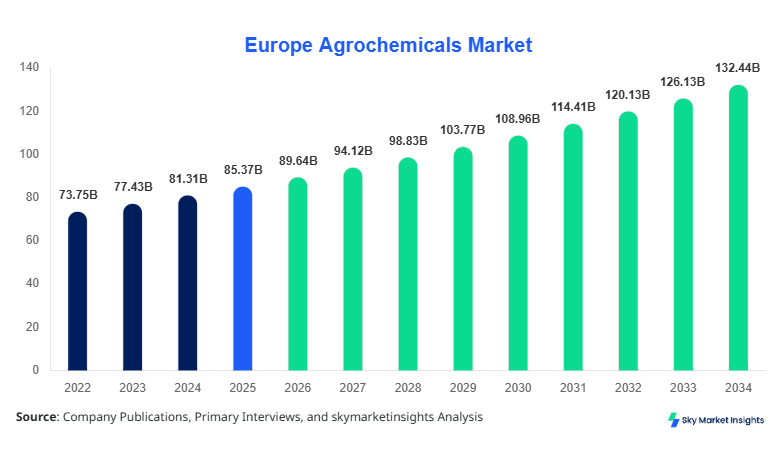
Europe's agrochemical market size is projected at USD 89.64 billion in 2026 and is expected to hit USD 132.48 billion by 2034 with a CAGR of 5.0%. The regional industry recorded a market valuation of USD 84.12 billion in 2025, while historical revenues stood at USD 77.45 billion in 2022, USD 79.91 billion in 2023, and USD 81.86 billion in 2024. Increasing demand for precision farming, higher agricultural productivity targets, and rising adoption of biological crop protection solutions are accelerating regional expansion. The report evaluates production volumes exceeding 178 million metric tons of agrochemical formulations annually across Europe and provides extensive segmentation analysis, competitive benchmarking, pricing trends, consumption analysis, and trade flow assessment across major European economies.
The agrochemicals sector includes fertilizers, pesticides, herbicides, fungicides, insecticides, and biological crop protection products used to improve agricultural productivity and crop resistance. Europe accounts for nearly 19.4% of global agrochemical consumption, with more than 165 million hectares of cultivated agricultural land requiring intensive crop nutrition and pest management solutions. Fertilizers contribute approximately 56% of total regional revenues, and pesticides account for 31%, while bio-based agrochemicals represent nearly 13% owing to increasing sustainable farming initiatives. Europe produced more than 62 million metric tons of nitrogen fertilizers and 18 million metric tons of phosphate-based products during 2025. Adoption of precision agriculture technologies surpassed 41% among large-scale farms in Germany, France, and the United Kingdom, while controlled-release fertilizer penetration crossed 28% across Western Europe. Consumer demand for residue-free produce increased by 34% between 2022 and 2025, driving adoption of biological crop protection products across fruit and vegetable cultivation. Cereal and grain applications account for 44% of agrochemical consumption, fruits and vegetables contribute 33%, and oilseeds and pulses represent 23%. Increasing mechanization rates, digital agriculture integration, and regulatory focus on sustainable farming continue strengthening the European agrochemicals market.
In France, the agrochemicals market represents the largest revenue contributor in Europe, accounting for nearly 24% of total regional demand during 2025. The country operates more than 780 agrochemical manufacturing and formulation facilities, while over 2,100 agricultural cooperatives distribute crop protection products across farming communities. France cultivated nearly 27 million hectares of agricultural land in 2025, including 9.2 million hectares dedicated to cereals and grains. Fertilizers contribute around 52% of national agrochemical revenues, fungicides account for 21%, herbicides represent 16%, and biological products contribute nearly 11%. Precision farming adoption exceeded 46% among commercial farms, while drone-assisted pesticide spraying increased by 31% year-over-year. More than 58% of vineyards and horticulture farms integrated bio-based crop protection solutions to comply with European sustainability standards. France exported agrochemical products worth USD 9.8 billion during 2025 and imported nearly 14.6 million metric tons of fertilizer products to support domestic production requirements. Increasing smart irrigation integration, AI-based soil monitoring systems, and nutrient optimization platforms continue reinforcing the agrochemicals market.
Explore more data points, trends and opportunities Download Free Sample Report
Agrochemicals Market Trends
Expansion of Bio-based Crop Protection Solutions
Europe witnessed a substantial shift toward biological agrochemical formulations, with bio-based pesticide production increasing from 4.8 million metric tons in 2022 to 7.1 million metric tons in 2025. Biological products now account for nearly 13% of regional agrochemical revenues, while adoption among fruit and vegetable growers surpassed 38%. Germany, France, and Italy collectively represent 61% of bio-pesticide consumption within Europe. More than 42% of greenhouse cultivation facilities integrated microbial fungicides and plant growth regulators to reduce chemical residue levels. The European Union allocated over USD 3.2 billion toward sustainable agriculture and biological input innovation programs between 2023 and 2025. Controlled-release fertilizers enhanced nutrient efficiency by 18% to 24%, reducing fertilizer wastage across large-scale cereal cultivation. Digital nutrient mapping technologies achieved penetration rates exceeding 36% among high-value crop producers. Increasing emphasis on sustainable farming practices and residue-free agricultural output continues shaping the agrochemicals market.
Adoption of Precision Agriculture and Smart Application Systems
Precision agriculture technologies significantly transformed agrochemical application methods across Europe. More than 47% of commercial farms adopted GPS-enabled fertilizer spreaders, drone-assisted pesticide spraying systems, and AI-driven crop monitoring tools during 2025. Europe recorded deployment of over 126,000 agricultural drones used specifically for agrochemical spraying and crop surveillance. Variable-rate fertilizer application systems reduced chemical usage by nearly 21% while improving crop yields by 14% to 19% across cereal farms in Germany and France. Sensor-based irrigation and nutrient monitoring systems achieved 32% penetration across Spain and Italy, especially in horticulture and greenhouse farming operations. The integration of satellite imagery and predictive analytics reduced pest infestation losses by approximately 17% across vineyards and fruit plantations. Increasing digitalization, automation, and smart farming infrastructure investment continue advancing the agrochemicals market.
Increasing Demand for Specialty Fertilizers
Specialty fertilizers, including micronutrients, water-soluble fertilizers, and controlled-release formulations, experienced rapid demand expansion across Europe. Specialty fertilizer revenues exceeded USD 18.6 billion during 2025 and are projected to expand steadily due to higher efficiency and environmental compliance advantages. Water-soluble fertilizer consumption increased by 29% between 2022 and 2025, particularly in greenhouse vegetable production and precision irrigation systems. Spain and Italy collectively account for 43% of specialty fertilizer demand because of extensive horticulture cultivation. More than 35% of commercial farms implemented fertigation systems capable of reducing water usage by 16% and nutrient loss by 22%. Advanced nutrient-coated fertilizer technologies improved nitrogen utilization efficiency above 78%, compared with conventional fertilizers averaging 54% efficiency rates. Rising investment in sustainable nutrient management solutions continues supporting the agrochemicals market.
Europe Agrochemicals Market Drivers
Rising Agricultural Productivity Requirements and Precision Farming Expansion
Europe’s agricultural sector faces increasing pressure to improve productivity amid declining arable land availability and rising food demand. Regional cereal production surpassed 286 million metric tons in 2025, while population-driven food demand increased by approximately 2.7% annually. More than 165 million hectares of farmland require consistent nutrient management and crop protection solutions to maintain yield stability. Precision farming technologies reduced fertilizer waste by 18% and increased crop output by nearly 14% across commercial farming operations in Germany, France, and the United Kingdom. Government subsidies supporting digital agriculture and sustainable crop protection exceeded USD 5.6 billion between 2023 and 2025. Farmers adopting integrated pest management solutions reported pesticide efficiency improvements of 21% and crop loss reductions of 16%. Fertilizer consumption in Europe reached nearly 82 million metric tons during 2025, driven by higher demand for nitrogen and phosphate formulations. Increasing mechanization, smart irrigation adoption, and biological crop protection integration continue strengthening the agrochemicals market.
Europe Agrochemicals Market Restraints
Strict Environmental Regulations and Chemical Usage Restrictions
Stringent European environmental policies remain a significant barrier for agrochemical manufacturers operating across the region. The European Union restricted or phased out more than 140 active chemical ingredients between 2020 and 2025 due to environmental and health concerns. Regulatory compliance costs increased by approximately 19% for agrochemical manufacturers, while product approval timelines extended beyond 4.5 years on average. Nearly 28% of pesticide formulations currently face partial usage restrictions across several European countries. Farmers reduced synthetic pesticide usage by 13% between 2022 and 2025 to comply with sustainability directives and residue standards. Additionally, rising carbon taxation and energy prices increased fertilizer manufacturing costs by nearly 22%, especially for nitrogen-based products requiring energy-intensive ammonia production. Small-scale manufacturers experienced profitability declines of approximately 11% due to compliance investments and research expenditures. Growing regulatory scrutiny and sustainability mandates continue challenging the agrochemicals market.
Europe Agrochemicals Market Opportunities
Rapid Expansion of Biological Inputs and Smart Farming Technologies
The growing preference for sustainable agriculture creates substantial opportunities for biological agrochemical manufacturers and precision farming technology providers. Europe’s bio-based agrochemical sector attracted investments exceeding USD 4.1 billion during 2025, while biological pesticide consumption expanded by 26% annually. More than 48% of consumers across Western Europe prefer organically cultivated produce, encouraging farmers to adopt eco-friendly crop protection products. Smart farming infrastructure investments surpassed USD 7.3 billion during 2025, including AI-enabled nutrient optimization systems, autonomous spraying technologies, and satellite crop monitoring platforms. Controlled-release fertilizers demonstrated nutrient efficiency improvements above 24%, reducing environmental runoff and improving compliance with sustainability targets. Drone-based spraying systems lowered labor costs by 17% while improving pesticide application precision by 31%. Increasing partnerships between agrochemical firms and agri-tech startups are accelerating innovation in microbial pesticides, nano-fertilizers, and digital crop management platforms, creating long-term expansion potential for the agrochemicals market.
Challenges in European Agrochemicals Market
Volatile Raw Material Costs and Supply Chain Disruptions
The European agrochemical industry continues facing challenges related to fluctuating raw material costs and supply chain instability. Natural gas prices, a critical component in nitrogen fertilizer production, increased by nearly 37% between 2022 and 2025, significantly affecting manufacturing economics. Europe imported approximately 42% of its potash and phosphate requirements from external suppliers, exposing the market to geopolitical disruptions and logistics constraints. Transportation expenses for bulk agrochemical products rose by 16% during 2025 because of fuel cost escalation and freight shortages. Nearly 23% of manufacturers reported production delays caused by shortages of active ingredients and packaging materials. Smaller agricultural distributors experienced inventory shortages averaging 14% during seasonal demand peaks. Climatic variability and drought conditions in Southern Europe additionally disrupted fertilizer demand forecasting and crop planning cycles. Persistent cost pressures and supply chain disruptions continue influencing operational stability across the agrochemicals market.
Report Scope
| Report Metric | Details |
|---|---|
| Market Size in 2025 | USD 84.12 Billion |
| Market Size in 2026 | USD 89.64 Billion |
| Market Size in 2034 | USD 132.48 Billion |
| CAGR | 5.0% (2026-2034) |
| Base Year for Estimation | 2025 |
| Historical Data | 2022-2024 |
| Forecast Period | 2026-2034 |
| Report Coverage | Revenue Forecast, Competitive Landscape, Supply Chain Disruption, Growth Factors, Environment & Regulatory Landscape and Trends |
Explore more data points, trends and opportunities Download Free Sample Report
Agrochemicals Market Segmentation
The European agrochemicals industry is segmented based on product type and crop type. Fertilizers dominate the market with nearly 56% revenue contribution, while cereals and grains remain the leading crop application segment with 44% consumption share. Increasing adoption of specialty nutrients, precision farming technologies, and biological crop protection products is diversifying demand patterns across major agricultural economies.
By Type
Fertilizers represent the largest product category, accounting for approximately 56% of total European agrochemical revenues during 2025. Nitrogen fertilizers contribute nearly 61% of fertilizer demand, phosphate fertilizers account for 24%, and potash products represent 15%. Europe produced more than 62 million metric tons of nitrogen fertilizers and consumed nearly 82 million metric tons of total fertilizer products during 2025. Controlled-release fertilizers improved nutrient utilization efficiency by 22%, while water-soluble formulations recorded adoption growth exceeding 29% among greenhouse and horticulture farms. Germany, France, and Russia collectively account for more than 58% of fertilizer production capacity in Europe. Precision fertigation systems reduced fertilizer wastage by approximately 17%, particularly in high-value crops. Micronutrient fertilizers gained popularity due to soil depletion concerns, with zinc and boron formulations expanding by 18% annually. Increasing investment in sustainable nutrient management and enhanced-efficiency fertilizer technologies continues driving product adoption across the agrochemical sector.
Pesticides contribute approximately 31% of regional agrochemical revenues and remain critical for crop protection across cereals, fruits, and oilseed cultivation. Herbicides account for nearly 39% of pesticide demand, fungicides contribute 34%, and insecticides represent 27%. Europe consumed over 3.8 million metric tons of pesticide formulations during 2025, with France, Spain, and Italy representing the highest fungicide utilization due to vineyard and horticulture cultivation. AI-assisted spraying technologies reduced pesticide overuse by nearly 18%, while drone-assisted application improved operational efficiency by 24%. Biological pesticide penetration exceeded 19% within greenhouse vegetable production. Increasing resistance management programs encouraged adoption of integrated pest management systems across more than 41% of commercial farms. Smart sprayers with sensor-controlled application mechanisms achieved penetration rates above 28% among large-scale agricultural operations. Regulatory pressure supporting sustainable crop protection continues influencing innovation within pesticide development.
Bio-based agrochemicals account for nearly 13% of Europe’s agrochemical revenues and are experiencing accelerated adoption because of sustainability initiatives and organic farming expansion. Europe produced over 7.1 million metric tons of biological formulations during 2025, including microbial pesticides, biofertilizers, and plant growth stimulants. Organic farming land exceeded 18 million hectares across Europe, creating substantial demand for eco-friendly crop inputs. Biological fungicides improved disease resistance efficiency by approximately 16% while reducing chemical residues by nearly 31%. France, Germany, and Italy collectively contribute over 63% of biological product consumption within Europe. Microbial biofertilizers enhanced soil nutrient absorption efficiency by 21%, especially in horticulture and greenhouse farming systems. Investments in biological R&D increased by 27% between 2022 and 2025 as manufacturers focused on sustainable product innovation. Rising consumer demand for organic produce and regulatory encouragement continue strengthening bio-based product penetration.
By Application
Cereals and grains constitute the largest application segment, accounting for approximately 44% of total agrochemical demand across Europe. Wheat, barley, maize, and rye cultivation collectively cover more than 72 million hectares of farmland. Fertilizer application rates average 148 kilograms per hectare in cereal production, while fungicide usage increased by 12% due to rising fungal disease prevalence. France, Germany, and Russia contribute nearly 64% of cereal agrochemical consumption in Europe. Precision nutrient management technologies improved cereal crop yields by 14% to 18%, while variable-rate fertilizer systems reduced nutrient waste by 19%. Herbicide penetration exceeds 81% across commercial cereal farms because of extensive weed management requirements. Biological seed treatment adoption crossed 22% in cereal cultivation during 2025. Increasing demand for food security, livestock feed production, and export-oriented grain farming continues driving agrochemical consumption within cereal and grain applications.
Fruits and vegetables represent nearly 33% of agrochemical demand, supported by high-value horticulture cultivation and greenhouse farming expansion. Europe cultivated over 14 million hectares of fruits and vegetables during 2025, while greenhouse farming capacity exceeded 230,000 hectares. Fungicides account for nearly 41% of agrochemical usage within horticulture because of disease-sensitive crop environments. Spain and Italy collectively contribute more than 48% of fruits and vegetables' agrochemical consumption due to intensive greenhouse cultivation and export-oriented production. Water-soluble fertilizers improved nutrient absorption rates by 26%, while biological pesticides achieved penetration rates exceeding 38% in vegetable farming. Controlled-environment agriculture systems integrated automated nutrient delivery technologies capable of reducing fertilizer waste by 21%. Consumer preference for residue-free produce encouraged increased adoption of biological fungicides and microbial pesticides. Expanding greenhouse infrastructure and export demand continue supporting agrochemical consumption within horticulture applications.
Oilseeds and pulses account for approximately 23% of Europe’s agrochemical demand, primarily driven by rapeseed, sunflower, soybean, and pulse cultivation. Europe cultivated nearly 22 million hectares of oilseed and pulse crops during 2025, requiring substantial herbicide and nutrient management inputs. Herbicides contribute approximately 43% of agrochemical usage within oilseed farming because of weed-sensitive crop conditions. Russia and France collectively represent nearly 51% of oilseed agrochemical consumption in Europe. Advanced nutrient-coated fertilizers improved oilseed productivity by 15%, while biological seed treatments reduced fungal disease incidence by 18%. Precision irrigation systems integrated with nutrient monitoring sensors achieved penetration rates exceeding 24% across commercial oilseed farms. Increasing biodiesel production and protein-rich food demand accelerated cultivation expansion across sunflower and soybean crops. Rising adoption of sustainable crop rotation practices continues driving innovation in specialized agrochemical formulations for oilseed and pulse farming.
Europe Agrochemicals Market Segmentations
Product Type
- Fertilizers
- Pesticides
- Bio-based Agrochemicals
Crop Type
- Cereals & Grains
- Fruits & Vegetables
- Oilseeds & Pulses
Europe Agrochemicals Market Regional Outlook
United Kingdom
The United Kingdom accounts for nearly 12% of Europe’s agrochemical revenues, supported by extensive cereal cultivation and advanced precision agriculture adoption. The country cultivated approximately 17.4 million hectares of farmland during 2025, with cereals contributing nearly 58% of agricultural output. Fertilizer consumption exceeded 4.9 million metric tons, while biological pesticide adoption increased by 23% year-over-year. More than 44% of commercial farms implemented precision spraying technologies and GPS-guided fertilizer systems. Greenhouse horticulture expansion increased demand for specialty fertilizers and water-soluble nutrient products. Government sustainability initiatives allocated nearly USD 780 million toward low-carbon agriculture and digital farming innovation. The United Kingdom continues expanding advanced agricultural automation systems and sustainable crop protection technologies.
Germany
Germany contributes approximately 18% of Europe’s agrochemical revenues and operates one of the region’s largest fertilizer production infrastructures. The country produced over 11 million metric tons of fertilizers during 2025 and maintained more than 14 million hectares of cultivated farmland. Precision agriculture penetration exceeded 52% among commercial farms, while smart irrigation systems expanded by 19%. Germany recorded pesticide consumption exceeding 620,000 metric tons annually, with fungicides representing 36% of demand due to high-value crop cultivation. Biological crop protection adoption crossed 27% across greenhouse farming operations. Investments in AI-based nutrient monitoring and autonomous spraying technologies surpassed USD 1.1 billion during 2025, strengthening Germany’s leadership in sustainable agricultural innovation.
France
France remains the dominant regional contributor, accounting for approximately 24% of Europe’s agrochemical revenues and cultivating over 27 million hectares of agricultural land. Fertilizer consumption surpassed 14 million metric tons during 2025, while pesticide demand exceeded 780,000 metric tons. More than 46% of commercial farms adopted precision farming technologies, including drone-assisted spraying and satellite-guided nutrient management systems. France leads European vineyard cultivation, increasing fungicide demand across wine-producing regions. Biological pesticide adoption expanded by 31% across horticulture and greenhouse farming operations. Strong export-oriented agriculture and government support for sustainable farming continue supporting large-scale agrochemical consumption.
Spain
Spain contributes nearly 14% of Europe’s agrochemical revenues and maintains one of the largest greenhouse farming sectors in the region. The country cultivated approximately 16 million hectares during 2025, including over 75,000 hectares of greenhouse infrastructure. Water-soluble fertilizer consumption increased by 28%, while fertigation system penetration exceeded 37% across horticulture farms. Spain accounts for nearly 22% of Europe’s biological pesticide demand because of export-focused fruit and vegetable cultivation. Smart irrigation systems reduced water consumption by approximately 18% across greenhouse operations. Rising climate variability and drought conditions increased demand for advanced nutrient optimization technologies and controlled-release fertilizers.
Italy
Italy accounts for nearly 11% of Europe’s agrochemical revenues, supported by extensive fruit, vegetable, and vineyard cultivation. The country consumed approximately 5.6 million metric tons of fertilizers during 2025 and expanded greenhouse farming infrastructure by 14% between 2022 and 2025. Biological crop protection products achieved penetration rates exceeding 34% across horticulture farms due to strict residue standards for export-oriented produce. Fungicides contribute nearly 39% of pesticide demand within Italian agriculture. Precision irrigation technologies reduced nutrient wastage by 17%, while AI-based disease monitoring systems improved crop productivity across vineyards and greenhouse farming operations.
Russia
Russia contributes approximately 16% of Europe’s agrochemical revenues and maintains significant fertilizer manufacturing capacity. The country produced more than 18 million metric tons of nitrogen fertilizers during 2025 and cultivated over 79 million hectares of agricultural land. Herbicides account for nearly 46% of pesticide demand due to large-scale cereal and oilseed farming. Precision farming adoption increased by 21% between 2022 and 2025, while satellite-guided nutrient application systems expanded rapidly across commercial grain production. Russia remains one of Europe’s leading exporters of fertilizer products, supporting regional supply chains and agricultural productivity.
Top players in European agrochemicals
- BASF SE
- Bayer AG
- Syngenta AG
- Yara International ASA
- Nutrien Ltd.
- CF Industries Holdings Inc.
- UPL Limited
- Corteva Agriscience
- K+S Aktiengesellschaft
- EuroChem Group
- Nufarm Limited
- FMC Corporation
- ICL Group Ltd.
- Adama Agricultural Solutions Ltd.
- OCI N.V.
BASF SE
-
BASF SE accounts for approximately 14% of Europe’s agrochemical revenues and maintains strong positioning across fungicides, specialty fertilizers, and biological crop protection products.
-
The company operates more than 40 production and formulation facilities across Europe and invests nearly 8% of annual agrochemical revenues into research and development.
-
BASF’s digital farming platform supports over 6 million hectares of cultivated farmland globally, improving nutrient optimization and pest management efficiency by nearly 20%.
-
The company expanded biological product portfolios by 27% between 2022 and 2025 to address growing demand for sustainable agriculture solutions.
Bayer AG
-
Bayer AG represents approximately 12% of Europe’s agrochemical revenues and maintains leadership in crop protection chemicals, seed technologies, and precision farming platforms.
-
The company’s integrated digital agriculture ecosystem supports more than 180,000 European farms with AI-based crop monitoring and predictive analytics solutions.
-
Bayer increased investments in biological pesticides and microbial seed treatment technologies by 31% during 2025.
-
The company’s precision spraying technologies improved pesticide efficiency by approximately 18%, reducing environmental impact while enhancing crop productivity across commercial farming operations.
Investment Analysis
Europe’s agrochemical sector attracted investments exceeding USD 18.7 billion between 2023 and 2025, driven by sustainability initiatives, biological product development, and precision farming infrastructure expansion. Fertilizer manufacturing projects accounted for nearly 39% of total investments, while biological crop protection and specialty nutrients represented approximately 28%. Precision agriculture technologies, including AI-enabled nutrient management systems and drone-assisted spraying platforms, captured nearly 21% of total capital allocation. Germany, France, and Spain collectively attracted over 58% of regional agrochemical investments because of advanced farming infrastructure and strong agricultural productivity targets.
Mergers, acquisitions, and strategic collaborations increased significantly across the European agrochemical industry. More than 42 strategic agreements were announced during 2025, including partnerships between biological product developers and precision farming technology providers. Cross-border acquisitions involving specialty fertilizer manufacturers exceeded USD 4.3 billion in transaction value. Agrochemical firms expanded collaboration with agri-tech startups focused on AI crop analytics, autonomous spraying systems, and microbial crop protection solutions. Joint ventures supporting biofertilizer manufacturing increased by 24% between 2022 and 2025. Public-private partnerships also accelerated investment in sustainable farming initiatives and carbon-neutral fertilizer production technologies. Increasing institutional funding for climate-resilient agriculture continues creating favorable investment opportunities across Europe.
New Product Developments
Manufacturers across Europe introduced more than 340 new agrochemical formulations during 2025, including controlled-release fertilizers, microbial fungicides, and nano-nutrient solutions. Biological product launches represented nearly 37% of all new product introductions due to growing demand for sustainable agriculture inputs. Advanced fertilizer coatings improved nutrient release efficiency by approximately 24%, while AI-compatible smart spraying systems reduced pesticide drift by nearly 19%. Water-soluble nutrient formulations designed for greenhouse cultivation achieved adoption growth exceeding 21%.
Innovation activities also focused on climate-resilient agriculture and precision farming compatibility. Companies developed sensor-integrated nutrient systems capable of reducing fertilizer wastage by 18% and improving yield consistency across drought-prone regions. Nano-formulation pesticides demonstrated absorption efficiency improvements above 16% compared with traditional chemical products. Increasing R&D expenditure and government sustainability incentives continue accelerating product innovation across Europe’s agrochemical sector.
Recent Developments in Europe Agrochemicals
- 2025: BASF SE expanded its biological crop protection production capacity in Germany by 22%, increasing annual microbial fungicide output above 180,000 metric tons. The project involved investments exceeding USD 420 million and supported demand from greenhouse horticulture and organic farming sectors. The expansion improved regional supply chain efficiency and reduced product delivery timelines by approximately 14%.
- 2025: Bayer AG introduced AI-enabled precision spraying systems across France and Spain, improving pesticide application efficiency by 19% while reducing chemical wastage by nearly 17%. The platform integrated drone-assisted crop monitoring and predictive pest analytics across more than 1.8 million hectares of farmland, supporting sustainable farming initiatives and higher agricultural productivity.
Research Methodology
The European agrochemicals industry report was developed using a combination of primary and secondary research methodologies.
Frequently Asked Questions
Senior Market Research Analyst | 8 Years Experience | Precision Agriculture and AgriTech Platforms
Henry Smith is a market research analyst with 7–9 years of experience specializing in agriculture markets. Contributed to 70+ research reports for global clients. Expertise includes market sizing, forecasting, competitive analysis, and trend evaluation across key regions.