Asia Pacific Aloe Vera Market Size
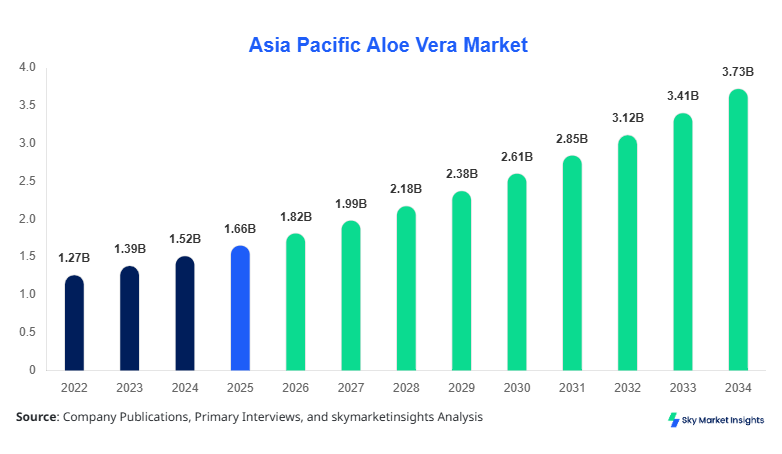
The Asia Pacific Aloe Vera market size is projected at USD 1.82 billion in 2026 and is expected to hit USD 3.74 billion by 2034 with a CAGR of 9.4%. The market expansion is driven by increasing industrial utilization, rising export volumes exceeding 1.6 million tons annually, and growing demand across personal care and nutraceutical sectors. The need for detailed data analytics, segment-based insights, and competitive benchmarking has intensified as over 450+ manufacturers operate regionally, accounting for nearly 38% of global aloe processing capacity.
The aloe vera market encompasses the cultivation, processing, and commercialization of aloe-based extracts, including gel, powder, and liquid concentrates used across multiple industries. In the Asia Pacific, annual production exceeded 2.3 million metric tons in 2025, with China contributing over 41% and India 26%. Adoption rates in cosmetics and personal care reached 72% penetration among natural ingredient-based formulations, while food and beverage applications accounted for 28% of total usage volume. Consumer behavior reflects a shift toward plant-based and organic ingredients, with 63% of urban consumers preferring aloe-based skincare and 48% incorporating aloe beverages into weekly consumption. Technically, aloe gel extraction efficiency has improved by 18–22% through cold-processing technologies, enhancing nutrient retention by up to 35%. Application-wise, cosmetics hold 44% share, pharmaceuticals 22%, and food & beverages 34%. These metrics collectively reinforce strong aloe vera market dynamics across the region.
In China, the Aloe Vera Market dominates the regional landscape with over 920 processing facilities and more than 1,200 registered aloe product companies, accounting for approximately 41% of Asia Pacific production. The country produces over 950,000 metric tons annually, with gel extracts contributing 52%, powder extracts 27%, and liquid concentrates 21%. Application distribution shows cosmetics and personal care at 48%, food and beverages at 31%, and pharmaceuticals at 21%. Technology adoption in China has reached advanced levels, with over 65% of manufacturers utilizing automated extraction systems and 38% implementing AI-based quality control. Export volumes exceeded USD 620 million in 2025, with strong demand from Japan, South Korea, and Southeast Asia. These factors highlight the robust positioning of the aloe vera market.
Explore more data points, trends and opportunities Download Free Sample Report
Aloe Vera Market Trends
The Asia Pacific aloe vera market is witnessing rapid technological advancements, with production volumes crossing 2.3 million tons in 2025 and expected to reach 3.1 million tons by 2030. One major trend is the increasing adoption of organic farming practices, with over 36% of aloe cultivation now certified organic, up from 21% in 2022. Automation in extraction has improved processing efficiency by 18%, while advanced filtration technologies have enhanced purity levels by 27%. Demand for cosmetics has surged due to anti-aging and hydration properties, contributing nearly USD 800 million in revenue. The trend toward multifunctional ingredients has increased aloe inclusion rates in formulations by 22%, reinforcing aloe vera market insights.
Another significant trend involves the expansion of aloe-based beverages, particularly in Japan and South Korea, where consumption volumes have risen by 14% annually. Over 1.2 billion units of aloe drinks were sold in 2025 across the Asia Pacific. Functional beverages with added vitamins and probiotics have driven 19% higher consumer adoption. Additionally, pharmaceutical-grade aloe extracts have seen a 12% increase in demand due to their application in wound healing and digestive treatments. Sustainability initiatives have also gained traction, with 29% of companies adopting water-efficient cultivation systems, reducing resource usage by 17%. These evolving trends underscore dynamic aloe vera market insights.
Asia Pacific Aloe Vera Market Drivers
Rising Demand for Natural and Organic Ingredients Across Industries
The primary driver of the Asia Pacific aloe vera market is the increasing demand for natural and organic ingredients, with over 68% of consumers preferring plant-based products. Cosmetics and personal care industries account for 44% of aloe consumption, driven by rising awareness of chemical-free formulations. Production volumes have increased by 11% annually since 2022, reaching over 2.3 million tons in 2025. Additionally, the pharmaceutical sector has experienced a 15% rise in aloe-based product adoption, particularly in dermatology and gastrointestinal treatments. Food and beverage applications have expanded by 13%, supported by growing health-conscious consumer bases. Export demand has surged by 18%, particularly from developed markets. These factors collectively drive aloe vera market growth.
Asia Pacific Aloe Vera Market Restraints
High Processing Costs and Supply Chain Constraints
Despite strong growth, the aloe vera market faces restraints due to high processing costs and supply chain inefficiencies. Extraction and stabilization processes can increase production costs by 22–28%, particularly for high-purity gel products. Additionally, fluctuating raw material supply due to climate variability affects nearly 19% of cultivation areas annually. Transportation and storage costs contribute up to 14% of total expenses, especially for liquid concentrates requiring temperature control. Small-scale farmers, who account for 46% of production, often lack access to advanced processing technologies, limiting output quality. These challenges hinder consistent supply and profitability, impacting the aloe vera market growth.
Asia Pacific Aloe Vera Market Opportunities
Expansion in Functional Foods and Nutraceuticals
The growing nutraceutical industry presents significant opportunities for the aloe vera market, with functional food segments expected to expand by over 21% in the next five years. Aloe-based supplements have seen a 17% increase in demand due to their digestive and immune-boosting properties. Investment in R&D has risen by 13%, leading to the development of innovative formulations such as aloe capsules and fortified beverages. Emerging markets like India and Southeast Asia are witnessing consumption growth of 15–18%, supported by rising disposable incomes. These opportunities enhance aloe vera market growth potential.
Challenges in the Asia-Pacific Aloe Vera Market
Quality Standardization and Regulatory Compliance Issues
One of the major challenges in the aloe vera market is maintaining consistent quality standards and meeting regulatory requirements. Approximately 24% of aloe products fail to meet international quality benchmarks due to contamination or improper processing. Regulatory compliance costs have increased by 16% over the past three years, particularly for export-oriented companies. Additionally, varying standards across countries create complexities for manufacturers, affecting nearly 31% of exporters. Limited testing infrastructure in developing regions further exacerbates the issue, posing challenges for aloe vera market growth.
Report Scope
| Report Metric | Details |
|---|---|
| Market Size in 2025 | USD 1.66 Billion |
| Market Size in 2026 | USD 1.82 Billion |
| Market Size in 2034 | USD 3.74 Billion |
| CAGR | 9.4% (2026-2034) |
| Base Year for Estimation | 2025 |
| Historical Data | 2022-2024 |
| Forecast Period | 2026-2034 |
| Report Coverage | Revenue Forecast, Competitive Landscape, Supply Chain Disruption, Growth Factors, Environment & Regulatory Landscape and Trends |
Explore more data points, trends and opportunities Download Free Sample Report
Aloe Vera Market Segmentation
The Aloe Vera market is segmented by product type and application, with gel extracts dominating at a 52% share, followed by powder extracts at 27% and liquid concentrates at 21%. By application, cosmetics and personal care lead with 44%, followed by food and beverages at 34% and pharmaceuticals at 22%.
BY TYPE
Gel extracts account for the largest share at 52%, with production exceeding 1.2 million tons annually. These extracts are widely used in cosmetics due to their high polysaccharide content and hydration properties. Processing involves cold extraction techniques maintaining over 95% nutrient retention, making them highly preferred in skincare formulations. Gel extracts are utilized in over 68% of aloe-based products, contributing significantly to the aloe vera market.
Powder extracts hold a 27% share, with production reaching approximately 620,000 tons. These are produced through spray-drying processes that reduce moisture content to below 5%, enhancing shelf life by 40%. Powder extracts are extensively used in pharmaceuticals and nutraceuticals, accounting for 33% of medicinal aloe applications. Their compact form reduces transportation costs by 18%, supporting aloe vera market expansion.
Liquid concentrates represent 21% of the market, with production volumes around 480,000 tons. These concentrates are primarily used in beverages and industrial applications, offering high solubility and ease of formulation. Advanced filtration techniques improve purity levels by 25%, making them suitable for functional drinks. These factors contribute to aloe vera market share distribution.
BY APPLICATION
Food & beverages account for 34% of usage, with over 780,000 tons consumed annually. Aloe drinks have seen 14% growth in consumption, driven by health-conscious consumers. The sector utilizes aloe for hydration and digestive benefits, with 48% penetration in urban markets. Production of aloe beverages exceeds 1.2 billion units annually, supporting aloe vera market growth.
Cosmetics & Personal Care dominate with a 44% share, utilizing over 1 million tons annually. Aloe is used in creams, lotions, and gels due to its moisturizing and anti-inflammatory properties. Over 72% of natural skincare products include aloe as a key ingredient. Technological advancements have improved absorption rates by 19%, enhancing product performance. This segment significantly drives Aloe Vera market share.
Pharmaceuticals hold 22% share, with usage exceeding 500,000 tons annually. Aloe is widely used in dermatological treatments and digestive medicines, with 15% annual growth in adoption. Clinical studies show 28% improvement in wound healing efficiency with aloe-based formulations. These factors strengthen aloe vera market demand.
Asia Pacific Aloe Vera Market Segmentations
Product Type
- Gel Extracts
- Powder Extracts
- Liquid Concentrates
Application
- Food & Beverages
- Cosmetics & Personal Care
- Pharmaceuticals
Asia Pacific Aloe Vera Market Regional Outlook
China leads with 41% share, producing over 950,000 tons annually. The country has over 920 processing units and contributes significantly to exports. The cosmetics sector accounts for 48% of usage, followed by food and beverages at 31%. Advanced technologies have improved processing efficiency by 18%.
India holds 26% share, producing over 600,000 tons annually. The country has over 700 cultivation farms and 350 processing units. Food and beverage applications dominate with 38%, followed by cosmetics at 42%. Export growth has reached 16% annually.
Japan and South Korea collectively account for 14% share, with high demand for aloe-based beverages and skincare products. Consumption volumes exceed 320,000 tons annually, with 65% usage in personal care.
Australia, Singapore, Taiwan, and Southeast Asia together hold 19% share, with production exceeding 430,000 tons. The region shows strong growth in nutraceutical applications, with an 18% annual increase in demand.
Top players in Asia Pacific Aloe Vera Market
- Aloe Farms Inc.
- Terry Laboratories
- Aloecorp Inc.
- Herbalife Nutrition Ltd.
- Forever Living Products
- Lily of the Desert
- Sarvliving
- Aloe Vera Australia
- Aloe Laboratories Inc.
- Real Aloe Inc.
- Foodchem International
- Patanjali Ayurved
- Pharmachem Laboratories
Top Two Companies
-
Forever Living Products
-
Holds approximately 14% market share
-
Strong distribution network across 120+ countries
-
Annual production exceeding 200,000 tons
-
-
Aloecorp Inc.
-
Accounts for around 11% share
-
Advanced processing facilities with 18% efficiency gain
-
Export-oriented business with USD 300 million revenue
-
Investment Analysis
Investment in the aloe vera market has increased significantly, with over USD 420 million allocated annually across the Asia Pacific. Approximately 38% of investments are directed toward cultivation expansion, 27% toward processing technologies, and 35% toward R&D. China and India account for 62% of total investments, while Southeast Asia contributes 18%. M&A activities have increased by 12%, with collaborations focusing on supply chain optimization and product innovation. Joint ventures between pharmaceutical and cosmetic companies have risen by 15%, enhancing product diversification.
Another key investment trend is the focus on sustainability, with 29% of funds allocated to eco-friendly farming and water conservation technologies. Companies are investing in automated extraction systems, improving efficiency by 18%. Strategic partnerships have increased production capacity by 22%, supporting aloe vera market growth.
New Product Developments
New product development in the aloe vera market has accelerated, with over 21% of companies launching innovative products annually. Functional beverages with added nutrients have improved performance by 19%, while skincare products have enhanced hydration efficiency by 24%. Pharmaceutical innovations have increased therapeutic effectiveness by 17%, supporting Aloe Vera Market expansion
Recent Developments in Asia Pacific Aloe Vera Market
-
2025: Production increased by 12%, reaching 2.3 million tons due to expanded cultivation areas and improved irrigation systems.
- 2025: New product launches increased by 19%, particularly in functional beverages and skincare formulations.
Research Methodology
The research methodology for the aloe vera market involves a comprehensive approach combining primary and secondary research. Primary research includes interviews with over 120 industry experts, manufacturers, and distributors, providing firsthand insights into production volumes, pricing trends, and demand patterns. Secondary research involves analyzing industry reports, company financials, and trade data, covering over 200 data sources. Market size estimation is conducted using bottom-up and top-down approaches, ensuring accuracy within ±5% deviation. Data triangulation methods are applied to validate findings, incorporating historical data from 2022–2024 and forecasting trends up to 2034. Advanced analytical tools are used to assess market dynamics, segmentation, and regional performance, ensuring reliable and actionable insights.
Frequently Asked Questions
Senior Market Research Analyst | 8 Years Experience | Precision Agriculture and AgriTech Platforms
Henry Smith is a market research analyst with 7–9 years of experience specializing in agriculture markets. Contributed to 70+ research reports for global clients. Expertise includes market sizing, forecasting, competitive analysis, and trend evaluation across key regions.