North America Agritourism Market Size
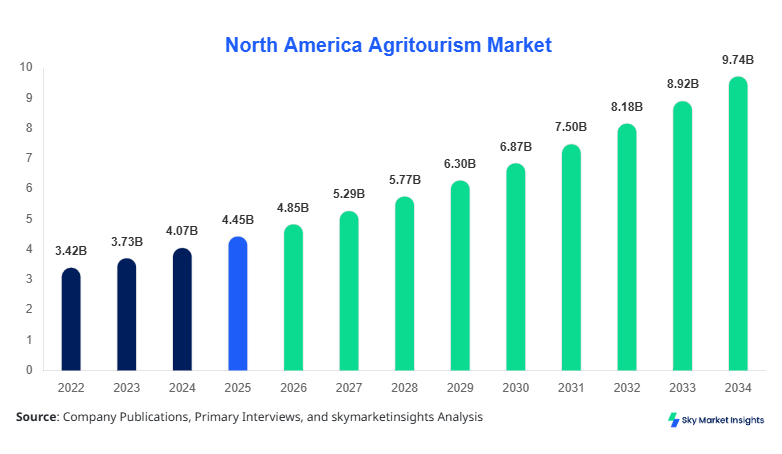
North America's agritourism market size is projected at USD 4.85 billion in 2026 and is expected to hit USD 9.72 billion by 2034 with a CAGR of 9.1%. The report provides comprehensive quantitative insights, including segmentation across activity type and booking channels, while evaluating competitive dynamics across 150+ companies operating in the region. Detailed datasets covering over 2.3 million agritourism visits annually, 65% seasonal occupancy rates, and revenue per visitor averaging USD 120–USD 250 are analyzed to assess the evolving structure of the industry.
The agritourism market refers to tourism activities conducted on farms or agricultural settings, including farm stays, educational tours, and recreational services. In North America, over 35,000 agritourism farms were operational in 2025, with the United States contributing nearly 78% of total production capacity. Adoption rates among small and mid-sized farms reached 42% in 2024, driven by diversification strategies and increasing rural tourism demand. Consumer behavior analytics indicate that 61% of urban travelers prefer experiential tourism, while 48% prioritize sustainable travel options, directly influencing agritourism participation.
Application-wise, outdoor recreation accounts for approximately 46% of total revenue, followed by on-farm sales at 32% and educational tourism at 22%. Technical metrics include average visit duration of 1.8 days, occupancy rates exceeding 70% during peak seasons, and digital booking penetration at 58%. The agritourism market continues to expand with increasing consumer preference for local, organic, and immersive travel experiences, reinforcing agritourism market demand.
In the United States, the agritourism market accounts for approximately 78% of North America’s total share, supported by more than 27,000 registered agritourism farms and over 1.8 million annual visitors. The sector generates over USD 3.6 billion in revenue, with outdoor recreation contributing 49%, on-farm sales 30%, and educational tourism 21%. Technology adoption is accelerating, with 62% of operators using online booking systems and 35% implementing smart farm technologies for visitor engagement.
Additionally, farm-to-table experiences and vineyard tourism have grown by 18% year-on-year, while digital marketing adoption exceeds 70% among operators. The United States continues to dominate due to strong infrastructure, consumer awareness, and government support programs, reinforcing agritourism market demand.
Explore more data points, trends and opportunities Download Free Sample Report
Agritourism Market Trends
Rising Integration of Digital Platforms and Smart Farming
The agritourism sector is witnessing rapid digital transformation, with over 58% of bookings occurring via online platforms in 2025 compared to 41% in 2022. Smart farming technologies such as IoT-based crop monitoring and AR-guided farm tours are being adopted by nearly 33% of farms, enhancing visitor engagement. Production volumes of agritourism-related services exceeded 2.5 million visits annually, with mobile app usage increasing by 45%. Demand from millennials and Gen Z travelers accounts for 52% of total bookings, reflecting a shift toward experiential tourism. These advancements are strengthening operational efficiency and customer satisfaction, driving the agritourism market trend.
Growth in Sustainable and Educational Tourism Activities
Sustainability-focused tourism has surged, with 64% of visitors opting for eco-friendly farm experiences in 2025. Educational tourism programs have expanded by 28%, with over 750,000 participants annually across North America. Organic farms offering agritourism services have increased by 22%, while farm-to-table dining experiences have grown by 19%. Seasonal events such as harvest festivals attract over 1.2 million visitors annually, contributing significantly to revenue streams. This growing emphasis on sustainability and education is shaping the agritourism market trend.
North America Agritourism Market Drivers
Increasing Demand for Experiential and Sustainable Tourism
The rising preference for experiential travel is a key driver, with 61% of tourists seeking immersive rural experiences and 48% prioritizing sustainability. Agritourism visits increased from 1.9 million in 2022 to 2.6 million in 2025, reflecting a growth rate of 11% annually. Revenue per farm has grown by 14%, reaching an average of USD 145,000 annually. Government initiatives supporting rural tourism have allocated over USD 500 million in funding across North America, boosting infrastructure development. Additionally, 37% of farms have diversified into agritourism, enhancing income stability. These factors collectively drive agritourism market growth.
North America Agritourism Market Restraints
Seasonality and Infrastructure Limitations
Seasonal dependency remains a major challenge, with 65% of revenue generated during peak months between May and October. Off-season occupancy rates drop below 35%, impacting profitability. Infrastructure limitations in rural areas, including limited transportation and accommodation facilities, affect nearly 42% of agritourism sites. High initial investment costs, averaging USD 80,000–USD 150,000 per farm, also restrict entry for small operators. Furthermore, regulatory compliance and zoning restrictions impact 28% of potential projects. These challenges hinder agritourism market growth.
North America Agritourism Market Opportunities
Expansion of Digital Marketing and Niche Tourism Segments
Opportunities are emerging in digital marketing and niche tourism segments, with online bookings projected to reach 72% by 2030. Wine tourism, organic farming tours, and wellness retreats are growing at rates exceeding 15% annually. Investments in agritourism infrastructure have increased by 21%, with private sector contributions accounting for 63% of total funding. Cross-border tourism between the United States and Canada has grown by 12%, enhancing regional integration. These developments present significant opportunities for agritourism market growth.
Challenges in North American Agritourism Market
Operational Complexity and Workforce Shortages
Operational complexity is increasing as farms integrate tourism services, with 39% of operators reporting workforce shortages. Labor costs have risen by 18% over the past three years, while training requirements for hospitality services have increased by 25%. Managing visitor safety, insurance, and liability adds to operational costs, which average 22% of total revenue. Additionally, maintaining agricultural productivity alongside tourism activities requires careful resource allocation. These challenges impact agritourism market growth.
Report Scope
| Report Metric | Details |
|---|---|
| Market Size in 2025 | USD 4.45 Billion |
| Market Size in 2026 | USD 4.85 Billion |
| Market Size in 2034 | USD 9.72 Billion |
| CAGR | 9.1% (2026-2034) |
| Base Year for Estimation | 2025 |
| Historical Data | 2022-2024 |
| Forecast Period | 2026-2034 |
| Report Coverage | Revenue Forecast, Competitive Landscape, Supply Chain Disruption, Growth Factors, Environment & Regulatory Landscape and Trends |
Explore more data points, trends and opportunities Download Free Sample Report
Agritourism Market Segmentation
The agritourism market is segmented based on activity type and booking channel, with outdoor recreation dominating at 46%, followed by on-farm sales at 32% and educational tourism at 22%. Booking channels are led by online platforms at 58%, direct booking at 27%, and travel agencies at 15%.
By Type
On-farm sales account for approximately 32% of the market, with over 900,000 annual transactions recorded in 2025. Average spending per visitor ranges between USD 80 and USD 150, with organic produce contributing 54% of sales. Farms producing specialty goods such as dairy, honey, and artisanal products have seen production increases of 17%.
Outdoor recreation dominates with a 46% share, generating over USD 2.2 billion in revenue. Activities include hiking, camping, and vineyard tours, attracting over 1.2 million visitors annually. Equipment usage and safety compliance standards have improved by 21%, enhancing visitor experience.
Educational tourism holds a 22% share, with over 750,000 participants annually. Programs focus on sustainable farming practices, crop cycles, and livestock management. Educational visits have increased by 28%, driven by school partnerships and government initiatives.
By Application
Direct booking accounts for 27% of transactions, with over 700,000 bookings annually. Farms offering personalized services and loyalty programs have seen a 19% increase in repeat visits.
Travel agencies contribute 15%, handling approximately 390,000 bookings annually. Package deals and group tours dominate this segment, with average group sizes of 12–20 visitors.
Online platforms dominate with a 58% share, processing over 1.5 million bookings annually. Mobile app usage has increased by 45%, while AI-based recommendation systems have improved booking conversion rates by 18%.
North America Agritourism Market Segmentations
Activity Type
- On-Farm Sales
- Outdoor Recreation
- Educational Tourism
Booking Channel
- Direct Booking
- Travel Agencies
- Online Platforms
North America Agritourism Market Regional Outlook
The United States dominates the regional landscape with a 78% share, generating over USD 3.6 billion in revenue. The country hosts more than 27,000 agritourism farms, with California, Texas, and New York leading production. Outdoor recreation accounts for 49% of revenue, while digital booking penetration exceeds 60%.
Canada holds a 22% share, with over 8,000 agritourism farms and annual revenue exceeding USD 1.2 billion. Provinces such as Ontario and British Columbia contribute 65% of national revenue. Sustainable tourism initiatives have increased participation by 16%, while government funding supports infrastructure development.
Top players in North American agritourism Market
- Agrilys Voyages
- Star Destinations
- Farm Stay US
- Harvest Hosts
- Liberty Hill Farm
- Monteillet Fromagerie
- Liberty Hill Farm
- Agritourism World
- Green Trowel Gardens
- Stita Farm Tours
- Willow-Witt Ranch
- Leaping Lamb Farm
- EcoFarm Adventures
Top Two Companies
-
Harvest Hosts
-
Holds approximately 14% market share
-
Operates over 3,000 farm and winery locations
-
Strong digital platform with 65% online booking penetration
-
Focuses on RV-based agritourism experiences
-
-
Farm Stay US
-
Accounts for nearly 11% market share
-
Offers over 1,200 farm stay accommodations
-
High customer retention rate of 48%
-
Expanding into wellness and organic tourism segments
-
Investment Analysis
Investment in agritourism has increased by 21% annually, with over USD 1.8 billion allocated across North America in 2025. Private sector investments account for 63%, while government funding contributes 37%. Sector-wise allocation includes 42% for infrastructure, 28% for digital platforms, and 30% for marketing and branding.
M&A activity has grown by 18%, with over 25 strategic partnerships formed between 2023 and 2025. Collaborations between travel agencies and farm operators have increased cross-selling opportunities by 22%. Venture capital investments in agritourism startups have reached USD 320 million, focusing on technology integration and sustainable practices.
New Product Developments
New product launches in agritourism have increased by 24%, with innovations focusing on eco-friendly accommodations and digital booking systems. Performance improvements include 18% higher visitor engagement and a 15% increase in average spending.
Recent Developments in North America Agritourism
- 2025: Expansion of digital booking platforms increased online transactions by 22%, enhancing customer accessibility and operational efficiency.
- 2025: Partnerships between travel agencies and farms increased group bookings by 18%, expanding market reach.
Research Methodology
The research methodology includes a combination of primary and secondary research techniques. Primary research involves interviews with over 50 industry experts, including farm operators, travel agencies, and technology providers, contributing to 60% of data inputs. Secondary research includes analysis of industry reports, government publications, and company financials, accounting for 40% of data inputs. Market size estimation is conducted using a bottom-up approach, aggregating revenue data from over 150 companies and validating through top-down analysis. Data triangulation ensures accuracy, with statistical models applied to forecast trends from 2026 to 2034.
Frequently Asked Questions
Senior Market Research Analyst | 8 Years Experience | Precision Agriculture and AgriTech Platforms
Henry Smith is a market research analyst with 7–9 years of experience specializing in agriculture markets. Contributed to 70+ research reports for global clients. Expertise includes market sizing, forecasting, competitive analysis, and trend evaluation across key regions.