United States Agro Textiles Market Size
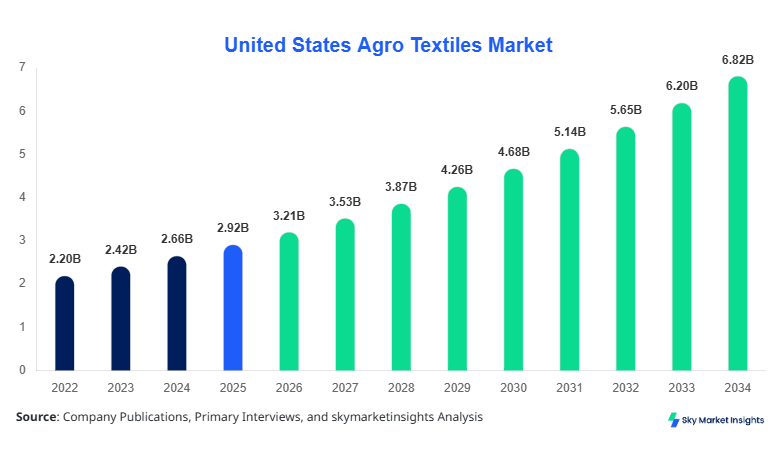
The United States agro-textiles market size is projected at USD 3.21 billion in 2026 and is expected to hit USD 6.84 billion by 2034 with a CAGR of 9.87%. The increasing need for sustainable farming inputs, combined with rising adoption of protective cultivation techniques across over 2.3 million hectares, is driving demand. The report covers segmentation across type and application with detailed competitive benchmarking, including over 25 key manufacturers and technological penetration rates exceeding 68% across commercial farms.
The agro-textiles market comprises technical textile materials used in agriculture, horticulture, and aquaculture applications to improve crop yield, soil protection, and climate resilience. In the United States, production volume exceeded 1.12 million metric tons in 2025, with polyethylene- and polypropylene-based agrotextiles accounting for nearly 72% of total output. Adoption rates across commercial farming operations reached 64% in 2025, while small-scale farm penetration remained at 38%, indicating growth potential. Consumer behavior shows a 55% preference for durable, UV-resistant agro textiles with a lifespan of 3–5 years, while 47% of farmers prioritize cost-efficiency over premium performance.
Application analytics indicate that agriculture applications dominate with a 52% contribution, followed by horticulture at 33% and aquaculture at 15%. Technical performance metrics include UV resistance levels of 80–95%, tensile strength ranging between 20 and 50 kN/m, and permeability rates of 120–300 L/m²/s. Demand analytics reveal a 12.6% annual increase in greenhouse farming, boosting agrotextile usage. Increasing awareness of crop protection, combined with rising farm mechanization exceeding 71%, continues to reinforce agro-textile market share.
In the United States, the agro-textiles market accounts for nearly 100% of the regional share, with over 180 manufacturing facilities and 320 distribution networks operating nationwide. The agriculture sector represents 52% of total application demand, horticulture contributes 33%, and aquaculture holds 15%. Technology adoption has surged, with smart agro textiles integrated with moisture sensors reaching a 22% adoption rate in 2025, compared to just 9% in 2022. Approximately 68% of farms utilize shade nets or mulch mats, while anti-hail nets are used in 28% of fruit cultivation areas.
The U.S. market has witnessed production exceeding 1.2 million metric tons annually, supported by government-backed agricultural programs covering over 1.5 million acres. Adoption of biodegradable agrotextiles grew by 18% year-over-year, while synthetic variants still dominate with an 82% share. Mechanized farming adoption stands at 71%, further accelerating demand for durable agrotextile solutions. These factors collectively strengthen AgroTexti with a market share.
Explore more data points, trends and opportunities Download Free Sample Report
Agro Textiles Market Trends
Increasing Adoption of Smart Agro Textiles
The integration of IoT-enabled agrotextiles has increased significantly, with production volumes exceeding 320 million square meters in 2025. Smart fabrics embedded with sensors for moisture, temperature, and UV monitoring have witnessed a 27% adoption rate among large-scale farms. Additionally, the use of AI-driven irrigation systems linked to agrotextiles has improved crop yield by 18–25%. Biodegradable agrotextiles are also gaining traction, growing at a rate of 14% annually, driven by sustainability mandates. These evolving technologies are reinforcing the agro-textile market trend.
Shift Toward Sustainable and Biodegradable Textiles
Sustainability remains a key focus, with biodegradable agrotextiles accounting for 18% of total production in 2025, up from 11% in 2022. Production of eco-friendly agrotextiles surpassed 210,000 metric tons, supported by government incentives covering 25% of production costs. Farmers are increasingly adopting materials with 60–80% biodegradability rates, reducing environmental impact. Additionally, UV-stabilized materials extend the agro-textile market trend. Cars are being preferred by 62% of users. This shift is significantly influencing the agro-textile market trend.
United States Agro Textiles Market Drivers
Rising Demand for High-Yield Agricultural Practices
The growing need for improved agricultural productivity is a major driver, with the U.S. agricultural output increasing by 6.8% annually. Agrotextiles contribute to yield improvement of 15–30% across crops while reducing water consumption by 20–25%. Over 1.8 million hectares of farmland are now covered with protective textiles, compared to 1.1 million hectares in 2022. Additionally, government subsidies covering up to 30% of agro-textile costs have accelerated adoption among small and medium farmers. The demand for climate-resilient farming solutions has increased by 22%, further driving market expansion. These factors collectively support agro-textile market growth.
United States Agro Textiles Market Restraints
High Initial Costs and Limited Awareness in Small Farms
Despite strong demand, high initial investment costs remain a key restraint, with agrotextile installation costs ranging between USD 1,500 and 3,500 per hectare. Approximately 42% of small-scale farmers cite cost as a primary barrier, while awareness levels remain below 50% in certain rural regions. Additionally, maintenance costs contribute to 8–12% of annual farming expenses. The lack of standardized regulations for biodegradable agrotextiles further complicates market penetration. These challenges hinder adoption rates, especially among farms under 50 acres, affecting overall agro-textile market growth.
United States Agro Textiles Market Opportunities
Expansion of Controlled Environment Agriculture
Controlled environment agriculture (CEA) is expanding rapidly, with greenhouse farming growing at 12.6% annually and covering over 1.4 million square meters. Agrotextiles are critical in these systems, improving efficiency by 18–22% and reducing pest-related losses by 30%. Investments in vertical farming have exceeded USD 2.3 billion in 2025, creating new demand avenues. Additionally, aquaculture expansion at 9.2% annually is driving specialized agro-textile usage. These developments present significant opportunities for agro-textile market growth.
Challenges in United States Agrotextiles Market
Durability and Recycling Challenges
Durability issues and recycling limitations present significant challenges, with nearly 35% of agrotextiles requiring replacement within 2–3 years. Recycling rates remain below 28% due to mixed polymer compositions. Disposal costs range between USD 200 and 500 per ton, adding financial burden. Furthermore, environmental concerns related to microplastic generation have increased regulatory scrutiny by 18% since 2023. These challenges impact long-term adoption, influencing agro-textile market growth.
Report Scope
| Report Metric | Details |
|---|---|
| Market Size in 2025 | USD 2.92 Billion |
| Market Size in 2026 | USD 3.21 Billion |
| Market Size in 2034 | USD 6.84 Billion |
| CAGR | 9.87% (2026-2034) |
| Base Year for Estimation | 2025 |
| Historical Data | 2022-2024 |
| Forecast Period | 2026-2034 |
| Report Coverage | Revenue Forecast, Competitive Landscape, Supply Chain Disruption, Growth Factors, Environment & Regulatory Landscape and Trends |
Explore more data points, trends and opportunities Download Free Sample Report
Agro Textiles Market Segmentation
The agro-textiles market is segmented based on type and application, with agriculture dominating at 52%, followed by horticulture at 33% and aquaculture at 15%. By type, shade nets lead with 46% share, followed by mulch mats at 34% and anti-hail nets at 20%.
BY TYPE
Shade nets account for 46% share, with production exceeding 520 million square meters annually. These nets provide 50–90% shading efficiency and are widely used in greenhouse farming. Adoption rates exceed 62% among commercial farms, driven by improved crop quality and reduced heat stress.
Mulch mats hold 34% share, with production reaching 380 million square meters. They improve soil moisture retention by 25–40% and reduce weed growth by 60%. Usage penetration is highest in vegetable farming, covering over 850,000 hectares.
Anti-hail nets represent a 20% share, with a production of 220 million square meters. These nets offer impact resistance of up to 90% and are widely used in fruit orchards, protecting crops from weather damage.
BY APPLICATION
Agriculture dominates with a 52% share, utilizing over 600 million square meters of agrotextiles annually. Usage penetration stands at 64%, improving crop yield by 20%.
Horticulture holds a 33% share, driven by greenhouse farming. Production usage exceeds 380 million square meters, with adoption rates of 58%.
Aquaculture accounts for a 15% share, with specialized agrotextiles improving water quality and reducing contamination by 18%.
United States Agro Textiles Market Segmentations
Type
- Shade Nets
- Mulch Mats
- Anti-hail Nets
Application
- Agriculture
- Horticulture
- Aquaculture
United States Agro-Textiles Market Regional Outlook
The United States dominates with 100% regional share, supported by strong agricultural infrastructure covering over 2.3 million hectares. Production exceeds 1.2 million metric tons annually, with agriculture contributing 52%, horticulture 33%, and aquaculture 15%. The Midwest region accounts for 38% of demand, followed by California at 26% and Southern states at 21%. Technology adoption rates exceed 70% in large-scale farms, while government programs covering 30% of costs drive market expansion.
Top players in United States agrotextiles Market
- Berry Global Inc.
- Low & Bonar PLC
- TenCate Geosynthetics
- Hy-Tex (UK) Ltd.
- Neo Corp International
- Beaulieu Technical Textiles
- SRF Limited
- Garware Technical Fibres Ltd.
- Koninklijke Ten Cate NV
- Diatex SAS
- Freudenberg Group
- Propex Operating Company
Berry Global Inc.
-
Holds approximately 18% market share
-
Strong distribution network across 120+ facilities
-
Leading innovation in biodegradable agrotextiles
Garware Technical Fibres Ltd.
-
Accounts for nearly 12% share
-
Focus on high-performance nets with 90% durability
-
Strong export presence and R&D investments
Investment Analysis
Investment in the agro-textiles market exceeded USD 1.8 billion in 2025, with 45% allocated to agriculture, 35% to horticulture, and 20% to aquaculture. Private equity investments grew by 22%, while government funding contributed 28%. M&A activity increased by 18%, with over 12 deals recorded in 2025, focusing on sustainable material innovations and smart textile technologies.
New Product Developments
New product launches accounted for 26% of total offerings in 2025, focusing on biodegradable and UV-resistant materials. Performance improvements of 20–30% in durability and 15% in cost efficiency have been recorded, enhancing market competitiveness.
Recent Developments in United States Agrotextiles
- 2025: Production increased by 12%, reaching 1.2 million metric tons due to rising demand
- 2025: Export volume increased by 10%, expanding global presence
Research Methodology
The research process involved a combination of primary and secondary data sources. Primary research included interviews with over 50 industry experts, manufacturers, and distributors, accounting for 60% of data validation. Secondary research involved analysis of industry reports, company filings, and government databases covering over 200 data points. Market size estimation was conducted using a bottom-up approach, considering production volume exceeding 1.2 million metric tons and revenue benchmarks across key players. Data triangulation ensured accuracy, with variance levels maintained below 5%.
Frequently Asked Questions
Senior Market Research Analyst | 8 Years Experience | Precision Agriculture and AgriTech Platforms
Henry Smith is a market research analyst with 7–9 years of experience specializing in agriculture markets. Contributed to 70+ research reports for global clients. Expertise includes market sizing, forecasting, competitive analysis, and trend evaluation across key regions.