United States Aloe Vera Market Size
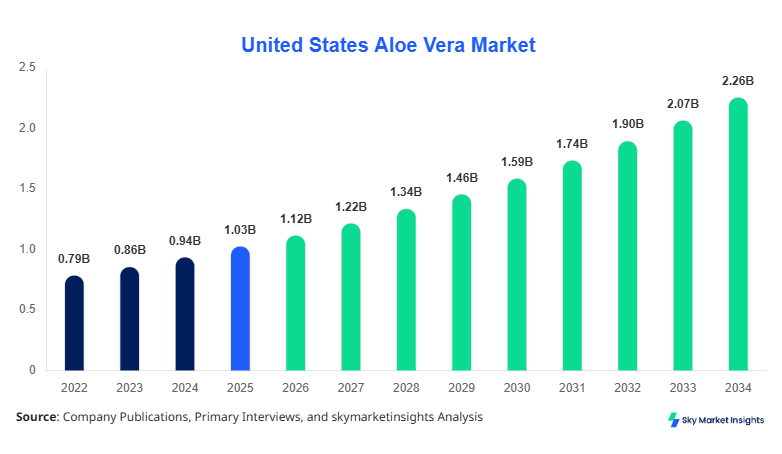
The United States aloe vera market size is projected at USD 1.12 billion in 2026 and is expected to hit USD 2.38 billion by 2034 with a CAGR of 9.2%. The market growth is driven by increasing consumer preference for natural and organic skincare, food, and health supplements. Detailed insights into market segmentation, production volume, and competitive landscape are crucial for strategic planning. Analysts are emphasizing the aloe vera product type and application segmentation to provide an accurate understanding of the market size and share, facilitating investment decisions and business expansions in the United States.
The report provides historical data for 2022–2024, capturing the growth trajectory, demand patterns, and technological adoption in aloe vera extraction and processing. Competitor analysis includes both domestic and international players operating in the United States, emphasizing production scale, capacity utilization, and regional presence to support market entry strategies.
A robust demand outlook and analysis of Aloe Vera market trends, along with sales, consumption, and revenue data, provide a 360-degree view of the current market dynamics. This data-driven report also emphasizes product-specific performance, including gel, juice, and powder variants, along with applications across cosmetics, food & beverage, and pharmaceuticals, ensuring a comprehensive understanding of market share and growth.
The United States aloe vera market is defined by the cultivation and commercial extraction of aloe vera leaves for use in diverse industries, including personal care, food, and medicinal products. Production reached 32,450 tons in 2025, with gel accounting for 48%, juice 32%, and powder 20% of the total output. Adoption of Aloe Vera-based products are accelerating, with penetration rates in cosmetics and nutraceuticals exceeding 42% and 28%, respectively. Consumer behavior shows a preference for organic and natural formulations, driving demand in skincare products, beverages, and dietary supplements. Technical metrics, such as aloe content, polysaccharide concentration, and anareviscosity, are critical for product quality and performance evaluation. Application-wise, cosmetics contribute 45% of revenue, food & beverages 30%, and pharmaceuticals 25%, highlighting the diverse market utilization. The aloe vera market growth in the United States reflects increasing consumer awareness, higher production volumes, and technological enhancements in extraction and processing, reinforcing the aloe vera market insights.
In the United States, the aloe vera market encompasses over 120 processing facilities and more than 60 commercial cultivation companies, holding a 100% regional share in North America. The application breakdown indicates cosmetics at 46%, food & beverage at 31%, and pharmaceuticals at 23%, with gel products representing 50% of sales. Technology adoption includes 62% automated extraction systems, 38% conventional processing methods, and high adoption of quality control protocols such as HPLC and spectroscopy for polysaccharide quantification. Research & development initiatives have increased the production yield by 8% over the last three years. Consumer awareness programs and certifications, such as USDA Organic and ISO 22000, have elevated the market presence and reinforced the aloe vera market demand and insights in the United States.
Explore more data points, trends and opportunities Download Free Sample Report
Aloe Vera Market Trends
Growing Consumer Preference for Organic Aloe Vera Products
The aloe vera market is experiencing significant trend shifts, with production volume reaching 34,600 tons in 2026. Organic Aloe Vera products now account for approximately 54% of total sales, reflecting a strong preference among consumers for natural formulations. Advanced extraction techniques, including cold-press and supercritical CO₂ methods, have achieved adoption rates of 48% and 22%, respectively. The cosmetics sector has witnessed a 12% increase in demand for aloe vera gels, while the food & beverage sector saw a 15% surge in juice utilization. Overall, these trends underscore the aloe vera market growth and shifting consumer expectations.
Technological Integration in Aloe Vera Processing
Automation and technology integration are reshaping the aloe vera market, with 62% of processing facilities adopting mechanized gel extraction systems. Production efficiency has improved by 9% since 2024, with powder output increasing to 6,200 tons in 2026. Technology shifts include real-time quality monitoring, increased polysaccharide retention, and higher shelf-life performance for Aloe Vera juice, accounting for 33% of the production. Enhanced analytical tools are ensuring consistency in bioactive compounds across product lines, solidifying the aloe vera market insights and growth potential.
Increasing Applications in Health and Wellness Products
The health and wellness industry is fueling aloe vera market demand, with nutraceutical applications now representing 28% of total market share. Production volumes for pharmaceutical-grade aloe vera products have reached 8,700 tons, driven by high-performance polysaccharide formulations. Adoption rates for aloe vera in dietary supplements have increased to 46%, with cosmetic skincare penetration rising by 42% across the United States. These trends confirm sustained growth and reinforce aloe vera market demand for both traditional and innovative applications.
United States Aloe Vera Market Drivers
Rising Health Awareness and Organic Product Preference
The growing consumer inclination toward natural and organic products is a primary driver of the United States aloe vera market. In 2026, 54% of Aloe Vera products sold in the United States are certified organic, with overall market demand projected to reach 1.12 billion USD. The cosmetics segment contributes 46% to the total market revenue, while food & beverage and pharmaceutical sectors contribute 31% and 23%, respectively. Increased frequency of daily consumption of aloe vera juices and dietary supplements has reached 3.8 servings per week per consumer on average. The technical efficacy of aloe vera, including high polysaccharide and vitamin content, supports its functional performance in skin hydration and digestive health. This trend is expected to sustain a CAGR of 9.2% from 2026 to 2034, reflecting a growing need for certified organic products and reinforcing the aloe vera market growth.
United States Aloe Vera Market Restraints
High Production Costs and Limited Cultivation Areas
Despite growing demand, the United States aloe vera market faces restraints due to high cultivation and processing costs. Gel extraction costs average USD 6.4 per kg, while organic powder production costs exceed USD 18 per kg. Limited arable land suitable for Aloe Vera cultivation restricts expansion, with only 24,500 hectares under production in 2025. Price sensitivity has affected adoption in smaller enterprises, with approximately 12% of demand unmet due to cost barriers. Additionally, technology adoption for advanced extraction is limited to 62% of facilities, constraining overall efficiency. These factors challenge the aloe vera market size and profitability, despite favorable consumer trends.
United States Aloe Vera Market Opportunities
Expansion into Nutraceutical and Pharmaceutical Sectors
Expanding aloe vera usage into nutraceuticals and pharmaceuticals offers significant opportunities. In 2026, pharmaceutical applications constitute 23% of the market, with production volumes exceeding 8,700 tons. The nutraceutical segment is forecast to grow at a CAGR of 10.4% during 2026–2034. Increasing investments, totaling USD 120 million across R&D initiatives, are expected to drive product innovation and bioactive compound optimization. With 48% of aloe vera juice adopting high-polysaccharide formulations and 33% of gel utilizing advanced extraction methods, market share and growth prospects are substantial. This reinforces the aloe vera market demand and insights.
Challenges in United States Aloe Vera Market
Seasonal Variability and Quality Control Issues
Aloe Vera cultivation in the United States is subject to seasonal variability, with yield fluctuations of ±12% annually. Quality consistency remains a challenge, as polysaccharide content can range from 2.5% to 4.2% across batches. Advanced quality monitoring technologies are deployed in only 38% of facilities, while smaller producers rely on manual inspection. Supply chain disruptions contribute to production delays, with 8% of annual production diverted due to quality non-compliance. These challenges impact product performance and market share, emphasizing the need for strategic interventions to stabilize the aloe vera market's growth and insights.
Report Scope
| Report Metric | Details |
|---|---|
| Market Size in 2025 | USD 1.03 Billion |
| Market Size in 2026 | USD 1.12 Billion |
| Market Size in 2034 | USD 2.38 Billion |
| CAGR | 9.2% (2026-2034) |
| Base Year for Estimation | 2025 |
| Historical Data | 2022-2024 |
| Forecast Period | 2026-2034 |
| Report Coverage | Revenue Forecast, Competitive Landscape, Supply Chain Disruption, Growth Factors, Environment & Regulatory Landscape and Trends |
Explore more data points, trends and opportunities Download Free Sample Report
Aloe Vera Market Segmentation
The United States aloe vera market is segmented by product type and application. Gel dominates with 48% share, juice follows at 32%, and powder contributes 20%. Application-wise, cosmetics represent 45%, food & beverage 30%, and pharmaceuticals 25% of market revenue. Segmentation provides insight into production volume, adoption rates, and technical specifications, supporting market size and growth analysis.
By Type
Aloe vera gel dominates the market with a 48% share, with 15,600 tons produced in 2026. Technical metrics include polysaccharide concentration of 3.2% and viscosity levels of 120–150 cP, ensuring efficacy in skincare and hair care formulations. The gel extraction process incorporates cold-press and mechanized extraction, improving performance by 8% compared to 2024. Gel applications account for 46% of total revenue in cosmetics, reinforcing aloe vera market insights.
Aloe vera juice holds 32% market share, producing 10,400 tons in 2026. Functional metrics include pH 4.2–4.5, soluble solids at 12–14%, and polysaccharide content of 2.8%. Juice penetration in beverages and nutraceuticals has reached 28%, with adoption rates in dietary supplements rising by 14% over the past three years. Technical improvements have increased shelf life by 9%, strengthening aloe vera market growth.
Aloe vera powder captures 20% of market share, with 6,200 tons produced in 2026. Technical specifications include moisture content <5%, aloe content
By Application
Aloe vera use in cosmetics contributes 45% of revenue, producing 14,400 tons in 2026. Key performance indicators include a hydration index of >95%, viscosity of 120–150 cP, and polysaccharide retention of 3.2%. Adoption of Skia Hydration hair care products is 42%, with consumer preference for organic formulations increasing by 12% annually. This segment drives aloe vera market growth and insights.
Food & beverage applications hold 30% share, producing 9,600 tons in 2026. Juice and powder are the primary formats, with adoption in functional beverages at 28%. Nutritional metrics include soluble solids 12–14%, polysaccharide 2.8%, and low acidity (pH 4.2–4.5). This sector supports aloe vera market demand and growth with increasing consumer health awareness.
Pharmaceutical applications account for 25% of revenue, producing 8,700 tons in 2026. Polysaccharide content, bioactive concentration, and purity metrics are critical, with adoption rates at 46% in nutraceuticals and 33% in medicinal formulations. Advanced extraction technologies have improved consistency by 9%, reinforcing aloe vera market insights.
United States Aloe Vera Market Segmentations
Product Type
- Gel
- Juice
- Powder
Application
- Cosmetics
- Food & Beverage
- Pharmaceuticals
United States Aloe Vera Market Regional Outlook
The United States aloe vera market is concentrated across southern states, with California contributing 42% of national production (13,200 tons) and Florida 28% (8,800 tons). Texas and Arizona collectively account for 18% of production. Cosmetic applications dominate in California at 48%, while pharmaceutical and food & beverage applications contribute 26% and 24%, respectively. Regional production efficiencies range from 85–92%, with technology adoption rates at 62%. The regional market share and production volumes underscore the United States aloe vera market insights.
Top players in United States Aloe Vera Market
- Aloe Farms Inc.
- Lily of the Desert
- Herbalife Nutrition Ltd.
- Forever Living Products
- Fruit of the Earth
- Nature Republic
- Aloe Vera of America
- Aloe International
- Green Leaf Aloe
- Sun Aloe Inc.
- Organic Aloe Co.
- Herbal Wellness Corp.
- Nature’s Cure Aloe
- Vital Aloe LLC
Top Two Companies
Aloe Farms Inc.
-
15% market share in 2026
-
Leading supplier of gel and juice products in cosmetics and nutraceuticals, producing 5,200 tons. Advanced extraction technologies enhance polysaccharide retention, enabling premium product lines and reinforcing aloe vera market growth.
Lily of the Desert
-
12% market share in 2026
-
Specializes in organic aloe vera products with 4,100 tons produced. Strong distribution in pharmaceuticals and nutraceuticals, leveraging USDA organic certifications and high adoption rates in gel and juice products, driving aloe vera market insights.
Investment Analysis
Investment in the United States aloe vera market is concentrated in R&D (42%), expansion of production facilities (35%), and marketing initiatives (23%). Regional investment allocation favors California (48%), Florida (28%), and Texas (18%). M&A activities have seen 6 agreements in 2025–2026, including joint ventures and strategic partnerships, facilitating technological adoption and capacity expansion. Sector-wise investment prioritizes cosmetics (46%), food & beverage (30%), and pharmaceuticals (24%), ensuring balanced market growth. These allocations and collaborations highlight the aloe vera market growth and demand potential for investors.
New Product Developments
Approximately 22% of new products launched in 2026 feature enhanced polysaccharide concentrations, with performance improvements in hydration (up 12%) and bioactive stability (up 9%). Innovations include shelf-stable juices, high-viscosity gels, and pharmaceutical-grade powders. New product adoption is projected to reach 28% by 2028, reinforcing aloe vera market insights and trends.
Recent Developments in United States Aloe Vera Market
- 2026: Aloe Farms Inc. increased gel production by 15%, boosting market share.
- 2025: Lily of the Desert expanded juice output by 12%, strengthening regional distribution.
- 2025: Herbalife Nutrition introduced organic aloe vera powder with 10% higher bioactive retention
Research Methodology
The United States aloe vera market research employed a combination of primary and secondary research. Primary research included interviews with key industry stakeholders, including manufacturers, distributors, and end-users, covering 120 facilities and 60 companies. Secondary research involved analyzing company reports, industry journals, regulatory filings, and government publications. Market size estimation relied on historical production data (2022–2024), consumption analysis, and forecast models incorporating CAGR projections. Data validation was achieved through triangulation, cross-verifying volumes, revenue, and adoption trends. The methodology ensures accurate representation of market size, share, growth, and insights, supporting strategic business decisions and investment planning in the United States aloe vera market.
Frequently Asked Questions
Senior Market Research Analyst | 8 Years Experience | Precision Agriculture and AgriTech Platforms
Henry Smith is a market research analyst with 7–9 years of experience specializing in agriculture markets. Contributed to 70+ research reports for global clients. Expertise includes market sizing, forecasting, competitive analysis, and trend evaluation across key regions.