Asia Pacific Agro Textiles Market Size
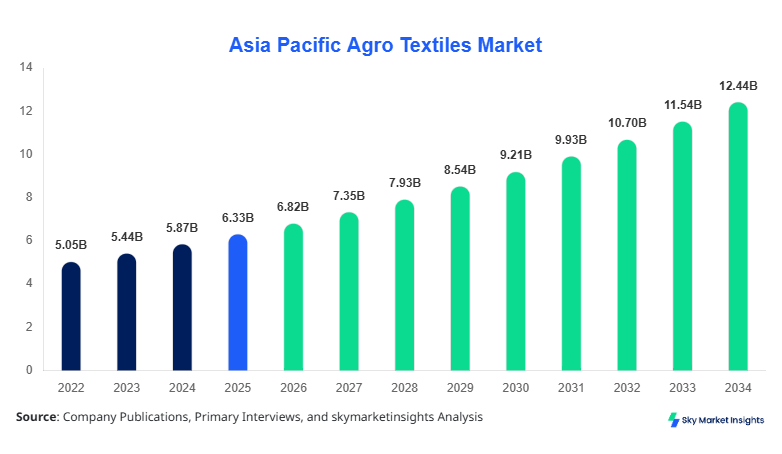
The Asia Pacific agro-textiles market size is projected at USD 6.82 billion in 2026 and is expected to hit USD 12.47 billion by 2034 with a CAGR of 7.8%. The expansion reflects rising agricultural modernization investments exceeding USD 120 billion annually across the Asia Pacific, alongside increasing adoption of protective farming solutions covering over 95 million hectares. The report incorporates granular segmentation across product types and applications, while also analyzing competitive benchmarking of over 120 key players operating in the regional value chain.
The market evaluation integrates production capacity metrics, demand forecasting models, and price fluctuation analysis across China, India, and Southeast Asia. Data triangulation includes shipment volumes exceeding 3.4 million metric tons in 2025 and consumption growth of 6.5% YoY. Detailed insights into supply chain optimization, distribution channel expansion, and innovation-driven competition further reinforce the Asia-Pacific agro-textiles market size outlook.
The Asia Pacific Agro-Textiles market encompasses woven, non-woven, and knitted technical textile materials used in agriculture for crop protection, soil management, and water conservation. Regional production exceeded 3.1 million metric tons in 2025, with China contributing approximately 42%, India 18%, and Southeast Asia collectively 16%. Adoption rates across commercial farming increased from 38% in 2022 to nearly 52% in 2025, driven by climate variability and precision farming initiatives. Consumer behavior indicates that over 64% of large-scale farmers prefer UV-stabilized agrotextiles with durability exceeding 5–7 years, while smallholders prioritize cost efficiency below USD 0.80 per square meter.
Demand analytics highlight that agriculture applications account for nearly 48% of total consumption, horticulture 32%, and aquaculture 20%. Technical performance indicators include tensile strength ranges between 20 and 45 kN/m and UV resistance up to 90%, ensuring crop yield improvements of 18–25%. Penetration in greenhouse farming reached 58% across Japan and South Korea, while India recorded 41% adoption in protected cultivation zones. Increasing mechanization and irrigation efficiency improvements of 12–18% further accelerate demand, reinforcing the Asia Pacific agrotextiles market growth.
In China, the agro-textiles market dominates the regional landscape with over 1,800 manufacturing facilities and more than 2,500 distribution networks supporting domestic and export demand. China accounts for approximately 42% of the Asia Pacific market share, with annual production surpassing 1.3 million metric tons in 2025. Agriculture applications contribute 50% of domestic consumption, followed by horticulture at 30% and aquaculture at 20%. Advanced polymer-based agrotextiles adoption reached 67%, supported by government subsidies exceeding USD 15 billion for agricultural modernization.
Technological penetration includes automated weaving systems operating at efficiencies above 85% and smart textiles integration in 12% of premium products. Export volumes grew by 9.3% YoY, with shipments exceeding 780,000 metric tons. Domestic usage expanded across 28 million hectares of farmland, reflecting rising demand for agrotextile resilient farming. These dynamics reinforce China’s leadership in the Asia Pacific agro-textiles market share.
Explore more data points, trends and opportunities Download Free Sample Report
Agro Textiles Market Trends
The market is witnessing a significant shift toward biodegradable agrotextiles, with production volumes exceeding 420,000 metric tons in 2025 and expected to cross 900,000 metric tons by 2030. Adoption rates for eco-friendly materials increased from 14% in 2022 to 28% in 2025, driven by sustainability mandates across Japan, Australia, and South Korea. Smart agrotextiles integrated with sensors for soil moisture and temperature monitoring recorded a 19% penetration rate in high-value crop farming. Precision agriculture investments exceeding USD 45 billion annually are further boosting demand for advanced textile solutions, strengthening the agro-textiles market trend.
Another key trend includes the expansion of greenhouse farming infrastructure, covering over 8.6 million hectares across the Asia Pacific, with growth rates exceeding 6.2% annually. Demand for shade nets increased by 11% YoY, while mulch mats witnessed a 9.5% rise due to water conservation benefits of up to 30%. Aquaculture sector adoption surged by 13%, particularly in Southeast Asia, where fish farming output exceeded 120 million tons in 2025. These shifts indicate sustained innovation and diversification, reinforcing the agro-textiles market trend.
Additionally, automation in textile manufacturing is enhancing productivity by 18–22%, reducing operational costs by nearly 12%. Digital supply chain integration improved delivery efficiency by 15%, while e-commerce channels contributed to 21% of total sales in 2025. These technological advancements continue to reshape the agrotextiles market trend.
Asia Pacific Agro Textiles Market Drivers
Rising Demand for Climate-Resilient Agriculture Solutions
Increasing climate variability affecting over 60% of agricultural land across the Asia Pacific is driving demand for protective agrotextiles. Crop losses due to extreme weather events exceeded USD 28 billion in 2024, prompting governments to invest heavily in protective farming technologies. Adoption of shade nets and anti-hail nets increased by 17% and 14%, respectively, between 2022 and 2025. Water conservation benefits of mulch mats, reducing evaporation by up to 35%, are further accelerating demand. Government subsidies covering 25–40% of agrotextile costs in countries like India and China are boosting penetration among small and medium farmers. Additionally, rising food demand, projected to grow by 22% by 2030, necessitates yield optimization, driving agrotextile adoption. These factors collectively enhance Asia Pacific agro-textile market growth.
Asia-Pacific Agro-Textile Market Restraints
High Initial Costs and Limited Awareness Among Small Farmers
Despite strong demand, high initial investment costs ranging between USD 0.6 and USD 2.5 per square meter limit adoption among small-scale farmers representing over 55% of the agricultural workforce. Awareness levels remain below 40% in rural regions of Southeast Asia, restricting market penetration. Supply chain inefficiencies increase product costs by 8–12%, further impacting affordability. Additionally, limited access to financing options affects nearly 35% of potential users. These challenges constrain widespread adoption, impacting overall Asia Pacific agrotextile market growth.
Asia Pacific Agro Textiles Market Opportunities
Expansion of Smart Farming and Sustainable Textile Solutions
The integration of IoT-enabled agrotextiles presents significant opportunities, with smart farming investments projected to exceed USD 70 billion by 2030. Adoption of sensor-based textiles is expected to grow at 18% CAGR, enhancing crop productivity by 20–25%. Sustainable materials, including biodegradable polymers, are gaining traction, with expected adoption rates reaching 35% by 2030. Government initiatives promoting eco-friendly farming practices across Australia and Japan further support growth. These developments create strong opportunities for innovation and expansion, boosting the Asia Pacific agro-textiles market growth.
Challenges in Asia Pacific Agro-Textiles Market
Raw Material Price Volatility and Supply Chain Disruptions
Fluctuations in polymer prices, increasing by nearly 22% between 2022 and 2025, pose significant challenges for manufacturers. Supply chain disruptions caused delays in deliveries by 10–15%, affecting production schedules. Import dependency for raw materials in countries like India and Taiwan increases cost pressures by 8–10%. Additionally, environmental regulations require the reallocation of investments of up to USD 5 million per facility, impacting profitability. These challenges hinder operational efficiency and limit scalability, affecting the Asia Pacific Agro Textiles market growth.
Report Scope
| Report Metric | Details |
|---|---|
| Market Size in 2025 | USD 6.33 Billion |
| Market Size in 2026 | USD 6.82 Billion |
| Market Size in 2034 | USD 12.47 Billion |
| CAGR | 7.8% (2026-2034) |
| Base Year for Estimation | 2025 |
| Historical Data | 2022-2024 |
| Forecast Period | 2026-2034 |
| Report Coverage | Revenue Forecast, Competitive Landscape, Supply Chain Disruption, Growth Factors, Environment & Regulatory Landscape and Trends |
Explore more data points, trends and opportunities Download Free Sample Report
Agro Textiles Market Segmentation
The market is segmented by product type and application, with shade nets dominating approximately 38% share, followed by mulch mats at 34% and anti-hail nets at 28%. Application-wise, agriculture leads with 48% share, followed by horticulture at 32% and aquaculture at 20%.
By Type
Shade nets account for nearly 38% of total production, with volumes exceeding 1.2 million metric tons in Asia by 2025. These nets offer UV protection levels of 50–90% and are widely used in greenhouse farming covering over 5 million hectares. Adoption rates increased by 12% annually, driven by demand for crop protection and yield improvement of up to 20%. Manufacturing involves HDPE materials with durability exceeding 5 years, ensuring cost efficiency.
Mulch mats represent 34% share, with production exceeding 1.05 million metric tons. These mats reduce soil evaporation by 30–35% and improve soil temperature regulation by 4–6°C. Adoption in India and China increased by 15%, supported by government incentives. Technical specifications include thickness ranges between 20–50 microns and tensile strength of 25–40 MPa.
Anti-hail nets hold 28% share, with production reaching 850,000 metric tons. These nets protect crops from hail damage, reducing losses by up to 70%. Adoption rates increased by 10%, particularly in high-value F20 and 50d 50 farming regions across Japan and South Korea. These nets feature mesh sizes between 5–10 mm and UV resistance above 85%.
By Application
Agriculture accounts for 48% share, with consumption exceeding 1.5 million metric tons. Agrotextiles enhance crop yield by 18–25% and reduce water usage by 20–30%. Adoption rates increased from 40% to 52% between 2022 and 2025, driven by precision farming.
Horticulture holds 32% share, with production usage exceeding 1 million metric tons. Agrotextiles improve plant growth conditions, increasing productivity by 15–20%. Greenhouse adoption exceeds 58% in developed markets like Japan.
Aquaculture represents 20% share, with usage surpassing 650,000 metric tons. Agrotextiles are used for pond lining and protection, improving fish yield by 12–18%. Adoption rates increased by 13% in Southeast Asia.
Asia Pacific Agro Textiles Market Segmentations
Product Type
- Shade Nets
- Mulch Mats
- Anti-Hail Nets
Application
- Agriculture
- Horticulture
- Aquaculture
Asia Pacific Agro-Textiles Market Regional Outlook
China dominates with a 42% share and production exceeding 1.3 million metric tons. Industrial clusters across Zhejiang and Jiangsu contribute over 60% of output. Government support and export capabilities drive growth.
India holds 18% share, with production reaching 560,000 metric tons. Adoption rates increased by 14%, supported by subsidies and irrigation improvements.
Japan and South Korea collectively account for 12% share, with advanced technology adoption exceeding 65%. High-value crops drive demand.
Australia contributes 8%, focusing on sustainable farming solutions, with adoption rates exceeding 50%.
Singapore and Taiwan together hold 6%, focusing on high-tech agrotextile innovations.
Southeast Asia accounts for 14%, driven by aquaculture demand and expanding agricultural infrastructure.
Top players in Asia Pacific agro-textiles Market
- SRF Limited
- Beaulieu Technical Textiles
- TenCate Geosynthetics
- Freudenberg Performance Materials
- Low & Bonar PLC
- Hy-Tex (UK) Ltd
- Garware Technical Fibers Ltd.
- Neo Corp International Ltd
- Diatex SAS
- Royal Ten Cate NV
- Belton Industries Inc
- Techfab India Industries Ltd
Top Two Companies
-
Garware Technical Fibers Ltd.
-
Holds approximately 12% regional share
-
Strong presence in aquaculture and agriculture segments
-
Production capacity exceeds 120,000 metric tons annually
-
Focus on innovation and exports
-
-
SRF Limited
-
Accounts for nearly 9% share
-
Diversified portfolio with strong polymer integration
-
Annual revenue contribution from agrotextiles exceeds USD 450 million
-
Expanding manufacturing footprint
-
Investment Analysis
Investment in the sector exceeded USD 18 billion in 2025, with 35% allocated to manufacturing expansion, 25% to R&D, and 20% to supply chain optimization. China leads with 45% investment share, followed by India at 22% and Southeast Asia at 18%. M&A activity increased by 12%, with over 25 deals recorded between 2023 and 2025, focusing on technology integration and capacity expansion.
Collaborations between textile manufacturers and agri-tech firms increased by 15%, enhancing product innovation. Venture capital funding in smart agro textiles grew by 20%, reflecting rising interest in IoT-enabled solutions.
New Product Developments
New product launches accounted for 18% of total offerings in 2025, focusing on biodegradable materials and smart textiles. Performance improvements include 25% higher durability and 30% enhanced UV resistance. Innovation investments increased by 22%, supporting product diversification.
Recent Developments in Asia Pacific Agro Textiles
- 2025: China increased production by 10%, reaching 1.4 million metric tons, driven by export demand and domestic adoption growth.
- 2025: Southeast Asia recorded 12% growth in aquaculture textile usage, driven by fish production exceeding 120 million tons.
Research Methodology
The research process integrates primary and secondary data sources, including interviews with over 150 industry experts, manufacturers, and distributors. Secondary research includes analysis of company reports, government publications, and trade databases. Market size estimation utilizes bottom-up and top-down approaches, incorporating production volumes, pricing trends, and consumption patterns. Data validation involves triangulation across multiple sources, ensuring accuracy and reliability. Forecasting models consider macroeconomic indicators, technological advancements, and regulatory frameworks to provide comprehensive insights into the Asia Pacific agro-textiles market.
Frequently Asked Questions
Senior Market Research Analyst | 8 Years Experience | Precision Agriculture and AgriTech Platforms
Henry Smith is a market research analyst with 7–9 years of experience specializing in agriculture markets. Contributed to 70+ research reports for global clients. Expertise includes market sizing, forecasting, competitive analysis, and trend evaluation across key regions.