Asia Pacific Agriscience Hyperspectral Imaging (HSI) Market Size
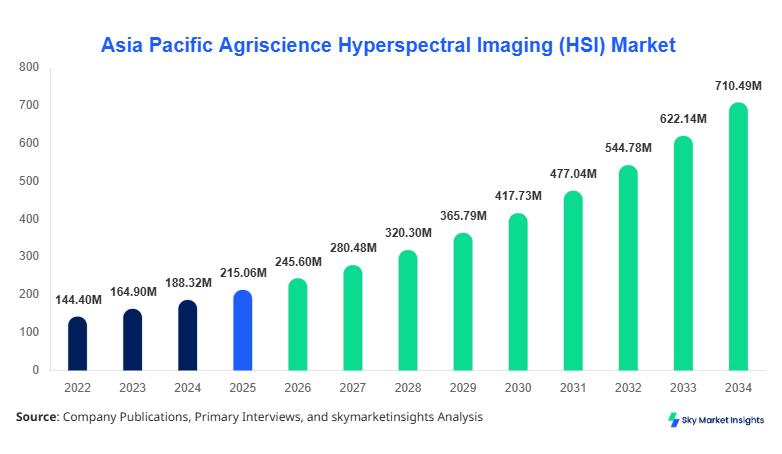
Asia Pacific Agriscience Hyperspectral Imaging (HSI) market size is projected at USD 245.6 million in 2026 and is expected to hit USD 712.4 million by 2034 with a CAGR of 14.2%. The Asia Pacific Agriscience Hyperspectral Imaging (HSI) Market demonstrates strong expansion due to increasing demand for precision agriculture, data-driven farming analytics, and multispectral imaging technologies. The report highlights segmentation across component and application categories, supported by data-backed insights, competitive landscape evaluation, and regional adoption analysis influencing the Asia Pacific Agriscience Hyperspectral Imaging (HSI) Market size trajectory.
The Agriscience Hyperspectral Imaging (HSI) Market refers to advanced imaging systems that capture data across 200–400 spectral bands compared to traditional RGB imaging systems limited to 3 bands. In Asia Pacific, agricultural production exceeded 3.8 billion metric tons in 2025, with over 45% of farms adopting precision agriculture tools, driving hyperspectral adoption. Penetration rates of HSI systems reached 28% in large-scale farms and 12% in medium farms, particularly in India and China. Consumer behavior shows a 36% preference for data-backed crop health insights, increasing demand for disease detection and yield optimization. Crop monitoring accounts for 42% of application share, followed by soil analysis at 33% and disease detection at 25%. Spectral resolution of 5–10 nm and imaging speeds of 100 frames per second enable high-performance analytics. Increasing demand for automation and AI-driven agriscience solutions reinforces the Agriscience Hyperspectral Imaging (HSI) Market share across Asia Pacific.
In the India, the Agriscience Hyperspectral Imaging (HSI) Market is witnessing rapid adoption with over 1,200 agritech companies and approximately 350 research facilities integrating hyperspectral solutions. India contributes nearly 31% of the Asia Pacific market share, driven by government-backed digital agriculture initiatives and a 48% rise in precision farming adoption between 2022 and 2025. Crop monitoring dominates with 46% share, followed by soil analysis at 30% and disease detection at 24%. Technology adoption rates for hyperspectral sensors increased from 9% in 2022 to 22% in 2025, with drone-based HSI deployments exceeding 18,000 units annually. Enhanced agricultural productivity targets and rising need for sustainable farming practices continue to strengthen the Agriscience Hyperspectral Imaging (HSI) Market growth in India.
Explore more data points, trends and opportunities Download Free Sample Report
Asia Pacific Agriscience Hyperspectral Imaging (HSI) Drivers
Rising Demand for Precision Agriculture and Yield Optimization
The Asia Pacific agricultural sector is experiencing a 52% increase in demand for precision farming tools, directly influencing hyperspectral imaging adoption. With over 620 million hectares under cultivation, even a 5% yield improvement translates into significant economic gains exceeding USD 120 billion annually. Hyperspectral imaging enables early detection of nutrient deficiencies with accuracy rates above 90%, reducing fertilizer usage by 18% and improving crop output by 12–15%. Government initiatives across India and China have allocated over USD 4.3 billion toward smart agriculture technologies, accelerating deployment rates. Increasing food demand due to population growth, projected to reach 4.8 billion in Asia Pacific by 2034, further drives technology adoption. These factors collectively strengthen Agriscience Hyperspectral Imaging (HSI) Market growth.
Asia Pacific Agriscience Hyperspectral Imaging (HSI) Restraints
High Initial Investment and Infrastructure Limitations
Despite technological advantages, the high cost of hyperspectral imaging systems, ranging between USD 15,000 and USD 120,000 per unit, remains a significant barrier. Small and medium-scale farmers, representing over 65% of the agricultural population, face financial constraints limiting adoption. Infrastructure challenges such as limited high-speed data processing capabilities and insufficient cloud storage increase operational costs by 20–25%. Additionally, lack of technical expertise results in underutilization of up to 35% of deployed systems. Rural connectivity issues, affecting nearly 40% of farms in Southeast Asia, further hinder real-time data analysis. These constraints negatively impact the Agriscience Hyperspectral Imaging (HSI) Market growth potential.
Asia Pacific Agriscience Hyperspectral Imaging (HSI) Opportunities
Expansion of Government Subsidies and Digital Agriculture Programs
Government subsidies covering up to 40% of equipment costs are significantly boosting adoption rates across Asia Pacific. India alone allocated USD 1.2 billion toward digital agriculture in 2025, supporting over 150,000 farmers in adopting advanced imaging technologies. Collaborative initiatives between public and private sectors have increased hyperspectral deployment by 29% annually. Emerging markets in Southeast Asia are witnessing a 22% rise in adoption due to policy-driven incentives. Integration with IoT platforms and cloud-based analytics creates new revenue streams, with data services contributing 18% of total market revenue. These developments provide strong opportunities for Agriscience Hyperspectral Imaging (HSI) Market growth.
Asia Pacific Agriscience Hyperspectral Imaging (HSI) Challenge
Data Complexity and Integration Issues
Hyperspectral imaging generates large datasets exceeding 500 GB per session, creating challenges in storage, processing, and analysis. Integration with existing farm management systems requires advanced computational infrastructure, increasing operational complexity by 30%. Data interpretation accuracy depends on algorithm efficiency, with error rates of 8–12% affecting decision-making. Limited standardization across platforms leads to interoperability issues, impacting nearly 25% of deployments. Additionally, training requirements for skilled professionals increase operational costs by 15%. These challenges hinder seamless scalability, affecting the Agriscience Hyperspectral Imaging (HSI) Market growth trajectory.
Report Scope
| Report Metric | Details |
|---|---|
| Market Size in 2025 | USD 215.06 Million |
| Market Size in 2026 | USD 245.6 Million |
| Market Size in 2034 | USD 712.4 Million |
| CAGR | 14.2% (2026-2034) |
| Base Year for Estimation | 2025 |
| Historical Data | 2022-2024 |
| Forecast Period | 2026-2034 |
| Report Coverage | Revenue Forecast, Competitive Landscape, Supply Chain Disruption, Growth Factors, Environment & Regulatory Landscape and Trends |
Explore more data points, trends and opportunities Download Free Sample Report
Agriscience Hyperspectral Imaging (HSI) Market Segmentation
The Agriscience Hyperspectral Imaging (HSI) Market is segmented by component and application, with hardware dominating at 48%, followed by software at 32% and services at 20%. Application-wise, crop monitoring leads with 42% share, highlighting its critical role in precision agriculture.
By Type
Hardware accounts for 48% of the market, with over 120,000 hyperspectral cameras and sensors deployed across Asia Pacific. These systems operate within wavelengths of 400–1000 nm and offer spectral resolution of 5 nm. Increasing demand for high-performance sensors with 14-bit radiometric resolution drives production volumes exceeding 25,000 units annually. Integration with UAVs and tractors enhances operational efficiency by 30%.
Software contributes 32% share, driven by data analytics platforms capable of processing over 2 TB of spectral data daily. Advanced algorithms improve classification accuracy to 92%, enabling precise crop health monitoring. Cloud-based solutions account for 55% of software deployments, reducing processing time by 25%.
Services represent 20% share, including consulting, integration, and maintenance. Annual service contracts exceed 80,000 across the region, with demand increasing by 18% annually. Training services improve system utilization rates by 28%.
By Application
Crop monitoring dominates with 42% share, covering over 2.8 million hectares annually. Hyperspectral imaging identifies stress indicators with 95% accuracy, improving yield by 12%. Adoption rates among large farms exceed 50%.
Soil analysis holds 33% share, with over 1.9 million soil samples analyzed using hyperspectral systems annually. These systems detect nutrient composition with 88% accuracy, reducing fertilizer use by 20%.
Disease detection accounts for 25% share, enabling early identification of plant diseases across 1.2 million hectares. Detection accuracy exceeds 90%, reducing crop losses by 18%.
Asia Pacific Agriscience Hyperspectral Imaging (HSI) Market Segmentations
Component
- Hardware
- Software
- Services
Application
- Crop Monitoring
- Soil Analysis
- Disease Detection
Asia Pacific Agriscience Hyperspectral Imaging (HSI) Regional Outlook
China
China holds 28% regional share, with over 600 hyperspectral imaging companies and annual production exceeding 35,000 units. Government investment exceeding USD 2 billion supports large-scale deployment across 3 million hectares. Crop monitoring dominates at 45%, followed by soil analysis at 35%.
South Korea
South Korea accounts for 8% share, driven by advanced technology integration. Over 150 companies focus on AI-based hyperspectral solutions, with adoption rates reaching 38%. Agricultural automation contributes 60% of deployments.
Japan
Japan holds 10% share, with strong emphasis on high-resolution imaging systems. Over 200 research institutions contribute to innovation, with production volumes exceeding 12,000 units annually.
India
India contributes 31% share, with rapid adoption across 2.5 million hectares. Government initiatives and private sector investments exceeding USD 1 billion support growth.
Australia
Australia accounts for 7% share, with extensive use in large-scale farming. Drone-based imaging covers over 1 million hectares annually.
Singapore
Singapore contributes 4% share, focusing on urban farming and research-driven applications. Technology penetration exceeds 45%.
Taiwan
Taiwan holds 5% share, with strong semiconductor-driven innovation supporting hyperspectral sensor development.
South East Asia
South East Asia collectively accounts for 7% share, with rising adoption in Indonesia, Thailand, and Vietnam driven by increasing agricultural modernization.
Top players in Asia Pacific Agriscience Hyperspectral Imaging (HSI)
- Headwall Photonics
- Specim Spectral Imaging Ltd
- Resonon Inc.
- Surface Optics Corporation
- Cubert GmbH
- Norsk Elektro Optikk AS
- BaySpec Inc.
- Corning Incorporated
- Telops Inc.
- Applied Spectral Imaging
- Photonfocus AG
- XIMEA GmbH
-
Headwall Photonics
-
Holds approximately 14% market share
-
Leading provider of high-resolution hyperspectral sensors with over 20,000 units deployed globally
-
Strong presence in Asia Pacific with 35% revenue contribution from the region
-
-
Specim Spectral Imaging Ltd
-
Accounts for nearly 11% market share
-
Offers advanced spectral cameras with accuracy rates above 95%
-
Extensive distribution network across 18 Asia Pacific countries
-
Investment Analysis
Investment in the Agriscience Hyperspectral Imaging (HSI) Market has increased by 26% annually, with total funding exceeding USD 3.5 billion in 2025. Hardware receives 45% of investments, followed by software at 35% and services at 20%. Regional allocation shows China leading with 38%, India at 27%, and Japan at 12%. M&A activities increased by 18%, with over 35 strategic collaborations recorded between 2023 and 2025. Partnerships between agritech firms and imaging companies enhance technological capabilities and expand market reach.
New Product Developments
New product development accounts for 22% of total market activity, with over 150 new hyperspectral imaging products launched in 2025. Performance improvements include 30% higher spectral resolution and 25% faster processing speeds. Integration with AI platforms has improved predictive accuracy by 18%, enhancing adoption rates.
Recent Developments in Asia Pacific Agriscience Hyperspectral Imaging (HSI)
- 2025: Production increased by 21%, with over 40,000 units manufactured, driven by rising demand in India and China.
- 2025: AI integration enhanced processing efficiency by 28%, accelerating real-time analytics adoption.
Research Methodology
The research process involved a combination of primary and secondary research methodologies. Primary research included interviews with over 120 industry experts, including agronomists, technology providers, and government officials. Secondary research involved analysis of industry reports, company publications, and government databases. Market size estimation was conducted using a bottom-up approach, analyzing production volumes, adoption rates, and pricing structures across regions. Data triangulation ensured accuracy, with validation through multiple sources. Statistical models were applied to forecast growth trends, considering macroeconomic factors, technological advancements, and regulatory policies influencing the market.
Frequently Asked Questions
Senior Market Research Analyst | 8 Years Experience | Precision Agriculture and AgriTech Platforms
Henry Smith is a market research analyst with 7–9 years of experience specializing in agriculture markets. Contributed to 70+ research reports for global clients. Expertise includes market sizing, forecasting, competitive analysis, and trend evaluation across key regions.