Europe Amino Acid Fertilizer Market Size
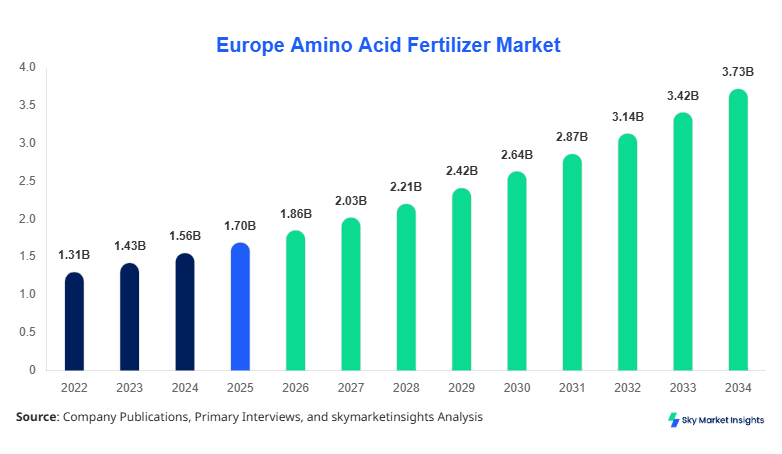
Europe Amino Acid Fertilizer market size is projected at USD 1.86 billion in 2026 and is expected to hit USD 3.74 billion by 2034 with a CAGR of 9.1%.
The increasing adoption of bio-based agricultural inputs across Europe is accelerating demand for amino acid fertilizer products in commercial farming operations. Rising emphasis on sustainable crop nutrition, precision agriculture, and organic farming standards has strengthened product penetration across cereals, horticulture, and greenhouse cultivation. The report evaluates production capacity, pricing structures, trade flows, application segmentation, and competitive positioning of major manufacturers operating in the regional amino acid fertilizer ecosystem. Expanding investments in crop yield optimization technologies and soil health management continue to reshape the Europe Amino Acid Fertilizer market.
The amino acid fertilizer industry comprises plant nutrition formulations developed using hydrolyzed proteins, enzymatic extraction, and microbial fermentation technologies that improve nutrient uptake efficiency, chlorophyll synthesis, stress tolerance, and crop productivity. Europe produced more than 4.8 million metric tons of specialty biofertilizer products in 2025, with amino acid fertilizer formulations accounting for nearly 18.4% of the specialty nutrition category. Adoption rates among greenhouse vegetable growers exceeded 54% across Western Europe, while organic farms represented nearly 31% of total amino acid fertilizer consumption. Consumer demand for residue-free food products increased by 22% between 2022 and 2025, pushing farmers toward biological crop enhancement products with lower environmental impact.
Demand analytics indicate that foliar amino acid formulations represented 47% of total product utilization in 2025 due to rapid nutrient absorption and drought stress mitigation capabilities. Liquid formulations contributed 51% of product consumption, followed by powder-based products at 33% and granular products at 16%. Cereals and grains accounted for 39% of application demand, while fruits and vegetables contributed 42% owing to intensive cultivation practices in greenhouse agriculture. Average nitrogen conversion efficiency improved by 14%–19% with amino acid fertilizer integration, while micronutrient uptake efficiency improved by nearly 23%. The Europe Amino Acid Fertilizer market continues to expand with growing penetration across sustainable agricultural production systems.
Explore more data points, trends and opportunities Download Free Sample Report
Amino Acid Fertilizer Market Trends
Expansion of Organic and Regenerative Farming Practices
The rapid transition toward organic and regenerative agriculture across Europe is significantly influencing amino acid fertilizer adoption. Organic farmland across Europe exceeded 19.8 million hectares in 2025, increasing from 16.4 million hectares in 2022. Spain, Italy, Germany, and France collectively contributed more than 63% of the total certified organic cultivation area. Amino acid fertilizer demand from organic horticulture farms expanded by 17.6% in 2025 due to higher consumer preference for chemical-free food products and stricter environmental regulations. More than 48% of greenhouse vegetable growers incorporated amino acid fertilizer products into crop management programs to improve nutrient assimilation and reduce synthetic fertilizer dependence. Increased focus on carbon-neutral farming systems and soil microbiome enhancement continues to strengthen Europe Amino Acid Fertilizer market expansion.
Rising Adoption of Precision Agriculture Technologies
Precision agriculture technologies are reshaping nutrient management practices across the Europe agricultural sector. More than 37% of large commercial farms integrated smart fertigation systems with amino acid fertilizer dosing mechanisms in 2025 compared with 22% in 2022. Drone-assisted foliar application technologies increased by 31%, while AI-enabled crop monitoring systems expanded by 26% annually across greenhouse and high-value crop cultivation. Advanced liquid amino acid fertilizer products demonstrated nutrient absorption efficiency improvements exceeding 24% compared with conventional nutrient formulations. Germany and the United Kingdom collectively represented nearly 41% of precision nutrient application investments in Europe. Technology-driven nutrient optimization continues to reinforce Europe Amino Acid Fertilizer market development.
Growth in Stress-Resistance Crop Nutrition Products
Climate variability and recurring drought conditions across Southern and Eastern Europe are accelerating demand for stress-resistance crop nutrition products. Heatwave-related crop losses increased by 14% between 2022 and 2025, encouraging farmers to adopt amino acid fertilizer products capable of improving osmotic balance and physiological stress tolerance. More than 52% of vineyard operators in Italy and Spain adopted amino acid fertilizer solutions to improve crop quality and reduce moisture stress impacts. Seaweed-amino acid blended formulations recorded annual sales growth of 18.9%, while enzymatic hydrolysis-based amino acid products achieved nearly 21% penetration in premium horticulture farming. The increasing emphasis on climate-resilient agriculture continues supporting Europe Amino Acid Fertilizer market development.
Europe Amino Acid Fertilizer Drivers
Rising Demand for Sustainable Crop Nutrition Solutions
Growing restrictions on synthetic agrochemical usage and increasing sustainability targets across Europe are major drivers accelerating amino acid fertilizer adoption. European agricultural emissions reduction initiatives targeting a 55% carbon reduction by 2030 are encouraging farmers to replace chemical-intensive nutrient programs with biologically derived fertilizers. More than 46% of commercial farms in Western Europe implemented partial biological fertilization strategies in 2025 compared with 29% in 2022. Amino acid fertilizer products improved nutrient utilization efficiency by 16%–25%, reduced nitrogen leaching losses by 13%, and enhanced drought tolerance across multiple crop categories. The fruits and vegetables segment alone consumed more than 1.2 million metric tons of amino acid fertilizer formulations during 2025. Increased consumer demand for organic produce, which expanded by 11.8% annually across Europe, continues to support biofertilizer investments. Government subsidy programs covering up to 22% of biological input costs in Germany, France, and Spain are further strengthening adoption. Expanding greenhouse cultivation and controlled-environment agriculture are also increasing product demand because amino acid fertilizer solutions improve crop uniformity and productivity under intensive cultivation systems. These factors continue accelerating Europe Amino Acid Fertilizer market expansion.
Europe Amino Acid Fertilizer Restraints
High Production and Formulation Costs
The relatively high manufacturing cost of amino acid fertilizer products remains a significant challenge for large-scale market penetration across price-sensitive agricultural regions. Protein hydrolysis, fermentation, and enzymatic extraction processes increase production expenses by nearly 28%–34% compared with conventional synthetic nutrient products. Raw material price volatility associated with animal proteins, plant proteins, and fermentation substrates also creates margin pressure for manufacturers. Average amino acid fertilizer product pricing ranged between USD 1,120 and USD 1,850 per metric ton in 2025, considerably higher than traditional NPK fertilizer products priced below USD 650 per metric ton. Small and medium-sized farms across Eastern Europe continue demonstrating lower adoption rates due to limited purchasing capacity and uncertain short-term yield gains. In Russia and parts of Southern Europe, amino acid fertilizer penetration remained below 18% because of insufficient awareness regarding long-term soil health benefits. Logistics expenses increased by 12% during 2024–2025 owing to rising energy and transportation costs, further impacting market competitiveness. Limited standardization of amino acid concentration levels and inconsistent product quality across regional suppliers also create hesitation among growers. These factors continue restricting Europe Amino Acid Fertilizer market penetration.
Europe Amino Acid Fertilizer Opportunities
Expansion of Controlled Environment Agriculture
The rapid development of greenhouse farming, hydroponics, and vertical agriculture presents substantial opportunities for amino acid fertilizer manufacturers across Europe. Greenhouse cultivation area across the region exceeded 248,000 hectares in 2025 and is projected to expand at over 8.4% annually through 2034. Hydroponic vegetable production alone increased by 19% between 2023 and 2025 due to urban food demand and water conservation requirements. Amino acid fertilizer solutions are increasingly integrated into fertigation systems because they improve nutrient solubility, root development, and stress recovery under controlled cultivation environments. More than 64% of hydroponic lettuce and tomato farms in the Netherlands, Germany, and the United Kingdom incorporated amino acid fertilizer products in nutrient programs during 2025. Investments exceeding USD 2.4 billion were allocated toward smart greenhouse infrastructure across Europe between 2023 and 2025. Product manufacturers are also developing highly concentrated formulations with 80%–90% amino acid purity levels suitable for precision agriculture systems. Rising investments in indoor farming and high-efficiency crop production technologies are expected to create substantial growth potential for the Europe Amino Acid Fertilizer market.
Europe Amino Acid Fertilizer Challenge
Regulatory Complexity and Product Certification Requirements
Regulatory compliance and certification procedures represent a major operational challenge for amino acid fertilizer manufacturers across Europe. Biological input regulations differ significantly across regional jurisdictions, creating lengthy approval timelines and additional compliance costs for product registration. More than 37% of small fertilizer producers reported delays exceeding 12 months for product approvals during 2024 and 2025. Organic certification standards regarding amino acid source materials, residue thresholds, and microbial contamination controls continue to tighten across the European Union. Manufacturers spend nearly 6%–9% of annual operating budgets on regulatory testing, documentation, and compliance management. Restrictions on animal-origin hydrolysates in selected European countries have also increased reformulation expenses by nearly 14%. Furthermore, inconsistent labeling requirements and nutrient declaration standards create distribution barriers across cross-border trade channels. Limited farmer awareness regarding application dosage optimization also results in inconsistent field performance outcomes. Climatic variability affecting crop nutrient absorption rates creates additional uncertainty for growers evaluating product return on investment. These operational and regulatory barriers continue challenging Europe Amino Acid Fertilizer market development.
Report Scope
| Report Metric | Details |
|---|---|
| Market Size in 2025 | USD 1.71 Billion |
| Market Size in 2026 | USD 1.86 Billion |
| Market Size in 2034 | USD 3.74 Billion |
| CAGR | 9.1% (2026-2034) |
| Base Year for Estimation | 2025 |
| Historical Data | 2022-2024 |
| Forecast Period | 2026-2034 |
| Report Coverage | Revenue Forecast, Competitive Landscape, Supply Chain Disruption, Growth Factors, Environment & Regulatory Landscape and Trends |
Explore more data points, trends and opportunities Download Free Sample Report
Amino Acid Fertilizer Market Segmentation
The Europe amino acid fertilizer industry is segmented by type and application based on formulation technology, nutrient delivery systems, crop compatibility, and cultivation requirements. Liquid formulations dominated with 51% share in 2025 owing to higher compatibility with fertigation systems and foliar application methods. Fruits and vegetables remained the largest application category with 42% demand share because of intensive greenhouse cultivation and high nutrient sensitivity in horticulture crops.
By Type
Liquid amino acid fertilizer represented the largest segment with approximately 51% revenue contribution in 2025. The segment produced more than 1.9 million metric tons across Europe due to increasing adoption in fertigation and foliar spray systems. Liquid products demonstrated nutrient absorption efficiency improvements of 21%–26% and reduced application wastage by nearly 18% compared with granular nutrient formulations. Greenhouse vegetable cultivation accounted for 46% of liquid formulation demand, while cereal applications contributed 29%. Average amino acid concentration levels ranged between 25% and 40%, supporting rapid plant metabolic activation during stress conditions.
Powder amino acid fertilizer accounted for nearly 33% of total market revenue in 2025 owing to longer shelf life and ease of transportation. Production volumes exceeded 1.2 million metric tons across Germany, France, and Spain. Powder products are widely utilized in dry blending operations and seed treatment applications because of superior storage stability and nutrient concentration exceeding 60% amino acid purity. Nearly 39% of powder-based demand originated from organic cereal production systems, while 31% came from horticulture applications. Water solubility rates improved by 14% through enzymatic hydrolysis processing technologies introduced between 2023 and 2025.
Granular amino acid fertilizer contributed approximately 16% share due to slower adoption across high-intensity farming operations. However, demand increased steadily across oilseed and pulse cultivation systems requiring controlled nutrient release. Production exceeded 620,000 metric tons in 2025, with Italy and Russia collectively accounting for 41% of granular product output. Controlled-release granules improved nutrient retention efficiency by 17% and reduced irrigation-linked nutrient loss by nearly 13%. Large-scale field crop cultivation remains the primary growth area for granular amino acid fertilizer products.
By Application
Fruits and vegetables represented the dominant application category with 42% market share in 2025 due to intensive greenhouse cultivation and high-value crop management practices. More than 2.1 million metric tons of amino acid fertilizer products were consumed across greenhouse tomato, cucumber, lettuce, pepper, and berry cultivation systems. Yield enhancement ranging between 12% and 19% was observed across controlled-environment horticulture farms using amino acid fertilizer formulations. Spain, Italy, and the United Kingdom represented nearly 58% of regional horticulture consumption due to extensive greenhouse infrastructure and export-oriented fresh produce industries.
Cereals and grains accounted for approximately 39% share because of rising emphasis on nutrient efficiency and climate-resilient crop production. Wheat, barley, maize, and rye cultivation collectively consumed more than 1.8 million metric tons of amino acid fertilizer products during 2025. Germany and France contributed nearly 44% of cereal-related demand owing to extensive mechanized farming operations. Foliar amino acid applications improved chlorophyll retention by 16% and drought tolerance by 13% in cereal production systems. Precision spraying technologies increased application efficiency across large-scale grain cultivation areas.
Oilseeds and pulses contributed nearly 19% share in 2025, supported by increasing protein crop cultivation and sustainable farming initiatives. Soybean, sunflower, rapeseed, and pulse farming consumed approximately 870,000 metric tons of amino acid fertilizer products across Europe. Italy and Russia represented nearly 36% of total oilseed demand due to large-scale sunflower and rapeseed cultivation. Amino acid fertilizer integration improved nitrogen fixation efficiency by 11% and increased seed protein content by 7%–9% across pulse crops. Expanding plant-protein consumption trends continue driving demand in this segment.
Europe Amino Acid Fertilizer Market Segmentations
Type
- Liquid Amino Acid Fertilizer
- Powder Amino Acid Fertilizer
- Granular Amino Acid Fertilizer
Application
- Cereals & Grains
- Fruits & Vegetables
- Oilseeds & Pulses
Europe Amino Acid Fertilizer Regional Outlook
United Kingdom
The United Kingdom accounted for approximately 24.7% of Europe market revenue in 2025 owing to strong greenhouse farming infrastructure and high biological fertilizer adoption rates. More than 420 specialty nutrient manufacturing and blending facilities operated across the country, supporting production exceeding 760,000 metric tons annually. Fruits and vegetables represented 44% of national demand, while cereals and grains accounted for 36%. Precision agriculture technology penetration exceeded 39% among large-scale commercial farms, accelerating foliar amino acid fertilizer usage. Organic cultivation area expanded by 13% between 2022 and 2025, supporting demand for sustainable nutrient products.
Germany
Germany represented nearly 21% of the regional revenue due to advanced agricultural mechanization and strong environmental sustainability policies. The country produced over 680,000 metric tons of amino acid fertilizer products in 2025, with liquid formulations accounting for 55% of domestic consumption. More than 31% of commercial farms integrated biological nutrient management systems. Cereals and grains represented 41% of application demand, while greenhouse horticulture contributed 34%. Government sustainability incentives covering up to 20% of biological fertilizer investment costs strengthened market adoption across precision farming operations.
France
France accounted for approximately 17% of Europe market revenue in 2025 due to extensive cereal cultivation and increasing organic farming penetration. More than 510,000 metric tons of amino acid fertilizer products were consumed across wheat, barley, and horticulture farming operations. Organic agricultural land exceeded 2.9 million hectares, representing nearly 11% of total agricultural area. Powder amino acid fertilizer products dominated with 38% share because of strong utilization in dry nutrient blending systems. Viticulture and vineyard cultivation contributed significantly to demand growth owing to stress-mitigation benefits under fluctuating climatic conditions.
Spain
Spain contributed nearly 14% of regional revenue owing to intensive greenhouse horticulture and export-oriented vegetable cultivation. The country operated more than 73,000 hectares of greenhouse cultivation infrastructure concentrated in Almería and Murcia. Amino acid fertilizer demand exceeded 430,000 metric tons in 2025, with fruits and vegetables accounting for nearly 58% of consumption. Water scarcity concerns accelerated adoption of precision fertigation systems integrated with liquid amino acid fertilizer products. More than 47% of greenhouse operators implemented biological nutrient management strategies between 2023 and 2025.
Italy
Italy accounted for approximately 13% of the Europe market in 2025 driven by strong horticulture, vineyard, and olive cultivation industries. More than 390,000 metric tons of amino acid fertilizer products were consumed across protected cultivation and specialty crop farming operations. Organic farming penetration exceeded 18%, among the highest levels in Europe. Vineyard cultivation represented nearly 24% of amino acid fertilizer demand due to increasing climate-related crop stress conditions. Liquid and powder formulations collectively accounted for 84% of national consumption owing to widespread foliar nutrient application practices.
Russia
Russia represented nearly 10% of regional revenue despite relatively lower penetration of specialty biological fertilizers. Large-scale cereal and oilseed cultivation supported consumption exceeding 310,000 metric tons in 2025. Granular amino acid fertilizer products accounted for 29% of domestic demand because of broad-acre farming suitability. Adoption rates among industrial farming enterprises increased by 16% annually between 2022 and 2025. Government agricultural modernization programs and increasing export-oriented grain production are expected to improve biological fertilizer penetration over the forecast period.
Top players in Europe Amino Acid Fertilizer
- Isagro S.p.A.
- Biolchim S.p.A.
- Haifa Group
- UPL Limited
- Tradecorp International
- Valagro S.p.A.
- Daymsa
- Fertenia S.L.
- Bionema Group
- ICL Group
- Atlántica Agrícola
- Agronutrition
- Hello Nature International
- Sikko Industries Ltd.
- Suståne Natural Fertilizer Inc.
Valagro S.p.A.
-
Valagro S.p.A. accounted for approximately 11.4% of Europe amino acid fertilizer revenue in 2025.
-
The company maintains strong positioning in biostimulants and specialty crop nutrition solutions across Italy, Spain, France, and Germany.
-
More than 38% of its product portfolio consists of amino acid and seaweed-based crop enhancement products.
-
The company operates advanced fermentation and extraction facilities capable of producing over 180,000 metric tons annually.
-
Investments in precision fertigation-compatible liquid formulations increased by 22% between 2023 and 2025.
-
Strong partnerships with greenhouse horticulture operators continue strengthening its Europe market presence.
Haifa Group
-
Haifa Group represented nearly 9.6% of Europe amino acid fertilizer sales during 2025.
-
The company maintains significant presence in fertigation systems and controlled-environment agriculture solutions.
-
More than 41% of its regional revenue originates from liquid amino acid fertilizer products integrated with precision irrigation technologies.
-
The company expanded R&D spending by 18% in 2025 to develop high-concentration amino acid formulations with enhanced nutrient uptake performance.
-
Distribution partnerships across the United Kingdom, Germany, and Spain support strong regional penetration.
-
Its advanced soluble nutrient portfolio continues reinforcing its competitive positioning across the Europe market.
Investment Analysis
Investment activity in the Europe amino acid fertilizer industry accelerated considerably between 2023 and 2026 due to increasing sustainability regulations and rising demand for biological crop nutrition products. More than USD 4.6 billion was allocated toward specialty fertilizer manufacturing, biological input R&D, and precision agriculture integration projects during the period. Approximately 39% of investments targeted liquid amino acid fertilizer production facilities, while 27% focused on fermentation-based amino acid extraction technologies. Greenhouse agriculture and controlled-environment farming collectively represented 33% of regional investment allocation. Germany, the United Kingdom, and Spain accounted for nearly 58% of total regional capital expenditure owing to strong greenhouse and high-value crop cultivation industries.
Mergers, acquisitions, and strategic collaborations increased substantially across the Europe agricultural biologicals sector. More than 26 partnership agreements involving specialty fertilizer manufacturers, agri-biotech firms, and precision agriculture companies were recorded between 2023 and 2025. Several companies invested heavily in microbial fermentation technologies capable of improving amino acid purity levels by 18%–24%. Joint ventures between greenhouse technology providers and biological fertilizer manufacturers expanded rapidly, especially across Spain and the Netherlands. Venture capital funding directed toward sustainable crop nutrition startups increased by nearly 31% annually, while investments in AI-based nutrient optimization systems expanded by 28%. Strategic consolidation among regional distributors and formulation companies is expected to continue supporting market expansion through 2034.
New Product Developments
Manufacturers operating in the Europe amino acid fertilizer industry introduced multiple high-efficiency formulations between 2024 and 2026 to improve nutrient uptake, stress tolerance, and application flexibility. More than 34% of newly launched products featured advanced enzymatic hydrolysis technologies capable of increasing amino acid bioavailability by 21%. Liquid formulations with amino acid concentrations above 45% expanded by 18% annually owing to increasing demand from fertigation systems and hydroponic farming operations. Companies also launched seaweed-amino acid blends designed to improve root growth and chlorophyll synthesis under drought stress conditions.
Innovation activity intensified across precision-compatible nutrient delivery systems. Nearly 29% of new products introduced during 2025 included compatibility with drone-assisted spraying and automated irrigation systems. Water-soluble powder formulations demonstrated dissolution efficiency improvements exceeding 17%, reducing application time and nutrient sedimentation issues. Product manufacturers also focused on low-sodium formulations and organic-certified amino acid products to address regulatory and sustainability requirements across Europe.
Recent Developments in Europe Amino Acid Fertilizer
- 2025: Valagro expanded its liquid amino acid fertilizer production capacity by 16% across Italy and Spain, increasing annual output beyond 210,000 metric tons. The company also invested in advanced fermentation systems improving amino acid extraction efficiency by 19%, supporting stronger supply for greenhouse horticulture operations across Western Europe.
- 2025: Haifa Group introduced a high-concentration fertigation-compatible amino acid fertilizer range for hydroponic vegetable cultivation. The new formulations improved nutrient absorption rates by 23% and reduced irrigation nutrient losses by nearly 12%, targeting rapidly expanding greenhouse farming infrastructure in Germany and the United Kingdom.
- 2025: ICL Group expanded specialty biological fertilizer investments by allocating over USD 120 million toward R&D and sustainable nutrient manufacturing infrastructure across Europe. The investment improved production automation by 26% and strengthened development of climate-resilient amino acid fertilizer formulations for drought-sensitive crop systems.
Research Methodology
The Europe amino acid fertilizer industry analysis was developed using a structured multi-stage research methodology integrating both primary and secondary research approaches. The research process included extensive data collection from agricultural ministries, fertilizer trade associations, company annual reports, sustainability publications, import-export databases, and biological fertilizer regulatory authorities across Europe. Primary research involved interviews with fertilizer manufacturers, greenhouse operators, distributors, agronomists, and agricultural technology providers to validate production capacity, pricing structures, adoption rates, and technology penetration trends. More than 85 industry participants contributed qualitative and quantitative insights supporting market validation.
Secondary research included analysis of agricultural production statistics, crop cultivation area trends, organic farming penetration, precision agriculture investments, and specialty fertilizer trade flows from 2022 to 2025. Market size estimation was conducted using both top-down and bottom-up analytical models integrating regional revenue data, product pricing benchmarks, production capacities, and consumption trends across the United Kingdom, Germany, France, Spain, Italy, and Russia. Forecast modeling incorporated macroeconomic indicators, sustainability regulations, greenhouse farming expansion, and biological fertilizer adoption patterns through 2034. Data triangulation and statistical validation techniques were used to ensure accuracy and consistency across all market projections and competitive assessments.
Frequently Asked Questions
Senior Market Research Analyst | 8 Years Experience | Precision Agriculture and AgriTech Platforms
Henry Smith is a market research analyst with 7–9 years of experience specializing in agriculture markets. Contributed to 70+ research reports for global clients. Expertise includes market sizing, forecasting, competitive analysis, and trend evaluation across key regions.