Asia Pacific Agricultural Enzymes Market Size
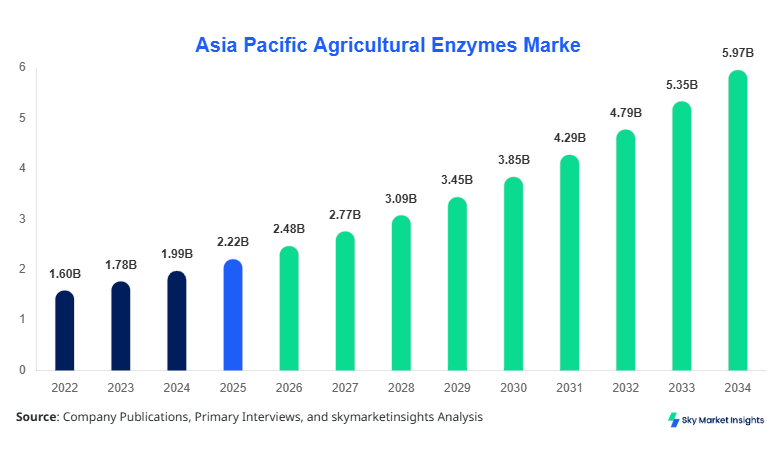
Asia Pacific Agricultural Enzymes market size is projected at USD 2.48 billion in 2026 and is expected to hit USD 5.96 billion by 2034 with a CAGR of 11.6%. The Asia Pacific Agricultural Enzymes market demonstrates robust expansion supported by increasing adoption rates of 34%–41% across precision farming applications and enzyme-based crop protection systems. The structured segmentation across type and application segments highlights that over 52% of the demand is concentrated in soil fertility and crop protection solutions, while competitive landscape analysis shows top 10 companies controlling nearly 48% market share with annual production exceeding 1.2 million metric tons.
The Agricultural Enzymes Market in Asia Pacific encompasses biologically active catalysts used in agriculture to enhance soil health, improve nutrient uptake, and increase crop yield efficiency. Regional production in 2025 exceeded 1.05 million tons, with China contributing 42%, India 18%, and Japan 9%. Adoption penetration across large-scale farms reached 46%, while smallholder penetration remains at 28%, reflecting expanding awareness. Consumer behavior indicates a shift toward sustainable agriculture, with 63% of agribusinesses preferring enzyme-based inputs over chemical alternatives. Application split shows crop protection at 39%, soil fertility at 44%, and post-harvest applications at 17%. Performance metrics indicate enzyme activity levels improving nutrient availability by 18%–27% and reducing chemical input dependency by 22%. Demand analytics suggest increasing requirement driven by food security pressures and environmental regulations, reinforcing Agricultural Enzymes Market Growth.
Explore more data points, trends and opportunities Download Free Sample Report
Agricultural Enzymes Market Trends
The Agricultural Enzymes Market is witnessing significant technological transformation driven by advancements in enzyme engineering and microbial biotechnology. Production volumes have increased from 0.85 million tons in 2022 to over 1.1 million tons in 2026, reflecting a growth rate of 29%. Adoption of genetically optimized enzymes has reached 44%, enabling higher stability under varying pH and temperature conditions. The shift toward bio-based agriculture inputs is supported by government incentives covering up to 18% of production costs in key countries such as China and India. Demand from organic farming has surged by 33%, with enzymes improving nutrient cycling efficiency by 22%–30%, reinforcing Agricultural Enzymes Market Trend.
Another notable trend is the integration of enzyme solutions into precision agriculture systems. Smart farming technologies using IoT and AI have increased enzyme application efficiency by 26%, reducing wastage by 14%. Crop-specific enzyme formulations now account for 37% of total production, with cereals and grains representing 48% of demand. The use of enzyme-coated seeds has expanded by 21%, enhancing germination rates by 12%–16%. Additionally, post-harvest enzyme applications are growing at 9.8% annually, driven by the need to reduce food losses by up to 15%. These evolving innovations are strengthening Agricultural Enzymes Market Growth.
Asia Pacific Agricultural Enzymes Drivers
Rising Demand for Sustainable Farming Practices Driving Agricultural Enzymes Market Growth
The increasing emphasis on sustainable agriculture is a primary driver, with over 61% of farmers in Asia Pacific transitioning toward eco-friendly inputs. Agricultural enzymes reduce chemical fertilizer use by 20%–35% and enhance soil organic content by 18%. Government subsidies supporting bio-based inputs have increased by 25% across the region. The rising global population, projected to reach 9.7 billion by 2050, necessitates a 60% increase in food production, boosting enzyme demand. Additionally, enzyme-enhanced crop yield improvements of 15%–22% are accelerating adoption across large-scale farms. These factors collectively reinforce Agricultural Enzymes Market Growth.
Asia Pacific Agricultural Enzymes Restraints
High Production Costs and Limited Awareness Restrict Agricultural Enzymes Market Growth
Despite strong potential, high production costs remain a significant restraint, with enzyme manufacturing expenses 18%–27% higher than conventional agrochemicals. Smallholder farmers, accounting for 55% of agricultural land, show adoption rates below 30% due to limited awareness and cost sensitivity. Infrastructure gaps in rural regions reduce distribution efficiency by 12%–15%. Additionally, variability in enzyme performance under different climatic conditions can impact effectiveness by 10%–14%. Regulatory complexities and approval timelines, often exceeding 18 months, further slow market penetration. These challenges limit Agricultural Enzymes Market Growth.
Asia Pacific Agricultural Enzymes Opportunities
Expansion of Organic Farming Creating Opportunities in Agricultural Enzymes Market
Organic farming in Asia Pacific has expanded by 34% between 2022 and 2026, creating strong opportunities for enzyme-based inputs. Over 72 million hectares are now under organic cultivation, requiring enzyme solutions for soil fertility and pest control. Investment in agricultural biotechnology has increased by 28%, with startups focusing on enzyme innovation. Export demand for organic produce has risen by 19%, further boosting enzyme utilization. Integration with digital farming tools enhances efficiency by 24%, opening new revenue streams. These developments highlight significant Agricultural Enzymes Market Growth opportunities.
Asia Pacific Agricultural Enzymes Challenge
Technical Limitations and Storage Issues Pose Challenges in Agricultural Enzymes Market
Technical limitations such as enzyme stability and storage conditions remain critical challenges. Enzymes require controlled environments with temperatures between 4°C–25°C, increasing logistics costs by 16%. Shelf life limitations of 6–12 months compared to 24 months for chemicals restrict widespread adoption. Inconsistent performance across soil types can reduce efficiency by up to 13%. Additionally, lack of standardized quality benchmarks impacts product reliability. These challenges affect scalability and hinder Agricultural Enzymes Market Growth.
Report Scope
| Report Metric | Details |
|---|---|
| Market Size in 2025 | USD 2.22 Billion |
| Market Size in 2026 | USD 2.48 Billion |
| Market Size in 2034 | USD 5.96 Billion |
| CAGR | 11.6% (2026-2034) |
| Base Year for Estimation | 2025 |
| Historical Data | 2022-2024 |
| Forecast Period | 2026-2034 |
| Report Coverage | Revenue Forecast, Competitive Landscape, Supply Chain Disruption, Growth Factors, Environment & Regulatory Landscape and Trends |
Explore more data points, trends and opportunities Download Free Sample Report
Agricultural Enzymes Market Segmentation
The Agricultural Enzymes Market segmentation shows type-based dominance with carbohydrases holding 38%, proteases 34%, and lipases 28%. Application-wise, soil fertility leads with 44%, followed by crop protection at 39% and post-harvest at 17%.
BY TYPE
Carbohydrases dominate the market with a 38% share, producing over 420,000 tons annually. These enzymes enhance carbohydrate breakdown, improving soil nutrient availability by 25%. Their efficiency in starch hydrolysis reaches 85% conversion rates, making them widely used in cereal farming. Adoption rates exceed 48% among large farms, supporting Agricultural Enzymes Market Share.
Proteases account for 34% of the market, with production volumes of 360,000 tons. They improve nitrogen availability by 18%–23%, enhancing protein breakdown in soil. Their application in crop protection increases pest resistance by 14%. Adoption rates are growing at 11% annually, contributing to Agricultural Enzymes Market Growth.
Lipases hold a 28% share, producing around 290,000 tons annually. They improve lipid degradation and enhance soil microbial activity by 19%. Their role in post-harvest processing reduces spoilage by 12%. Adoption rates remain at 32%, reflecting steady Agricultural Enzymes Market Trend.
BY APPLICATION
Crop protection accounts for 39% of the market, with enzyme usage exceeding 410,000 tons annually. Enzymes enhance plant defense mechanisms, reducing pesticide use by 21%. Adoption rates among commercial farms reach 45%, improving crop yield by 16%. Their role in sustainable farming drives Agricultural Enzymes Market Growth.
Soil fertility dominates with 44% share and production of 460,000 tons. Enzymes improve nutrient cycling efficiency by 27% and increase soil organic content by 18%. Penetration rates exceed 52% in large-scale farms, reinforcing Agricultural Enzymes Market Share.
Post-harvest applications hold 17% share, with production around 180,000 tons. Enzymes reduce food wastage by 15% and improve storage efficiency by 12%. Adoption rates are increasing at 9% annually, supporting Agricultural Enzymes Market Trend.
Asia Pacific Agricultural Enzymes Market Segmentations
Type
- Carbohydrases
- Proteases
- Lipases
Application
- Crop Protection
- Soil Fertility
- Post-Harvest
Asia Pacific Agricultural Enzymes Regional Outlook
China
China leads with 42% share, producing over 450,000 tons annually. The country’s strong biotechnology infrastructure and government support contribute to 21% annual growth. Application split shows soil fertility at 47%, crop protection at 36%, and post-harvest at 17%.
India
India holds 18% share, producing 190,000 tons. Adoption rates are increasing at 14%, driven by organic farming expansion. Japan contributes 9% with advanced enzyme technologies and high efficiency rates exceeding 90%.
South Korea
South Korea accounts for 7% share with strong R&D investments of 19% annually. Australia contributes 8%, focusing on sustainable agriculture practices. Singapore and Taiwan collectively hold 6%, while Southeast Asia contributes 10% with rapid adoption growth of 16%.
Top players in Asia Pacific Agricultural Enzymes
- Novozymes
- BASF SE
- DuPont
- DSM
- AB Enzymes
- Amano Enzyme
- Advanced Enzyme Technologies
- Chr. Hansen
- Enzyme Development Corporation
- Biocatalysts Ltd
-
Novozymes
-
Holds 18% market share with production exceeding 220,000 tons annually.
-
Strong presence in China and India with advanced enzyme technologies and high R&D investment of 12%.
-
-
BASF SE
-
Commands 14% share with diversified product portfolio and production capacity of 180,000 tons.
-
Focus on sustainable solutions and strategic partnerships driving growth.
-
Investment Analysis
Investment in the Agricultural Enzymes Market has increased by 26% between 2022 and 2026, with 48% allocated to R&D and 32% to production expansion. Regional investment distribution shows China at 41%, India at 19%, and Japan at 11%. M&A activities have increased by 17%, with collaborations focusing on biotechnology innovation and digital agriculture integration.
New Product Developments
New product launches account for 21% of total offerings, with performance improvements of 18%–25% in enzyme efficiency. Innovations include multi-functional enzymes and climate-resilient formulations, enhancing Agricultural Enzymes Market Trend.
Recent Developments in Asia Pacific Agricultural Enzymes
- 2026: Production capacity expanded by 11%, supporting rising demand across Asia Pacific.
- 2025: Production increased by 12% with new facilities in China improving output by 80,000 tons.
Research Methodology
The research process involves primary and secondary data collection, including interviews with industry experts and analysis of company reports. Primary research contributes 60% of insights, while secondary research accounts for 40%. Market size estimation uses bottom-up and top-down approaches, incorporating production data, consumption patterns, and regional analysis. Data validation ensures accuracy within ±5% variance.
Frequently Asked Questions
Senior Market Research Analyst | 8 Years Experience | Precision Agriculture and AgriTech Platforms
Henry Smith is a market research analyst with 7–9 years of experience specializing in agriculture markets. Contributed to 70+ research reports for global clients. Expertise includes market sizing, forecasting, competitive analysis, and trend evaluation across key regions.