Europe Algaculture Market Size
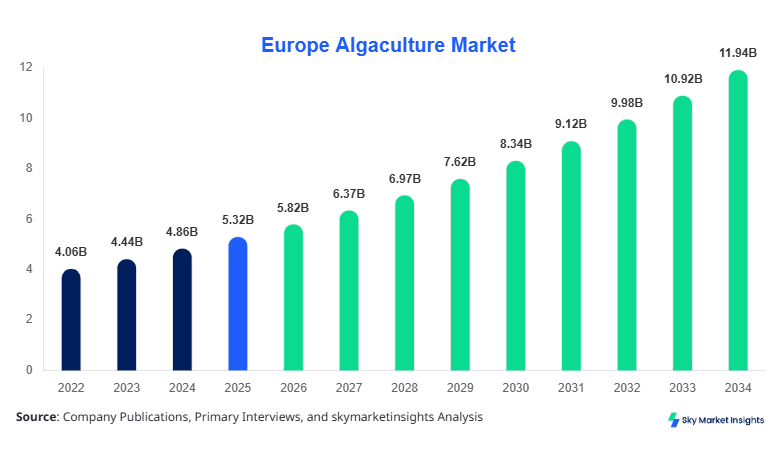
Europe Algaculture market size is projected at USD 5.82 billion in 2026 and is expected to hit USD 11.96 billion by 2034 with a CAGR of 9.4%.
The Europe Algaculture Market continues to expand due to rising investments in sustainable biomass cultivation, high-value algae-derived proteins, and renewable biofuel applications across France, Germany, and the United Kingdom. Increasing demand for nutraceuticals, pharmaceutical-grade extracts, and low-carbon production systems is accelerating commercialization activities across more than 2,400 operational algaculture facilities in Europe. The market evaluation includes detailed segmentation analysis, production capacity assessment, distribution networks, technology penetration, and competitive landscape benchmarking across key European economies.
The algaculture industry refers to the controlled cultivation and commercialization of algae species including microalgae, macroalgae, and cyanobacteria for applications in food processing, pharmaceuticals, cosmetics, feedstock, and renewable energy production. Europe produced approximately 18.6 million metric tons of cultivated algae biomass in 2025, with France accounting for nearly 22% of regional production output. Closed photobioreactor systems represented 41% of total commercial installations, while open pond cultivation contributed 59% of industrial-scale production volume. Adoption of algal protein ingredients in functional foods increased by 17.3% during 2025 as consumer demand for vegan nutrition and sustainable protein sources accelerated across Europe.
Consumer purchasing behavior indicates that 48% of European consumers prefer plant-based nutritional supplements containing spirulina and chlorella extracts due to their protein concentration exceeding 55% dry weight content. Food and beverage applications accounted for 46% of overall demand, followed by pharmaceuticals at 29% and biofuel applications at 18%. More than 620,000 tons of algae-derived food additives were consumed across Europe in 2025, while pharmaceutical-grade algae extracts reached 74,000 tons in annual processing volume. Technological efficiency improvements enabled biomass productivity rates of 28–42 grams per square meter daily in advanced photobioreactor facilities. Europe Algaculture Market analysis further highlights increasing adoption across renewable industrial applications.
Explore more data points, trends and opportunities Download Free Sample Report
Algaculture Market Trends
The increasing integration of algae-derived proteins into functional foods and nutraceutical products represents one of the strongest industry trends across Europe. During 2025, algae protein incorporation in sports nutrition products increased by 21%, while vegan dietary supplement launches containing spirulina extracts rose by 26%. More than 1,800 food manufacturers across Europe integrated algae ingredients into beverages, bakery products, and fortified snacks. Production output from high-density photobioreactors exceeded 7.4 million metric tons annually, reflecting rapid industrialization of microalgae cultivation. Advanced LED-controlled cultivation systems improved algae growth efficiency by 16% and reduced operational energy consumption by 11%. Increasing adoption of carbon-neutral cultivation systems continues strengthening Europe Algaculture Market expansion.
Another major trend involves biofuel commercialization and carbon capture integration within large-scale algaculture operations. European biofuel companies invested more than USD 1.2 billion in algae-based renewable energy projects between 2023 and 2025. Algal biodiesel production reached 980 million liters in 2025, supported by rising demand for low-emission transportation fuels. Germany, France, and Spain collectively represented 67% of total regional algae biofuel investments. Industrial carbon capture utilization projects linked with algae cultivation increased by 29%, allowing facilities to absorb approximately 4.8 million tons of industrial CO2 emissions annually. Offshore macroalgae farming acreage expanded by 18%, particularly in Mediterranean and Atlantic coastal regions. These developments continue reinforcing long-term Europe Algaculture Market opportunities.
Technological modernization is also reshaping industrial productivity and scalability across the region. Artificial intelligence-enabled nutrient optimization systems improved biomass yield consistency by 13%, while automated harvesting technologies reduced labor expenses by nearly 19%. Europe installed more than 860 new tubular photobioreactor systems during 2025, particularly for pharmaceutical-grade algae production. Pharmaceutical companies increased procurement of algae-derived omega-3 compounds by 23%, supported by rising consumer demand for natural cardiovascular supplements. Industrial biotechnology partnerships between universities and commercial producers expanded by 32% during the year. Continuous innovation in algae extraction, drying, and biomass stabilization technologies supports Europe Algaculture Market development.
Europe Algaculture Drivers
Rising Demand for Sustainable Plant-Based Protein Ingredients
The increasing shift toward sustainable nutrition and plant-based food systems is a major growth driver for the algaculture industry in Europe. Approximately 39% of European consumers actively purchased plant-based products in 2025, while algae-derived proteins gained popularity because of their high amino acid concentration and lower environmental footprint compared to animal proteins. Europe consumed more than 1.4 million tons of algae-derived nutritional ingredients during the year, reflecting annual demand growth exceeding 15%. Food manufacturers expanded algae inclusion across fortified beverages, snacks, bakery products, and dairy alternatives due to protein concentrations ranging between 45% and 70% dry weight. Spirulina production capacity alone exceeded 320,000 metric tons across European facilities. Governments across France, Germany, and the Netherlands also introduced sustainability incentives supporting algae cultivation projects and carbon-neutral food production systems. Industrial-scale cultivation facilities achieved biomass productivity levels exceeding 40 grams per square meter daily, improving commercial feasibility and profitability. Growing investment in vegan nutrition and low-emission agriculture continues accelerating Europe Algaculture Market development.
Europe Algaculture Restraints
High Production Costs and Infrastructure Requirements
Despite rapid commercialization, the algaculture industry faces substantial operational and infrastructure-related restraints across Europe. Establishing commercial photobioreactor systems requires capital expenditures ranging between USD 2.5 million and USD 9 million per facility depending on production capacity and automation levels. Energy-intensive lighting, nutrient management, and harvesting systems contribute nearly 34% of total operational expenses in indoor cultivation facilities. Open pond systems remain more affordable but experience contamination rates exceeding 18%, reducing biomass quality and commercial yields. Additionally, large-scale drying and extraction technologies increase post-harvest processing costs by 21% compared to conventional agricultural biomass industries. Limited scalability of pharmaceutical-grade algae extraction facilities further constrains supply availability across Europe. More than 27% of small-scale producers reported profitability challenges during 2025 due to fluctuating energy costs and supply chain disruptions. Regulatory compliance requirements for food-grade and pharmaceutical-grade algae products also create additional certification and quality assurance expenses. These challenges continue limiting Europe Algaculture Market penetration among smaller manufacturers.
Europe Algaculture Opportunities
Expansion of Renewable Biofuel and Carbon Capture Applications
The growing focus on renewable energy and industrial carbon reduction presents significant opportunities for the algaculture sector across Europe. Algae-based biofuel production generates up to 30 times more oil yield per hectare compared to traditional biofuel crops, increasing its attractiveness among energy producers. Europe allocated nearly 18% of renewable energy research funding toward algae-based technologies during 2025. More than 120 pilot projects involving algae carbon capture systems were operational across industrial manufacturing sites in France, Germany, and Italy. Industrial facilities integrated algae bioreactors capable of absorbing approximately 1.8 kilograms of CO2 per kilogram of biomass generated. Aviation fuel manufacturers also expanded procurement agreements for algae-derived sustainable aviation fuel feedstocks, with projected processing volumes surpassing 420 million liters annually by 2030. Offshore cultivation infrastructure investments increased by 22% as marine algae farming gained traction in coastal economies. Expanding integration of algae within renewable fuel systems and carbon-neutral manufacturing creates substantial Europe Algaculture Market opportunities.
Challenges in Europe Algaculture
Limited Commercial Scalability and Supply Chain Standardization
Commercial scalability and fragmented supply chain infrastructure remain major challenges for the European algaculture industry. More than 46% of algaculture producers operate small-to-medium-scale facilities with annual output below 20,000 tons, limiting economies of scale and supply consistency. Transportation and cold-chain logistics for wet biomass increase distribution expenses by approximately 14% across inland European markets. Variability in cultivation conditions such as light intensity, salinity, and nutrient composition also affects biomass quality and extraction efficiency, particularly for pharmaceutical and nutraceutical applications. Europe currently lacks standardized quality certification systems across several algae product categories, creating procurement challenges for multinational food and pharmaceutical companies. Seasonal fluctuations in offshore macroalgae production can reduce annual yield consistency by 12–18%, affecting industrial supply contracts. In addition, workforce shortages in marine biotechnology and algae engineering disciplines increased labor costs by nearly 11% during 2025. Addressing industrial standardization and scalable infrastructure requirements remains critical for long-term Europe Algaculture Market expansion.
Report Scope
| Report Metric | Details |
|---|---|
| Market Size in 2025 | USD 5.32 Billion |
| Market Size in 2026 | USD 5.82 Billion |
| Market Size in 2034 | USD 11.96 Billion |
| CAGR | 9.4% (2026-2034) |
| Base Year for Estimation | 2025 |
| Historical Data | 2022-2024 |
| Forecast Period | 2026-2034 |
| Report Coverage | Revenue Forecast, Competitive Landscape, Supply Chain Disruption, Growth Factors, Environment & Regulatory Landscape and Trends |
Explore more data points, trends and opportunities Download Free Sample Report
Algaculture Market Segmentation
The Europe algaculture industry is segmented by type and application, with microalgae accounting for approximately 52% of total production volume due to strong demand in nutraceutical and pharmaceutical industries. Food and beverage applications dominated the market with 46% consumption share, followed by pharmaceuticals at 29% and biofuel at 18%. Technological integration across cultivation and extraction processes continues improving production efficiency and commercial scalability across major European economies.
BY TYPE
Microalgae represented the dominant product category with nearly 52% of total European algaculture production during 2025. Commercial species including spirulina and chlorella accounted for over 7.2 million metric tons of processed biomass annually. Protein concentration levels between 55% and 68% dry weight increased their suitability for food fortification, nutraceutical formulations, and aquaculture feed applications. More than 1,050 photobioreactor cultivation facilities specialized in microalgae production across Europe. France and Germany together contributed approximately 48% of regional microalgae output. High-density cultivation systems achieved productivity rates exceeding 42 grams per square meter daily under optimized nutrient conditions. Industrial adoption increased significantly among sports nutrition and dietary supplement manufacturers due to growing consumer preference for vegan protein alternatives. Advanced extraction systems improved omega-3 recovery efficiency by 17%, supporting pharmaceutical utilization across cardiovascular and cognitive health products.
Macroalgae accounted for approximately 34% of total production volume in Europe, primarily cultivated across offshore marine farms in France, Spain, and Norway. Annual macroalgae biomass production exceeded 6.1 million metric tons in 2025. Brown algae species dominated cultivation acreage due to their application in hydrocolloid extraction, food additives, fertilizers, and industrial bioplastics. Offshore cultivation areas expanded by nearly 18% across Atlantic coastal regions. More than 380 commercial seaweed farming companies operated within Europe during the year. Macroalgae demonstrated strong carbon sequestration potential, absorbing approximately 2.7 tons of CO2 per ton of dry biomass produced. Industrial utilization increased among cosmetic and pharmaceutical manufacturers seeking natural polysaccharides and anti-inflammatory compounds. Continuous investment in offshore farming automation and harvesting vessels improved productivity efficiency by 12%.
Cyanobacteria contributed nearly 14% of Europe’s algaculture production value, driven primarily by pharmaceutical and specialty biochemical applications. Commercial production exceeded 1.8 million metric tons annually, supported by advanced cultivation systems across research-oriented biotechnology facilities. Cyanobacteria strains are increasingly utilized for bioactive compounds, pigments, and biofertilizers due to their high metabolic efficiency and nitrogen fixation capabilities. More than 140 research collaborations involving cyanobacteria biotechnology were active across Europe in 2025. Pharmaceutical applications accounted for nearly 38% of total cyanobacteria consumption due to their antioxidant and antimicrobial properties. Technological improvements in strain engineering enhanced pigment extraction efficiency by 21%, supporting growth across food coloring and cosmetic formulations. Increasing investment in sustainable agricultural inputs also accelerated demand for cyanobacteria-based biofertilizers.
BY APPLICATION
Food & beverages represented the leading application segment with approximately 46% share of overall European algae consumption during 2025. More than 620,000 tons of algae-derived ingredients were utilized across protein beverages, bakery products, confectionery, dairy alternatives, and nutritional supplements. Spirulina and chlorella dominated product utilization because of their protein content exceeding 60% dry weight and high vitamin concentration. More than 1,800 European food companies integrated algae ingredients into commercial formulations during the year. Consumer adoption of algae-based products increased by 19%, particularly among vegan and fitness-oriented demographics. Functional beverage manufacturers expanded algae incorporation rates by 23%, while fortified snack production using algae extracts rose by 17%. Advanced spray-drying technologies improved ingredient shelf stability by 14%, enhancing commercial scalability across retail food applications.
Pharmaceutical applications accounted for approximately 29% of regional algae demand due to increasing utilization of omega-3 fatty acids, antioxidants, anti-inflammatory compounds, and bioactive pigments. Europe processed nearly 74,000 tons of pharmaceutical-grade algae extracts during 2025. More than 260 pharmaceutical companies sourced algae-derived compounds for nutraceutical and therapeutic formulations. Astaxanthin production increased by 18%, while omega-3 extraction volumes exceeded 28,000 tons annually. Clinical research involving algae-derived compounds expanded by 24% across Europe due to growing interest in cardiovascular, neurological, and immune-support treatments. Precision extraction systems improved purity levels above 95% for high-value pharmaceutical compounds. Biotechnology firms also increased investments in algae-based drug discovery platforms and natural bioactive ingredient development.
Biofuel applications represented nearly 18% of total market demand, supported by rising renewable energy targets across Europe. Algae-based biodiesel production exceeded 980 million liters in 2025, with France, Germany, and Spain accounting for nearly 67% of total output. Commercial biofuel facilities processed more than 3.8 million tons of algae feedstock annually. Oil yield productivity from microalgae cultivation exceeded 4,500 liters per hectare, substantially higher than conventional biofuel crops. Aviation fuel producers increased algae-derived sustainable fuel procurement by 21% during the year. Industrial carbon capture projects integrated algae cultivation systems capable of utilizing nearly 4.8 million tons of industrial CO2 emissions annually. Continuous innovation in lipid extraction and biomass conversion technologies improved fuel conversion efficiency by 16%.
Europe Algaculture Market Segmentations
Type
- Microalgae
- Macroalgae
- Cyanobacteria
Application
- Food & Beverages
- Pharmaceuticals
- Biofuel
Europe Algaculture Regional Outlook
United Kingdom
The United Kingdom accounted for approximately 14% of the European algaculture industry during 2025, supported by rising investments in biotechnology, sustainable food systems, and offshore seaweed cultivation. The country produced nearly 2.3 million metric tons of algae biomass annually, with Scotland contributing over 41% of national macroalgae cultivation output. More than 180 commercial facilities operated across nutraceutical, cosmetic, and renewable energy applications. Food applications represented 43% of total algae consumption, while pharmaceuticals contributed 28%. Government-backed marine biotechnology initiatives allocated over USD 320 million toward algae innovation programs between 2023 and 2025. Demand for algae-derived protein ingredients increased by 16% across the country.
Germany
Germany represented nearly 18% of the European algaculture industry value due to advanced industrial biotechnology infrastructure and strong pharmaceutical demand. More than 290 algae cultivation facilities operated across the country during 2025, generating approximately 3.1 million metric tons of biomass. Pharmaceutical applications contributed 36% of domestic demand, while food applications represented 39%. Germany also accounted for nearly 24% of Europe’s algae-based biofuel investments. AI-driven cultivation systems improved biomass productivity by 15%, while industrial carbon capture projects linked with algae cultivation expanded rapidly across manufacturing zones. Demand for pharmaceutical-grade omega-3 extracts increased by 22%.
France
France remained the dominant regional market with approximately 24.8% share of the overall European industry. Annual algae biomass production exceeded 4.1 million metric tons, supported by 540 commercial cultivation facilities. Food and nutraceutical applications accounted for 44% of total demand, while pharmaceutical utilization contributed 31%. Offshore macroalgae cultivation acreage expanded by 19% during 2025. France also led Europe in algae biotechnology research partnerships, accounting for nearly 28% of total regional marine biotechnology funding. Government sustainability policies accelerated investments in algae-based renewable fuel and carbon capture projects.
Spain
Spain accounted for nearly 12% of the European algaculture industry in 2025 due to favorable coastal conditions and increasing renewable energy investments. Annual algae biomass production surpassed 1.9 million metric tons, with macroalgae cultivation dominating industrial output. More than 150 offshore algae farming operations were active across Mediterranean and Atlantic coastal regions. Biofuel applications represented approximately 24% of national demand, while food applications contributed 41%. Spain increased investments in algae-derived aviation fuel production by 18% during 2025. Advanced harvesting technologies improved offshore cultivation efficiency by nearly 13%.
Italy
Italy represented approximately 10% of the European algaculture sector during 2025. The country produced nearly 1.6 million metric tons of algae biomass annually, supported by increasing pharmaceutical and cosmetic applications. More than 120 biotechnology companies sourced algae-derived bioactive compounds for skincare and nutraceutical formulations. Food applications accounted for 38% of domestic algae utilization, while pharmaceuticals contributed 33%. Italy expanded investments in Mediterranean offshore macroalgae farming by 14% during the year. Demand for natural algae-based antioxidants increased substantially among premium cosmetic manufacturers.
Russia
Russia accounted for approximately 9% of Europe’s algaculture production capacity during 2025, driven primarily by industrial biomass and biofuel applications. Annual production volume exceeded 1.5 million metric tons, with more than 110 large-scale cultivation facilities operating across coastal and inland regions. Biofuel applications represented 29% of domestic demand, while agricultural biofertilizers contributed significantly to commercial utilization. Russia invested heavily in industrial-scale open pond cultivation systems capable of processing over 420,000 tons of biomass annually. Government-backed renewable energy projects accelerated commercialization of algae-based fuel technologies.
Top players in Europe Algaculture
- Corbion NV
- AlgaEnergy S.A.
- Roquette Klötze GmbH
- Cyanotech Corporation
- Fermentalg
- Algama Foods
- Phycom BV
- DIC Corporation
- Seaweed Energy Solutions
- Triton Algae Innovations
- Allmicroalgae Natural Products S.A.
- Ecoduna AG
- Aurora Algae Inc.
- Prolgae Spirulina Supplies Pvt. Ltd.
- Heliae Development LLC
Corbion NV
-
Estimated European market positioning share: 11.4%
-
Strong presence across algae-derived omega-3 and nutraceutical applications
-
Operates advanced fermentation and extraction facilities across Europe
-
Supplies pharmaceutical and food-grade algae ingredients to over 70 countries
Corbion NV remains one of the leading participants in the European algaculture industry due to extensive specialization in algae-derived omega-3 ingredients and sustainable biochemical production. The company expanded its algae ingredient production capacity by 18% during 2025 and increased investment allocation toward pharmaceutical-grade extraction technologies. Corbion operates highly automated production facilities with extraction purity exceeding 95% for nutritional formulations. The company also strengthened partnerships with European food manufacturers and aquaculture feed producers, supporting large-scale commercialization of algae-based sustainable proteins and fatty acids.
AlgaEnergy S.A.
-
Estimated regional market positioning share: 8.7%
-
Major supplier of algae-based agricultural biostimulants and biofertilizers
-
Operates commercial cultivation facilities across Spain and France
-
Strong investment in renewable algae biofuel innovation
AlgaEnergy S.A. has established a strong position within Europe’s algaculture ecosystem through extensive investments in agricultural biotechnology and renewable algae applications. The company expanded commercial cultivation acreage by 16% during 2025 while increasing biostimulant production output to support sustainable agriculture initiatives. AlgaEnergy also collaborates with industrial carbon capture projects integrating algae cultivation systems for emission reduction. Its diversified portfolio across agriculture, food, and energy applications enhances long-term competitiveness within the regional industry landscape.
Investment Analysis
European investment activity within the algaculture sector increased substantially during 2025, with total industry investments surpassing USD 3.8 billion. Approximately 34% of investment allocation targeted food-grade algae ingredient manufacturing, while pharmaceutical applications received 28% and biofuel projects accounted for 24% of total funding. France, Germany, and the United Kingdom collectively attracted nearly 62% of all regional investments due to strong biotechnology infrastructure and government sustainability initiatives. Venture capital participation within algae biotechnology startups increased by 19% during the year. Offshore macroalgae cultivation projects secured over USD 740 million in infrastructure financing.
Mergers, acquisitions, and strategic collaborations also accelerated across the industry. More than 46 strategic agreements involving biotechnology firms, pharmaceutical manufacturers, and renewable energy companies were announced between 2024 and 2025. Pharmaceutical companies increased investment in algae-derived bioactive compounds due to rising demand for natural nutraceutical ingredients. Industrial partnerships between algae producers and carbon capture technology providers expanded by 27%, supporting integrated low-emission production systems. Joint research initiatives involving European universities and commercial companies increased by 31%, particularly in strain optimization and photobioreactor automation technologies.
Institutional investors and government-backed sustainability funds also increased participation across renewable algae fuel projects. Approximately 18% of total renewable energy innovation funding in Europe was allocated toward algae-based fuel technologies during 2025. Aviation fuel producers entered long-term supply agreements with algae biomass suppliers to support sustainable aviation fuel commercialization. Industrial algae cultivation infrastructure investments improved production scalability and reduced operational costs by nearly 11% across newly commissioned facilities.
New Product Developments
New product development activity accelerated significantly across the European algaculture industry during 2025. More than 320 new algae-based nutritional products were introduced across Europe, representing an annual increase of 22%. Functional beverages containing spirulina and chlorella extracts recorded the highest launch frequency, accounting for approximately 38% of new product introductions. Pharmaceutical companies also expanded commercialization of algae-derived omega-3 supplements and antioxidant compounds. Advanced extraction technologies improved nutrient retention efficiency by 16%, while new drying systems extended shelf life performance by 14%.
Innovation in algae-based biodegradable packaging materials and cosmetic formulations also increased during the year. More than 70 biotechnology companies launched algae-derived skincare ingredients with improved antioxidant concentration and anti-inflammatory performance. Industrial R&D spending within algae biotechnology increased by 18%, supporting development of high-yield cultivation strains and low-energy harvesting systems. Automated cultivation systems incorporating artificial intelligence improved production consistency and reduced contamination rates by nearly 12%.
Recent Developments in Europe Algaculture
- 2025: Corbion NV expanded its algae omega-3 production capacity in Europe by 18%, increasing annual output to support rising pharmaceutical and nutraceutical demand. The expansion included advanced purification systems capable of exceeding 95% extraction purity. The project also improved supply chain integration across France and Germany while reducing operational energy consumption by 9%.
- 2025: AlgaEnergy S.A. announced a strategic collaboration with renewable energy companies to scale algae-based biofuel production across Spain and France. The agreement increased processing capacity by 21% and enabled integration of industrial carbon capture systems capable of utilizing nearly 420,000 tons of CO2 annually across participating facilities.
Research Methodology
The Europe algaculture industry assessment was developed using a combination of primary research, secondary research, statistical modeling, and industry validation methodologies. The research process included data collection from algae cultivation companies, biotechnology firms, food ingredient manufacturers, renewable energy companies, government databases, trade associations, and marine biotechnology research institutions across Europe. Primary research involved interviews with more than 85 industry executives, cultivation facility managers, product distributors, and technology providers to assess market penetration, operational efficiency, and production trends. Secondary research included analysis of company annual reports, industrial journals, export-import statistics, regulatory publications, and sustainability reports covering the 2022–2025 historical period.
Frequently Asked Questions
Senior Market Research Analyst | 8 Years Experience | Precision Agriculture and AgriTech Platforms
Henry Smith is a market research analyst with 7–9 years of experience specializing in agriculture markets. Contributed to 70+ research reports for global clients. Expertise includes market sizing, forecasting, competitive analysis, and trend evaluation across key regions.