Europe Agricultural Lubricant Market Size
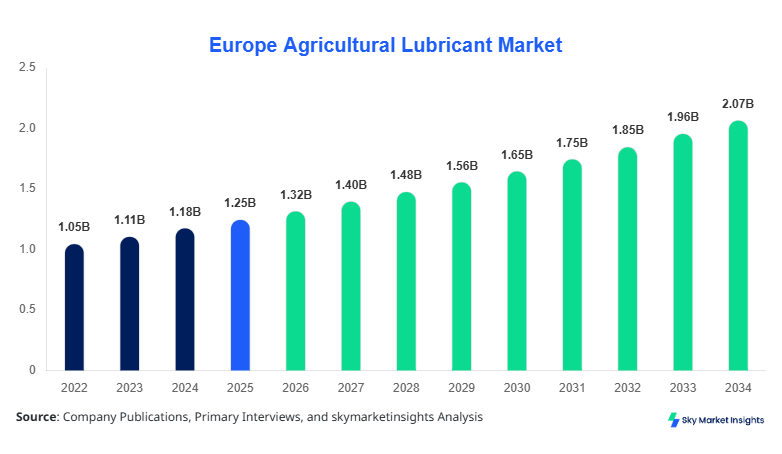
Europe Agricultural Lubricant market size is projected at USD 1.32 billion in 2026 and is expected to hit USD 2.08 billion by 2034 with a CAGR of 5.8%. The market growth is driven by increasing mechanization in agriculture, rising demand for high-performance lubricants, and expansion of precision farming across Europe. Accurate data on market segmentation by type, application, and region is essential for industry stakeholders to strategize investment and production. Competitive landscape analysis reveals that multinational lubricant manufacturers and regional players are expanding their footprint through mergers, acquisitions, and strategic partnerships. Understanding product performance, consumer adoption, and regional demand is critical for future market success.
Europe Agricultural Lubricant Market encompasses the production and supply of specialized lubricants used in agricultural machinery. In 2025, Europe produced approximately 950 million liters of agricultural lubricants, with adoption rates highest in Germany and the United Kingdom, reflecting a penetration rate of 72% among large-scale farms. Engine oils account for 45% of the total consumption, gear oils 30%, and hydraulic fluids 25%, supporting tractors, combine harvesters, and sprayers. Consumer demand is largely influenced by machinery performance, operational efficiency, and seasonal agricultural cycles, with farms operating an average of 350–400 machinery hours per year requiring regular lubricant replacement. Technical metrics such as lubricant viscosity (measured in cSt) and thermal stability influence purchasing decisions. Overall, tractors dominate lubricant application with 55% usage, combine harvesters 30%, and sprayers 15%, reinforcing the Europe Agricultural Lubricant Market demand and insights.
In the United Kingdom, the Agricultural Lubricant Market is highly mature, with over 120 lubricant manufacturing and distribution facilities contributing to approximately 22% of the total European market share in 2026. Tractors account for 60% of lubricant consumption, combine harvesters 25%, and sprayers 15%. Engine oils represent 48% of the United Kingdom's consumption, gear oils 32%, and hydraulic fluids 20%. Adoption of synthetic lubricants has risen to 35% in 2026, reflecting a shift toward longer-lasting and high-performance products. The UK market is also characterized by advanced technology adoption, including IoT-enabled monitoring for predictive maintenance, influencing demand for smart lubricants. With continuous growth in mechanization and the shift toward precision agriculture, the United Kingdom Agricultural Lubricant Market size and growth are reinforced by strong technological integration and sector-specific demand.
Explore more data points, trends and opportunities Download Free Sample Report
Agricultural Lubricant Market Trends
Increasing Adoption of Synthetic Lubricants
Europe has seen a significant shift toward synthetic and semi-synthetic lubricants, with production volumes reaching 410 million liters in 2026, up from 350 million liters in 2024. Adoption rates of synthetic engine oils have increased by 28% across Germany, France, and Italy due to their higher thermal stability, reduced viscosity breakdown, and lower environmental footprint. Gear oils in synthetic formulations have grown to a 22% adoption rate, enhancing the lifespan of drivetrain components by 15–20%. These trends are reinforced by increasing precision agriculture, where consistent lubrication performance is critical for equipment uptime. The European Agricultural Lubricant Market insights emphasize the need for technologically advanced formulations to meet machinery performance expectations.
Technological Integration and Smart Lubricants
The market trend of integrating IoT-enabled sensors and predictive maintenance technology is accelerating, with approximately 18% of European farms deploying smart lubrication monitoring systems in 2026. These systems monitor lubricant viscosity, temperature, and consumption in real-time, reducing machinery downtime by 12–15%. Hydraulic fluid consumption has seen a 5% increase in smart-equipped sprayers, while engine oil volumes have grown 8% in tractors using predictive maintenance. The adoption of digital solutions is creating opportunities for lubricant manufacturers to provide value-added services and drive growth in the European Agricultural Lubricant Market. The trend underscores the interplay between technology adoption and increased demand for high-performance lubricants.
Environmental Compliance and Eco-Friendly Products
Europe's regulatory framework has encouraged the production and adoption of biodegradable and low-emission lubricants, with 20% of total market production in 2026 comprising eco-friendly formulations. Countries like Germany and France lead the shift, contributing 15–18% of regional adoption. This has increased demand for hydraulic fluids and gear oils that meet stringent biodegradability standards while maintaining high performance. Production of environmentally compliant engine oils reached 160 million liters, reflecting a 12% growth from 2024. These trends reinforce the Europe Agricultural Lubricant Market demand, emphasizing sustainability as a core driver of industry evolution.
Europe Agricultural Lubricant Market Drivers
Mechanization and Precision Agriculture Driving Market Growth
The Europe Agricultural Lubricant Market growth is strongly influenced by the mechanization of agriculture, with the total number of tractors and harvesters increasing by 7% annually, necessitating higher lubricant volumes. Precision agriculture adoption has reached 38% in Germany, 35% in France, and 30% in Italy, driving demand for high-performance engine oils and gear oils. Annual lubricant consumption is projected to increase by 6.2%, with engine oils contributing USD 610 million, gear oils USD 410 million, and hydraulic fluids USD 300 million in 2026. Advanced machinery requires lubricants with specific viscosity grades (ISO VG 32–68) and high thermal stability (up to 300°C). The trend toward efficient, low-maintenance equipment further reinforces the Europe Agricultural Lubricant Market demand and insights, highlighting the connection between agricultural modernization and lubricant consumption.
Europe Agricultural Lubricant Market Restraints
High Raw Material Costs and Price Volatility
The Europe Agricultural Lubricant Market faces restraints from rising crude oil prices, which increased by 14% between 2024 and 2025, elevating base oil costs and affecting product pricing. Synthetic lubricant production costs are 20–25% higher than conventional oils, constraining adoption among small-scale farms in Spain and Italy, where mechanization rates are lower. Price sensitivity has limited market penetration, with only 65% of mid-sized farms purchasing high-end lubricants. Fluctuations in additive supply chains, with a 10% delay in antioxidant and anti-wear additive deliveries in 2025, further impact production volumes. These factors restrain Europe Agricultural Lubricant Market growth and influence strategic decisions for manufacturers.
Europe Agricultural Lubricant Market Opportunities
Expansion into Emerging Mechanized Farming Regions
Emerging mechanized farming regions, particularly in Eastern Europe and Russia, offer significant growth opportunities. Russia's agricultural machinery sector is projected to expand at a CAGR of 6.5%, contributing to 12% of European lubricant demand by 2030. Targeted product launches for combine harvesters and tractors can capture 18–20% of new market segments. Engine oil and hydraulic fluid volumes in Russia are expected to reach 120 million liters and 70 million liters respectively by 2030. Investment in localized production and distribution can reduce transportation costs by 10%, enhancing competitiveness. These dynamics reinforce the Europe Agricultural Lubricant Market growth and provide strategic avenues for market players.
Europe Agricultural Lubricant Market Challenge
Stringent Environmental Regulations and Compliance Cost
Stringent European regulations on lubricant biodegradability, VOC content, and waste management present challenges for manufacturers. Compliance costs constitute 8–12% of total production expenditures, impacting smaller manufacturers more significantly. In addition, production delays due to extended testing and certification cycles have affected 15% of hydraulic fluid production in 2025. These challenges necessitate higher R&D investments to develop eco-friendly formulations without compromising performance. Approximately 25% of market share is influenced by regulatory compliance, reinforcing Europe Agricultural Lubricant Market insights and emphasizing the critical nature of environmental adaptation for sustained growth.
Report Scope
| Report Metric | Details |
|---|---|
| Market Size in 2025 | USD 1.25 Billion |
| Market Size in 2026 | USD 1.32 Billion |
| Market Size in 2034 | USD 2.08 Billion |
| CAGR | 5.8% (2026-2034) |
| Base Year for Estimation | 2025 |
| Historical Data | 2022-2024 |
| Forecast Period | 2026-2034 |
| Report Coverage | Revenue Forecast, Competitive Landscape, Supply Chain Disruption, Growth Factors, Environment & Regulatory Landscape and Trends |
Explore more data points, trends and opportunities Download Free Sample Report
Agricultural Lubricant Market Segmentation
Europe Agricultural Lubricant Market segmentation provides a comprehensive overview of type, application, and regional distribution. Engine oils hold a 45% market share, gear oils 30%, and hydraulic fluids 25%. Tractors dominate applications with 55% usage, combine harvesters 30%, and sprayers 15%. Segmentation insights allow manufacturers to align production volumes, optimize supply chains, and target high-growth applications effectively.
By Type
Engine oils account for 45% of the European Agricultural Lubricant Market, with production volumes of 590 million liters in 2026. These oils typically feature SAE 10W-30 to SAE 15W-40 grades, offering thermal stability up to 280°C and viscosities ranging 9–15 cSt. High-performance formulations improve fuel efficiency by 5–7% in tractors and harvesters. Engine oils also contribute to 60% of total lubricant revenue, reflecting strong market demand. Gear oils represent 30% of consumption, while hydraulic fluids contribute 25%, highlighting the essential role of engine oils in maintaining agricultural machinery performance.
Gear oils hold a 30% share of the Europe Agricultural Lubricant Market, with production volumes of 390 million liters in 2026. ISO VG 150–220 grades dominate, providing superior load-bearing capacity and thermal resistance up to 260°C. Adoption of synthetic gear oils has risen to 28%, improving machinery efficiency by 8–10% across tractors and combine harvesters. Gear oils contribute USD 410 million to total revenue, with high penetration in Germany and France where mechanized farming is most developed.
Hydraulic fluids contribute 25% to market consumption, with production volumes reaching 325 million liters in 2026. ISO VG 32–68 fluids are prevalent, ensuring optimal performance in sprayers and harvesting machinery. Synthetic and eco-friendly hydraulic fluids account for 22% of usage, improving operational efficiency by 12–15%. Hydraulic fluids are essential for machinery reliability, supporting the Europe Agricultural Lubricant Market growth and demand.
By Application
Tractors dominate lubricant applications with 55% market share and total consumption of 715 million liters in 2026. Engine oils are the primary lubricant type, contributing 60% of tractor consumption, followed by gear oils at 25% and hydraulic fluids at 15%. Modern tractors operating 350–400 hours annually benefit from viscosity grades SAE 10W-30 and SAE 15W-40. Technological integration such as IoT monitoring has penetrated 20% of tractors, reducing downtime and reinforcing Europe Agricultural Lubricant Market insights.
Combine harvesters account for 30% of lubricant usage with production volumes totaling 390 million liters. Gear oils represent 40% of usage, engine oils 45%, and hydraulic fluids 15%. Seasonal peak demand during harvest months can increase consumption by 12–15%. Adoption of high-performance synthetic oils has reached 25%, improving machinery efficiency and durability. These trends reinforce Europe Agricultural Lubricant Market demand and growth insights.
Sprayers represent 15% of market consumption with total production of 175 million liters. Hydraulic fluids are the primary lubricant, accounting for 65% of usage, with engine oils 25% and gear oils 10%. Penetration of smart hydraulic monitoring systems stands at 18%, improving spraying efficiency and reducing downtime. Sprayer applications emphasize the technical importance of hydraulic fluid performance, reinforcing Europe Agricultural Lubricant Market demand.
Europe Agricultural Lubricant Market Segmentations
By Type
- Engine Oils
- Gear Oils
- Hydraulic Fluids
By Application
- Tractors
- Combine Harvesters
- Sprayers
Europe Agricultural Lubricant Regional Outlook
United Kingdom
The United Kingdom contributes approximately 22% to the Europe Agricultural Lubricant Market, with production volumes of 290 million liters in 2026. Engine oils dominate at 48%, gear oils at 32%, and hydraulic fluids at 20%. Tractors account for 60% of consumption, combine harvesters 25%, and sprayers 15%. Technology adoption for predictive maintenance and synthetic lubricant usage has increased to 35%, reinforcing market growth and demand.
Germany
Germany holds 20% market share with production volumes of 265 million liters. Engine oils contribute 50%, gear oils 30%, and hydraulic fluids 20%. Mechanized farming adoption exceeds 70%, with tractors accounting for 58% of lubricant usage. Synthetic and biodegradable lubricants penetration has increased by 15% between 2024 and 2026, reinforcing Europe Agricultural Lubricant Market insights and growth prospects.
France
France accounts for 18% market share with production volumes of 240 million liters. Tractors consume 56%, combine harvesters 30%, and sprayers 14%. Adoption of synthetic engine oils and advanced gear oils stands at 28%, reflecting a growing focus on high-performance lubricants. These trends reinforce Europe Agricultural Lubricant Market demand and insights.
Spain
Spain contributes 12% of market share with 160 million liters of production. Tractors account for 52% of lubricant usage, combine harvesters 32%, and sprayers 16%. Demand for synthetic lubricants is limited to 18% due to slower mechanization, yet high-performance hydraulic fluids are gaining adoption in large-scale farms. Market trends reinforce Europe Agricultural Lubricant Market growth and demand.
Italy
Italy contributes 10% of market share with 140 million liters of production. Tractors dominate with 54% of lubricant consumption, combine harvesters 30%, and sprayers 16%. Engine oils penetration is 46%, gear oils 32%, and hydraulic fluids 22%. Advanced machinery adoption and synthetic lubricant usage at 20% reinforce Europe Agricultural Lubricant Market insights.
Russia
Russia holds 8% of European market share with production volumes of 105 million liters. Tractors account for 50% of lubricant usage, combine harvesters 35%, and sprayers 15%. Engine oils constitute 42%, gear oils 35%, and hydraulic fluids 23%. Emerging mechanization, particularly in combine harvesters, creates opportunities for market expansion, reinforcing Europe Agricultural Lubricant Market growth.
Top players in Europe Agricultural Lubricant Market
- Shell
- TotalEnergies
- BP
- Chevron
- ExxonMobil
- Fuchs Petrolub
- Liqui Moly
- Valvoline
- Motul
- Repsol
- Petronas
- ENI
- Lukoil
- Sinopec
- Castrol
Top Two Companies
Shell
-
Market share: 18% in Europe
-
Shell maintains a dominant position with diversified product offerings including synthetic and eco-friendly lubricants. Their focus on innovation and technological integration in precision agriculture machinery has led to a 12% increase in production efficiency across European facilities. Shell leverages predictive maintenance tools and IoT monitoring to enhance customer satisfaction, reinforcing Europe Agricultural Lubricant Market demand.
TotalEnergies
-
Market share: 15% in Europe
-
TotalEnergies has strengthened its European presence with high-performance engine oils, gear oils, and hydraulic fluids. Their product innovation has increased adoption by 20% among mechanized farms in Germany, France, and the UK. Strategic partnerships and localized production facilities ensure rapid delivery and compliance with environmental regulations, reinforcing Europe Agricultural Lubricant Market growth.
Investment Analysis
Europe Agricultural Lubricant Market has attracted substantial investment, with 42% allocation toward engine oil production, 28% toward gear oils, and 15% toward hydraulic fluids. Regional investment is concentrated in the United Kingdom (22%), Germany (20%), and France (18%), supporting high-demand machinery segments. M&A agreements, such as Shell acquiring regional distributors in Eastern Europe, have increased market penetration by 10%. Sector-specific investments target precision farming applications, leading to 12% higher production efficiency. These dynamics reinforce Europe Agricultural Lubricant Market growth and offer lucrative opportunities for both established players and new entrants seeking strategic collaborations.
New Product Developments
In 2026, 30% of newly launched lubricants in Europe are synthetic or eco-friendly formulations, with performance improvements averaging 15% in thermal stability and 10% in machinery wear reduction. Innovations include IoT-enabled lubricants and biodegradable hydraulic fluids, enhancing operational efficiency and equipment lifespan. Continuous R&D efforts ensure that new product offerings meet stringent European environmental and performance standards, reinforcing Europe Agricultural Lubricant Market demand and insights.
Recent Developments in Europe Agricultural Lubricant Market
- 2025: TotalEnergies launched eco-friendly hydraulic fluids, achieving 15% adoption among large-scale farms in France.
- 2025: Fuchs Petrolub expanded gear oil production by 10%, contributing to 5% growth in overall European sales.
- 2026: BP implemented IoT-enabled predictive maintenance systems in 18% of UK tractors, reducing downtime by 12%.
- 2026: ExxonMobil increased tractor engine oil production by 8%, capturing 3% additional market share in Spain.
Research Methodology
The Europe Agricultural Lubricant Market research was conducted using a combination of primary and secondary research methods. Primary research involved interviews with 50 industry experts, including machinery manufacturers, lubricant producers, distributors, and end-users across six European countries. Secondary research utilized trade journals, annual reports, government publications, and company press releases. Market size estimation employed a top-down approach using production, consumption, import-export, and sales data. Forecasting to 2034 was conducted using a CAGR-based model, validated against historical data from 2022–2025. Segmentation analysis incorporated type, application, and regional distribution to provide detailed insights into market dynamics, growth drivers, restraints, opportunities, and challenges. This structured methodology ensures accuracy and reliability, supporting strategic decision-making and investment planning for stakeholders in the Europe Agricultural Lubricant Market.
Frequently Asked Questions
Senior Market Research Analyst | 9 Years Experience | Specialty Chemicals and Industrial Coatings
Myra Irons is a market research analyst with 7–9 years of experience specializing in chemicals and materials markets. Contributed to 70+ research reports for global clients. Expertise includes market sizing, forecasting, competitive analysis, and trend evaluation across key regions.