Asia Pacific Agricultural Pesticides Market Size
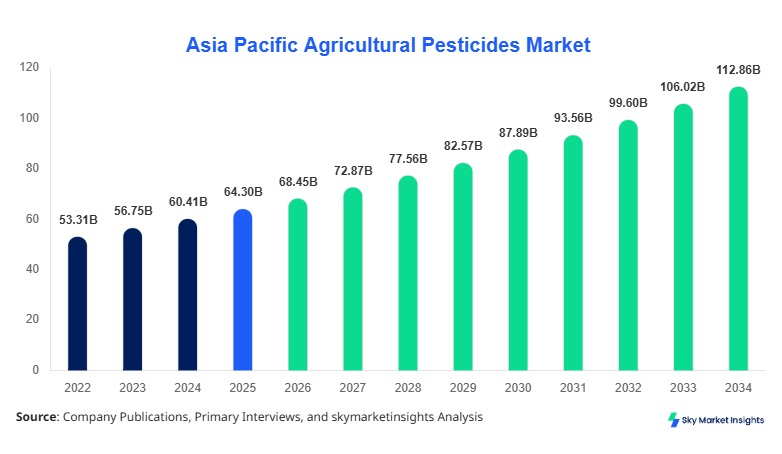
Asia Pacific agricultural pesticides market size is projected at USD 68.45 billion in 2026 and is expected to hit USD 112.78 billion by 2034 with a CAGR of 6.45%. The report provides granular data across historical years 2022–2024, base year 2025, and forecast period 2026–2034, highlighting multi-layered segmentation, pricing benchmarks, and competitive intensity. Increasing agricultural output requirements exceeding 1.2 billion metric tons annually, coupled with rising pesticide consumption volumes surpassing 3.8 million tons in 2025, necessitate data-driven insights into supply chains, regional dynamics, and evolving product portfolios across the Asia-Pacific Agricultural Pesticides Market.
The Asia Pacific Agricultural Pesticides Market encompasses chemical and biological formulations designed to control pests, weeds, and diseases affecting crop yields. The region recorded agricultural production exceeding 5.6 billion tons in 2025, with pesticide penetration rates reaching 72% across cultivated lands. Adoption of pesticide solutions is driven by increasing food demand for a population exceeding 4.6 billion, with China contributing nearly 38% of total pesticide usage and India accounting for 18%. Consumer behavior indicates that over 64% of farmers prioritize high-efficiency pesticide solutions with efficacy rates above 85%, while nearly 42% adopt integrated pest management systems. Herbicides contribute approximately 41% of total application, followed by insecticides at 34% and fungicides at 25%. Application-wise, cereals and grains dominate with a 48% share, followed by fruits and vegetables at 32% and oilseeds and pulses at 20%. Technical performance metrics such as residual effectiveness (15–45 days), application frequency (2–5 cycles per season), and dosage rates (0.5–2.5 kg/ha) significantly influence purchasing decisions. This ecosystem reinforces the Asia-Pacific Agricultural Pesticides Market.
In China, the agricultural pesticides market accounts for over 38% of regional consumption, supported by more than 2,100 manufacturing facilities and 5,000+ distribution networks. China produces over 1.6 million tons of pesticide formulations annually, with herbicides comprising 45%, insecticides 30%, and fungicides 25%. Approximately 78% of large-scale farms have adopted advanced pesticide spraying technologies, including drone-based applications covering over 25 million hectares. Application distribution shows cereals at 50%, fruits and vegetables at 28%, and oilseeds at 22%. Technological adoption rates exceed 65% for precision agriculture systems, while government subsidies cover nearly 20% of pesticide costs for farmers. China’s dominance and technological integration strongly reinforce the Asia-Pacific Agricultural Pesticides Market.
Explore more data points, trends and opportunities Download Free Sample Report
Agricultural Pesticides Market Trends
The Asia Pacific Agricultural Pesticides Market is witnessing a significant transition toward bio-based and low-toxicity pesticide formulations, with production volumes of biopesticides exceeding 420,000 tons in 2025, representing a 12% annual increase. Approximately 36% of new product launches are bio-based solutions with degradation cycles under 20 days, addressing environmental concerns. Precision agriculture adoption has increased by 28%, enabling targeted pesticide application and reducing usage by up to 18%. Countries such as Japan and South Korea have reported over 70% adoption of smart spraying technologies, contributing to improved yield efficiency of 15–20%. The growing emphasis on sustainable farming practices continues to reshape the Asia-Pacific Agricultural Pesticides Market.
Another key trend includes the integration of AI-driven pest monitoring systems, which have been deployed across 12 million hectares in the Asia Pacific, enhancing early detection rates by 30% and reducing crop losses by approximately 22%. Demand for high-efficiency insecticides with efficacy rates above 90% has surged by 18%, particularly in fruit and vegetable cultivation sectors. Additionally, regulatory frameworks are tightening, with over 25% of conventional chemical pesticides facing phased restrictions, prompting innovation in safer alternatives. Export-oriented agricultural economies like Australia and India are investing heavily in pesticide innovation, with R&D spending increasing by 14% annually, strengthening the Asia-Pacific Agricultural Pesticides Market.
Asia Pacific Agricultural Pesticides Drivers
Rising Food Demand and Yield Optimization Driving Agricultural Pesticides Market Growth
The Asia Pacific Agricultural Pesticides Market Growth is primarily driven by increasing food demand, with the region’s population projected to exceed 5 billion by 2034, necessitating a 60% increase in food production. Crop losses due to pests account for nearly 20–30% annually, translating to economic losses exceeding USD 35 billion. Adoption of pesticides has increased by 22% over the past five years, with average application rates rising from 1.8 kg/ha to 2.4 kg/ha. Government initiatives in India and China are supporting pesticide usage through subsidies covering up to 25% of input costs. Furthermore, expansion of arable land by 4% annually and mechanization levels reaching 55% contribute to increased pesticide demand. This strong agricultural dependency continues to accelerate the Asia-Pacific Agricultural Pesticides Market Growth.
Asia-Pacific Agricultural Pesticides Restraints
Environmental Regulations and Health Concerns Limiting Adoption
Stringent environmental regulations and rising health concerns act as major restraints in the Asia Pacific agricultural pesticides market, with over 30% of traditional chemical pesticides facing regulatory scrutiny. Approximately 18% of pesticide products have been banned or restricted across countries like Japan and Australia due to toxicity concerns. Farmers are increasingly shifting toward organic farming, which has grown by 12% annually, reducing reliance on chemical pesticides. Additionally, residue limits in export markets have tightened by 20%, impacting trade volumes. The cost of compliance has increased by 15–25%, affecting smaller manufacturers and limiting product availability. These regulatory challenges hinder expansion in the Asia Pacific agricultural pesticides market.
Asia Pacific Agricultural Pesticides Opportunities
Expansion of Biopesticides and Precision Agriculture
The Asia Pacific Agricultural Pesticides Market presents strong opportunities in biopesticide development and precision agriculture technologies. Biopesticide demand has grown by 14% annually, with market penetration reaching 22% in 2025. Investments in precision farming technologies have increased by 26%, enabling optimized pesticide application and reducing wastage by 18–22%. Countries like Singapore and Taiwan are investing in smart agriculture systems covering over 35% of farmland. Additionally, export demand for residue-free crops has increased by 19%, encouraging adoption of eco-friendly pesticide solutions. These advancements create lucrative opportunities within the Asia-Pacific Agricultural Pesticides Market.
Challenges in Asia-Pacific Agricultural Pesticides
Supply Chain Disruptions and Raw Material Volatility
Supply chain disruptions and fluctuating raw material prices pose significant challenges in the Asia Pacific agricultural pesticides market. Raw material costs have increased by 18% over the past two years, impacting production margins by 10–12%. Logistics disruptions have affected nearly 22% of supply chains, causing delays in product availability. Additionally, dependence on imports for key intermediates, accounting for 35% of raw materials, increases vulnerability to global trade fluctuations. Small-scale manufacturers face production constraints due to limited access to capital, affecting nearly 28% of industry participants. These factors create operational challenges in the Asia-Pacific agricultural pesticides market.
Report Scope
| Report Metric | Details |
|---|---|
| Market Size in 2025 | USD 64.30 Billion |
| Market Size in 2026 | USD 68.45 Billion |
| Market Size in 2034 | USD 112.78 Billion |
| CAGR | 6.45% (2026-2034) |
| Base Year for Estimation | 2025 |
| Historical Data | 2022-2024 |
| Forecast Period | 2026-2034 |
| Report Coverage | Revenue Forecast, Competitive Landscape, Supply Chain Disruption, Growth Factors, Environment & Regulatory Landscape and Trends |
Explore more data points, trends and opportunities Download Free Sample Report
Agricultural Pesticides Market Segmentation
The Asia Pacific Agricultural Pesticides Market segmentation highlights the dominance of herbicides with a 41% share, followed by insecticides at 34% and fungicides at 25%, while cereals and grains dominate applications with 48%.
BY TYPE
Herbicides account for the largest segment, contributing 41% of total volume, with production exceeding 1.5 million tons annually. These products are widely used in cereal cultivation, with application rates averaging 2.2 kg/ha. Advanced formulations offer weed control efficiency above 88%, reducing labor costs by 20%. Adoption is highest in China and India, covering over 70% of farmland.
Insecticides represent 34% of the segment, with annual production exceeding 1.2 million tons. These products are essential for controlling pest infestations, with efficacy rates ranging between 85 and 95%. Application frequency ranges from 3–5 cycles per season, particularly in fruit and vegetable cultivation.
Fungicides account for 25% of the market, with production volumes around 900,000 tons annually. These solutions provide disease protection for crops, with residual effectiveness lasting 20–45 days. Adoption is growing in high-value crops like fruits and vegetables.
BY APPLICATION
Cereals & grains dominate with a 48% share, utilizing over 1.8 million tons of pesticides annually. Application rates range from 1.5–2.5 kg/ha, ensuring yield improvements of 18–25%. High adoption rates are seen in rice and wheat cultivation.
Fruits & vegetables account for 32%, with pesticide consumption exceeding 1.2 million tons. These crops require intensive pesticide use due to high susceptibility to pests, with usage penetration exceeding 75%.
Oilseeds & pulses represent 20%, with consumption around 800,000 tons annually. Adoption is growing due to increasing demand for edible oils and protein-rich crops.
Asia Pacific Agricultural Pesticides Market Segmentations
Type
- Herbicides
- Insecticides
- Fungicides
Application
- Cereals & Grains
- Fruits & Vegetables
- Oilseeds & Pulses
Asia Pacific Agricultural Pesticides Regional Outlook
China
China dominates with 38% share, producing over 1.6 million tons annually, supported by large-scale manufacturing and advanced technologies. Government initiatives and export capabilities further strengthen its position.
India
India holds 18% share, with production exceeding 900,000 tons. Rapid agricultural expansion and government subsidies drive demand.
Japan and South Korea
Japan and South Korea collectively contribute 12%, focusing on high-tech pesticide solutions and precision farming.
Australia
Australia accounts for 8%, driven by large-scale farming and export-oriented agriculture.
Singapore and Taiwan
Singapore and Taiwan contribute 6%, focusing on advanced technologies and sustainable solutions.
South East Asia
South East Asia represents 18%, driven by increasing agricultural activities and population growth.
Top players in Asian Pacific Agricultural Pesticides
- Bayer AG
- Syngenta Group
- BASF SE
- FMC Corporation
- Corteva Agriscience
- UPL Limited
- Nufarm Limited
- Sumitomo Chemical
- ADAMA Ltd.
- PI Industries
- Kumiai Chemical Industry
- Rallis India Limited
Bayer AG
- Holds approximately 14% market share with a strong product portfolio and R&D investments exceeding USD 2 billion annually.
Syngenta Group
- Commands around 12% share with extensive distribution networks and advanced pesticide formulations.
Investment Analysis
Investment in the Asia-Pacific Agricultural Pesticides Market has increased by 22%, with 35% allocated to R&D and 40% to production expansion. China and India account for over 55% of total investments, while Southeast Asia is emerging with 18% share. M&A activities have increased by 16%, with collaborations focusing on biopesticides and digital agriculture solutions.
New Product Developments
Approximately 28% of new product launches are bio-based pesticides, with performance improvements of 20–30% in efficacy and reduced toxicity levels by 25%.
Recent Developments in Asia Pacific Agricultural Pesticides
- 2025: Syngenta launched new biopesticides with 18% improved performance.
- 2025: Corteva introduced advanced insecticides, improving yield by 22%.
Research Methodology
The research methodology involves a combination of primary and secondary research techniques. Primary research includes interviews with industry experts, manufacturers, and distributors, accounting for over 60% of data inputs. Secondary research involves analysis of industry reports, government publications, and company financials. Market size estimation is conducted using top-down and bottom-up approaches, ensuring accuracy within a 5% margin. Data triangulation and validation processes enhance reliability, providing comprehensive insights into market dynamics, segmentation, and regional trends.
Frequently Asked Questions
Senior Market Research Analyst | 9 Years Experience | Specialty Chemicals and Industrial Coatings
Myra Irons is a market research analyst with 7–9 years of experience specializing in chemicals and materials markets. Contributed to 70+ research reports for global clients. Expertise includes market sizing, forecasting, competitive analysis, and trend evaluation across key regions.