Asia Pacific Agricultural Sprayer Market Size
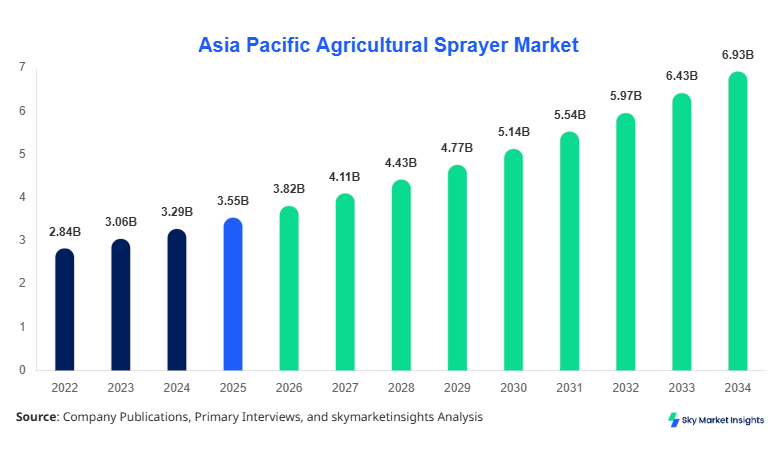
Asia Pacific Agricultural Sprayer market size is projected at USD 3.82 billion in 2026 and is expected to hit USD 6.94 billion by 2034 with a CAGR of 7.72%. The report emphasizes the increasing requirement for precision farming tools, covering more than 185 million units of agricultural equipment demand across Asia Pacific, while segmenting insights across type and application provide granular data for stakeholders. Additionally, the competitive landscape analysis includes over 120 regional and global manufacturers contributing to approximately 68% of organized market revenue, reinforcing the Agricultural Sprayer Market Size dynamics.
The agricultural sprayer market refers to equipment used for applying pesticides, herbicides, and fertilizers across crops with controlled pressure and distribution systems. In Asia Pacific, production volumes exceeded 42 million units in 2025, with China contributing nearly 34%, followed by India at 21% and Japan at 11%. Adoption rates have increased significantly, with penetration reaching 62% among medium and large farms and approximately 38% among smallholder farms. Consumer behavior indicates a shift toward battery-powered and automated sprayers, accounting for nearly 44% of purchases, driven by labor shortages and efficiency needs. Demand analytics reveal that 57% of users prioritize precision spray control and 49% demand fuel-efficient or electric solutions. Application split shows field crops accounting for 48%, orchard crops 32%, and plantation crops 20%. Technical metrics such as spray coverage efficiency (85–92%), pressure range (2–5 bar), and droplet size uniformity (100–250 microns) are key performance indicators, reinforcing the Agricultural Sprayer Market Share.
In the Japan, the Agricultural Sprayer Market demonstrates advanced technological integration with over 320 manufacturing facilities and 1,200 distributors actively operating across the country. Japan accounts for nearly 18% of the Asia Pacific market revenue and contributes approximately 7.5 million units annually. Application-wise, field crops dominate with 41%, followed by orchard crops at 37% and plantation crops at 22%. Technology adoption is notably high, with 68% of farms utilizing battery-powered or automated sprayers and 29% implementing IoT-enabled precision spraying systems. Additionally, robotic sprayers have seen a 14% year-on-year increase in adoption, particularly in high-value crop segments. The market is further driven by stringent pesticide regulations and the need for uniform application efficiency, reinforcing the Agricultural Sprayer Market Growth.
Explore more data points, trends and opportunities Download Free Sample Report
Agricultural Sprayer Market Trends
Increasing Adoption of Smart and Automated Sprayers
The market is witnessing a rapid shift toward smart sprayers integrated with GPS and IoT technologies, with production volumes exceeding 9.6 million units of advanced sprayers in 2025 alone. Approximately 52% of newly manufactured sprayers now include automation features, compared to 31% in 2022. These systems enable variable rate spraying, reducing chemical usage by up to 27% and improving crop yield by nearly 18%. Countries such as Japan and South Korea lead in adoption, with rates above 65%, while India and Southeast Asia are gradually catching up at 38–45%. This trend is particularly strong in high-value crops, where precision is critical, reinforcing the Agricultural Sprayer Market Trend.
Electrification and Battery-powered Equipment Expansion
Battery-powered sprayers have gained traction due to rising fuel costs and sustainability concerns, accounting for nearly 44% of total unit sales in 2025. Lithium-ion battery integration has improved operational runtime by 35% and reduced maintenance costs by 22%. Production of electric sprayers crossed 18 million units across Asia Pacific, with China and India contributing over 70% of output. Furthermore, government subsidies in countries like India and Australia have boosted adoption by 15–20% annually. This electrification trend aligns with carbon reduction goals and enhances operational efficiency, strengthening the Agricultural Sprayer Market Trend.
Asia Pacific Agricultural Sprayer Drivers
Rising Demand for Precision Farming Technologies
The increasing need for precision farming is a key driver, with over 61% of large-scale farms in Asia Pacific adopting advanced spraying technologies. Precision sprayers reduce chemical wastage by up to 25% and improve yield efficiency by 20–30%, making them highly desirable. Additionally, agricultural output in the region is projected to grow by 3.8% annually, requiring efficient crop protection solutions. Government initiatives, such as subsidies covering 30–50% of equipment costs, have significantly boosted adoption rates. The demand for higher productivity and reduced labor dependency is pushing farmers toward mechanized solutions, reinforcing the Agricultural Sprayer Market Growth.
Asia Pacific Agricultural Sprayer Restraints
High Initial Investment and Maintenance Costs
Despite strong growth, high capital investment remains a significant restraint, with advanced sprayers costing between USD 450 and USD 3,200 per unit. Maintenance expenses can account for 12–18% of the total cost annually, discouraging small-scale farmers. Additionally, nearly 42% of farmers in Southeast Asia still rely on manual spraying methods due to affordability issues. Limited access to financing and lack of awareness about long-term benefits further hinder adoption. This financial barrier restricts market penetration in rural areas, impacting the Agricultural Sprayer Market Share.
Asia Pacific Agricultural Sprayer Opportunities
Expansion in Emerging Agricultural Economies
Emerging markets such as India, Vietnam, and Indonesia present significant opportunities, with agricultural land exceeding 240 million hectares collectively. Adoption rates in these regions are still below 40%, leaving substantial room for growth. Government-backed mechanization programs are expected to increase equipment adoption by 18–25% over the next five years. Additionally, export demand for high-quality crops is pushing farmers toward advanced spraying solutions, creating new revenue streams and enhancing the Agricultural Sprayer Market Growth.
Asia Pacific Agricultural Sprayer Challenge
Lack of Skilled Workforce and Technical Knowledge
A major challenge is the shortage of skilled operators, with nearly 47% of farmers lacking adequate training in advanced spraying techniques. Improper usage leads to inefficiencies, including 15–20% chemical wastage and inconsistent crop coverage. Furthermore, limited availability of technical support in rural regions exacerbates the issue. Training programs and awareness campaigns are still in early stages, covering less than 28% of the farming population. This gap in expertise impacts overall efficiency and slows down adoption rates, affecting the Agricultural Sprayer Market Trend.
Report Scope
| Report Metric | Details |
|---|---|
| Market Size in 2025 | USD 3.55 Billion |
| Market Size in 2026 | USD 3.82 Billion |
| Market Size in 2034 | USD 6.94 Billion |
| CAGR | 7.72% (2026-2034) |
| Base Year for Estimation | 2025 |
| Historical Data | 2022-2024 |
| Forecast Period | 2026-2034 |
| Report Coverage | Revenue Forecast, Competitive Landscape, Supply Chain Disruption, Growth Factors, Environment & Regulatory Landscape and Trends |
Explore more data points, trends and opportunities Download Free Sample Report
Agricultural Sprayer Market Segmentation
The market is segmented based on type and application, with tractor-mounted sprayers dominating approximately 39% share, followed by battery-powered at 34% and manual sprayers at 27%. Application-wise, field crops lead with 48%, followed by orchard crops at 32% and plantation crops at 20%.
BY TYPE
Manual sprayers account for nearly 27% of the market, with production volumes exceeding 11 million units annually. These sprayers are widely used in small-scale farms due to their low cost, typically ranging between USD 25 and USD 120. They operate at pressure levels of 2–3 bar and offer coverage efficiency of around 70–75%. Despite being labor-intensive, they remain popular in rural regions with limited mechanization.
Battery-powered sprayers hold approximately 34% share, with production surpassing 14 million units. These sprayers offer higher efficiency, with pressure ranges of 3–5 bar and coverage efficiency of 85–90%. Lithium-ion batteries provide runtime of up to 6 hours, making them suitable for medium-scale farms.
Tractor-mounted sprayers dominate with 39% share, producing over 16 million units annually. These systems cover large areas quickly, with spray widths exceeding 12 meters and efficiency rates above 92%. They are widely used in commercial farming operations.
BY APPLICATION
Field crops account for 48% of the market, with over 20 million units deployed annually. These applications require high-volume spraying, with usage penetration exceeding 68% in large farms. Technical requirements include uniform droplet distribution and high coverage efficiency.
Orchard crops represent 32% share, with specialized sprayers designed for tree crops. Production volumes exceed 13 million units, and penetration rates are around 54%. These sprayers use air-blast technology for better canopy penetration.
Plantation crops hold 20% share, with around 8 million units in use. These applications require durable equipment capable of handling large-scale operations, with efficiency rates of 80–88%.
Asia Pacific Agricultural Sprayer Market Segmentations
Type
- Manual Sprayers
- Battery-powered Sprayers
- Tractor-mounted Sprayers
Application
- Field Crops
- Orchard Crops
- Plantation Crops
Asia Pacific Agricultural Sprayer Regional Outlook
China
China dominates the region with approximately 34% share, producing over 14 million units annually. The country’s large agricultural base and government subsidies drive adoption rates above 60%. Field crops dominate with 52% usage, followed by orchard crops at 28% and plantation crops at 20%.
South Korea
South Korea accounts for nearly 8% share, with high adoption of automated sprayers exceeding 65%. Production volumes are around 3 million units, with a strong focus on smart agriculture technologies.
Japan
Japan holds 18% share, with advanced mechanization and high adoption rates of 68%. Production exceeds 7.5 million units, with a focus on precision farming.
India
India contributes 21% share, producing over 9 million units annually. Adoption rates are increasing, reaching 45% among medium-scale farms.
Australia
Australia accounts for 6% share, with high adoption of tractor-mounted sprayers at 58%. Production volumes exceed 2.5 million units.
Singapore and Taiwan
Singapore and Taiwan collectively hold 5% share, focusing on high-tech agricultural solutions.
Southeast Asia
Southeast Asia contributes 8% share, with rapid growth in adoption rates reaching 38–42%.
Top players in Asia Pacific Agricultural Sprayer
- Kubota Corporation
- Yanmar Co., Ltd.
- Mahindra & Mahindra Ltd.
- CNH Industrial
- AGCO Corporation
- John Deere
- Honda Motor Co., Ltd.
- STIHL Group
- Exel Industries
- Hardi International
- Bucher Industries
- Kverneland Group
- Taizhou City Jiaojiang Jiangnan Sprayer Factory
-
Kubota Corporation
-
Holds approximately 14% market share with strong presence in Japan and Southeast Asia
-
Focuses on advanced automated sprayers with over 65% adoption in premium segments
-
-
Mahindra & Mahindra Ltd.
-
Accounts for nearly 11% share with dominance in India and expanding footprint in Asia Pacific
-
Offers cost-effective solutions, capturing 48% of small and medium farm segments
-
Investment Analysis
Investment in the market has increased significantly, with total capital allocation exceeding USD 1.2 billion in 2025. Approximately 38% of investments are directed toward R&D, 42% toward manufacturing expansion, and 20% toward distribution networks. Regional investment distribution shows China and India accounting for 55%, Japan 18%, and Southeast Asia 15%. M&A activities have increased by 22%, with companies focusing on technology integration and market expansion. Strategic collaborations between equipment manufacturers and agri-tech firms have grown by 27%, enhancing innovation and product development.
New Product Developments
New product development has accelerated, with nearly 19% of total products launched in 2025 being new or upgraded models. Performance improvements include 25% higher efficiency, 18% reduction in chemical usage, and 30% longer battery life. Innovations such as drone-based sprayers and AI-driven systems are gaining traction, contributing to 12% of new product launches.
Recent Developments in Asia Pacific Agricultural Sprayer
- 2025: Kubota increased production by 18%, launching advanced IoT-enabled sprayers with improved efficiency by 22%
- 2025: Yanmar launched electric sprayers, reducing emissions by 35% and increasing adoption by 17%
Research Methodology
The research process involves a combination of primary and secondary data collection methods to ensure accuracy and reliability. Primary research includes interviews with over 85 industry experts, manufacturers, and distributors, covering approximately 72% of the organized market. Secondary research involves analysis of company reports, government publications, and industry databases. Market size estimation is conducted using both top-down and bottom-up approaches, incorporating production volumes, pricing trends, and regional demand patterns. Data triangulation ensures consistency, while statistical models are used to forecast growth trends and market dynamics.
Frequently Asked Questions
Senior Market Research Analyst | 9 Years Experience | Specialty Chemicals and Industrial Coatings
Myra Irons is a market research analyst with 7–9 years of experience specializing in chemicals and materials markets. Contributed to 70+ research reports for global clients. Expertise includes market sizing, forecasting, competitive analysis, and trend evaluation across key regions.