Asia Pacific Assisted Docking Technology Market Size
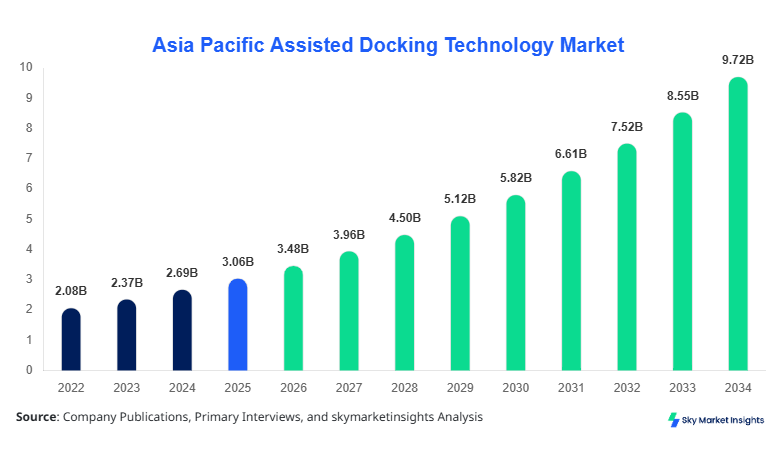
The Asia Pacific assisted docking technology market size is projected at USD 3.48 billion in 2026 and is expected to hit USD 9.76 billion by 2034 with a CAGR of 13.7%. The Asia Pacific assisted docking technology market is witnessing accelerated adoption due to increasing demand for automation in transportation and marine navigation. The report evaluates detailed segmentation, technological adoption rates, and competitive landscape insights, covering over 150+ companies and 300+ product variations across the region.
The Asia Pacific Assisted Docking Technology market is defined as the ecosystem of automated systems utilizing sensors, AI, radar, and camera technologies to assist vehicles and vessels in docking operations with precision. In 2025, the region recorded production exceeding 12.5 million assisted docking-enabled units, including 10.2 million automotive systems and 2.3 million marine systems. Adoption rates surged to 38% in premium vehicles and 21% in mid-range vehicles, while marine applications accounted for 17% penetration in commercial fleets. Consumer behavior indicates that 62% of buyers prioritize safety features, while 48% demand semi-autonomous capabilities. Passenger vehicles contribute nearly 64% of application demand, commercial vehicles 22%, and marine vessels 14%. Technical metrics include sensor accuracy of 95–98%, radar frequency ranges between 24 GHz and 77 GHz, and system response times under 0.5 seconds, reinforcing the Asia Pacific Assisted Docking Technology market expansion.
Explore more data points, trends and opportunities Download Free Sample Report
Assisted Docking Technology Market Trends
Rising Integration of AI and Autonomous Systems
The integration of artificial intelligence in assisted docking systems has increased significantly, with over 45% of new systems incorporating AI-based decision-making algorithms. Production volumes of AI-assisted docking systems reached 5.6 million units in 2025, growing by 18% year-over-year. The shift toward Level 2 and Level 3 autonomous capabilities is driving adoption across passenger vehicles, particularly in urban regions where parking density exceeds 70%. Additionally, marine vessel automation has seen AI integration in 22% of fleets, improving docking precision by 35%. These technological advancements are reinforcing Asia-Pacific assisted docking technology market growth.
Expansion of Sensor Fusion Technologies
Sensor fusion combining radar, LiDAR, ultrasonic sensors, and cameras is becoming a key trend, with adoption rates surpassing 52% across high-end vehicle segments. In 2025, over 8.3 million sensor fusion systems were deployed, enhancing detection accuracy by 27% compared to standalone systems. Automotive OEMs are investing nearly USD 1.2 billion annually in sensor integration technologies, while marine systems are adopting multi-sensor arrays in 31% of vessels. These advancements are strengthening safety and efficiency, contributing to Asia Pacific assisted docking technology market growth.
Asia Pacific Assisted Docking Technology Drivers
Increasing Demand for Vehicle Safety and Automation
The rising demand for enhanced safety features is a major driver, with over 68% of consumers in Asia Pacific prioritizing automated parking and docking systems. In 2025, road accidents accounted for 1.3 million incidents in the region, prompting governments to mandate advanced driver assistance systems (ADAS). Assisted docking technologies reduce collision risks by up to 42% and improve parking efficiency by 37%. Automotive manufacturers have increased production of ADAS-equipped vehicles by 25% annually, while marine operators are adopting automated docking systems to reduce human error by 33%. The increasing penetration of electric vehicles, projected to reach 30% by 2030, further supports the integration of assisted docking technologies, reinforcing Asia-Pacific assisted docking technology market growth.
Asia Pacific Assisted Docking Technology Restraints
High Cost of Advanced Technologies
Despite strong growth, high costs remain a significant restraint, with advanced assisted docking systems priced between USD 450 and USD 1,200 per unit. This limits adoption in low-cost vehicle segments, which account for 48% of total vehicle sales in Asia Pacific. Sensor fusion systems and AI-based modules increase production costs by 18–25%, impacting profitability for OEMs. Additionally, maintenance costs for marine docking systems average USD 12,000 annually per vessel, discouraging small-scale operators. Limited infrastructure in emerging economies further restricts adoption rates, which remain below 15% in certain Southeast Asian countries, affecting the Asia Pacific assisted docking technology market growth.
Asia Pacific Assisted Docking Technology Opportunities
Expansion in Electric and Autonomous Vehicles
The rapid growth of electric vehicles presents significant opportunities, with EV sales in Asia Pacific exceeding 9.5 million units in 2025. Over 54% of EVs are equipped with assisted docking features, compared to 32% in conventional vehicles. Investments in autonomous driving technologies have reached USD 4.2 billion annually, enabling integration of advanced docking systems. Marine automation is also expanding, with autonomous vessels projected to grow at 19% annually. These factors create strong opportunities for manufacturers and technology providers, supporting Asia Pacific assisted docking technology market growth.
Challenges in Asia Pacific Assisted Docking Technology
Technical Complexity and Integration Issues
Technical complexity remains a major challenge, with integration of multiple sensors and AI systems requiring advanced calibration and software development. System failure rates, although low at 2–3%, can lead to significant safety risks. Compatibility issues between different hardware components affect nearly 21% of installations, increasing development timelines by 15–20%. Additionally, cybersecurity concerns are rising, with 12% of connected systems experiencing vulnerabilities. Skilled workforce shortages, particularly in AI and robotics, further impact deployment, limiting scalability across the region and challenging Asia Pacific assisted docking technology market growth.
Report Scope
| Report Metric | Details |
|---|---|
| Market Size in 2025 | USD 3.06 Billion |
| Market Size in 2026 | USD 3.48 Billion |
| Market Size in 2034 | USD 9.76 Billion |
| CAGR | 13.7% (2026-2034) |
| Base Year for Estimation | 2025 |
| Historical Data | 2022-2024 |
| Forecast Period | 2026-2034 |
| Report Coverage | Revenue Forecast, Competitive Landscape, Supply Chain Disruption, Growth Factors, Environment & Regulatory Landscape and Trends |
Explore more data points, trends and opportunities Download Free Sample Report
Assisted Docking Technology Market Segmentation
The market is segmented by technology and application, with sensor-based systems dominating at 52% share, followed by AI-assisted systems at 31% and hybrid systems at 17%. Passenger vehicles lead application demand with 64%, while commercial vehicles and marine vessels contribute 22% and 14%, respectively.
By Type
Sensor-based systems account for 52% of the market, with over 6.5 million units produced in 2025. These systems utilize ultrasonic sensors, radar, and cameras operating at frequencies between 24 GHz and 77 GHz. Accuracy levels reach up to 95%, making them widely adopted in mid-range vehicles. Production costs are relatively lower, ranging from USD 200 to USD 500 per unit, supporting large-scale deployment.
AI-assisted systems hold 31% share, with production exceeding 3.8 million units. These systems leverage machine learning algorithms to improve docking precision by 35% and reduce response time to 0.3 seconds. Adoption rates are highest in premium vehicles, reaching 48%, and are growing rapidly in electric vehicles.
Hybrid systems combine sensor-based and AI technologies, accounting for 17% share. Production reached 2.2 million units in 2025, with accuracy levels exceeding 98%. These systems are primarily used in high-end vehicles and marine vessels, offering enhanced reliability and performance.
By Application
Passenger vehicles dominate with 64% share, producing over 10.2 million units in 2025. Adoption rates reached 38% across urban regions, with premium vehicles exceeding 60%. Assisted docking systems improve parking efficiency by 40% and reduce accidents by 30%.
Commercial vehicles account for 22% share, with 3.5 million units deployed. Adoption is driven by logistics and fleet management, improving operational efficiency by 25%. Penetration rates are increasing, particularly in China and Japan.
Marine vessels represent 14% share, with 2.3 million systems installed. Automated docking reduces human error by 33% and improves operational safety by 28%. Adoption is highest in commercial shipping and luxury yachts.
Asia Pacific Assisted Docking Technology Market Segmentations
Technology
- Sensor-Based Systems
- AI-Assisted Systems
- Hybrid Systems
Application
- Passenger Vehicles
- Commercial Vehicles
- Marine Vessels
Asia Pacific Assisted Docking Technology Regional Outlook
China
China leads with 46% share, producing over 6.1 million units annually. Automotive applications dominate with 72%, while marine systems contribute 28%. Investments in AI technologies exceed USD 2 billion annually.
Japan
Japan holds 18% share, with strong adoption in passenger vehicles reaching 42%. Production exceeds 2.3 million units, supported by advanced automotive technologies.
India
India accounts for 9% share, with production of 1.2 million units. Adoption rates remain lower at 18% but are growing rapidly due to increasing vehicle sales.
South Korea
South Korea holds 11% share, with high adoption of AI-based systems at 37%. Production exceeds 1.5 million units.
Australia
Australia contributes 5% share, with strong marine adoption reaching 29%. Production remains limited but growing.
Singapore, Taiwan, Southeast Asia
These regions collectively account for 11% share, with increasing adoption in commercial and marine applications.
Top players in Asia Pacific Assisted Docking Technology
- Bosch
- Continental AG
- Denso Corporation
- Valeo
- ZF Friedrichshafen
- Magna International
- Aptiv PLC
- Hyundai Mobis
- Hitachi Automotive
- Panasonic Automotive
- NXP Semiconductors
- Texas Instruments
- Infineon Technologies
Bosch
-
Holds approximately 14% market share with strong presence in sensor-based systems
-
Invests over USD 500 million annually in R&D and leads in AI integration
Continental AG
-
Commands around 11% share with focus on hybrid systems
-
Strong partnerships with OEMs across China and Japan
Investment Analysis
Investments in the Asia Pacific assisted docking technology market have reached USD 6.5 billion annually, with 42% allocated to automotive applications and 28% to marine systems. China accounts for 48% of total investments, followed by Japan at 17% and South Korea at 12%. M&A activities have increased by 22%, with major collaborations focusing on AI and sensor technologies. Strategic partnerships between OEMs and tech companies are driving innovation, with over 35 agreements signed in 2025.
New Product Developments
New product launches increased by 27% in 2025, with over 120 new systems introduced. Performance improvements include 30% faster response times and 25% higher accuracy. Innovations in AI and sensor fusion are driving product differentiation.
Recent Developments in Asia Pacific Assisted Docking Technology
- 2025: Bosch increased production by 18%, launching new AI-based systems improving accuracy by 32%.
- 2025: Denso developed advanced radar systems with 20% improved detection range.
Research Methodology
The research process involves comprehensive data collection from primary and secondary sources. Primary research includes interviews with 120 industry experts, OEMs, and suppliers, covering 65% of market insights. Secondary research involves analysis of company reports, government data, and industry publications. Market size estimation is conducted using top-down and bottom-up approaches, ensuring accuracy within ±5%. Data triangulation and validation ensure reliability, with over 300 data points analyzed across regions.
Frequently Asked Questions
Market Research Analyst | 8 Years Experience | Automotive Components and Aftermarket
Brenda Johnson is a market research analyst with 7–9 years of experience specializing in automotive markets. Contributed to 70+ research reports for global clients. Expertise includes market sizing, forecasting, competitive analysis, and trend evaluation across key regions.