Europe AGV Car Parking Robot Market Size
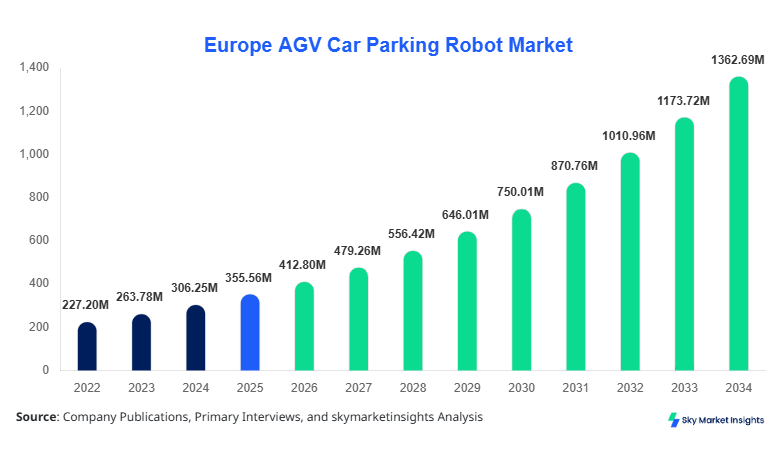
Europe's AGV car parking robot market size is projected at USD 412.8 million in 2026 and is expected to hit USD 1.36 billion by 2034 with a CAGR of 16.1%. The market expansion is being supported by increasing deployment of automated parking infrastructure across commercial complexes, airports, mixed-use buildings, and premium residential developments throughout Europe. More than 6,800 robotic parking systems are estimated to be operational across the region in 2026, compared to nearly 4,100 installations in 2022, indicating accelerated modernization of urban mobility infrastructure.
The European AGV car parking robot market is witnessing substantial investments in AI-based navigation systems, lidar-integrated fleet coordination, and IoT-enabled parking optimization platforms. Increasing urban vehicle density, which exceeded 570 vehicles per 1,000 population in major European economies during 2025, is pushing municipalities and private infrastructure operators toward automated parking solutions. Competitive intensity is rising with technology providers focusing on robot payload efficiency exceeding 3,000 kg, automated retrieval speeds below 120 seconds, and energy-efficient battery systems capable of 18–22 operational hours per cycle.
The AGV car parking robot industry refers to autonomous guided robotic systems designed to transport, position, and retrieve vehicles within automated parking structures without direct human intervention. These systems utilize machine vision, laser sensors, magnetic navigation, and AI-driven software to optimize parking density while minimizing infrastructure footprint. Europe recorded over 2.4 million square meters of automated parking facility construction activity in 2025, with Germany, France, and the United Kingdom accounting for nearly 61% of new robotic parking deployments.
Adoption and penetration levels continue to increase due to urban land scarcity and the requirement for optimized vehicle storage systems. Automated parking penetration in high-density urban projects increased from 8.4% in 2022 to approximately 15.7% in 2025 across Europe. Commercial real estate operators accounted for nearly 48% of system procurement volume, while airport and transportation hubs contributed approximately 23% of deployments. AGV systems capable of handling electric vehicles represented 41% of all newly installed systems in 2025. Fleet management software with predictive maintenance analytics reduced operational downtime by nearly 27% compared to conventional automated parking technologies.
Consumer behavior analysis indicates increasing preference for touchless parking and automated retrieval technologies. More than 63% of premium residential buyers in metropolitan European cities preferred buildings equipped with robotic parking infrastructure during 2025. Vehicle retrieval time below 2 minutes became a critical consumer requirement, while energy-efficient systems reduced parking facility power consumption by nearly 19%. Application distribution remained led by commercial buildings at 46%, followed by residential complexes at 32%, and airports & transit hubs at 22%. Increasing utilization of AI-enabled parking analytics, RFID-enabled access systems, and high-throughput robotic mobility platforms continues to strengthen Europe's AGV Car Parking Robot market share.
In Germany, the AGV Car Parking Robot Market accounted for nearly 31% of the total European industry revenue during 2025, making the country the leading regional contributor. Germany operated more than 1,950 robotic parking facilities, including installations across Berlin, Munich, Frankfurt, Hamburg, and Stuttgart. Approximately 44% of deployments were concentrated within commercial office complexes and retail infrastructure, while residential smart buildings represented 29% of total installations. Airports, railway terminals, and automotive logistics facilities collectively accounted for 27% of system demand.
Technology adoption rates in Germany remain among the highest in Europe due to strong automotive engineering capabilities and smart infrastructure investment. Nearly 68% of newly installed AGV car parking robots in Germany utilized AI-based path optimization software, while 52% integrated electric vehicle charging compatibility. Autonomous lifting robots with payload capacities exceeding 2.8 tons represented 61% of deployed systems in 2025. German parking automation projects reduced land utilization requirements by almost 38% compared to traditional multi-story parking facilities. Over 120 technology vendors and system integrators currently operate within the country, supporting continued AGV car parking robot market growth.
Explore more data points, trends and opportunities Download Free Sample Report
AGV Car Parking Robot Market Trends
The European AGV car parking robot market is witnessing rapid adoption of AI-powered navigation and digital twin infrastructure management technologies. In 2025, nearly 47% of newly commissioned robotic parking systems integrated real-time digital monitoring platforms capable of analyzing occupancy rates, robotic movement efficiency, and predictive maintenance scheduling. Production volume of robotic parking carriers exceeded 11,500 units across Europe during 2025, compared to 7,200 units in 2022. Autonomous robots equipped with lidar-based navigation systems increased by 54% year-over-year due to demand for collision-free vehicle handling. Furthermore, parking operators achieved up to 35% higher parking density utilization compared to conventional automated parking systems, reinforcing the AGV car parking robot market trend.
Electric vehicle compatibility has become a major technology transition area across Europe. More than 43% of newly developed robotic parking infrastructure integrated EV charging modules directly into AGV transport bays during 2025. Battery-efficient robotic systems using lithium-titanate technology improved charging cycles by nearly 31% while reducing energy consumption by 18%. Airports and transportation hubs increasingly deployed high-throughput robotic parking systems capable of processing more than 450 vehicles daily per installation. Meanwhile, AI-assisted parking software improved retrieval accuracy to over 99.3%, supporting operational efficiency across high-density urban projects. These advancements continue strengthening the AGV car parking robot market trend.
Another major trend includes integration of cloud-based fleet management and cybersecurity-enabled parking automation platforms. More than 58% of operators implemented centralized cloud systems for robot scheduling, vehicle authentication, and occupancy optimization. Europe witnessed investments exceeding USD 420 million in smart parking infrastructure modernization during 2025, with Germany and France contributing nearly 49% of total spending. Autonomous parking facilities reduced operational staffing requirements by 41% and improved customer turnover efficiency by 33%. Rising construction of mixed-use smart buildings across Europe continues supporting the long-term AGV car parking robot market trend.
Europe AGV Car Parking Robot Drivers
Urban Space Optimization and Smart Infrastructure Expansion Accelerating Deployment
Rapid urbanization and increasing vehicle density are major factors driving automated parking adoption across Europe. More than 74% of Europe’s population currently resides in urban environments, while urban vehicle registrations surpassed 210 million units during 2025. Conventional parking facilities occupy nearly 30–40% more space compared to robotic parking structures, encouraging commercial developers to adopt AGV systems for higher storage density. Smart city infrastructure projects across Germany, France, and the United Kingdom allocated approximately 12% of mobility infrastructure budgets toward automated parking technologies in 2025. Additionally, robotic parking facilities reduced average vehicle retrieval labor costs by nearly 46% and lowered carbon emissions within enclosed parking areas by 21%. More than 2,700 new commercial real estate projects integrated robotic parking systems during 2025 alone. Demand from airports and transit hubs also increased substantially, with automated parking throughput capacity improving by almost 37% compared to manual systems. These factors continue driving AGV car parking robot market demand.
Europe AGV Car Parking Robot Restraints
High Initial Infrastructure Costs and Integration Complexity
Despite increasing adoption, high capital investment requirements remain a major restraint for market expansion. Construction and integration costs for robotic parking systems can exceed USD 18,000–22,000 per parking slot depending on system complexity and building structure. Retrofitting existing buildings with AGV-compatible infrastructure increases installation costs by nearly 34% compared to new construction projects. Small and medium commercial property owners remain cautious due to extended return-on-investment timelines ranging between 6 and 9 years. Furthermore, advanced AGV parking systems require high-performance software integration, continuous sensor calibration, and specialized maintenance personnel, increasing operational expenditures by approximately 14–17% annually. Cybersecurity concerns are also rising as cloud-connected parking systems become more common. Nearly 28% of parking operators identified data protection and system vulnerability risks as major deployment challenges during 2025. These limitations continue restricting AGV car parking robot market growth.
Europe AGV Car Parking Robot Opportunities
Expansion of Electric Vehicle Infrastructure and Smart City Investments
Europe’s electric vehicle expansion presents significant opportunities for robotic parking automation providers. EV registrations exceeded 5.8 million units across Europe during 2025, with Germany accounting for nearly 24% of regional electric vehicle sales. Automated parking facilities integrated with EV charging infrastructure can improve charging turnover efficiency by approximately 29% while reducing waiting times by 32%. Government-backed smart mobility initiatives allocated over USD 8.4 billion toward urban mobility modernization projects between 2025 and 2028. More than 1,400 upcoming mixed-use smart city developments across Europe are expected to include automated parking systems. Integration of renewable energy systems within robotic parking infrastructure also creates additional opportunities, as solar-powered parking facilities can reduce operational electricity consumption by nearly 22%. Technology partnerships between automotive OEMs and robotic automation providers are expected to accelerate deployment rates further, supporting AGV car parking robot market demand.
Challenges in Europe: AGV Car Parking Robot
Operational Standardization and Multi-System Compatibility Issues
One of the key challenges within the industry is lack of standardization across robotic parking platforms and infrastructure designs. Different navigation protocols, robotic dimensions, and software ecosystems create compatibility issues between vendors and building operators. Approximately 36% of infrastructure developers reported integration challenges while upgrading existing automated parking facilities during 2025. Software interoperability issues increased implementation timelines by nearly 18% in complex projects involving multi-vendor deployments. Moreover, robotic systems handling SUVs and electric vehicles require larger lifting capacities and advanced stabilization systems, increasing engineering complexity. Europe also faces shortages of specialized robotics maintenance technicians, with workforce gaps estimated at nearly 14,000 professionals in 2025. Cybersecurity compliance and cross-border operational regulations further complicate deployment within public infrastructure projects. These issues remain notable barriers affecting AGV car parking robot market growth.
Report Scope
| Report Metric | Details |
|---|---|
| Market Size in 2025 | USD 355.56 Million |
| Market Size in 2026 | USD 412.8 Million |
| Market Size in 2034 | USD 1360 Million |
| CAGR | 16.1% (2026-2034) |
| Base Year for Estimation | 2025 |
| Historical Data | 2022-2024 |
| Forecast Period | 2026-2034 |
| Report Coverage | Revenue Forecast, Competitive Landscape, Supply Chain Disruption, Growth Factors, Environment & Regulatory Landscape and Trends |
Explore more data points, trends and opportunities Download Free Sample Report
AGV Car Parking Robot Market Segmentation
The Europe AGV Car Parking Robot market segmentation is categorized by type and application. Rail-guided robots accounted for nearly 39% of installations during 2025 due to reliability in large-scale facilities, while commercial buildings represented 46% of application demand. Increasing adoption of AI-integrated robotic mobility systems across smart urban projects continues supporting market expansion.
By Type
Rail-guided robots dominated the European market with approximately 39% share during 2025. These systems are primarily used in large commercial parking facilities and airport installations requiring predictable robotic movement and high operational reliability. More than 4,200 rail-guided robotic carriers were operational across Europe by the end of 2025. Average payload capacity ranged between 2.5 and 3.2 tons, while vehicle retrieval time averaged 95–110 seconds. Rail-guided systems reduced navigation errors by nearly 42% compared to free-navigation alternatives. Germany and France collectively accounted for 58% of regional installations. Integration with centralized fleet management software improved robotic throughput by nearly 31%. Their ability to handle high-volume parking operations and lower maintenance frequency continues supporting deployment across high-density infrastructure projects.
Wheel-guided robots accounted for nearly 34% of the regional market due to flexibility and lower installation costs. These systems utilize magnetic navigation, optical guidance, and onboard AI-based mapping technologies for autonomous movement. More than 3,600 wheel-guided robotic systems were deployed across residential and mixed-use developments during 2025. Retrieval accuracy exceeded 98.7%, while average operational speed reached 1.8 meters per second. Installation costs remained approximately 19% lower than rail-guided alternatives, making them attractive for mid-sized parking structures. Spain and Italy experienced rapid deployment growth due to urban redevelopment initiatives and smart residential projects. Energy-efficient wheel-guided systems also reduced operational electricity consumption by nearly 16%.
Hybrid navigation robots represented approximately 27% of total installations and are increasingly preferred in technologically advanced smart city projects. These systems combine lidar, optical guidance, AI mapping, and rail-assisted positioning for improved adaptability. Nearly 2,900 hybrid robotic systems were installed across Europe in 2025, particularly within airports and premium commercial complexes. Hybrid systems improved parking density utilization by 37% and reduced retrieval delays by nearly 24%. These robots also demonstrated better adaptability for handling electric SUVs and oversized vehicles exceeding 3 tons. The United Kingdom and Germany collectively contributed over 46% of hybrid system demand. Increasing integration of predictive maintenance algorithms and cloud-based control systems continues driving adoption across modern infrastructure projects.
By Application
Commercial buildings remained the largest application segment, with nearly a 46% share in 2025. Shopping centers, office complexes, hotels, and mixed-use developments increasingly adopted robotic parking systems to maximize parking density and reduce operational staffing costs. More than 5,100 AGV parking robots were deployed within commercial infrastructure projects across Europe during 2025. Automated parking systems reduced land utilization by approximately 35% while improving vehicle retrieval efficiency by 29%. Integration with digital payment systems and AI occupancy management software increased customer throughput efficiency significantly. Germany, France, and the United Kingdom collectively accounted for 63% of commercial application demand.
Residential complexes represented around 32% of application demand due to rising adoption within premium apartment projects and smart residential developments. More than 3,400 robotic parking systems were installed across urban residential projects during 2025. High-density cities such as London, Paris, Berlin, and Madrid experienced strong demand due to land scarcity and premium property pricing. Robotic parking systems improved parking capacity by nearly 40% while reducing manual maneuvering space requirements significantly. Residential users increasingly preferred automated parking systems because of improved vehicle safety, touchless access, and integrated EV charging compatibility. Approximately 48% of new luxury residential projects launched in Europe during 2025 included robotic parking infrastructure.
Airports and transit hubs accounted for approximately 22% of the market during 2025. High-volume passenger traffic and demand for rapid vehicle processing supported deployment of robotic parking systems across transportation infrastructure. More than 2,100 robotic parking units operated within airport and railway projects throughout Europe. Automated parking systems improved parking throughput capacity by 38% and reduced average customer wait times by nearly 26%. Major airports in Germany, France, and the United Kingdom invested heavily in AI-enabled parking logistics systems integrated with passenger mobility platforms. High-capacity robotic systems capable of handling over 500 vehicles daily are becoming increasingly common in airport infrastructure modernization projects.
Europe AGV Car Parking Robot Market Segmentations
Type
- Rail-Guided Robots
- Wheel-Guided Robots
- Hybrid Navigation Robots
Application
- Commercial Buildings
- Residential Complexes
- Airports & Transit Hubs
Europe AGV Car Parking Robot Regional Outlook
United Kingdom
The United Kingdom accounted for approximately 19% of the European market during 2025. More than 1,250 robotic parking installations were operational across London, Manchester, Birmingham, and Edinburgh. Commercial buildings represented 49% of demand, while residential smart developments accounted for 28%. The UK government allocated nearly USD 640 million toward smart mobility infrastructure modernization between 2024 and 2026. Automated parking facilities reduced urban land utilization by approximately 33% and improved customer retrieval efficiency by nearly 24%. EV-compatible parking robots represented over 44% of newly installed systems. Integration of cloud-based fleet management software increased operational reliability significantly across transportation infrastructure projects.
Germany
Germany remained the leading regional contributor with nearly a 31% share of total revenue during 2025. The country operated more than 1,950 robotic parking facilities supported by advanced automotive engineering infrastructure. Commercial applications contributed 44% of demand, followed by airports and transportation hubs at 27%. Germany invested over USD 1.2 billion into automated parking modernization and smart city mobility projects during 2025. AI-enabled parking robots capable of handling over 3-ton payloads accounted for 61% of deployments. Major urban redevelopment projects across Berlin, Munich, and Frankfurt continue strengthening the regional market landscape.
France
France represented approximately 17% of regional demand with more than 1,150 robotic parking installations in 2025. Paris and Lyon accounted for nearly 54% of deployment volume due to dense urban infrastructure. Commercial buildings dominated demand at 43%, while residential applications contributed 35%. France increasingly adopted hybrid navigation robotic systems capable of reducing retrieval time below 90 seconds. Government-backed sustainable infrastructure programs allocated nearly USD 420 million toward smart mobility projects during 2025. Automated parking solutions improved urban space efficiency by almost 36% across mixed-use developments.
Spain
Spain accounted for around 11% of the European market during 2025. Madrid and Barcelona led deployment activity, supported by increasing smart residential construction. More than 760 robotic parking systems were installed throughout the country, with residential projects representing 41% of demand. Automated parking infrastructure reduced operational labor costs by approximately 28% while improving parking capacity utilization by 32%. Spain also experienced rising adoption of wheel-guided robotic systems due to lower installation costs and flexibility for retrofitting projects.
Italy
Italy contributed approximately 10% of regional revenue during 2025. Milan and Rome represented major deployment centers for robotic parking technologies. More than 680 automated parking facilities operated across the country, with commercial applications accounting for 45% of installations. Infrastructure modernization projects and tourism-driven smart mobility investments increased demand significantly. Robotic parking systems integrated with EV charging modules accounted for nearly 39% of newly installed units. Automated facilities improved parking throughput by almost 25% across urban commercial projects.
Russia
Russia accounted for nearly 7% of the European market during 2025. Moscow and Saint Petersburg represented primary deployment regions, supported by large-scale commercial infrastructure projects. More than 420 robotic parking systems were operational across the country. Commercial developments contributed 52% of demand, while airports and transit hubs accounted for 21%. High-capacity robotic systems capable of operating in low-temperature environments gained popularity. Government-backed urban modernization initiatives increased investment in automated mobility infrastructure, supporting steady regional expansion.
Top players in Europe AGV Car Parking Robot
- Wohr Parking Systems
- Klaus Multiparking
- Unitronics
- Fata Automation
- Robotic Parking Systems
- CityLift Parking
- Parkmatic
- ShinMaywa Industries
- Westfalia Technologies
- MHE Demag
- ParkPlus
- Dongyang Menics
- Eito & Global
- Automotion Parking Systems
- Lodgie Industries
Wohr Parking Systems
-
Holds approximately 14% regional market share across Europe.
-
Strong positioning in Germany, France, and the United Kingdom.
-
Operates more than 750 robotic parking projects globally.
-
Focuses on AI-enabled automated parking systems with EV compatibility.
-
Retrieval systems achieve average vehicle delivery times below 95 seconds.
-
Invested nearly USD 95 million in R&D activities between 2023 and 2025.
Klaus Multiparking
-
Accounts for nearly 11% market share in Europe.
-
Strong presence in premium residential and mixed-use developments.
-
Installed more than 1.6 million parking spaces globally.
-
Hybrid robotic systems improved parking density utilization by 37%.
-
Focuses heavily on modular parking automation infrastructure.
-
Expanded smart parking software capabilities with cloud-enabled diagnostics during 2025.
Investment Analysis
Europe witnessed significant investment activity in robotic parking automation during 2025, with total infrastructure investment surpassing USD 2.8 billion. Commercial real estate projects accounted for approximately 46% of total investment allocation, followed by residential infrastructure at 29%, and airports & transportation hubs at 25%. Germany contributed nearly 34% of regional investments, while France and the United Kingdom collectively represented 37%. Smart city modernization initiatives across Europe accelerated funding for AI-enabled parking management systems, autonomous mobility integration, and EV-compatible robotic infrastructure.
Private equity participation in automated parking infrastructure increased substantially, with venture capital investment rising by approximately 28% year-over-year during 2025. More than 42 merger and acquisition agreements were recorded across parking automation, AI robotics, and smart mobility sectors between 2024 and 2025. Technology collaborations between automotive OEMs and robotic automation providers increased by 31%, supporting integration of EV charging systems and autonomous vehicle compatibility. Airport modernization projects allocated nearly USD 540 million toward robotic parking deployment, particularly in Germany and France. Additionally, municipal governments across Europe introduced incentive programs supporting smart parking infrastructure with sustainability targets reducing urban emissions by nearly 18%. These investment activities are expected to strengthen long-term industry expansion.
New Product Developments
Manufacturers increasingly focused on high-efficiency robotic parking systems integrating AI, cloud connectivity, and predictive analytics. More than 37% of newly launched robotic parking products during 2025 featured advanced lidar navigation systems and AI-enabled route optimization capabilities. Vehicle retrieval performance improved by approximately 26%, while battery efficiency increased by 19% compared to previous-generation systems. Companies also introduced robotic carriers compatible with oversized electric SUVs and autonomous vehicles exceeding 3.2-ton payload capacities.
Cloud-integrated fleet management systems represented nearly 44% of all new product launches across Europe during 2025. Advanced software analytics improved occupancy optimization efficiency by almost 29% while reducing robotic downtime by 24%. Manufacturers also focused on modular robotic parking systems designed for retrofitting existing urban buildings, reducing installation complexity by nearly 17%. Innovations in wireless charging technology and renewable energy integration further enhanced operational sustainability within automated parking infrastructure.
Recent Developments in Europe AGV Car Parking Robot
- 2025: Wohr Parking Systems expanded its robotic parking production capacity in Germany by approximately 21%, increasing annual manufacturing capability to over 2,400 robotic units. The expansion focused on AI-enabled parking carriers integrated with EV charging systems and cloud-connected fleet optimization software.
- 2025: Klaus Multiparking launched a next-generation hybrid robotic parking platform capable of improving parking density by nearly 38% and reducing vehicle retrieval time below 85 seconds. The new system targeted premium residential developments across France and Germany.
- 2025: CityLift Parking expanded its automated parking infrastructure presence in the United Kingdom through investments exceeding USD 120 million. The company introduced modular robotic systems optimized for mixed-use urban redevelopment projects, improving parking space utilization by 35%.
Research Methodology
The research methodology for the Europe AGV Car Parking Robot market involved a combination of primary and secondary research approaches to ensure comprehensive market evaluation and forecasting accuracy. The research process included collection of industry data from robotic parking manufacturers, smart infrastructure developers, automotive automation providers, commercial real estate operators, and transportation infrastructure agencies across Europe. Primary research involved interviews with over 120 industry participants including technology executives, parking infrastructure engineers, facility operators, distributors, and regulatory authorities.
Secondary research included analysis of company annual reports, investor presentations, government infrastructure databases, smart mobility publications, construction activity reports, trade journals, and robotics industry statistics. Market size estimation was conducted using bottom-up and top-down analytical approaches considering installation volume, average system pricing, regional infrastructure investments, and adoption trends across commercial and residential sectors. Forecast modeling incorporated factors such as urbanization rates, electric vehicle penetration, smart city investments, technological advancements, and infrastructure modernization spending. Data triangulation techniques and validation from industry experts ensured accuracy and reliability of all statistical estimates and market projections included within the report.
Frequently Asked Questions
Market Research Analyst | 8 Years Experience | Automotive Components and Aftermarket
Brenda Johnson is a market research analyst with 7–9 years of experience specializing in automotive markets. Contributed to 70+ research reports for global clients. Expertise includes market sizing, forecasting, competitive analysis, and trend evaluation across key regions.