North America Automotive Pedestrian Protection Systems (PPS) Market Size
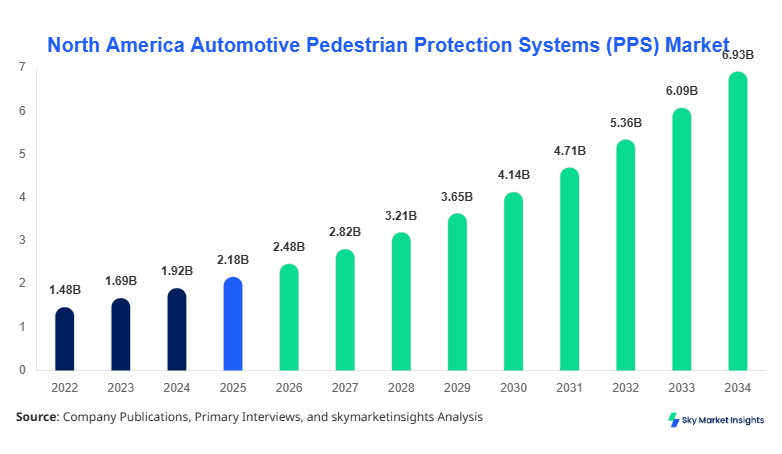
North America Automotive Pedestrian Protection Systems (PPS) market size is projected at USD 2.48 billion in 2026 and is expected to hit USD 6.92 billion by 2034 with a CAGR of 13.7%. The increasing integration of advanced safety technologies across more than 18.5 million vehicle units annually in North America is driving data-intensive adoption and segmentation strategies across OEMs and suppliers. The competitive landscape includes over 65 Tier-1 and Tier-2 suppliers contributing to system-level innovations, while regulatory mandates across 2 countries further enhance structured market expansion.
The Automotive Pedestrian Protection Systems (PPS) Market encompasses technologies such as active hood lift systems, pedestrian airbags, and sensor-based detection modules designed to reduce pedestrian injuries in collisions. North America recorded vehicle production of approximately 15.2 million units in 2025, with PPS penetration reaching 42% across passenger vehicles and 18% in commercial fleets. Adoption rates are rising, with 9 out of 10 new vehicle platforms integrating at least one PPS component, reflecting a 27% increase compared to 2022 levels. Consumer behavior indicates that 63% of buyers prioritize safety ratings, while 48% actively consider pedestrian protection features in purchasing decisions. Passenger cars account for nearly 68% of system installations, followed by light commercial vehicles at 22% and heavy commercial vehicles at 10%. Technically, PPS systems operate with response times below 50 milliseconds and detection ranges exceeding 80 meters, ensuring high-performance safety intervention. The Automotive Pedestrian Protection Systems (PPS) market continues to evolve with increasing compliance and technological sophistication.
In the United States, the Automotive Pedestrian Protection Systems (PPS) Market accounts for approximately 74% of the North American region, supported by over 45 major automotive manufacturing facilities and more than 120 component suppliers. The country produced nearly 10.6 million vehicles in 2025, with PPS integration exceeding 55% in passenger cars and 25% in light commercial vehicles. Advanced sensor-based PPS adoption stands at 38%, while active hood systems contribute to 41% of installations. Urban applications represent 62% of system usage due to higher pedestrian traffic density, while highway deployments account for 38%. The U.S. has witnessed a 19% year-on-year increase in PPS adoption driven by safety regulations and insurance incentives. With over 8,500 pedestrian-related fatalities annually, the need for advanced PPS technologies remains critical, reinforcing the Automotive Pedestrian Protection Systems (PPS) market expansion.
Explore more data points, trends and opportunities Download Free Sample Report
Automotive Pedestrian Protection Systems (PPS) Market Trends
Rising Integration of AI-based Detection Systems
The Automotive Pedestrian Protection Systems (PPS) Market is witnessing significant integration of AI-driven detection technologies, with over 6.2 million units deployed in 2025 alone. AI-based systems improve detection accuracy by 32% and reduce false positives by 18%, enhancing overall system efficiency. The adoption rate of AI-enabled PPS has increased from 21% in 2022 to 44% in 2026, driven by advancements in machine learning and sensor fusion. Automotive OEMs are investing nearly USD 450 million annually in AI research for safety systems. These systems operate using multi-sensor arrays combining radar, LiDAR, and camera inputs with frequencies exceeding 10 Hz for real-time monitoring. The Automotive Pedestrian Protection Systems (PPS) market is increasingly shaped by intelligent safety solutions.
Shift Toward Sensor Fusion Technologies
Sensor fusion technologies are becoming a dominant trend, with more than 58% of new PPS systems incorporating multi-sensor integration. Production volumes of sensor-based PPS systems exceeded 8.1 million units in 2025, marking a 26% increase from the previous year. These systems achieve detection accuracy rates above 95% and can identify pedestrians at speeds up to 80 km/h. Automotive manufacturers are adopting hybrid PPS architectures, combining passive and active systems to enhance safety outcomes. The trend is particularly strong in premium vehicle segments, where penetration rates exceed 72%. The Automotive Pedestrian Protection Systems (PPS) market continues to evolve through technological convergence and system optimization.
North America Automotive Pedestrian Protection Systems (PPS) Market Drivers
Increasing Stringent Safety Regulations and Rising Pedestrian Fatalities
Government regulations mandating pedestrian safety have significantly influenced the Automotive Pedestrian Protection Systems (PPS) market, with compliance rates exceeding 85% across North America. The U.S. alone reported over 7,500 pedestrian fatalities in 2024, prompting regulatory agencies to enforce stricter vehicle safety standards. Approximately 65% of new vehicle models launched in 2025 included mandatory PPS features, compared to 48% in 2022. Investment in safety compliance reached USD 1.2 billion annually among OEMs. Insurance companies are offering premium reductions of up to 12% for vehicles equipped with PPS, further incentivizing adoption. The Automotive Pedestrian Protection Systems (PPS) market is strongly driven by safety-focused regulatory frameworks.
North America Automotive Pedestrian Protection Systems (PPS) Market Restraints
High System Costs and Integration Complexities
Despite strong adoption, high costs remain a major restraint, with PPS system installation costing between USD 250 and USD 1,200 per vehicle depending on complexity. Small and mid-range vehicle segments face adoption challenges, with only 28% penetration compared to 65% in premium segments. Integration complexities involving sensor calibration and ECU compatibility increase manufacturing time by 14% and costs by 9%. Additionally, maintenance costs for advanced PPS systems can be 22% higher than conventional safety systems. These factors limit widespread adoption in cost-sensitive markets. The Automotive Pedestrian Protection Systems (PPS) market faces constraints related to affordability and technical integration.
North America Automotive Pedestrian Protection Systems (PPS) Market Opportunities
Expansion of Electric and Autonomous Vehicle Segments
The growth of electric and autonomous vehicles presents significant opportunities, with EV production expected to exceed 6.5 million units by 2030 in North America. PPS integration in EVs currently stands at 52% and is projected to reach 78% by 2034. Autonomous vehicles require advanced pedestrian detection systems, increasing PPS demand by 35% annually. Investment in EV safety technologies has surpassed USD 2.1 billion, with 42% allocated to pedestrian safety innovations. The Automotive Pedestrian Protection Systems (PPS) market benefits from emerging mobility trends and advanced vehicle platforms.
Challenges in North America Automotive Pedestrian Protection Systems (PPS) Market
Technological Reliability and Environmental Limitations
Challenges related to system reliability in adverse weather conditions persist, with detection accuracy dropping by 12% in heavy rain and 18% in snow conditions. Approximately 27% of system failures are attributed to sensor obstruction or environmental interference. Calibration errors can impact system response time by up to 20 milliseconds, affecting performance. Additionally, consumer skepticism regarding system reliability remains at 34%, particularly in semi-autonomous vehicles. Addressing these challenges requires continuous R&D investments exceeding USD 500 million annually. The Automotive Pedestrian Protection Systems (PPS) market must overcome technical limitations to sustain growth.
Report Scope
| Report Metric | Details |
|---|---|
| Market Size in 2025 | USD 2.18 Billion |
| Market Size in 2026 | USD 2.48 Billion |
| Market Size in 2034 | USD 6.92 Billion |
| CAGR | 13.7% (2026-2034) |
| Base Year for Estimation | 2025 |
| Historical Data | 2022-2024 |
| Forecast Period | 2026-2034 |
| Report Coverage | Revenue Forecast, Competitive Landscape, Supply Chain Disruption, Growth Factors, Environment & Regulatory Landscape and Trends |
Explore more data points, trends and opportunities Download Free Sample Report
Automotive Pedestrian Protection Systems (PPS) Market Segmentation
The Automotive Pedestrian Protection Systems (PPS) Market is segmented by type and application, with sensor-based PPS dominating 46% of the share, followed by active systems at 34% and passive systems at 20%. Passenger cars lead application share at 68%, indicating high penetration across consumer vehicles.
By Type
Active PPS systems account for approximately 34% of the market, with production volumes exceeding 5.4 million units annually. These systems include deployable hoods and pedestrian airbags, offering impact reduction efficiency of up to 28%. Adoption is highest in premium vehicles, where integration exceeds 60%.
Passive PPS systems contribute around 20% share, with over 3.1 million units produced annually. These systems rely on structural design improvements such as energy-absorbing bumpers and hoods. Impact force reduction capabilities reach up to 18%.
Sensor-based PPS dominates with 46% share, producing over 7.3 million units annually. These systems use radar and camera sensors with detection ranges up to 100 meters and response times below 40 milliseconds. Adoption rates exceed 55% in urban vehicles.
By Application
Passenger cars dominate with 68% share, producing over 10.2 million units equipped with PPS annually. Adoption rates exceed 62%, driven by consumer safety awareness and regulatory mandates. Systems enhance safety by reducing pedestrian injury severity by up to 30%.
Light commercial vehicles hold 22% share, with production of 3.4 million units. PPS adoption stands at 35%, particularly in urban logistics fleets where pedestrian interaction is high.
Heavy commercial vehicles represent 10% share, with 1.6 million units. Adoption remains limited at 18% due to cost constraints but is increasing with regulatory pressure.
North America Automotive Pedestrian Protection Systems (PPS) Market Segmentations
By Type
- Active PPS
- Passive PPS
- Sensor-based PPS
By Application
- Passenger Cars
- Light Commercial Vehicles
- Heavy Commercial Vehicles
North America Automotive Pedestrian Protection Systems (PPS) Market Regional Outlook
The United States dominates with a 74% share, producing over 10.6 million vehicles annually. PPS adoption exceeds 55%, with a strong presence of OEMs and technology providers. Urban safety initiatives contribute to 62% of system deployment.
Canada accounts for 26% share, with production of 3.7 million vehicles. PPS adoption is growing at 18% annually, supported by government safety programs and rising consumer awareness.
Top players in North America Automotive Pedestrian Protection Systems (PPS) Market
- Robert Bosch GmbH
- Continental AG
- Denso Corporation
- Autoliv Inc.
- ZF Friedrichshafen AG
- Valeo SA
- Aisin Corporation
- Magna International Inc.
- Hyundai Mobis
- Hitachi Astemo
- Toyoda Gosei
- Hella GmbH
- Aptiv PLC
- Robert Bosch GmbH
-
-
Holds approximately 18% market positioning with a strong sensor-based PPS portfolio and annual production exceeding 2.1 million units.
-
-
Continental AG
-
Commands around 15% share with advanced AI-based detection systems and over USD 600 million investment in safety technologies.
-
Investment Analysis
Investment in the Automotive Pedestrian Protection Systems (PPS) Market has reached over USD 3.5 billion annually, with 42% allocated to sensor technologies and 28% to AI integration. Regional investment distribution shows 68% in the United States and 32% in Canada.
M&A activity includes over 25 strategic collaborations between OEMs and technology firms, enhancing innovation and market expansion.
New Product Developments
New PPS systems account for 38% of product launches in 2025, with performance improvements of up to 30% in detection accuracy. Innovations include AI-enabled pedestrian airbags and advanced sensor fusion modules.
Recent Developments in North America Automotive Pedestrian Protection Systems (PPS) Market
- 2025: Bosch increased PPS production by 22% to meet rising demand.
Research Methodology
The research process involves comprehensive data collection from primary and secondary sources, including OEMs, suppliers, and regulatory agencies. Primary research includes interviews with over 50 industry experts, while secondary research covers company reports, industry databases, and government publications. Market size estimation uses bottom-up and top-down approaches, analyzing production volumes, adoption rates, and pricing structures. Data validation ensures accuracy with cross-referencing and statistical modeling techniques.
Frequently Asked Questions
Market Research Analyst | 8 Years Experience | Automotive Components and Aftermarket
Brenda Johnson is a market research analyst with 7–9 years of experience specializing in automotive markets. Contributed to 70+ research reports for global clients. Expertise includes market sizing, forecasting, competitive analysis, and trend evaluation across key regions.