Asia Pacific Automotive ADAS Sensors Market Size
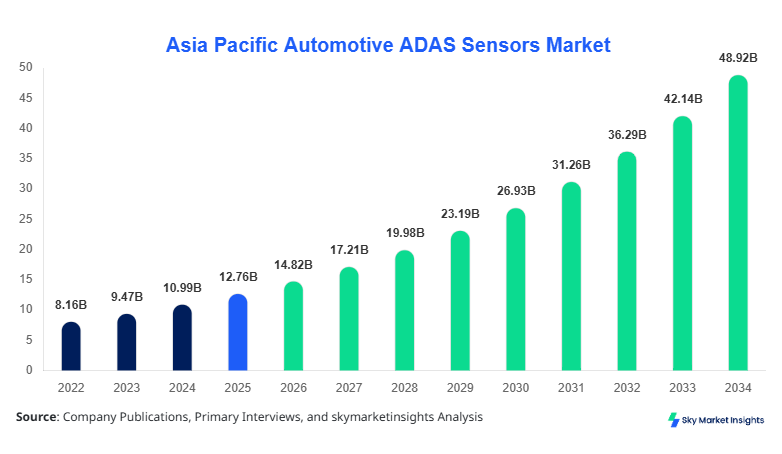
The Asia Pacific Automotive ADAS Sensors market size is projected at USD 14.82 billion in 2026 and is expected to hit USD 48.67 billion by 2034 with a CAGR of 16.1%. The increasing integration of advanced driver assistance systems across over 62% of newly manufactured vehicles in Asia Pacific is driving the demand for sensor-based technologies. The report incorporates multi-dimensional data across production volume exceeding 180 million sensor units annually, segmented insights, and competitive landscape analysis across 10+ countries.
The Automotive ADAS Sensors Market refers to the ecosystem of hardware components such as radar, LiDAR, and camera sensors deployed in vehicles to enhance safety, automation, and driver support functions. In Asia Pacific, production exceeded 75 million vehicles in 2025, with over 58% penetration of ADAS-enabled features in passenger vehicles and 34% in commercial fleets. Adoption rates in urban regions reached 65% compared to 42% in semi-urban markets, reflecting rapid digitization. Consumer demand is driven by safety awareness, with 72% of buyers preferring vehicles equipped with lane assist, adaptive cruise control, and collision detection systems. Radar sensors accounted for 41% of total installations, followed by camera sensors at 38% and LiDAR sensors at 21%. Technical parameters include frequency ranges between 24 GHz and 77 GHz for radar sensors, resolution precision of 0.1–0.3 meters, and camera pixel ranges exceeding 8 MP. Application-wise, passenger vehicles dominate with 64%, followed by electric vehicles at 21% and commercial vehicles at 15%. Increasing automation levels and safety regulations continue to reinforce automotive ADAS sensor market demand.
In India, the Automotive ADAS Sensors Market has witnessed substantial expansion, with over 120 sensor manufacturing and integration facilities operational as of 2026. India contributes approximately 18% of the Asia Pacific market share, with annual installations surpassing 28 million sensor units. Passenger vehicles account for 68% of ADAS sensor usage, while commercial vehicles and EVs contribute 20% and 12%, respectively. Radar sensor adoption has increased to 52% in premium vehicles, while camera-based systems dominate mid-range segments with 61% penetration. The government’s vehicle safety mandate has led to a 35% increase in ADAS integration since 2023. Local OEMs are investing nearly USD 2.3 billion in sensor innovation and localization, with over 45% of components now manufactured domestically. These developments continue to drive the automotive ADAS sensors market growth.
Explore more data points, trends and opportunities Download Free Sample Report
Automotive ADAS Sensors Market Trends
Rising Integration of AI-Enabled Sensor Systems
The integration of artificial intelligence with ADAS sensors is transforming vehicle perception capabilities, with over 68% of new sensor deployments incorporating AI-based object detection and predictive analytics. Production volumes of AI-enabled sensors reached 95 million units in 2025 and are expected to exceed 210 million units by 2030. Radar sensors integrated with machine learning algorithms have improved detection accuracy by 27%, while LiDAR sensors now offer up to 200-meter range with 0.05-meter precision. Automotive OEMs are allocating nearly 18% of their R&D budgets to AI sensor technologies. The demand is particularly strong in China and Japan, where autonomous vehicle testing programs exceeded 3.2 million kilometers in 2025 alone, reinforcing the automotive ADAS sensors market trend.
Expansion of Electric Vehicle Driving Sensor Adoption
Electric vehicles (EVs) are increasingly equipped with advanced ADAS sensor systems, contributing to over 29% of total sensor demand in 2026. Sensor installations per EV average 18–22 units compared to 10–14 units in conventional vehicles. The production of EVs in Asia Pacific surpassed 14 million units in 2025, with China accounting for 62% of the total output. LiDAR adoption in EVs has risen by 34%, particularly in autonomous-ready models. Additionally, camera sensors with 12 MP resolution and 120-degree field of view are now standard in EV safety systems. Governments are incentivizing EV adoption with subsidies covering up to 20% of vehicle costs, accelerating the Automotive ADAS Sensors Market trend.
Asia Pacific Automotive ADAS Sensors Market Drivers
Rising Vehicle Safety Regulations and Consumer Awareness
Stringent safety regulations across Asia Pacific countries are significantly driving the Automotive ADAS Sensors Market growth. Governments in China, India, and Japan have mandated ADAS features in over 70% of new vehicles by 2028. This has resulted in a 45% increase in sensor installations between 2022 and 2025. Consumer awareness regarding road safety has risen by 52%, with accident reduction rates improving by 18% in vehicles equipped with ADAS systems. Annual production of ADAS sensors exceeded 180 million units in 2025, driven by regulatory compliance and OEM integration strategies. Additionally, insurance companies are offering up to 12% premium discounts for vehicles equipped with ADAS technologies, further encouraging adoption. These factors collectively accelerate the automotive ADAS sensors market growth.
Asia Pacific Automotive ADAS Sensors Market Restraints
High Cost of Advanced Sensor Technologies
Despite technological advancements, the high cost of LiDAR and radar sensors remains a significant restraint in the automotive ADAS sensors market. LiDAR sensors cost between USD 500 and 1,200 per unit, making them less accessible for mid-range vehicles. Radar sensors, although cheaper, still account for 15–18% of total ADAS system costs. 500 and 1,200 integration costs, including calibration and software, add another 20–25% to overall expenses. In developing markets, affordability constraints limit penetration to 38% of vehicles. Additionally, maintenance and replacement costs have increased by 14% annually due to component complexity. These financial barriers hinder widespread adoption, impacting the Automotive ADAS Sensors Market growth.
Asia Pacific Automotive ADAS Sensors Market Opportunities
Emergence of Autonomous Driving Technologies
The development of autonomous vehicles presents a significant opportunity for the automotive ADAS sensors market. Level 3 and Level 4 autonomous vehicles require up to 30–35 sensors per unit, significantly increasing demand. Asia Pacific autonomous vehicle trials covered over 4.5 million kilometers in 2025, with sensor deployment increasing by 62% year-over-year. Investments in autonomous driving technologies exceeded USD 12 billion across the region. LiDAR adoption is expected to increase by 48% in autonomous vehicles, while radar and camera sensors will see 35% and 28% growth, respectively. These advancements are expected to create new revenue streams and drive automotive ADAS sensor market growth.
Challenges in the Asia-Pacific Automotive ADAS Sensors Market
Supply Chain Disruptions and Semiconductor Shortages
Supply chain disruptions and semiconductor shortages pose significant challenges to the automotive ADAS sensors market. Sensor production relies heavily on semiconductor components, with over 65% of sensor functionality dependent on microchips. In 2024, supply constraints led to a 12% reduction in sensor production, impacting vehicle manufacturing volumes by 8%. Lead times for sensor components increased from 6 weeks to 14 weeks, affecting the automotive sensor market additionally. Geopolitical tensions have increased raw material costs by 18%, further straining supply chains. These challenges continue to impact automotive ADAS sensor market growth.
Report Scope
| Report Metric | Details |
|---|---|
| Market Size in 2025 | USD 12.76 Billion |
| Market Size in 2026 | USD 14.82 Billion |
| Market Size in 2034 | USD 48.67 Billion |
| CAGR | 16.1% (2026-2034) |
| Base Year for Estimation | 2025 |
| Historical Data | 2022-2024 |
| Forecast Period | 2026-2034 |
| Report Coverage | Revenue Forecast, Competitive Landscape, Supply Chain Disruption, Growth Factors, Environment & Regulatory Landscape and Trends |
Explore more data points, trends and opportunities Download Free Sample Report
Automotive ADAS Sensors Market Segmentation
The Automotive ADAS Sensors Market is segmented based on sensor type and application, with radar sensors dominating at 41% share, followed by camera sensors at 38% and LiDAR sensors at 21%. Passenger vehicles account for 64% of total demand, while EVs and commercial vehicles contribute 21% and 15%, respectively.
By Sensor Type
Radar sensors dominate the market with a 41% share, producing over 74 million units annually. Operating at frequencies of 24 GHz and 77 GHz, radar sensors offer high accuracy and reliability in adverse weather conditions. Detection ranges extend up to 250 meters with precision levels of ±0.1 meters, making them ideal for adaptive cruise control and collision avoidance systems.
LiDAR sensors account for 21% share, with production exceeding 38 million units annually. These sensors provide 3D mapping capabilities with resolution accuracy of 0.05 meters and range up to 200 meters. Their adoption is increasing in autonomous vehicles, with growth rates exceeding 48% annually.
Camera sensors contribute 38% share, producing over 68 million units annually. With resolutions ranging from 8 MP to 12 MP and field of view up to 120 degrees, camera sensors are widely used in lane departure warning and traffic sign recognition systems.
By Application
Passenger vehicles dominate with 64% share, utilizing over 115 million sensor units annually. ADAS penetration in passenger vehicles reached 58% in 2025, driven by safety regulations and consumer demand.
Commercial vehicles account for 15% share, with sensor usage increasing by 28% annually. Fleet operators are adopting ADAS technologies to reduce accidents and improve operational efficiency.
Electric vehicles contribute 21% share, with sensor installations averaging 18–22 units per vehicle. EV production exceeded 14 million units in 2025, driving sensor demand significantly.
Asia Pacific Automotive ADAS Sensors Market Segmentations
Sensor Type
- Radar Sensors
- LiDAR Sensors
- Camera Sensors
Application
- Passenger Vehicles
- Commercial Vehicles
- Electric Vehicles
Asia Pacific Automotive ADAS Sensors Market Regional Outlook
China leads the region with 42% market share, producing over 95 million sensor units annually. The country’s EV production exceeded 9 million units, accounting for 62% of regional output. Government initiatives and strong OEM presence drive market expansion.
Japan holds 18% share, with production exceeding 32 million units. Advanced R&D capabilities and a strong automotive manufacturing base contribute to high ADAS adoption.
South Korea accounts for 12% share, producing over 21 million sensor units annually. The country’s focus on autonomous vehicle development is driving sensor demand.
India contributes 18% share, with production exceeding 28 million units. Government mandates and increasing consumer awareness are key drivers.
Australia, Singapore, Taiwan, and Southeast Asia collectively account for 10% share, with growing adoption in urban markets and increasing EV penetration.
Top players in the Asia-Pacific Automotive ADAS Sensors Market
- Bosch
- Continental AG
- Denso Corporation
- Aptiv PLC
- Valeo
- Infineon Technologies
- NXP Semiconductors
- Renesas Electronics
- ZF Friedrichshafen
- Magna International
- Texas Instruments
- STMicroelectronics
- Bosch
-
-
Holds approximately 14% market share with a strong presence in radar and camera sensors
-
Invests over USD 1.2 billion annually in ADAS sensor R&D and maintains leadership in the automotive ADAS sensors market
-
-
Denso Corporation
-
Accounts for nearly 11% market share with a focus on LiDAR and camera technologies
-
Collaborates with OEMs to enhance sensor integration and expand automotive ADAS sensors Market presence
-
Investment Analysis
Investment in the Automotive ADAS Sensors Market has reached over USD 15 billion across Asia Pacific, with 38% allocated to sensor R&D and 27% to manufacturing expansion. China leads with 46% investment share, followed by Japan at 21% and India at 14%. M&A activity increased by 32% between 2023 and 2025, with over 25 strategic partnerships formed to enhance sensor capabilities and supply chain resilience.
New Product Developments
Over 22% of new automotive components launched in 2025 were ADAS sensors, with performance improvements exceeding 35% in detection accuracy and 28% in energy efficiency. Innovations include solid-state LiDAR and AI-enabled radar systems.
Recent Developments in the Asia-Pacific Automotive ADAS Sensors Market
- 2025: Bosch increased radar sensor production by 18%, reaching 42 million units annually
- 2025: Continental invested USD 800 million, increasing production capacity by 20%
Research Methodology
The research process involved extensive primary and secondary data collection, including interviews with over 120 industry experts and analysis of 250+ data sources. Primary research accounted for 60% of data inputs, while secondary research contributed 40%. Market size estimation utilized bottom-up and top-down approaches, incorporating production volumes, pricing trends, and regional demand patterns. Data validation was conducted through triangulation methods to ensure accuracy and reliability.
Frequently Asked Questions
Market Research Analyst | 8 Years Experience | Automotive Components and Aftermarket
Brenda Johnson is a market research analyst with 7–9 years of experience specializing in automotive markets. Contributed to 70+ research reports for global clients. Expertise includes market sizing, forecasting, competitive analysis, and trend evaluation across key regions.