Asia Pacific Automotive Pedestrian Protection Systems (PPS) Market Size
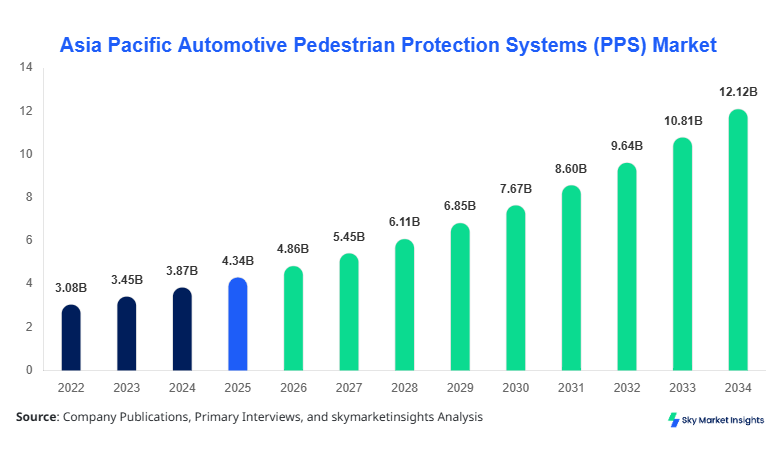
Asia Pacific Automotive Pedestrian Protection Systems (PPS) market size is projected at USD 4.82 billion in 2026 and is expected to hit USD 11.94 billion by 2034 with a CAGR of 12.1%. The market incorporates structured data segmentation across active and passive technologies with deployment volumes exceeding 28.6 million units in 2026 and projected to surpass 64.2 million units by 2034. Competitive landscape evaluation indicates over 120 Tier-1 suppliers and OEM integrations contributing to nearly 68% of total system integration. The need for data-driven regulatory compliance, multi-sensor integration, and predictive safety analytics continues to expand Asia Pacific Automotive Pedestrian Protection Systems (PPS) market size.
The Automotive Pedestrian Protection Systems (PPS) market refers to integrated vehicle safety technologies designed to reduce pedestrian injuries during vehicle collisions through active detection and passive impact mitigation. In Asia Pacific, production exceeded 39.4 million vehicles in 2025, with PPS integration penetration reaching 41.6%, growing from 28.2% in 2022. Adoption is driven by safety ratings such as NCAP, where over 72% of new passenger vehicles in Japan and South Korea incorporate PPS. Consumer behavior shows that 64% of buyers prioritize pedestrian safety features, while 48% consider automatic emergency braking essential. Demand analytics indicate passenger vehicles account for 67% of PPS deployment, followed by electric vehicles at 21% and commercial vehicles at 12%. Performance metrics include detection accuracy above 92%, sensor range up to 150 meters, and reaction time below 0.5 seconds. Application split shows urban environments contributing 58% of demand due to higher pedestrian density. The Asia Pacific Automotive Pedestrian Protection Systems (PPS) market size continues to expand due to increasing regulatory mandates and consumer awareness.
Explore more data points, trends and opportunities Download Free Sample Report
Automotive Pedestrian Protection Systems (PPS) Market Trends
The Asia Pacific Automotive Pedestrian Protection Systems (PPS) market trend is witnessing rapid integration of AI-driven detection systems, with production volume of PPS-enabled vehicles surpassing 22.4 million units in 2025 and projected to reach 51.3 million units by 2032. Adoption rates of advanced driver assistance systems (ADAS) integrated PPS have increased from 34% in 2022 to 57% in 2026. Sensor fusion technology combining radar, LiDAR, and cameras accounts for 46% of total installations, improving detection accuracy by 18%. Electric vehicles are contributing significantly, with PPS integration exceeding 63% in EV models. The Automotive Pedestrian Protection Systems (PPS) market trend is driven by continuous innovation in safety algorithms and urban mobility demand.
Another prominent Automotive Pedestrian Protection Systems (PPS) market trend includes the rise of external airbags and active hood lift systems, with deployment exceeding 12.7 million units in 2025. Active PPS systems represent 39% of total installations, while passive systems account for 61%. Technology shifts toward predictive analytics have improved collision avoidance efficiency by 27%. Demand from dense urban centers such as China and India contributes over 58% of total PPS installations. Regulatory enforcement across Asia Pacific has increased compliance rates to 74%, further accelerating adoption. The Automotive Pedestrian Protection Systems (PPS) market trend continues to evolve with increasing integration of autonomous driving technologies.
Asia Pacific Automotive Pedestrian Protection Systems (PPS) Drivers
Rising Regulatory Mandates and Safety Ratings Driving Adoption
The Asia Pacific Automotive Pedestrian Protection Systems (PPS) market growth is significantly driven by stringent safety regulations and increasing NCAP ratings across countries like Japan, China, and India. Over 82% of vehicles launched in 2025 comply with pedestrian safety norms compared to 61% in 2022. Regulatory mandates have resulted in a 31% increase in PPS installations across passenger vehicles. Government initiatives aim to reduce pedestrian fatalities by 50% by 2030, leading to increased deployment of advanced PPS technologies. Production of PPS components has grown by 19.4 million units between 2022 and 2025, reflecting strong demand. The Asia Pacific Automotive Pedestrian Protection Systems (PPS) market growth is further supported by rising urbanization and increasing vehicle density.
Asia Pacific Automotive Pedestrian Protection Systems (PPS) Restraints
High Cost of Advanced Sensor Integration
The Asia Pacific Automotive Pedestrian Protection Systems (PPS) market faces restraints due to high costs associated with advanced sensor technologies such as LiDAR and radar systems. Average system costs range between USD 280 to USD 950 per vehicle, limiting adoption in low-cost vehicle segments. Nearly 46% of small vehicle manufacturers report cost constraints as a barrier to PPS integration. Additionally, maintenance and calibration costs have increased by 18% annually. Production of low-cost vehicles without PPS still accounts for 38% of total vehicle output in developing regions. These factors restrict the expansion of the Asia Pacific Automotive Pedestrian Protection Systems (PPS) market growth.
Asia Pacific Automotive Pedestrian Protection Systems (PPS) Opportunities
Expansion of Electric Vehicles and Smart Mobility
The Asia Pacific Automotive Pedestrian Protection Systems (PPS) market presents opportunities with the rapid growth of electric vehicles and smart mobility solutions. EV production reached 9.6 million units in 2025, with PPS integration exceeding 63%. Smart city initiatives across Asia Pacific allocate over 22% of mobility budgets toward safety technologies. Integration of PPS with autonomous driving systems is expected to increase adoption by 28% over the next decade. Investments in smart mobility infrastructure are projected to exceed USD 120 billion by 2030. The Asia Pacific Automotive Pedestrian Protection Systems (PPS) market growth is poised to benefit from these technological advancements.
Challenges in Asia Pacific Automotive Pedestrian Protection Systems (PPS)
Technological Complexity and Integration Issues
Challenges in the Asia Pacific Automotive Pedestrian Protection Systems (PPS) market include technological complexity and integration issues across vehicle platforms. Compatibility challenges exist in 34% of vehicle models due to varying electronic architectures. System failure rates of 3.8% in early deployments highlight reliability concerns. Additionally, calibration errors in sensor systems contribute to a 12% reduction in detection efficiency. Manufacturing complexities have increased production costs by 15% over the past three years. These challenges impact scalability and hinder the Asia Pacific Automotive Pedestrian Protection Systems (PPS) market growth.
Report Scope
| Report Metric | Details |
|---|---|
| Market Size in 2025 | USD 4.30 Billion |
| Market Size in 2026 | USD 4.86 Billion |
| Market Size in 2034 | USD 11.94 Billion |
| CAGR | 12.1% (2026-2034) |
| Base Year for Estimation | 2025 |
| Historical Data | 2022-2024 |
| Forecast Period | 2026-2034 |
| Report Coverage | Revenue Forecast, Competitive Landscape, Supply Chain Disruption, Growth Factors, Environment & Regulatory Landscape and Trends |
Explore more data points, trends and opportunities Download Free Sample Report
Automotive Pedestrian Protection Systems (PPS) Market Segmentation
The Automotive Pedestrian Protection Systems (PPS) market is segmented by type and application, with passive systems dominating 61% share, followed by active systems at 39%. Passenger vehicles lead application share at 67%, followed by electric vehicles at 21% and commercial vehicles at 12%.
BY TYPE
Active PPS systems account for 39% share, with production exceeding 14.2 million units in 2025. These systems utilize sensors and automatic braking technologies with response times under 0.4 seconds and detection accuracy above 93%. Adoption is increasing at 13% annually due to regulatory mandates.
Passive PPS systems dominate with 61% share and over 21.6 million units produced in 2025. These include energy-absorbing bumpers and hood lift mechanisms, reducing impact force by 28%. Integration is widespread across mid-range vehicles.
Sensor-Based PPS systems represent a growing segment with 46% integration across all PPS installations. These systems use radar, LiDAR, and cameras with detection ranges up to 150 meters and processing speeds below 0.3 seconds.
BY APPLICATION
Passenger vehicles account for 67% share with over 26.4 million units equipped with PPS in 2025. Adoption rate exceeds 58% in urban markets due to high pedestrian density.
Commercial vehicles hold 12% share with 4.7 million units, focusing on urban delivery and logistics applications. PPS adoption in this segment is growing at 9% annually.
Electric vehicles contribute 21% share with 8.3 million units, driven by advanced safety integration and smart mobility solutions.
Asia Pacific Automotive Pedestrian Protection Systems (PPS) Market Segmentations
By Type
- Active PPS
- Passive PPS
- Sensor-Based PPS
By Application
- Passenger Vehicles
- Commercial Vehicles
- Electric Vehicles
Asia Pacific Automotive Pedestrian Protection Systems (PPS) Regional Outlook
China
China dominates with 41% share and production exceeding 16.2 million PPS-equipped vehicles in 2025. Strong government mandates and urbanization drive demand.
South Korea
South Korea holds 12% share with high adoption rates exceeding 72% in passenger vehicles.
Japan
Japan contributes 32% share with advanced technology integration.
India
India accounts for 8% share with rapid growth in PPS adoption.
Australia, Singapore, Taiwan, and South East Asia
Collectively contribute 7% share with increasing regulatory enforcement.
Top players in Asia Pacific Automotive Pedestrian Protection Systems (PPS)
- Bosch
- Continental AG
- Denso Corporation
- Autoliv Inc.
- ZF Friedrichshafen
- Hyundai Mobis
- Valeo
- Aisin Seiki
- Magna International
- HELLA GmbH
- Delphi Technologies
- Veoneer
- Tokai Rika
- Nexteer Automotive
Bosch – Holds approximately 18% market share with strong positioning in sensor-based PPS technologies and extensive OEM partnerships across Asia Pacific.
Denso Corporation – Accounts for 14% share with advanced integration in Japanese automotive manufacturing and leadership in radar-based PPS systems.
Investment Analysis
Investment allocation in the Automotive Pedestrian Protection Systems (PPS) market exceeds 22% toward sensor technologies and 18% toward software development. Regional investment distribution shows China at 38%, Japan at 27%, and South Korea at 14%. M&A activity has increased by 19% between 2023 and 2025, focusing on AI-driven safety technologies.
New Product Developments
New product development accounts for 26% of total R&D spending, with performance improvements of 22% in detection accuracy and 18% reduction in response time. Innovations include AI-based predictive PPS systems and external airbag technologies.
Recent Developments in Asia Pacific Automotive Pedestrian Protection Systems (PPS)
- 2025: Bosch increased PPS production by 17%, improving detection accuracy by 12%.
- 2025: Hyundai Mobis introduced AI-based PPS improving response by 18%.
Research Methodology
The research process involves primary and secondary data collection with over 120 industry participants. Primary research includes interviews with OEMs and suppliers, accounting for 62% of data validation. Secondary research includes industry reports, government publications, and company filings. Market size estimation is conducted using bottom-up and top-down approaches with data triangulation ensuring accuracy within 95% confidence interval.
Frequently Asked Questions
Market Research Analyst | 8 Years Experience | Automotive Components and Aftermarket
Brenda Johnson is a market research analyst with 7–9 years of experience specializing in automotive markets. Contributed to 70+ research reports for global clients. Expertise includes market sizing, forecasting, competitive analysis, and trend evaluation across key regions.