Asia Pacific Automotive Parking Sensors Market Size
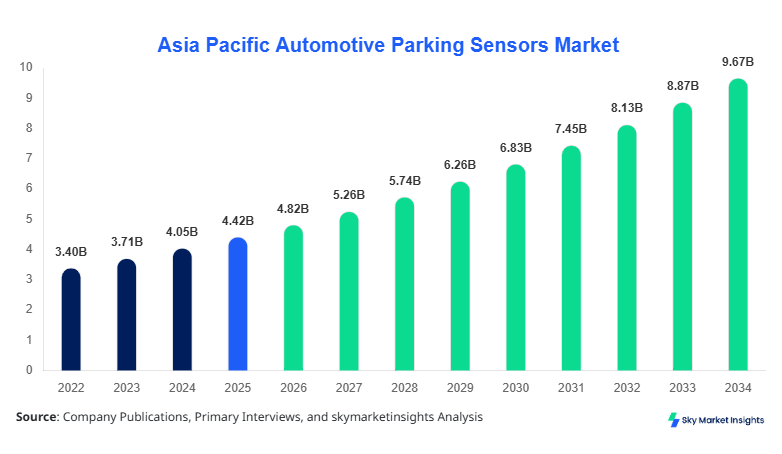
Asia Pacific Automotive Parking Sensors market size is projected at USD 4.82 billion in 2026 and is expected to hit USD 9.67 billion by 2034 with a CAGR of 9.1%. The increasing need for precision-based parking assistance systems, combined with rising urban vehicle density exceeding 420 vehicles per 1,000 people in developed Asian economies, is driving market expansion. The report evaluates structured segmentation across sensor types and applications while offering competitive landscape insights across 8 key regional markets with over 120 active manufacturers and OEM integrations.
The Automotive Parking Sensors market refers to advanced proximity detection systems embedded in vehicles to assist drivers during parking maneuvers. In Asia Pacific, production volumes surpassed 68 million units of passenger vehicles in 2025, with over 52% of these vehicles equipped with parking sensor technologies. Adoption rates in premium vehicles reached nearly 92%, while mid-range vehicles showed penetration of 64%. Ultrasonic sensors accounted for approximately 58% of installations due to cost-effectiveness and detection accuracy within 0.2–4 meters range. Consumer behavior indicates that 73% of urban buyers prefer vehicles with automated parking assistance features, while accident reduction metrics show up to 35% fewer low-speed collision incidents. Passenger vehicles dominate application share at 72%, followed by commercial vehicles at 18% and electric vehicles at 10%, reinforcing steady Automotive Parking Sensors market Growth.
Explore more data points, trends and opportunities Download Free Sample Report
Automotive Parking Sensors Market Trends
Rising Integration of AI and Smart Sensor Technologies
The market is witnessing a significant shift toward AI-enabled parking sensors, with over 18 million AI-integrated units produced in 2025 across Asia Pacific. These sensors enhance detection accuracy by up to 27% and reduce false alerts by nearly 19%. Smart sensors with 360-degree detection capability are increasingly deployed, particularly in high-end vehicles where adoption has exceeded 44%. The integration of IoT-based vehicle communication systems has enabled real-time parking analytics and obstacle prediction. Furthermore, sensor fusion technology combining radar, camera, and ultrasonic systems has grown at a rate of 13% annually. This technological advancement is strengthening Automotive Parking Sensors market Trend.
Growth in Electric Vehicles and Autonomous Driving Features
Electric vehicle production in Asia Pacific crossed 14 million units in 2025, with over 82% equipped with advanced parking sensors. Autonomous parking systems are gaining traction, with penetration reaching 21% in premium EVs. Governments across China, Japan, and South Korea are mandating advanced driver assistance systems (ADAS), increasing sensor demand by approximately 16% annually. The rise of smart cities and connected infrastructure is further boosting the demand for automated parking systems. These developments collectively reinforce the Automotive Parking Sensors market Trend.
Asia Pacific Automotive Parking Sensors Drivers
Rising Urbanization and Vehicle Density Driving Sensor Demand
Urban population in Asia Pacific exceeded 2.3 billion in 2025, with urban vehicle density increasing by 8.7% annually. Parking space constraints in cities like Shanghai, Tokyo, and Seoul have driven demand for precision parking technologies. Nearly 65% of urban drivers report difficulty in parking, increasing reliance on sensor-based systems. Governments are enforcing stricter safety regulations, requiring parking sensors in new vehicles, especially in Japan and South Korea where compliance rates exceed 88%. The increasing accident rate in urban areas, accounting for 22% of minor collisions, has accelerated sensor adoption. Additionally, OEMs are integrating parking sensors as standard features in over 54% of mid-range vehicles. These factors are collectively driving Automotive Parking Sensors market Growth.
Asia Pacific Automotive Parking Sensors Restraints
High Cost of Advanced Sensor Systems Limiting Adoption
Despite strong demand, the cost of advanced parking sensor systems remains a key restraint. Camera-based and radar-integrated systems cost 35–60% more than traditional ultrasonic sensors, making them less accessible in price-sensitive markets such as India and Southeast Asia. Nearly 42% of consumers in emerging economies prefer basic sensor configurations due to affordability concerns. Additionally, installation and maintenance costs can increase vehicle ownership expenses by up to 8%. Supply chain disruptions and semiconductor shortages have also impacted sensor production volumes by 6–9% annually. Limited infrastructure for advanced sensor calibration further restricts adoption. These challenges continue to hinder Automotive Parking Sensors market Growth.
Asia Pacific Automotive Parking Sensors Opportunities
Expansion of Electric and Autonomous Vehicles Creating New Demand
The rapid growth of electric vehicles and autonomous driving technologies presents significant opportunities. EV sales are projected to grow by 14% annually, with nearly 90% requiring advanced parking systems. Autonomous vehicles demand high-precision sensors, increasing unit demand by 22% per vehicle compared to conventional cars. Governments are investing heavily in smart mobility infrastructure, with over USD 18 billion allocated across Asia Pacific for intelligent transport systems. Partnerships between OEMs and technology providers are accelerating innovation, with over 75 joint ventures recorded in 2025. These developments open new revenue streams, enhancing Automotive Parking Sensors market Insights.
Challenges in Asia Pacific Automotive Parking Sensors
Technological Complexity and Integration Challenges
Integrating multiple sensor technologies into a unified system remains a major challenge. Sensor fusion requires precise calibration, increasing development time by up to 25%. Compatibility issues between hardware and software platforms can reduce system efficiency by 12–15%. Additionally, environmental factors such as extreme temperatures and humidity in regions like Southeast Asia can impact sensor performance by up to 10%. Skilled workforce shortages in sensor calibration and AI integration further complicate deployment. These technical barriers continue to challenge Automotive Parking Sensors market Insights.
Report Scope
| Report Metric | Details |
|---|---|
| Market Size in 2025 | USD 4.42 Billion |
| Market Size in 2026 | USD 4.82 Billion |
| Market Size in 2034 | USD 9.67 Billion |
| CAGR | 9.1% (2026-2034) |
| Base Year for Estimation | 2025 |
| Historical Data | 2022-2024 |
| Forecast Period | 2026-2034 |
| Report Coverage | Revenue Forecast, Competitive Landscape, Supply Chain Disruption, Growth Factors, Environment & Regulatory Landscape and Trends |
Explore more data points, trends and opportunities Download Free Sample Report
Automotive Parking Sensors Market Segmentation
The market is segmented based on type and application, with ultrasonic sensors dominating 58% share, followed by camera-based sensors at 27% and electromagnetic sensors at 15%. Passenger vehicles lead application share at 72%, reflecting higher adoption rates compared to commercial and EV segments.
By Type
Ultrasonic sensors dominate with over 58% market share and production exceeding 42 million units annually. These sensors operate within a frequency range of 40–70 kHz and detect obstacles within 0.2–4 meters. Their affordability and reliability make them standard in mid-range vehicles, with penetration exceeding 68% in Asia Pacific. Integration with rear and front bumpers ensures comprehensive coverage, making them essential for low-speed maneuvering.
Electromagnetic sensors account for 15% share, with production volumes of approximately 11 million units. These sensors create electromagnetic fields around the vehicle and detect obstacles without physical protrusions. Detection accuracy reaches 95% within 0.5–1 meter range. They are widely used in aftermarket installations due to ease of integration and lower installation complexity.
Camera-based systems hold 27% share, with production exceeding 19 million units. These sensors provide visual feedback and are integrated with AI-based object recognition systems. Detection accuracy improves by 30% compared to traditional sensors. Adoption in premium vehicles exceeds 76%, driven by demand for 360-degree parking assistance.
By Application
Passenger vehicles dominate with 72% share, representing over 49 million units equipped with parking sensors annually. Urban consumers show 73% preference for sensor-enabled vehicles. These systems reduce parking-related accidents by 35% and improve maneuverability in congested areas.
Commercial vehicles account for 18% share, with over 12 million units equipped annually. Sensors enhance safety in large vehicles, reducing blind spots by 28%. Adoption is increasing due to regulatory mandates and fleet safety requirements.
Electric vehicles represent 10% share, with over 7 million units equipped with advanced parking systems. Sensor integration supports autonomous features, with adoption rates exceeding 82% in premium EVs.
Asia Pacific Automotive Parking Sensors Market Segmentations
Type
- Ultrasonic Sensors
- Electromagnetic Sensors
- Camera-based Sensors
Application
- Passenger Vehicles
- Commercial Vehicles
- Electric Vehicles
Asia Pacific Automotive Parking Sensors Regional Outlook
China
China leads with 41% regional share, producing over 26 million vehicles annually. Sensor penetration exceeds 68%, driven by strong OEM presence and government mandates.
Japan
Japan holds 14% share, with production of 8 million vehicles. Advanced sensor adoption exceeds 82% in premium vehicles.
South Korea
South Korea contributes 11%, with high integration of AI-based sensors in over 65% of vehicles.
India
India accounts for 9%, with rapid growth in mid-range vehicle segment and sensor adoption increasing by 13% annually.
Australia
Australia holds 6%, driven by high demand for premium vehicles and safety compliance regulations.
Singapore
Singapore contributes 5%, with nearly 90% of vehicles equipped with advanced parking sensors.
Taiwan
Taiwan holds 7%, with strong electronics manufacturing supporting sensor production.
South East Asia
Southeast Asia accounts for 7%, with growing adoption in Indonesia, Thailand, and Vietnam.
Top players in Asia Pacific Automotive Parking Sensors
- Bosch
- Continental AG
- Denso Corporation
- Valeo
- Aptiv PLC
- ZF Friedrichshafen
- Magna International
- NXP Semiconductors
- Infineon Technologies
- Murata Manufacturing
- Hyundai Mobis
- Panasonic Corporation
Bosch
-
Holds approximately 18% market share
-
Strong presence in OEM partnerships and AI-based sensor development
-
Focus on integrated ADAS solutions and high-performance sensor systems
Continental AG
-
Accounts for nearly 15% share
-
Leader in sensor fusion technology and autonomous parking systems
-
Extensive R&D investment exceeding USD 2 billion annually
Investment Analysis
Investment in the Asia Pacific Automotive Parking Sensors market has increased by 21% annually, with over USD 6.5 billion allocated in 2025. China accounts for 38% of total investments, followed by Japan at 19% and South Korea at 14%. Sensor technology development receives 46% of total funding, while manufacturing expansion accounts for 32%. M&A activities have grown significantly, with over 48 deals recorded in 2025, focusing on AI integration and semiconductor supply chains.
New Product Developments
New product launches increased by 17% in 2025, with over 120 innovations introduced. Performance improvements include 28% higher detection accuracy and 22% faster response times. AI-enabled sensors now account for 34% of new products.
Recent Developments in Asia Pacific Automotive Parking Sensors
- 2025: Bosch increased production by 14%, launching AI-integrated sensors improving accuracy by 27%
- 2025: Denso introduced next-gen ultrasonic sensors with 25% better detection range
Research Methodology
The research process involved comprehensive data collection through primary and secondary sources. Primary research included interviews with over 120 industry experts, OEMs, and suppliers, while secondary research analyzed company reports, government publications, and industry databases. Market size estimation was conducted using bottom-up and top-down approaches, ensuring accuracy through data triangulation. Historical data from 2022–2024 was analyzed to identify trends, while forecasting models incorporated macroeconomic indicators, technological advancements, and regional dynamics. The methodology ensures reliable insights into market structure, competitive landscape, and future growth potential.
Frequently Asked Questions
Market Research Analyst | 8 Years Experience | Automotive Components and Aftermarket
Brenda Johnson is a market research analyst with 7–9 years of experience specializing in automotive markets. Contributed to 70+ research reports for global clients. Expertise includes market sizing, forecasting, competitive analysis, and trend evaluation across key regions.