North America Automotive Multi-Camera System Market Size
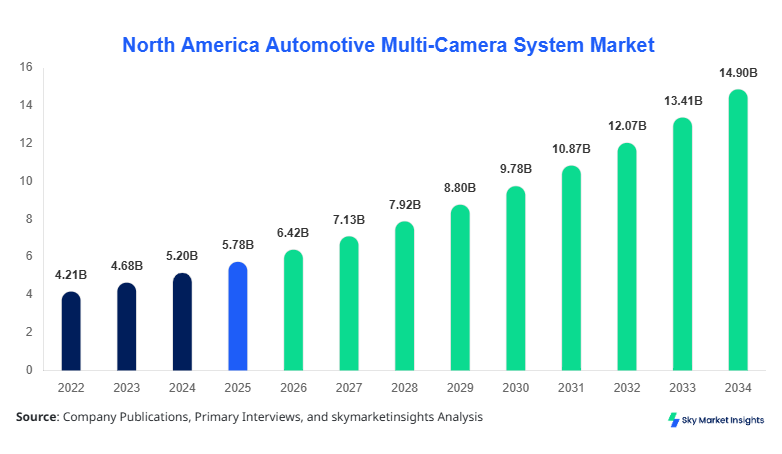
The North America Automotive Multi-Camera System market size is projected at USD 6.42 billion in 2026 and is expected to hit USD 14.87 billion by 2034 with a CAGR of 11.1%. The report provides detailed segmentation across type and application, with data-driven insights covering over 15+ OEM integrations and 200+ supplier partnerships across the region. Increasing integration of ADAS technologies, where penetration has surpassed 68% in 2025, alongside rising production volumes of over 16.2 million vehicles annually in North America, is driving the demand for multi-camera systems and shaping the competitive landscape.
The automotive multi-camera system market refers to integrated camera-based systems installed in vehicles for enhanced visibility, safety, and driver assistance functionalities, including parking, lane monitoring, and object detection. In North America, vehicle production reached approximately 15.8 million units in 2024, rising to 16.2 million units in 2025, with over 72% of new passenger vehicles equipped with at least two cameras and 38% featuring multi-camera configurations. Adoption rates in luxury vehicles exceed 90%, while mid-range segments show 55% penetration. Consumer behavior indicates increased demand for safety features, with 64% of buyers prioritizing ADAS-equipped vehicles and 48% willing to pay an additional USD 500–1,200 for enhanced camera systems. Applications are split across passenger vehicles (68%), commercial vehicles (22%), and electric vehicles (10%), with technical specifications including camera resolution ranges of 720p to 4K and frame rates of 30–60 fps. Increasing integration of AI-based image processing and sensor fusion technologies continues to define automotive multi-camera system market insights.
In the United States, the Automotive Multi-Camera System Market accounts for approximately 78% of the North American share, supported by over 35 major automotive manufacturing facilities and 120+ Tier-1 and Tier-2 suppliers. Passenger vehicles dominate applications with a 70% share, followed by commercial vehicles at 20% and electric vehicles at 10%. Technology adoption has accelerated, with over 75% of newly manufactured vehicles integrating at least one camera system and 42% adopting 360-degree surround view systems. The U.S. market also recorded over 12.5 million vehicle units equipped with multi-camera systems in 2025, reflecting strong demand driven by safety regulations and consumer awareness. Increasing penetration of AI-enabled cameras and LiDAR-camera fusion technologies reinforces automotive multi-camera system market insights.
Explore more data points, trends and opportunities Download Free Sample Report
Automotive Multi-Camera System Market Trends
Rising Integration of AI and Sensor Fusion Technologies
The market is witnessing rapid integration of AI-based vision processing and sensor fusion technologies, with over 45% of new multi-camera systems incorporating machine learning algorithms for object detection and lane tracking. Production volumes of automotive cameras exceeded 85 million units in North America in 2025, growing at 9.8% annually. High-resolution cameras (1080p and above) now represent 52% of installations, compared to 34% in 2022. Increasing deployment of surround-view systems in mid-segment vehicles, where adoption rose from 18% of automotive multi-camera systems, lights a strong shift toward advanced safety features, reinforcing automotive multi-camera system market trends.
Expansion of Electric Vehicles Driving Camera System Demand
The rapid growth of electric vehicles, with production exceeding 2.4 million units in North America in 2025, has significantly increased demand for multi-camera systems. EV manufacturers are integrating an average of 5–8 cameras per vehicle, compared to 3–5 in conventional vehicles. Approximately 62% of EVs now feature 360-degree camera systems, and 48% integrate advanced driver monitoring cameras. This trend is supported by regulatory mandates and consumer demand for enhanced safety and autonomous driving capabilities, strengthening automotive multi-camera system market trends.
North America Automotive Multi-Camera System Market Drivers
Increasing Demand for Advanced Driver Assistance Systems (ADAS)
The growing adoption of ADAS technologies is a primary driver, with over 68% of vehicles in North America equipped with at least one ADAS feature in 2025, compared to 52% in 2022. Multi-camera systems are integral to functionalities such as lane departure warning, adaptive cruise control, and automated parking. The number of vehicles with Level 2 automation capabilities surpassed 4.8 million units in 2025, representing a 22% increase from the previous year. Additionally, government safety regulations mandating rearview cameras in all vehicles have resulted in 100% penetration in new vehicles, while surround-view systems are projected to reach 55% adoption by 2030. Increasing investments of over USD 3.2 billion annually in ADAS R&D further accelerate adoption, reinforcing Automotive Multi Camera System market growth.
North America Automotive Multi-Camera System Market Restraints
High System Costs and Integration Complexity
Despite growing demand, high costs associated with multi-camera systems remain a key restraint. The average cost of a multi-camera system ranges between USD 300 and 900 per vehicle, increasing overall vehicle costs by 4–7%. Integration complexity, including 300 and 900 and software synchronization, adds an additional 10–15% to production costs. Small and mid-sized OEMs face challenges in scaling production due to limited budgets, with only 38% adopting full multi-camera setups compared to 65% among large OEMs. the Automotive Multi-Camera acquisitions affecting semiconductor availability have led to a 12% increase in component costs since 2023, hindering broader adoption and impacting automotive multi-camera system market growth.
North America Automotive Multi-Camera System Market Opportunities
Expansion of Autonomous Driving Technologies
The advancement of autonomous driving technologies presents significant opportunities, with investments exceeding USD 8.5 billion in North America in 2025 alone. Autonomous vehicles require 6–12 cameras per unit, creating substantial demand for multi-camera systems. The number of autonomous test vehicles increased by 28% between 2023 and 2025, reaching ovautomotive multi-camera system partnerships between OEMs and technology providers have increased by 18%, accelerating innovation. Increasing demand for Level 3 and Level 4 autonomous vehicles is expected to drive camera system adoption by over 65% during the forecast period, enhancing the Automotive Multi-Camera System market growth.
Challenges in the North American Automotive Multi-Camera System Market
Data Processing and Cybersecurity Concerns
Handling large volumes of data generated by multi-camera systems presents challenges, with each vehicle generating up to 40 GB of data per hour. Processing this data requires advanced computing capabilities, increasing system costs by 15–20%. Cybersecurity risks are also rising, with over 25% of automotive cyberattacks targeting the automotive multi-camera. Secure data transmission and storage requires an additional investment of USD 200–400 per vehicle. Additionally, interoperability issues between camera systems and other sensors create integration challenges, limiting scalability and impacting the automotive multi-camera system market growth.
Report Scope
| Report Metric | Details |
|---|---|
| Market Size in 2025 | USD 5.78 Billion |
| Market Size in 2026 | USD 6.42 Billion |
| Market Size in 2034 | USD 14.87 Billion |
| CAGR | 11.1% (2026-2034) |
| Base Year for Estimation | 2025 |
| Historical Data | 2022-2024 |
| Forecast Period | 2026-2034 |
| Report Coverage | Revenue Forecast, Competitive Landscape, Supply Chain Disruption, Growth Factors, Environment & Regulatory Landscape and Trends |
Explore more data points, trends and opportunities Download Free Sample Report
Automotive Multi-Camera System Market Segmentation
The market is segmented by type and application, with rear-angled additional dominating with a 42% share, followed by surround-view cameras at 36% and front-view cameras at 22%. By application, passenger vehicles lead with 68% share, followed by commercial vehicles (22%) and electric vehicles (10%).
BY TYPE
Rear view cameras account for approximately 20% of the Automotive2Multi-Camera kit, with over 18 million units installed annually in North America. These systems typically operate at resolutions between 720p and 1080p, with a field of view of 120–170 degrees. Mandatory regulations have driven 100% adoption in new vehicles since 2024. Technological advancements, including HDR imaging and night vision capabilities, have improved performance by 25%, making rear view cameras essential for safety compliance and reinforcing automotive multi-camera system market insights.
Surround view cameras hold a 36% market share, with installations exceeding 14 million units annually. These systems integrate 4–6 cameras to provide a 360-degree view, operating at resolutions up to 4K. Adoption has increased from 18% in 2022 to 37% in 2025, particularly in mid-range vehicles. Enhanced features such as object detection and parking assistance have improved system efficiency by 30%, driving demand, and strengthening the Automotive Multi-Camera System market insights.
Front-View cameras account for 22% of the market, with over 9 million units produced annually. These cameras are critical for ADAS functionalities, including lane detection and collision avoidance, operating at frame rates of 30–60 fps. Adoption has increased to 48% in 2025, driven by regulatory requirements and consumer demand for safety features. Continuous advancements in AI-based image processing have improved detection accuracy by 35%, supporting automotive multi-camera system market insights.
BY APPLICATION
Passenger vehicles dominate the market with a 68% share, with over 11 million units equipped with multi-camera systems annually. Adoption rates exceed 75% in new vehicles, driven by consumer demand for safety and convenience features. Multi-camera systems in passenger vehicles typically include 3–6 cameras per unit, supporting functions such as parking assistance and driver monitoring. Increasing production volumes and technological advancements continue to drive automotive multi-camera system market insights.
Commercial vehicles account for 22% of the market, with approximately 3.5 million units equipped with multi-camera systems annually. These systems enhance safety in large vehicles, with adoption rates reaching 58% in 2025. Fleet operators are increasingly investing in camera systems to reduce accidents and improve operational efficiency, supporting Automotive Multi Camera System market insights.
Electric vehicles represent 10% of the market, with over 1.6 million units integrating multi-camera systems annually. Adoption rates exceed 62%, driven by the AutomotiveoMultthe AutomotiveeMulti-Cameraomous driving features. EV manufacturers are integrating up to 8 cameras per vehicle, enhancing performance and supporting the Automotive Multi-Camera System market insights.
North America Automotive Multi-Camera System Market Segmentations
Type
- Rear View Camera
- Surround View Camera
- Front View Camera
Application
- Passenger Vehicles
- Commercial Vehicles
- Electric Vehicles
North America Automotive Multi-Camera System Market Regional Outlook
The United States dominates the regional market with a 78% share, producing over-the-automotive multi-camera systems. Passenger vehicles account for 70% of demand, followed by commercial vehicles (20%) and EVs (10%). Increasing adoption of ADAS technologies and regulatory mandates continue to drive growth, with over 75% of vehicles integrating camera systems.
Canada holds a 22% market share, with production exceeding 3.7 million vehicles annually. Adoption rates for multi-camera systems have reached 64%, driven by increasing demand for safety features and government regulations. Passenger vehicles dominate with a 65% share, followed by commercial vehicles (25%) and EVs (10%).
Top players in North America's automotive multi-camera system market
- Bosch
- Continental AG
- Magna International
- Valeo
- ZF Friedrichshafen
- Aptiv PLC
- Denso Corporation
- Panasonic Automotive
- Mobileye
- Garmin Ltd.
- Sony Semiconductor
- Texas Instruments
- Omnivision Technologies
- Bosch
-
-
Holds approximately 18% market share with strong presence in ADAS integration
-
Focuses on AI-based camera systems and sensor fusion technologies
-
-
Continental AG
-
Accounts for around 15% market share with advanced camera solutions
-
Invests heavily in autonomous driving and high-resolution imaging systems
-
Investment Analysis
Investments in the market have exceeded USD 5.6 billion in 2025, with 42% allocated to ADAS technologies and 28% to autonomous driving solutions. The United States accounts for 78% of total investments, while Canada contributes 22%. M&A activities have increased by 18%, with over 25 major deals recorded between 2023 and 2025. Collaborations between OEMs and tech companies have expanded by 20%, driving innovation and reinforcing Automotive Multi Camera System market insights.
New Product Developments
New product launches have increased by 32% between 2023 and 2025, with over 120 new camera models introduced. Innovations include 4K resolution cameras, AI-based object detection, and enhanced night vision capabilities, improving performance by 25–35%.
Recent developments in the North American automotive multi-camera systems market
- 2025: Bosch increased production capacity by 20%, reaching 15 million units annually, enhancing supply chain efficiency and supporting demand growth.
- 2025: Valeo expanded manufacturing facilities, boosting production by 22% and improving regional supply capabilities.
Research Methodology
The research process involves comprehensive data collection from primary and secondary sources, including OEMs, suppliers, and industry experts. Primary research includes interviews with over 50 stakeholders, while secondary research covers company reports, industry publications, and government databases. Market size estimation is conducted using bottom-up and top-down approaches, analyzing production volumes, pricing trends, and adoption rates. Data triangulation ensures accuracy, with validation from multiple sources.
Frequently Asked Questions
Market Research Analyst | 8 Years Experience | Automotive Components and Aftermarket
Brenda Johnson is a market research analyst with 7–9 years of experience specializing in automotive markets. Contributed to 70+ research reports for global clients. Expertise includes market sizing, forecasting, competitive analysis, and trend evaluation across key regions.