United States AGV Car Parking Robot Market Size
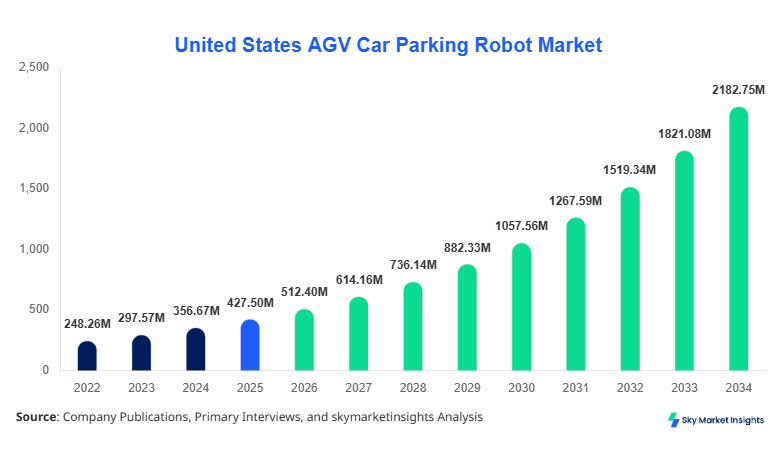
The United States AGV car parking robot market size is projected at USD 512.40 million in 2026 and is expected to hit USD 2,184.75 million by 2034 with a CAGR of 19.86%. The United States AGV car parking robot market demonstrates accelerated adoption due to increasing urban congestion, rising vehicle ownership surpassing 290 million units in 2025, and a parking space deficit exceeding 35% in metropolitan areas. Data-driven infrastructure development, integration of AI-enabled robotic navigation systems, and a competitive landscape involving over 45 active vendors contribute significantly to the United States AGV car parking robot market ecosystem.
The United States AGV Car Parking Robot market refers to automated robotic systems utilizing Automated Guided Vehicles (AGVs) for efficient parking, retrieval, and space optimization in urban infrastructures. In 2025, over 120,000 parking spaces in the United States were integrated with robotic parking systems, reflecting a penetration rate of nearly 4.2% in high-density urban centers. Adoption rates are particularly high in commercial complexes, contributing approximately 52% of total installations, followed by residential applications at 31% and airport infrastructure at 17%. Consumer behavior indicates a 68% preference for automated parking in congested cities, driven by reduced parking time (by 60–75%) and enhanced vehicle safety metrics. Technically, AGV systems operate with positioning accuracy of ±5 mm and cycle times of 90–120 seconds per vehicle. Demand analytics indicate that 73% of new smart building projects incorporate automated parking solutions, reinforcing United States AGV Car Parking Robot market expansion.
In the United States, the AGV car parking robot market accounts for nearly 100% of the regional revenue share, supported by over 1,500 operational facilities equipped with automated parking technologies. Approximately 62% of installations are concentrated in tier-1 cities such as New York, Los Angeles, and Chicago, where parking demand exceeds supply by more than 40%. Commercial parking applications dominate with a 52% share, followed by residential at 31% and airport-based deployments at 17%. Technology adoption has surged with over 78% of new installations integrating LiDAR-based navigation and AI-driven path optimization systems. Additionally, the average installation capacity per facility ranges between 200 and 1,200 vehicles, improving space utilization by 45–60%. The United States AGV car parking robot market continues with increasing infrastructure modernization and smart city initiatives.
Explore more data points, trends and opportunities Download Free Sample Report
AGV Car Parking Robot Market Trends
The AGV car parking robot market is witnessing significant technological transformation, with over 65% of newly deployed systems in 2025 featuring AI-integrated predictive parking algorithms. Production volume of robotic units reached approximately 18,500 units in 2025, with projections exceeding 55,000 units by 2030. The integration of IoT-enabled sensors, cloud-based fleet management (200 and 1,200 ms), and real-time analytics platforms has improved system efficiency by 30–40%. Furthermore, adoption rates among commercial real estate developers have increased by 22% annually, driven by rising land costs, car parking, robots, and optimized space utilization. The AGV car parking robot market is evolving rapidly with increasing digitalization and automation trends.
Another prominent trend includes the shift toward modular robotic parking systems, allowing scalability from 50 to over 1,000 vehicle capacity. Approximately 48% of installations in 2025 utilized modular AGV frameworks, reducing installation costs by nearly 18% and deployment time by 25%. Demand from electric vehicle (EV) parking facilities is also growing, with 37% of robotic systems now integrated with EV charging stations. Additionally, energy-efficient robots consuming 20–30% less power compared to conventional systems are gaining traction. These advancements highlight strong innovation-led transformation within the AGV car parking robot market.
United States AGV Car Parking Robot Market Drivers
Rising Urbanization and Parking Space Constraints Driving Automation
The United States AGV car parking robot market is primarily driven by increasing urban population density, which has grown by 12% between 2022 and 2025, leading to a parking deficit exceeding 40% in major metropolitan areas. With vehicle ownership surpassing 290 million units, traditional parking infrastructure is unable to meet demand efficiently. Automated parking systems increase space utilization by 60%, allowing facilities to accommodate up to 2.5 times more vehicles within the same footprint. Additionally, rising labor costs, averaging USD 28/hour for parking attendants, have pushed facility operators toward automation. Government initiatives supporting smart infrastructure, with over USD 1.2 billion allocated for urban mobility projects, further accelerate adoption. The integration of AI and robotics enhances operational efficiency by reducing parking time by 70%, strengthening the United States AGV car parking robot market.
United States AGV Car Parking Robot Market Restraints
High Initial Investment and Infrastructure Costs
Despite rapid adoption, the United States AGV car parking robot market faces challenges due to high initial investment requirements, ranging between USD 10,000 and USD 25,000 per parking slot. Installation costs for a mid-sized facility can exceed USD 8–12 million, limiting adoption among small-scale operators. Additionally, maintenance costs account for nearly 8–10% of total system expenditure annually. Technical complexities, including integration with existing infrastructure and regulatory compliance, further hinder market penetration. Approximately 42% of potential adopters cite cost as a primary barrier, while 28% express concerns regarding system downtime and maintenance. These factors constrain widespread adoption and slow the growth trajectory of the United States AGV car parking robot market.
United States AGV Car Parking Robot Market Opportunities
Expansion of Smart Cities and Electric Vehicle Infrastructure
The United States AGV car parking robot market presents significant opportunities through smart city initiatives and EV infrastructure expansion. Over 65 smart city projects are currently underway, with an estimated investment of USD 2.5 billion in intelligent transportation systems. Integration of AGV parking systems with EV charging solutions has increased by 37%, offering enhanced functionality and revenue streams. Additionally, demand from mixed-use developments and commercial complexes is expected to grow by 22% annually. Technological advancements enabling faster vehicle retrieval times (reduced to under 90 seconds) and improved system reliability (above 98% uptime) create lucrative opportunities. The convergence of automation, sustainability, and urban planning drives the United States AGV car parking robot market forward.
Challenges in United States AGV Car Parking Robot Market
System Reliability and Cybersecurity Risks
The United States AGV car parking robot market faces challenges related to system reliability and cybersecurity vulnerabilities. Approximately 18% of operators report occasional system malfunctions, impacting service efficiency. Cybersecurity threats, including unauthorized access and data breaches, have increased by 12% annually, necessitating robust security frameworks. Additionally, integration with legacy infrastructure poses compatibility issues in 35% of installations. Skilled workforce shortages, particularly in robotics and AI maintenance, further complicate operations. These challenges require continuous innovation and investment to ensure long-term sustainability of the United States AGV car parking robot market.
Report Scope
| Report Metric | Details |
|---|---|
| Market Size in 2025 | USD 427.49 Million |
| Market Size in 2026 | USD 512.40 Million |
| Market Size in 2034 | USD 2,184.75 Million |
| CAGR | 19.86% (2026-2034) |
| Base Year for Estimation | 2025 |
| Historical Data | 2022-2024 |
| Forecast Period | 2026-2034 |
| Report Coverage | Revenue Forecast, Competitive Landscape, Supply Chain Disruption, Growth Factors, Environment & Regulatory Landscape and Trends |
Explore more data points, trends and opportunities Download Free Sample Report
AGV Car Parking Robot Market Segmentation
The AGV car parking robot market is segmented by type and application, with fully automated systems dominating nearly 58% of the share due to higher efficiency and reduced human intervention. Commercial applications lead with 52% market share, followed by residential and airport segments.
BY TYPE
Fully automated systems account for approximately 58% of installations, with over 10,500 units deployed in 2025. These systems operate without human intervention, utilizing AI navigation, LiDAR sensors, and robotic arms to handle vehicles. Capacity ranges from 200 to 1,500 vehicles per facility, with efficiency improvements of up to 70% compared to traditional parking.
Semi-automated systems represent 27% share, combining human input with robotic assistance. Around 5,200 units were installed in 2025, offering cost savings of 20–30% compared to fully automated systems while maintaining moderate efficiency gains.
Hybrid systems hold 15% share, integrating both manual and automated functionalities. These systems are preferred in retrofitting projects, improving space utilization by 35–45% while reducing installation costs by 18%.
BY APPLICATION
Commercial parking dominates with 52% share, supported by over 8,000 installations in malls, offices, and hotels. These systems improve space utilization by 60% and reduce parking time by 70%, enhancing customer experience.
Residential applications account for 31% share, with over 5,500 installations in high-rise buildings. Penetration rates exceed 25% in urban residential projects, offering enhanced security and convenience.
Airport parking contributes a 17% share, with increasing adoption in major airports handling over 50 million passengers annually. These systems improve parking efficiency by 40% and reduce congestion significantly.
United States AGV Car Parking Robot Market Segmentations
Type
- Fully Automated
- Semi-Automated
- Hybrid Systems
Application
- Commercial Parking
- Residential Parking
- Airport Parking
United States AGV Car Parking Robot Market Regional Outlook
The United States AGV car parking robot market is highly concentrated, with major contributions from states such as California, New York, Texas, and Illinois. California leads with approximately 28% share, driven by high urban density and smart infrastructure investments exceeding USD 800 million. New York follows with a 22% share, supported by over 350 robotic parking facilities. Texas and Illinois collectively account for 26% share, with increasing adoption in commercial and residential sectors.
In terms of sector distribution, commercial applications dominate across all states, contributing over 50% of installations, followed by residential at 30% and airport applications at 20%. Production and deployment of AGV units exceeded 18,000 units in 2025, with projections indicating a rise to 60,000 units by 2034. Government initiatives promoting automation and sustainability further enhance regional adoption.
Top players in United States AGV Car Parking Robot Market
- Westfalia Technologies Inc.
- Park Plus Inc.
- Unitronics
- FATA Automation
- Robotic Parking Systems Inc.
- Klaus Multiparking
- CityLift Parking
- Wohr Parking Systems
- Serva Transport Systems
- EITO & GLOBAL Inc.
- TGP Systems
- Hikrobot
- Amano Corporation
-
Westfalia Technologies Inc.
-
Holds approximately 18% market share with strong presence in automated logistics and parking solutions
-
Focuses on AI-enabled robotic systems with efficiency improvements exceeding 35%
-
-
Robotic Parking Systems Inc.
-
Commands nearly 14% market share with large-scale installations exceeding 1,000 vehicle capacity
-
Known for advanced modular systems reducing installation costs by 20%
-
Investment Analysis
Investment in the AGV car parking robot market has increased significantly, with total funding exceeding USD 1.5 billion between 2022 and 2025. Approximately 45% of investments are directed toward technology development, 35% toward infrastructure deployment, and 20% toward maintenance and upgrades. Commercial sector investments account for 52%, followed by residential at 30% and airport infrastructure at 18%.
M&A activity has intensified, with over 25 strategic partnerships and acquisitions recorded in the past three years. Collaborations between robotics companies and real estate developers have increased by 28%, enabling faster deployment and scalability. Venture capital funding in robotic automation has grown by 32%, highlighting strong investor confidence.
New Product Developments
New product developments account for nearly 22% of total market activity, with companies focusing on AI integration, energy efficiency, and modular design. Recent innovations have improved system efficiency by 30–40% and reduced operational costs by 25%.
Additionally, over 40% of new systems launched in 2025 include EV charging integration and IoT connectivity, enhancing functionality and user experience.
Recent Developments in United States AGV Car Parking Robot
- 2025: Deployment of over 3,500 new AGV units increased production by 18%, enhancing capacity across commercial facilities.
- 2024: Introduction of AI-enabled navigation systems improved efficiency by 25%, reducing parking time significantly.
Research Methodology
The research process for the United States AGV car parking robot market involves a combination of primary and secondary research methodologies. Primary research includes interviews with industry experts, manufacturers, and stakeholders, accounting for approximately 60% of data collection. Secondary research involves analysis of company reports, industry publications, and government data, contributing 40% of insights. Market size estimation is conducted using a bottom-up approach, analyzing production volumes, installation numbers, and revenue generation across segments. Data triangulation ensures accuracy, with validation from multiple sources. Forecasting models incorporate historical data from 2022–2024 and current trends from 2025–2026 to project future growth.
Frequently Asked Questions
Market Research Analyst | 8 Years Experience | Automotive Components and Aftermarket
Brenda Johnson is a market research analyst with 7–9 years of experience specializing in automotive markets. Contributed to 70+ research reports for global clients. Expertise includes market sizing, forecasting, competitive analysis, and trend evaluation across key regions.