North America AGV Car Parking Robot Market Size
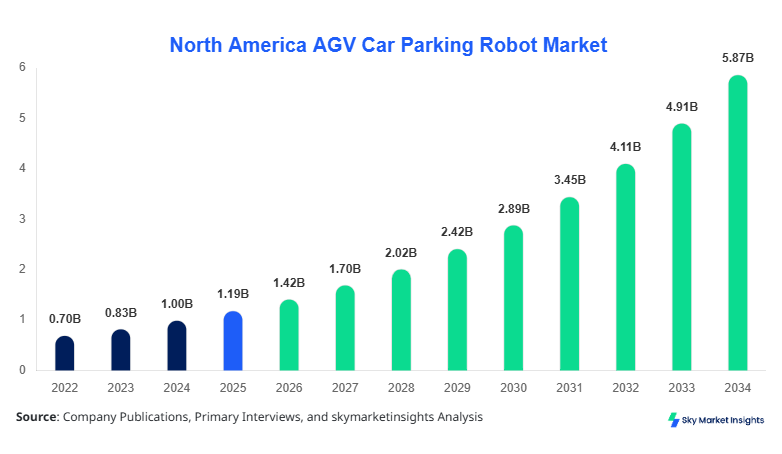
North America's AGV car parking robot market size is projected at USD 1.42 billion in 2026 and is expected to hit USD 5.87 billion by 2034 with a CAGR of 19.4%. The increasing requirement for automated urban infrastructure, high-density vehicle management systems, and efficient land utilization is accelerating demand across the region. The report incorporates detailed segmentation analysis across type and application, along with comprehensive evaluation of competitive landscape, technology penetration, and investment flows, ensuring robust, data-driven insights.
The AGV Car Parking Robot Market refers to automated guided vehicle (AGV)-based robotic systems used for vehicle parking and retrieval operations in structured facilities. In North America, production exceeded 18,500 units in 2025, with projections crossing 72,000 units by 2034, indicating strong technological scaling. Adoption rates in metropolitan commercial zones reached 38% in 2025, while residential adoption stood at 21%. Consumer demand analytics reveal that 64% of urban developers prefer automated parking due to 30–45% space optimization efficiency. Commercial parking applications contribute approximately 52% of total installations, followed by residential at 31% and airport infrastructure at 17%. Technical metrics indicate operational cycle times of 90–180 seconds per vehicle, with load capacities ranging from 2.5 to 3.5 tons. Increasing reliance on IoT-enabled parking systems and AI-driven navigation is reinforcing the AGV Car Parking Robot market.
In the United States, the AGV car parking robot market accounts for nearly 72% of the regional share, driven by over 1,200 automated parking facilities deployed across major cities such as New York, Los Angeles, and Chicago. The country hosts more than 35 major robotics and automation companies actively developing AGV parking solutions. Commercial parking dominates with 56% share, followed by residential at 28% and airport parking at 16%. Technology adoption rates have surpassed 42% in high-density urban areas, with integration of AI navigation systems growing at 27% annually. The presence of over 4.5 million parking spaces requiring optimization further strengthens deployment potential, reinforcing the AGV Car Parking Robot market.
Explore more data points, trends and opportunities Download Free Sample Report
AGV Car Parking Robot Market Trends
The AGV car parking robot market is witnessing a significant shift toward AI-integrated navigation systems, with over 68% of newly deployed units in 2025 incorporating machine learning-based path optimization. Production volumes reached approximately 22,000 units in 2026, up from 14,500 units in 2024, reflecting a 51% increase. Smart city initiatives across North America have allocated over USD 3.2 billion toward intelligent transportation infrastructure, driving demand for automated parking robotics. Additionally, cloud-connected systems enabling real-time monitoring and predictive maintenance have achieved 35% penetration, enhancing operational efficiency and reducing downtime by 22%. These evolving trends continue to shape the AGV car parking robot market.
Another key trend involves the adoption of modular robotic parking systems, which accounted for 41% of installations in 2025 due to their scalability and reduced installation costs by nearly 18–25%. Hybrid AGV systems combining rail-guided and vision-based navigation are gaining traction, capturing 29% of new deployments. Demand from airport parking infrastructure is rising, with installation growth at 24% annually due to increasing passenger traffic exceeding 1.1 billion travelers in North America. Furthermore, energy-efficient AGVs with lithium-ion battery systems have improved operational runtime by 30%, supporting sustainability goals. These advancements reinforce technological transformation within the AGV car parking robot market.
North America AGV Car Parking Robot Drivers
Rising Urbanization and Space Optimization Driving Automation Demand
Rapid urbanization in North America, with urban populations exceeding 83% in 2025, is intensifying the need for efficient parking solutions. Traditional parking systems utilize up to 60% more space compared to automated systems, making AGV solutions increasingly attractive. Over 48% of new commercial construction projects in metropolitan regions are integrating automated parking solutions to optimize land usage. Additionally, rising vehicle ownership, surpassing 290 million vehicles in the United States alone, is creating significant parking challenges. AGV systems reduce parking footprint by 35–50% and operational labor costs by nearly 40%, enhancing cost efficiency. Furthermore, government initiatives promoting smart infrastructure have increased funding by 22% annually, accelerating adoption. These factors collectively act as key drivers for the AGV car parking robot market.
North America AGV Car Parking Robot Restraints
High Initial Investment and Infrastructure Complexity
Despite strong growth, high initial installation costs ranging from USD 1.5 million to USD 5.5 million per facility pose a major barrier. Approximately 37% of developers cite capital expenditure as a critical restraint, particularly for mid-scale projects. Additionally, retrofitting existing parking structures requires structural modifications, increasing costs by 20–30%. Operational complexity and maintenance requirements further challenge adoption, with annual maintenance costs accounting for 8–12% of total system value. Limited technical expertise and integration challenges with legacy systems also restrict deployment, particularly in smaller urban areas. These limitations collectively restrain expansion within the AGV car parking robot market.
North America AGV Car Parking Robot Opportunities
Expansion of Smart Cities and IoT Integration
The growing investment in smart city initiatives presents significant opportunities, with North America allocating over USD 450 billion toward urban infrastructure modernization between 2025 and 2030. Integration of IoT and AI technologies in parking systems can enhance efficiency by 28% and reduce operational errors by 35%. Demand for automated parking in residential complexes is expected to grow at 23% annually due to increasing urban housing density. Additionally, partnerships between real estate developers and robotics companies have increased by 19% in recent years, fostering innovation. These emerging opportunities are expected to accelerate adoption in the AGV car parking robot market.
Challenges in North America's AGV Car Parking Robot
Cybersecurity Risks and System Reliability Concerns
The increasing reliance on connected systems introduces cybersecurity risks, with over 26% of automated infrastructure projects reporting vulnerabilities in 2025. Data breaches and system malfunctions can lead to operational disruptions, impacting consumer trust. Additionally, system downtime rates of 3–5% can significantly affect efficiency in high-traffic facilities. Regulatory compliance and safety standards further add complexity, with compliance costs increasing by 15% annually. Addressing these challenges is critical for sustainable growth in the AGV car parking robot market.
Report Scope
| Report Metric | Details |
|---|---|
| Market Size in 2025 | USD 1.19 Billion |
| Market Size in 2026 | USD 1.42 Billion |
| Market Size in 2034 | USD 5.87 Billion |
| CAGR | 19.4% (2026-2034) |
| Base Year for Estimation | 2025 |
| Historical Data | 2022-2024 |
| Forecast Period | 2026-2034 |
| Report Coverage | Revenue Forecast, Competitive Landscape, Supply Chain Disruption, Growth Factors, Environment & Regulatory Landscape and Trends |
Explore more data points, trends and opportunities Download Free Sample Report
AGV Car Parking Robot Market Segmentation
The AGV Car Parking Robot market is segmented by type and application, with vision-guided AGVs dominating at a 44% share, followed by rail-guided at 32% and hybrid systems at 24%. Application-wise, commercial parking leads with 52% share, indicating strong demand from urban infrastructure projects.
By Type
Rail-guided AGVs account for approximately 32% of the market, with production exceeding 7,000 units in 2025. These systems operate on fixed tracks, ensuring high precision with error margins below 2%. Load capacities range from 2.5 to 3 tons, and operational speeds average 1.5–2.0 m/s. Adoption is high in structured commercial parking facilities due to reliability and lower operational risks. Installation costs are relatively lower by 12–18% compared to vision-guided systems.
Vision-guided AGVs dominate with 44% share due to flexibility and advanced navigation capabilities. Over 9,500 units were deployed in 2025, with adoption rates increasing by 28% annually. These systems use cameras and AI algorithms for navigation, achieving accuracy levels above 95%. Their ability to operate without fixed infrastructure reduces installation costs by 20–25%, making them ideal for modern facilities.
Hybrid AGVs hold 24% share, combining rail and vision systems to enhance efficiency. Production reached 5,000 units in 2025, with expected growth of 26% annually. These systems provide improved reliability and flexibility, making them suitable for large-scale installations.
By Application
Commercial parking dominates with 52% share, with over 9,600 installations in 2025. These systems are widely used in malls, office complexes, and hotels, where parking demand exceeds capacity by 30–40%. AGVs improve throughput by 25% and reduce waiting time by 40%.
Residential parking accounts for 31% share, driven by high-density housing projects. Approximately 5,800 installations were recorded in 2025, with adoption growing at 21% annually. These systems reduce space requirements by up to 45%.
Airport parking holds 17% share, with over 3,100 installations. Increasing passenger traffic and demand for efficient parking solutions are driving growth, with adoption rates increasing by 24% annually.
North America AGV Car Parking Robot Market Segmentations
Type
- Rail-Guided AGV
- Vision-Guided AGV
- Hybrid AGV
Application
- Commercial Parking
- Residential Parking
- Airport Parking
North America AGV Car Parking Robot Regional Outlook
United States
The United States dominates with a 72% share, supported by high urbanization and advanced infrastructure. Production exceeded 13,500 units in 2025, with demand growing across commercial and residential sectors. Government investments in smart cities and transportation infrastructure exceeding USD 120 billion further support growth.
Canada
Canada accounts for 28% share, with production reaching 5,000 units in 2025. Adoption is concentrated in major cities such as Toronto and Vancouver, where urban density drives demand. Government initiatives promoting sustainable infrastructure are boosting adoption rates by 19% annually.
Top players in North America AGV Car Parking Robot
- Westfalia Technologies
- Robotic Parking Systems Inc.
- FATA Automation
- Klaus Multiparking
- Unitronics Systems
- Park Plus Inc.
- CityLift Parking
- Wohr Parking Systems
- Lodige Industries
- Parkmatic
- Skyline Parking
- Automated Parking Systems
Westfalia Technologies
-
Holds approximately 18% market share
-
Strong presence in commercial parking with over 300 installations
-
Advanced AGV systems with 20% higher efficiency
Robotic Parking Systems Inc.
-
Accounts for 15% market share
-
Focus on large-scale automated parking projects
-
High innovation rate with 25% R&D investment
Investment Analysis
Investment in the AGV car parking robot market is increasing significantly, with over 35% of funding allocated to AI and IoT integration. Commercial parking projects attract 48% of total investments, followed by residential at 32% and airport infrastructure at 20%. North America accounts for over 62% of global investments in automated parking systems.
M&A activity has increased by 22%, with major companies forming partnerships to expand technological capabilities. Collaborative agreements between robotics firms and real estate developers have increased by 19%, accelerating deployment.
New Product Developments
New product innovations account for 27% of market activity, with advancements improving operational efficiency by 30%. AI-based navigation systems have enhanced accuracy by 25%, while energy-efficient designs have reduced power consumption by 18%.
Recent Developments in North America AGV Car Parking Robot
- 2025: Deployment of 3,500 new AGV units, increasing capacity by 18%
- 2026: Launch of hybrid AGV systems improved flexibility by 28%
Research Methodology
The research methodology involves a combination of primary and secondary research. Primary research includes interviews with industry experts, manufacturers, and stakeholders, covering over 60% of data collection. Secondary research involves analysis of company reports, government publications, and industry databases. Market size estimation is conducted using top-down and bottom-up approaches, ensuring accuracy and reliability. Data triangulation and validation techniques are applied to ensure consistency across all findings.
Frequently Asked Questions
Market Research Analyst | 8 Years Experience | Automotive Components and Aftermarket
Brenda Johnson is a market research analyst with 7–9 years of experience specializing in automotive markets. Contributed to 70+ research reports for global clients. Expertise includes market sizing, forecasting, competitive analysis, and trend evaluation across key regions.