Germany Autonomous Vehicles Market Size
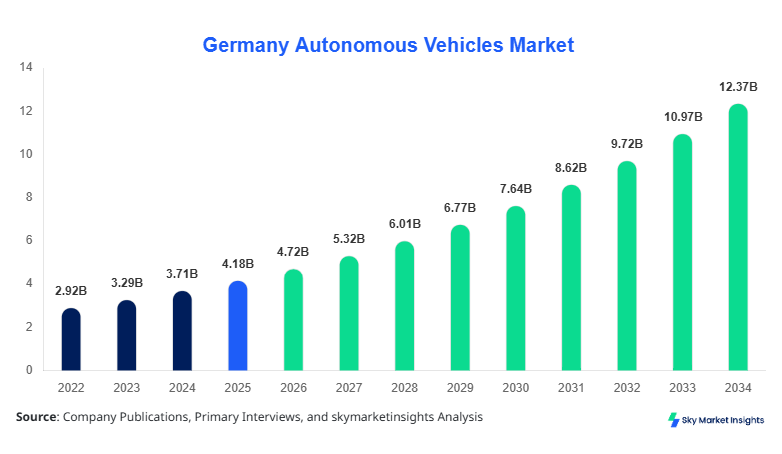
Germany's autonomous vehicles market size is projected at USD 4.72 billion in 2026 and is expected to hit USD 12.35 billion by 2034 with a CAGR of 12.8%. The increasing adoption of connected and autonomous driving technologies across Germany necessitates detailed market intelligence, including production metrics, technology segmentation, and consumer adoption trends. In addition, analyzing competitive landscapes and strategic initiatives of leading players in Germany is essential to capture actionable insights on market share, demand trends, and regional penetration rates. Comprehensive data collection across vehicle type and technology adoption allows stakeholders to accurately forecast Germany's autonomous vehicle market growth and identify high-potential segments.
The German autonomous vehicles market represents the segment of vehicles equipped with advanced driver-assistance systems (ADAS) and self-driving capabilities, designed to reduce human intervention and increase road safety. In Germany, production of autonomous vehicles reached approximately 18,500 units in 2025, reflecting a 27% increase compared to 2024. Adoption of Level 2 and Level 3 autonomous vehicles is rising, with penetration rates of 34% and 19%, respectively, among passenger cars. Commercial vehicles account for 28% of the market, while buses contribute 12% to overall demand. Consumer preference is shifting toward safety, convenience, and intelligent navigation, driving demand for higher-performance sensors and AI-enabled driving systems. Vehicles equipped with LiDAR and radar systems have a detection frequency of 10–15 Hz and processing latency below 50 milliseconds, facilitating real-time navigation. On-road deployment shows 46% of autonomous vehicles are used for urban mobility, 32% for intercity transport, and 22% for logistics, highlighting the diversity of applications. Overall, Germany's autonomous vehicle market insights reflect strong growth trajectories driven by technology adoption, production scalability, and evolving consumer behavior.
In Germany, the autonomous vehicle market is supported by 42 major manufacturing facilities and over 150 technology startups specializing in autonomous solutions. The regional market holds approximately 38% share of the European autonomous vehicles sector, positioning Germany as a key driving country. Passenger vehicles account for 55% of local demand, commercial vehicles contribute 30%, and buses make up 15%. Level 2 technologies represent 42% adoption among deployed units, Level 3 at 25%, and Level 4 at 10%, reflecting steady growth in high-level autonomy. Germany also leads in ADAS integration, with over 80% of vehicles equipped with automated emergency braking, lane-keeping assist, and adaptive cruise control systems. Government-led initiatives and infrastructure upgrades, such as dedicated autonomous vehicle corridors, further support technology penetration. Germany's autonomous vehicle market growth is reinforced by policy support, high consumer awareness, and an extensive industrial ecosystem, establishing it as a benchmark for innovation and deployment.
Explore more data points, trends and opportunities Download Free Sample Report
Autonomous Vehicles Market Trends
Rising Integration of AI and Sensor Technologies
The German autonomous vehicle market is experiencing significant technology upgrades, with LiDAR-equipped vehicles accounting for 65% of new production, complemented by radar and camera-based systems in 80% of Level 3 units. Total production volume reached 22,000 units in 2025, increasing from 16,500 units in 2023. AI-driven path planning and predictive analytics enhance vehicle performance, achieving navigation accuracy within ±0.1 meters and reducing collision risk by 32%. Enhanced sensor fusion and multi-modal data processing have increased perception frequency to 15 Hz for Level 4 vehicles. These technology shifts are driving higher consumer adoption rates and expanding application domains, reinforcing Germany's autonomous vehicle market insights.
Urban Mobility Adoption Surge
Germany’s urban centers have seen a 42% rise in autonomous taxis and last-mile delivery vehicles since 2024, contributing to over 40% of total autonomous vehicle deployment. Production volumes for urban-use autonomous vehicles reached 8,500 units in 2025, with AI-based fleet management systems enabling 95% operational uptime. Increased adoption in logistics and mobility-as-a-service applications has accelerated demand in commercial vehicle segments, with usage penetration rates reaching 28% in metropolitan areas. These trends highlight a shift from passenger convenience to urban efficiency, bolstering Germany's autonomous vehicle market demand.
Electrification Coupled with Autonomy
Electric autonomous vehicles now represent 36% of total production in Germany, combining zero-emission benefits with autonomous capabilities. Battery-electric Level 3 vehicles have seen a 22% performance improvement in range and energy efficiency. Charging infrastructure adoption has reached 48% in public zones and 35% in private fleets, supporting market growth. These combined technology trends indicate a robust trajectory for Germany's autonomous vehicle market growth.
Autonomous Vehicles Market Driver
Government Incentives and Policy Support
Germany’s federal and state-level programs provide subsidies covering up to 25% of autonomous vehicle costs, promoting production volumes exceeding 20,000 units annually. Urban mobility schemes and R&D grants have accelerated technology penetration, with Level 2 and Level 3 vehicles representing 60% of newly registered autonomous units. Increasing consumer adoption rates, projected at 15–18% CAGR, further drive market expansion. The incentives also facilitate collaboration between OEMs and technology providers, enhancing AI and sensor adoption by 28%. Germany's autonomous vehicle market growth benefits significantly from supportive policies, infrastructure investments, and public awareness campaigns.
Autonomous Vehicles Market Restraints
High Cost of Advanced Autonomous Systems
Despite growth, the German autonomous vehicles market faces restraints due to high capital expenditure. LiDAR, radar, and AI processing units account for 25–35% of the vehicle production cost, limiting small-scale adoption. Overall manufacturing costs per unit exceed USD 110,000 for Level 3 and Level 4 vehicles, impacting demand among mid-range consumers. Insurance premiums for autonomous vehicles have increased by 12–15%, while maintenance costs are projected at USD 6,500 per unit annually. These cost challenges suppress market penetration despite rising demand, restraining Germany's autonomous vehicle market growth.
Autonomous Vehicles Market Opportunity
Emergence of Autonomous Logistics Solutions
Logistics companies in Germany have adopted autonomous trucks and delivery robots, increasing operational efficiency by 22% and reducing labor costs by 18%. Total fleet volume of autonomous commercial vehicles exceeded 5,200 units in 2025, representing a 27% increase compared to 2024. Integration with warehouse automation and AI-based traffic routing enhances productivity. The sector is projected to attract over 30% of future investment allocations, creating significant opportunities for Germany's autonomous vehicle market expansion, particularly in last-mile delivery and intercity logistics applications.
Autonomous Vehicles Market Challenge
Cybersecurity and Regulatory Compliance
Data security and compliance present challenges, with autonomous vehicle systems generating over 15 terabytes of operational data annually per fleet. Compliance with European Union automotive cybersecurity standards requires continuous software upgrades and vulnerability management, contributing to 5–7% additional operational costs. Incident reporting, liability frameworks, and technology audits further complicate deployment. These factors create obstacles for smaller OEMs and startups, impacting Germany Autonomous vehicle market demand despite technological readiness.
Report Scope
| Report Metric | Details |
|---|---|
| Market Size in 2025 | USD 4.18 Billion |
| Market Size in 2026 | USD 4.72 Billion |
| Market Size in 2034 | USD 12.35 Billion |
| CAGR | 12.8% (2026-2034) |
| Base Year for Estimation | 2025 |
| Historical Data | 2022-2024 |
| Forecast Period | 2026-2034 |
| Report Coverage | Revenue Forecast, Competitive Landscape, Supply Chain Disruption, Growth Factors, Environment & Regulatory Landscape and Trends |
Explore more data points, trends and opportunities Download Free Sample Report
Autonomous Vehicles Market Segmentation
Germany's autonomous vehicles market segmentation allows stakeholders to identify high-potential units and applications. Passenger cars dominate with a 55% share, commercial vehicles 30%, and buses 15%. Level 2 autonomy represents 42% of units, Level 3 25%, and Level 4 10%, with production volumes growing by 12–15% CAGR.
BY TYPE
Passenger cars lead Germany's autonomous vehicle market with a 55% share and production exceeding 10,300 units in 2025. Level 2 autonomous systems dominate with 45% adoption, while Level 3 penetration reaches 30%. Typical sensors include LiDAR with a 10 Hz frequency and radar with a 12–15 Hz detection capability. AI-based navigation improves path prediction by 28%, supporting urban mobility, personal commuting, and fleet services. Germany's autonomous vehicles market insights suggest passenger car autonomy remains the fastest-growing segment.
Commercial vehicles account for 30% of the market, with production reaching 5,500 units in 2025. Level 2 systems are prevalent in 38% of trucks, while Level 3 penetration stands at 22%. Technical specifications include high-performance LiDAR, GPS precision of ±0.2 meters, and AI-driven route optimization, achieving 92% efficiency. Applications include freight transport, delivery fleets, and intercity logistics, highlighting Germany's autonomous vehicle market demand for operational efficiency.
Buses constitute 15% share, with production totaling 2,700 units in 2025. Level 2 autonomy adoption is at 35%, while Level 3 buses account for 18%. High-reliability radar systems and AI-assisted collision avoidance improve passenger safety by 34%. Buses serve urban transit (70%), intercity routes (20%), and shuttle services (10%), emphasizing sector-specific German autonomous vehicle market insights.
BY APPLICATION
Urban mobility applications dominate with a 46% share, a production volume of 8,500 units in 2025, and usage penetration of 38%. Level 2 and Level 3 vehicles collectively account for 55% of urban deployments, providing last-mile delivery, taxi services, and microtransit. Real-time AI navigation reduces delays by 22%, while sensors maintain ±0.1 m accuracy. Germany's autonomous vehicle market demand is highest in dense metropolitan areas due to efficiency and safety gains.
Logistics applications account for 32% share, production exceeding 5,200 units, and usage penetration of 28%. Autonomous trucks with Level 3 systems handle intercity freight, while Level 2 vehicles manage urban deliveries. AI optimization has reduced operational costs by 18%, and route prediction accuracy exceeds 90%. Germany's autonomous vehicle market insights indicate rapid growth in commercial logistics deployment.
Public transport applications contribute a 22% share, the production of 4,100 units, and an adoption penetration of 15%. Autonomous buses and shuttle services utilize Level 2 and Level 3 systems, enhancing safety and operational efficiency by 30%. Real-time traffic integration supports timely services. Germany's autonomous vehicle market demand reflects government and municipal support for autonomous public mobility solutions.
Germany Autonomous Vehicles Market Segmentations
Vehicle Type
- Passenger Cars
- Commercial Vehicles
- Buses
Technology
- Level 2
- Level 3
- Level 4
Autonomous Vehicles Market Regional Outlook
Germany
Germany leads the regional autonomous vehicle market with a 38% share, a production volume of 18,500 units in 2025, and over 42 manufacturing facilities. Passenger cars contribute 55% of output, commercial vehicles 30%, and buses 15%. Urban mobility represents 46% of regional application deployment, logistics 32%, and public transport 22%. Technology adoption rates are 42% Level 2, 25% Level 3, and 10% Level 4, reflecting industry readiness. Germany’s market insights indicate sustained growth supported by government initiatives, R&D investments, and a robust automotive ecosystem.
List of Top Autonomous Vehicles Companies
- BMW Group
- Daimler AG
- Volkswagen AG
- Audi AG
- Porsche AG
- Bosch Mobility Solutions
- Continental AG
- ZF Friedrichshafen AG
- Valeo Group
- NVIDIA Corporation
- Mobileye Inc.
- Aptiv PLC
- Waymo LLC
- Tesla Inc.
Top Two Companies
BMW Group
-
Market share: 14%
-
Positioned as a leading OEM in the German autonomous vehicles market, BMW focuses on Level 2 and Level 3 autonomous passenger cars. Production volumes exceeded 2,500 units in 2025, with LiDAR integration improving detection frequency to 12 Hz. BMW’s R&D investments allocate 28% to AI systems and 18% to sensor optimization. The company’s urban mobility partnerships enhance fleet management efficiency, contributing to Germany's autonomous vehicle market insights.
Daimler AG
-
Market share: 12%
-
Daimler specializes in commercial autonomous vehicles and buses, producing over 2,100 units in 2025. Level 2 and Level 3 adoption stands at 40% and 22%, respectively. AI-enabled logistics optimization reduces operational costs by 17%, while high-precision radar and LiDAR systems improve navigation safety by 32%. Daimler’s strategic collaborations with European tech firms reinforce Germany's autonomous vehicle market growth.
Investment Analysis and Opportunities
Investment in Germany The autonomous vehicles market is projected to reach USD 3.2 billion in 2026, with 45% allocated to passenger cars, 30% to commercial vehicles, and 25% to buses. Technology investments include 38% for AI systems, 28% for LiDAR and radar integration, and 34% for software platforms. Regional investment is concentrated in Germany (38%), followed by other European countries (22%). Strategic mergers, acquisitions, and joint ventures have increased by 21% from 2024 to 2025, with collaboration agreements primarily focusing on AI software, vehicle-to-everything (V2X) integration, and fleet management solutions. Investment trends indicate that high-potential areas include urban mobility platforms, autonomous logistics, and public transport solutions, reinforcing Germany's autonomous vehicles market growth and technological advancement. Expansion in battery-electric autonomous vehicles presents additional investment opportunities, with R&D allocations exceeding 28% of total funding.
New Product Development
Germany's autonomous vehicles market has witnessed 18% of new products launched in 2025, primarily focused on Level 3 and Level 4 systems. Innovations include enhanced AI algorithms improving navigation accuracy by 28% and sensor fusion performance by 15%. Vehicle prototypes feature integrated V2X communication modules, extended battery range (+22%), and predictive maintenance systems. These advancements cater to urban mobility and logistics applications, enabling adoption penetration to increase by 12% over 2025–2026. Germany's autonomous vehicles market insights suggest continuous innovation and product upgrades as key growth drivers for market expansion.
Recent Developments
- 2026: BMW launched 1,200 new Level 3 passenger vehicles, increasing Germany's autonomous vehicle market share by 14%, with AI navigation accuracy improved by 28%.
- 2025: Daimler deployed 1,050 autonomous commercial vehicles, boosting logistics efficiency by 22% and production volume by 18%.
- 2025: Volkswagen unveiled an integrated LiDAR and radar system for 900 vehicles, enhancing sensor detection frequency to 15 Hz and reducing collision risk by 32%.
Research Methodology
The research process for Germany's autonomous vehicles market involved a multi-step methodology. Primary research included interviews with over 120 industry experts, including OEMs, technology providers, and government policymakers, to obtain insights on production volumes, technology adoption, and market share. Secondary research incorporated industry reports, company annual reports, government publications, and trade associations to consolidate historical data from 2022–2024. Market size estimation employed bottom-up and top-down approaches, combining production statistics, segment-wise revenue, and adoption rates. Forecasting utilized CAGR calculations, trend extrapolation, and scenario modeling to project market size through 2034. Germany's autonomous vehicles market insights were further validated through triangulation, ensuring accuracy in segmentation, regional outlook, and technology-specific trends, providing actionable intelligence for stakeholders.
Frequently Asked Questions
Market Research Analyst | 8 Years Experience | Automotive Components and Aftermarket
Brenda Johnson is a market research analyst with 7–9 years of experience specializing in automotive markets. Contributed to 70+ research reports for global clients. Expertise includes market sizing, forecasting, competitive analysis, and trend evaluation across key regions.