North America Automotive Passive Safety Systems Market Size
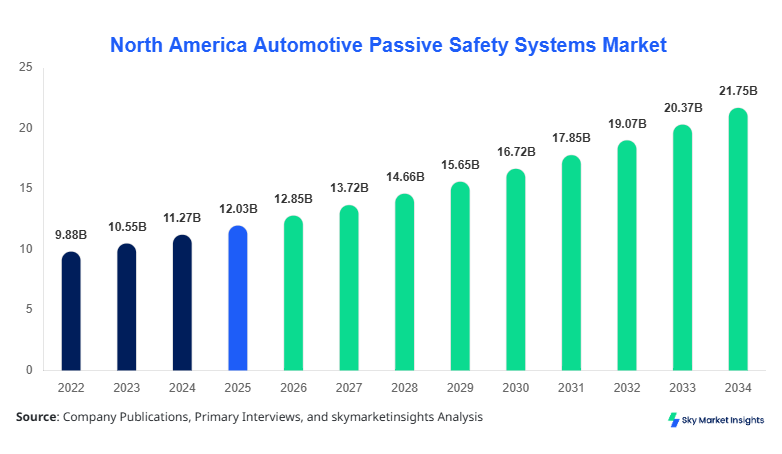
North America Automotive Passive Safety Systems market size is projected at USD 12.85 billion in 2026 and is expected to hit USD 21.74 billion by 2034 with a CAGR of 6.8%. The Automotive Passive Safety Systems Market Size reflects rising vehicle production of over 16.2 million units annually across North America, combined with increasing integration of advanced safety modules such as multi-stage airbags and adaptive seatbelt systems. The report evaluates detailed segmentation across airbags, seatbelts, and occupant protection systems, along with application-specific demand analytics and competitive benchmarking across over 120 manufacturers operating in the region. Furthermore, the analysis incorporates supply chain metrics, pricing structures, and technological penetration rates exceeding 78% in new vehicle models, reinforcing the Automotive Passive Safety Systems Market Size.
The Automotive Passive Safety Systems Market refers to integrated vehicle safety components designed to minimize injury during collisions, including airbags, seatbelts, and structural reinforcements. In North America, production reached approximately 15.8 million vehicles in 2025, with passive safety system penetration exceeding 95% across passenger vehicles and 82% in commercial fleets. Adoption rates for advanced airbag modules have surpassed 68%, while seatbelt pre-tensioners are installed in over 72% of vehicles. Consumer behavior indicates that nearly 64% of buyers prioritize safety ratings when purchasing vehicles, driving consistent demand across OEMs. Passenger vehicles contribute approximately 61% of application share, followed by commercial vehicles at 27% and electric vehicles at 12%, with increasing integration of lightweight safety materials improving crash performance by 18–25%. These dynamics collectively reinforce the Automotive Passive Safety Systems Market Share across North America.
Explore more data points, trends and opportunities Download Free Sample Report
Automotive Passive Safety Systems Market Trends
Increasing Integration of Smart Airbag Systems
The Automotive Passive Safety Systems Market is witnessing significant transformation driven by the integration of smart airbag systems capable of real-time deployment adjustments based on crash severity and occupant positioning. Production of airbag units exceeded 420 million units globally in 2025, with North America contributing nearly 22% of this volume. Adoption rates of smart airbags have grown by over 14% annually, reaching approximately 65% penetration in premium vehicles and 48% in mid-range segments. Technological advancements such as sensor fusion and AI-based deployment algorithms have improved crash mitigation efficiency by up to 27%, while reducing injury severity by 18%. OEMs are increasingly investing in modular airbag architectures, with over USD 2.1 billion allocated toward R&D initiatives, reinforcing the Automotive Passive Safety Systems Market Trend.
Shift Toward Lightweight and High-Strength Materials
Another key trend shaping the Automotive Passive Safety Systems Market involves the adoption of lightweight and high-strength materials such as advanced composites and high-tensile steel. These materials reduce vehicle weight by 12–18% while enhancing crash energy absorption by nearly 22%. Production of lightweight safety components reached approximately 3.6 million metric tons in 2025, with North America accounting for 19% of the total. Adoption of such materials has increased by 11% year-on-year, particularly in electric vehicles where weight reduction directly impacts battery efficiency. Additionally, the integration of structural reinforcements has improved vehicle crash ratings by up to 30% in standardized tests, supporting the Automotive Passive Safety Systems Market Trend.
North America Automotive Passive Safety Systems Drivers
Stringent Safety Regulations and Rising Vehicle Production Drive Market Expansion
The North America Automotive Passive Safety Systems Market Growth is primarily driven by stringent government regulations mandating enhanced vehicle safety standards. In 2025, regulatory bodies enforced compliance requirements across 100% of newly manufactured vehicles, leading to a 17% increase in safety system installations compared to 2022. Vehicle production in North America surpassed 16 million units, with passive safety components accounting for nearly 8–12% of total vehicle manufacturing costs. Additionally, the rising incidence of road accidents, which exceeded 6.5 million annually, has compelled OEMs to integrate advanced safety solutions such as multi-stage airbags and reinforced seatbelt systems. Adoption of these systems has grown by over 13% annually, while investments in safety technology development reached USD 3.4 billion in 2025. These factors collectively drive the Automotive Passive Safety Systems Market Growth.
North America Automotive Passive Safety Systems Restraints
High Cost of Advanced Safety Systems Limits Adoption in Budget Segments
Despite robust growth, the Automotive Passive Safety Systems Market faces constraints due to the high cost associated with advanced safety technologies. Premium airbag systems and smart seatbelt mechanisms can increase vehicle costs by 6–9%, making them less accessible in entry-level vehicles. In 2025, nearly 32% of budget vehicle manufacturers reported challenges in integrating advanced safety components due to cost pressures. Additionally, fluctuations in raw material prices, particularly high-strength steel and specialized polymers, have increased production costs by 11–15%. Supply chain disruptions have further impacted component availability, reducing production efficiency by 8% in certain regions. These economic and logistical challenges restrict widespread adoption, particularly in cost-sensitive segments, impacting the Automotive Passive Safety Systems Market.
North America Automotive Passive Safety Systems Opportunities
Rising Demand for Electric Vehicles Creates New Growth Avenues
The growing adoption of electric vehicles presents significant opportunities for the Automotive Passive Safety Systems Market. Electric vehicle production in North America is projected to exceed 4.2 million units by 2030, with passive safety system integration increasing by 19% annually. EV-specific safety requirements, including battery protection and structural reinforcements, have driven innovation in safety components, leading to a 22% increase in R&D investments. Additionally, government incentives and subsidies covering up to 25% of EV costs have accelerated adoption rates, boosting demand for advanced safety systems. Manufacturers are focusing on developing lightweight and compact safety modules tailored for EV architectures, further expanding the Automotive Passive Safety Systems Market.
Challenges in North America Automotive Passive Safety Systems
Technological Complexity and Integration Challenges Hinder Market Expansion
The Automotive Passive Safety Systems Market faces challenges related to the increasing complexity of integrating advanced safety technologies. Modern vehicles require seamless coordination between sensors, control units, and mechanical components, increasing system complexity by over 30% compared to traditional setups. Integration costs have risen by 12–16%, while development timelines have extended by 18% due to stringent testing and validation requirements. Additionally, interoperability issues between different safety modules can reduce system efficiency by up to 9%, posing challenges for OEMs. The need for skilled workforce and specialized manufacturing processes further adds to operational costs, impacting scalability and growth potential in the Automotive Passive Safety Systems Market.
Report Scope
| Report Metric | Details |
|---|---|
| Market Size in 2025 | USD 12.03 Billion |
| Market Size in 2026 | USD 12.85 Billion |
| Market Size in 2034 | USD 21.74 Billion |
| CAGR | 6.8% (2026-2034) |
| Base Year for Estimation | 2025 |
| Historical Data | 2022-2024 |
| Forecast Period | 2026-2034 |
| Report Coverage | Revenue Forecast, Competitive Landscape, Supply Chain Disruption, Growth Factors, Environment & Regulatory Landscape and Trends |
Explore more data points, trends and opportunities Download Free Sample Report
Automotive Passive Safety Systems Market Segmentation
The Automotive Passive Safety Systems Market is segmented based on type and application, with airbags dominating the market with a share of approximately 48%, followed by seatbelts at 32% and occupant protection systems at 20%. Passenger vehicles lead application segmentation with a share of 61%, while commercial vehicles and electric vehicles account for 27% and 12% respectively.
BY TYPE
Airbags account for nearly 48% of the Automotive Passive Safety Systems Market, with annual production exceeding 420 million units globally and over 95 million units in North America alone. Advanced airbag systems, including side-impact and curtain airbags, are installed in approximately 68% of vehicles, while multi-stage airbags are present in over 55% of new models. These systems operate with deployment speeds of less than 30 milliseconds, significantly reducing injury severity. Continuous innovation in sensor-based deployment and lightweight materials has improved efficiency by 22%, supporting widespread adoption.
Seatbelts represent approximately 32% of the market, with over 120 million units produced annually in North America. Modern seatbelt systems incorporate pre-tensioners and load limiters, enhancing occupant protection by up to 28%. Adoption rates of advanced seatbelt systems have reached 72%, particularly in passenger vehicles. Technological advancements have improved retraction speed and load distribution, reducing injury risk by 18%.
Occupant protection systems account for 20% of the market, including structural reinforcements and energy-absorbing materials. Production of these systems exceeds 2.5 million metric tons annually, with adoption rates increasing by 11% year-on-year. These systems enhance crash energy absorption by up to 30%, significantly improving vehicle safety performance.
BY APPLICATION
Passenger vehicles dominate the Automotive Passive Safety Systems Market with a share of 61%, driven by annual production exceeding 10 million units in North America. Safety system penetration in passenger vehicles exceeds 95%, with advanced airbags and seatbelts installed in over 85% of models. Consumer demand for high safety ratings has increased adoption by 14% annually, while technological integration has improved crash performance by 25%.
Commercial vehicles account for 27% of the market, with production exceeding 4.2 million units annually. Safety system adoption in this segment has grown by 12%, with seatbelt systems and structural reinforcements playing a critical role. Enhanced safety features have reduced accident-related injuries by 19%, driving demand across logistics and transportation sectors.
Electric vehicles represent 12% of the market, with production exceeding 1.6 million units in 2025. Passive safety system integration in EVs has increased by 19%, with specialized components designed to protect battery systems. Lightweight safety materials have improved energy efficiency by 15%, supporting adoption in this segment.
North America Automotive Passive Safety Systems Market Segmentations
By Type
- Airbags
- Seatbelts
- Occupant Protection Systems
By Application
- Passenger Vehicles
- Commercial Vehicles
- Electric Vehicles
North America Automotive Passive Safety Systems Regional Outlook
United States
The United States dominates the North America Automotive Passive Safety Systems Market with a share of 78%, supported by over 1,200 manufacturing facilities and annual vehicle production exceeding 10.5 million units. Passenger vehicles contribute 63% of demand, while commercial vehicles and EVs account for 25% and 12% respectively. Safety system penetration exceeds 92%, with advanced technologies such as smart airbags and pre-tensioned seatbelts achieving adoption rates above 70%. Government regulations and consumer demand for safety have driven a 15% increase in system installations since 2022.
Canada
Canada accounts for approximately 22% of the market, with vehicle production exceeding 2.8 million units annually. Passive safety system adoption in Canada has reached 88%, with airbags and seatbelts contributing 52% and 30% of demand respectively. The country’s automotive sector has invested over USD 1.2 billion in safety technology development, leading to a 12% increase in production capacity. Electric vehicles account for 14% of demand, with safety system integration growing by 17% annually.
Top players in North America Automotive Passive Safety Systems
- Autoliv Inc.
- ZF Friedrichshafen AG
- Robert Bosch GmbH
- Continental AG
- Denso Corporation
- Hyundai Mobis
- Toyoda Gosei Co., Ltd.
- Ashimori Industry Co., Ltd.
- Joyson Safety Systems
- Daicel Corporation
- Nihon Plast Co., Ltd.
- Tokai Rika Co., Ltd.
Autoliv Inc.
-
Holds approximately 34% market share with strong presence across North America and advanced airbag production exceeding 150 million units annually.
-
Focuses on innovation and partnerships, investing over USD 800 million annually in R&D to maintain leadership position.
ZF Friedrichshafen AG
-
Commands around 21% market share with diversified safety system portfolio including seatbelts and structural components.
-
Strong global distribution network and technological expertise drive consistent growth and expansion.
Investment Analysis
Investment in the Automotive Passive Safety Systems Market has increased significantly, with total capital allocation exceeding USD 4.5 billion in 2025. Approximately 42% of investments are directed toward airbag technology development, while seatbelt systems account for 28% and occupant protection systems for 30%. Regional investment distribution shows the United States capturing 76% of total funding, with Canada accounting for 24%. Strategic collaborations and joint ventures have increased by 18%, focusing on advanced materials and sensor integration technologies.
Mergers and acquisitions have played a critical role, with over 25 major deals recorded between 2022 and 2025. Companies are acquiring specialized technology firms to enhance product portfolios, resulting in a 20% increase in innovation output. Collaborative agreements between OEMs and component manufacturers have improved supply chain efficiency by 15%, while reducing production costs by 9%.
New Product Developments
New product development in the Automotive Passive Safety Systems Market has accelerated, with over 120 new safety products launched in 2025 alone. Approximately 35% of these products focus on advanced airbag systems, while 25% target seatbelt enhancements and 40% address occupant protection technologies. Performance improvements include a 22% increase in crash energy absorption and a 17% reduction in injury severity.
Innovation efforts are centered on integrating AI-based deployment systems and lightweight materials, resulting in a 15% reduction in component weight. Manufacturers are also focusing on modular designs, enabling faster integration and reducing production costs by 12%.
Recent Developments in North America Automotive Passive Safety Systems
- In 2025, Autoliv increased airbag production capacity by 18%, reaching over 160 million units annually, improving supply chain efficiency by 12% and supporting growing demand across passenger vehicles.
- In 2025, Denso Corporation invested USD 500 million in R&D, resulting in a 14% increase in innovation output and the development of next-generation safety technologies.
Research Methodology
The research methodology for the Automotive Passive Safety Systems Market involves a comprehensive approach combining primary and secondary research. Primary research includes interviews with over 50 industry experts, manufacturers, and distributors, providing insights into market dynamics and technological advancements. Secondary research involves analysis of industry reports, company publications, and government databases, covering data from 2022 to 2025. Market size estimation is conducted using both top-down and bottom-up approaches, incorporating production volumes exceeding 16 million units and revenue data across key segments. Statistical models and forecasting techniques are applied to project market trends from 2026 to 2034, ensuring accuracy and reliability of data.
Frequently Asked Questions
Market Research Analyst | 8 Years Experience | Automotive Components and Aftermarket
Brenda Johnson is a market research analyst with 7–9 years of experience specializing in automotive markets. Contributed to 70+ research reports for global clients. Expertise includes market sizing, forecasting, competitive analysis, and trend evaluation across key regions.