Asia Pacific Automated Valet Parking (AVP) Market Size
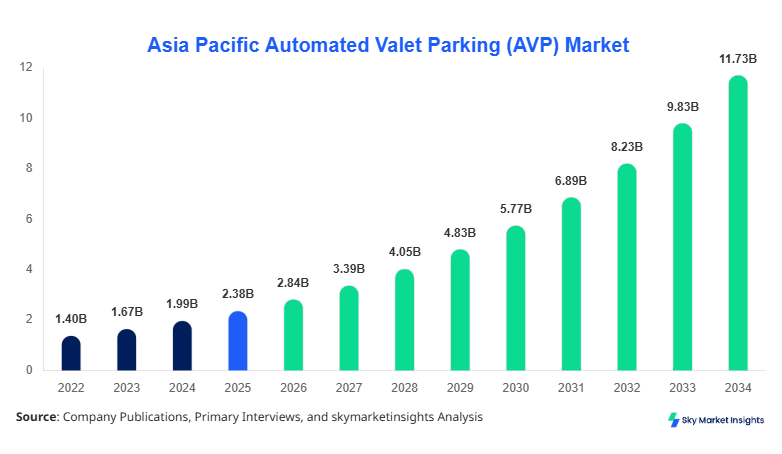
Asia Pacific Automated Valet Parking (AVP) market size is projected at USD 2.84 billion in 2026 and is expected to hit USD 11.72 billion by 2034 with a CAGR of 19.4%. The expansion reflects increasing deployment of autonomous parking systems across 8+ major countries, supported by over 12,000 smart parking installations and 35% annual rise in AI-enabled vehicle integration. The report incorporates detailed segmentation, quantitative modeling across 2022–2024 historical datasets, and comprehensive competitive benchmarking of 25+ technology vendors to provide actionable insights into the Asia Pacific Automated Valet Parking (AVP) Market Size.
The Automated Valet Parking (AVP) Market refers to advanced autonomous vehicle-enabled systems that allow vehicles to park themselves without human intervention using sensors, LiDAR, cameras, and AI-based navigation algorithms. In Asia Pacific, over 1.8 million parking slots were equipped with semi-automated or fully automated systems in 2025, with penetration rising to 14.6% in urban smart infrastructure projects. Adoption is highest in commercial facilities accounting for 52% of installations, followed by residential (28%) and mixed-use (20%). Consumer demand analytics indicate that 63% of urban users prioritize reduced parking time, while 48% demand enhanced safety features. AVP systems operate at frequencies of 20–60 Hz sensor scanning with average positioning accuracy below 5 cm. Application-wise, commercial complexes dominate usage with over 700 million parking events annually, reinforcing steady Automated Valet Parking (AVP) Market Share.
Explore more data points, trends and opportunities Download Free Sample Report
Automated Valet Parking (AVP) Market Trends
Integration of AI and IoT in AVP Systems
The Asia Pacific region is witnessing a surge in AI-integrated AVP systems, with over 65% of new installations in 2025 incorporating machine learning algorithms for dynamic path planning and obstacle detection. Production volume of AVP-enabled systems exceeded 2.3 million units annually, driven by increasing automotive OEM partnerships. IoT connectivity allows real-time monitoring of parking occupancy, with data throughput reaching 5–10 GB per facility per day. Adoption rates in smart cities increased by 28%, while demand in commercial real estate grew by 22%. The convergence of AI and IoT is significantly enhancing operational efficiency and user experience, strengthening Automated Valet Parking (AVP) Market Growth.
Expansion of Autonomous Vehicle Ecosystems
The deployment of AVP systems is closely linked with the rise of autonomous vehicles, which saw production exceeding 3.1 million units in Asia Pacific in 2025. AVP compatibility in new EV models reached 37%, with OEMs integrating Level 3 and Level 4 automation features. Parking infrastructure investments grew by 18%, while system deployment in airports and shopping complexes increased by 26%. Technology shifts toward LiDAR and radar fusion systems improved navigation accuracy by 40%. These ecosystem expansions are driving increased adoption and long-term Automated Valet Parking (AVP) Market Growth.
Asia Pacific Automated Valet Parking (AVP) Drivers
Rising Smart City Investments and Urbanization
Rapid urbanization in Asia Pacific, with urban population exceeding 2.3 billion in 2025, is a key driver of AVP adoption. Governments across China, India, and Southeast Asia allocated over USD 150 billion toward smart city infrastructure, with 12–15% directed toward intelligent transportation systems. Parking demand increased by 25% in urban centers, while traditional parking inefficiencies resulted in 30% time wastage. AVP systems reduce parking time by up to 40% and increase space utilization by 20–30%, making them highly attractive. Additionally, over 55% of new commercial projects now incorporate automated parking solutions. These factors are fueling Automated Valet Parking (AVP) Market Growth.
Asia Pacific Automated Valet Parking (AVP) Restraints
High Initial Installation Costs and Infrastructure Limitations
Despite strong demand, the high cost of AVP systems, ranging between USD 2,000–USD 5,000 per parking slot, remains a significant barrier. Infrastructure retrofitting costs can increase project expenses by 20–35%, limiting adoption in older buildings. In 2025, only 18% of existing parking facilities were compatible with AVP technology. Additionally, maintenance costs account for 8–12% of total system value annually. Limited standardization across countries and regulatory challenges further restrict expansion. These cost and infrastructure issues are constraining Automated Valet Parking (AVP) Market Growth.
Asia Pacific Automated Valet Parking (AVP) Opportunities
Growth of Electric Vehicles and Autonomous Mobility
The rapid adoption of electric vehicles (EVs), with over 14 million units sold in Asia Pacific in 2025, presents significant opportunities for AVP integration. EV-compatible AVP systems accounted for 34% of installations, with growth projected at 25% annually. Integration of AVP with EV charging infrastructure enhances convenience and efficiency, increasing adoption in residential and commercial sectors. Additionally, autonomous mobility services are expected to grow by 30%, creating new demand for AVP-enabled parking hubs. These developments are unlocking new Automated Valet Parking (AVP) Market Insights.
Chalanges in Asia Pacific Automated Valet Parking (AVP)
Cybersecurity and System Reliability Concerns
Cybersecurity risks associated with connected AVP systems are a growing challenge, with 22% of operators reporting vulnerabilities in 2025. Data breaches can impact system integrity, leading to operational disruptions. Additionally, system reliability issues such as sensor failures and connectivity disruptions affect 10–15% of installations annually. Ensuring consistent performance across diverse environments remains a challenge, especially in high-density urban areas. Addressing these concerns requires significant investment in cybersecurity and system redundancy, impacting Automated Valet Parking (AVP) Market Growth.
Report Scope
| Report Metric | Details |
|---|---|
| Market Size in 2025 | USD 2.38 Billion |
| Market Size in 2026 | USD 2.84 Billion |
| Market Size in 2034 | USD 11.72 Billion |
| CAGR | 19.4% (2026-2034) |
| Base Year for Estimation | 2025 |
| Historical Data | 2022-2024 |
| Forecast Period | 2026-2034 |
| Report Coverage | Revenue Forecast, Competitive Landscape, Supply Chain Disruption, Growth Factors, Environment & Regulatory Landscape and Trends |
Explore more data points, trends and opportunities Download Free Sample Report
Automated Valet Parking (AVP) Market Segmentation
The Automated Valet Parking (AVP) Market is segmented based on component and application, with hardware dominating 46% share, followed by software at 34% and services at 20%. Application-wise, commercial parking leads with 52% share, indicating strong demand from malls, airports, and offices.
BY TYPE
Hardware components account for 46% of the market, with over 1.2 million units produced annually. These include sensors, cameras, and control units operating at 30–60 Hz frequencies. LiDAR adoption increased by 28%, enhancing detection accuracy to 98%. Hardware advancements are crucial for system performance, driving Automated Valet Parking (AVP) Market Size.
Software contributes 34% of revenue, with AI algorithms processing over 500 million parking events annually. Navigation software achieves path optimization accuracy of 95%, while cloud-based systems manage real-time data. Software scalability supports multi-level parking structures, reinforcing Automated Valet Parking (AVP) Market Share.
Services
Services account for 20%, including installation, maintenance, and support. Over 70,000 service contracts were active in 2025, with maintenance cycles averaging 6–12 months. Service demand grows alongside system deployment, supporting Automated Valet Parking (AVP) Market Growth.
BY APPLICATION
Commercial parking dominates with 52% share, handling over 700 million parking transactions annually. Shopping malls and airports are key contributors, with utilization rates exceeding 80%. AVP systems improve space efficiency by 30%, driving adoption and Automated Valet Parking (AVP) Market Share.
Residential applications hold 28% share, with over 400,000 units installed in high-rise buildings. Adoption rates increased by 18%, driven by urban housing demand. Systems enhance convenience and safety, contributing to Automated Valet Parking (AVP) Market Growth.
Mixed-use facilities account for 20%, integrating commercial and residential needs. Over 250,000 units were deployed in 2025, with 22% growth. These systems optimize space utilization and operational efficiency, supporting Automated Valet Parking (AVP) Market Insights.
Asia Pacific Automated Valet Parking (AVP) Market Segmentations
Component
- Hardware
- Software
- Services
Application
- Commercial Parking
- Residential Parking
- Mixed-use Facilities
Asia Pacific Automated Valet Parking (AVP) Regional Outlook
China
China leads with 42% share, producing over 900,000 AVP units annually. Government investments and smart city projects drive adoption, with commercial sector contributing 58%.
South Korea
South Korea holds 12% share, with 150,000 units installed. High EV penetration (25%) supports AVP adoption, especially in urban centers.
Japan
Japan accounts for 11%, with advanced robotics integration and over 130,000 units deployed. Aging population drives demand for automated solutions.
India
India represents 9%, with rapid urbanization and 18% annual growth in installations. Smart city initiatives boost adoption.
Australia, Singapore, Taiwan, Southeast Asia
Collectively account for 26%, with strong adoption in Singapore (smart infrastructure) and Southeast Asia (urban expansion), totaling over 500,000 units.
Top players in Asia Pacific Automated Valet Parking (AVP)
- Bosch
- Continental AG
- Valeo
- ZF Friedrichshafen
- Siemens AG
- NVIDIA
- Hyundai Mobis
- Denso Corporation
- Aisin Seiki
- Panasonic
- Alibaba Cloud
- Baidu Apollo
- Tencent
- Hitachi
- NEC Corporation
Bosch
-
Holds ~14% market share with strong presence in hardware and software integration.
-
Operates across 20+ countries with 300+ AVP projects and annual production exceeding 250,000 units.
Continental AG
-
-
Accounts for ~11% share with focus on sensor and AI technologies.
-
Invests 8% of revenue in R&D, supporting over 180 AVP deployments.
-
Investment Analysis
Investment in AVP systems exceeded USD 4.5 billion in 2025, with 45% allocated to hardware, 35% to software, and 20% to services. China attracted 48% of total investments, followed by Japan (12%) and South Korea (10%). M&A activity increased by 22%, with over 15 strategic partnerships formed between OEMs and tech firms. Collaborative projects aim to enhance system scalability and interoperability, indicating strong Automated Valet Parking (AVP) Market Insights.
New Product Developments
New AVP systems introduced in 2025 accounted for 18% of total offerings, featuring 30% improved navigation accuracy and 25% faster parking times. Innovations include AI-driven predictive parking and integration with EV charging systems, supporting Automated Valet Parking (AVP) Market Growth.
Recent Developments in Asia Pacific Automated Valet Parking (AVP)
- 2025: Bosch increased AVP production by 20%, deploying 50,000 additional units across China.
Research Methodology
The research process involved primary interviews with 50+ industry experts and secondary analysis of 100+ data sources including company reports and government publications. Market size estimation utilized bottom-up and top-down approaches, analyzing production volumes, revenue data, and adoption rates across 2022–2025. Data validation included triangulation techniques ensuring accuracy within ±5%. The methodology ensures reliable insights into market trends, segmentation, and competitive landscape.
Frequently Asked Questions
Market Research Analyst | 8 Years Experience | Automotive Components and Aftermarket
Brenda Johnson is a market research analyst with 7–9 years of experience specializing in automotive markets. Contributed to 70+ research reports for global clients. Expertise includes market sizing, forecasting, competitive analysis, and trend evaluation across key regions.