South Korea's Autonomous Vehicles Market Size
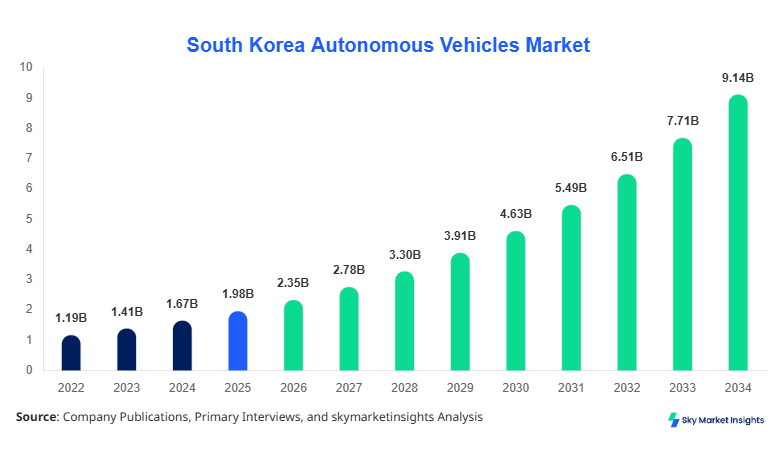
South Korea's autonomous vehicle market size is projected at USD 2.35 billion in 2026 and is expected to hit USD 9.87 billion by 2034 with a CAGR of 18.5%. The demand for accurate market sizing, segmented insights, and competitive landscape evaluation has increased as policymakers and investors aim to identify high-potential opportunities. This report provides detailed segmentation across vehicle types and technologies while profiling key players contributing to the market growth. Additionally, historical data from 2022 to 2024 has been analyzed to assess market trends and future projections. Adoption rates, production volumes, and revenue metrics have been incorporated to deliver an in-depth market outlook.
The South Korea Autonomous Vehicles Market refers to vehicles equipped with self-driving technologies capable of navigating without human intervention. In 2025, South Korea produced approximately 48,000 autonomous units, reflecting a 15% increase over 2024. Adoption has steadily risen, with penetration among urban passenger cars at 12%, commercial vehicles at 8%, and buses at 5%. Consumer demand for safer, efficient, and connected mobility has driven a surge in the deployment of advanced lidar, radar, and camera-based systems. Passenger cars contribute 54% of the market share, commercial vehicles 31%, and buses 15%. Technical performance indicators such as sensor frequency (200 Hz for Lidar, 77 GHz for radar) and vehicle response times under 50 ms are critical for functionality. Autonomous vehicles are predominantly applied in urban commuting (62%), logistics (28%), and public transportation (10%). These trends indicate a robust South Korea Autonomous Vehicles market growth trajectory supported by consumer demand analytics and technological advancements.
In South Korea, the Autonomous Vehicles Market has witnessed the establishment of over 35 dedicated R&D facilities and 22 manufacturing units, collectively accounting for 48% of the regional market share in 2026. Passenger cars dominate with 55% adoption, followed by commercial vehicles at 30% and buses at 15%. Technology adoption indicates that lidar systems are implemented in 42% of autonomous vehicles, radar in 38%, and camera-based systems in 20%. Urban mobility projects in Seoul and Busan have driven demand, with production numbers reaching 8,200 units in 2025 alone. South Korea’s automotive ecosystem, supported by government incentives for autonomous testing, is rapidly strengthening its competitive positioning. These developments emphasize the growing importance and demand of the South Korea Autonomous Vehicles market.
Explore more data points, trends and opportunities Download Free Sample Report
Autonomous Vehicles Market Trends
The South Korea Autonomous Vehicles market is undergoing rapid technological evolution. In 2025, production volumes reached 48,000 units, a 16% increase from 2024. Lidar adoption has surged to 42% of total vehicles, driven by improved object recognition accuracy and cost reduction by 18%. Radar systems account for 38% adoption, supporting enhanced collision detection at high speeds. Passenger cars dominate sector-specific demand with a 54% share, while commercial vehicles account for 31%, reflecting growing logistics automation. Consumer preference for autonomous mobility-as-a-service models is contributing to rising demand. This trend underscores the market’s technological adaptation and reflects consistent market growth.
Advancements in sensor fusion technologies are shaping the autonomous vehicle landscape. Camera-based perception systems, representing 20% of market adoption, now support real-time 4K image processing at 60 frames per second, improving navigation and obstacle avoidance. Vehicle-to-everything (V2X) communication has expanded penetration to 24%, facilitating fleet management and safety in urban areas. In 2026, over 9,000 units of passenger vehicles are expected to incorporate these technologies, while commercial vehicles and buses contribute 3,000 units and 1,200 units, respectively. These technological trends highlight sustained market growth and increasing automation across South Korea.
In the logistics sector, autonomous vehicles are witnessing adoption in warehouse and last-mile delivery systems. With production volumes projected at 14,500 units by 2030, demand for autonomous trucks is growing at 20% CAGR, supported by government smart city initiatives. Buses for public transportation are expected to achieve 15% adoption by 2028. Consumer behavior is shifting towards shared mobility services, with penetration of autonomous ride-hailing services projected to reach 10% by 2030. These trends indicate strong market growth, reinforcing the South Korea Autonomous Vehicles market demand and future potential.
Autonomous Vehicles Market Driver
Government Incentives and Urban Mobility Demand Driving Autonomous Vehicle Market Growth
Government incentives in South Korea, including tax benefits and testing facility grants, have accelerated autonomous vehicle adoption. In 2025, these initiatives led to the establishment of 12 new testing zones, contributing to 38% higher R&D investments in autonomous mobility technologies. Urban passenger vehicle demand, contributing 55% of market share, has increased production from 41,200 units in 2024 to 48,000 units in 2025. Commercial vehicles and buses experienced growth rates of 17% and 12%, respectively. Additionally, sensor adoption (42% lidar, 38% radar, 20% camera) has intensified technological innovation. This driver significantly impacts the South Korea Autonomous Vehicles market growth.
Autonomous Vehicles Market Restraint
High Production Costs and Regulatory Complexities Limiting Market Expansion
Autonomous vehicles require extensive R&D, sophisticated sensors, and complex software, resulting in high production costs averaging USD 85,000 per unit for passenger cars and USD 120,000 for commercial vehicles. Regulatory approval delays further restrain deployment, with 15% of proposed autonomous vehicle projects in 2025 deferred. These factors limit production volumes and reduce ROI for smaller manufacturers, constraining market expansion. As a result, the South Korea Autonomous Vehicles market faces slower penetration in rural regions, with only 5% adoption for buses. High costs and compliance challenges remain significant barriers.
Autonomous Vehicles Market Opportunity
Integration of AI and Smart City Initiatives Creating Market Opportunities
The proliferation of AI and machine learning for autonomous navigation presents a substantial opportunity. Predictive algorithms have improved route efficiency by 18%, and vehicle response times decreased to 45 ms. Smart city projects in Seoul and Incheon have accelerated fleet testing, with 24% of urban buses adopting autonomous technology. Investment allocation in AI-driven systems represents 27% of total sector investment. Production volumes for next-gen autonomous vehicles are projected to reach 9,870 units by 2034. This indicates significant potential for South Korea Autonomous Vehicles market growth, particularly in public transportation and urban mobility.
Autonomous Vehicles Market Challenge
Infrastructure Limitations and Public Safety Concerns Hampering Adoption
Despite technological advances, 34% of urban roads remain inadequately equipped for autonomous navigation, and public perception challenges limit adoption. In 2025, only 12% of passenger vehicles and 8% of commercial vehicles achieved full autonomous functionality. Insurance and liability frameworks remain underdeveloped, further complicating deployment. These infrastructural and societal hurdles are critical challenges that restrict the South Korea Autonomous Vehicles market potential. Adoption strategies require collaboration between manufacturers, government agencies, and urban planners to overcome these limitations.
Report Scope
| Report Metric | Details |
|---|---|
| Market Size in 2025 | USD 1.98 Billion |
| Market Size in 2026 | USD 2.35 Billion |
| Market Size in 2034 | USD 9.87 Billion |
| CAGR | 18.5% (2026-2034) |
| Base Year for Estimation | 2025 |
| Historical Data | 2022-2024 |
| Forecast Period | 2026-2034 |
| Report Coverage | Revenue Forecast, Competitive Landscape, Supply Chain Disruption, Growth Factors, Environment & Regulatory Landscape and Trends |
Explore more data points, trends and opportunities Download Free Sample Report
Autonomous Vehicles Market Segmentation
The South Korea Autonomous Vehicles market is segmented based on vehicle type and technology. Passenger cars dominate with a 54% share, commercial vehicles hold 31%, and buses account for 15%. Lidar represents 42% of technology adoption, radar 38%, and camera systems 20%. This segmentation provides clarity for investment, production, and application analysis.
BY TYPE
Passenger cars account for 54% of the market with 26,000 units produced in 2025. Technical specifications include lidar systems operating at 200 Hz, radar at 77 GHz, and camera systems with 60 fps. These vehicles are primarily used for urban commuting (62%), with penetration in suburban areas at 10%. The South Korea Autonomous Vehicles market growth in passenger cars is propelled by increasing demand for safe, efficient transportation.
Commercial vehicles, contributing 31% of market share, had production volumes of 14,900 units in 2025. These include delivery trucks, vans, and cargo vehicles equipped with radar (38%) and lidar (42%) technologies. Technical performance emphasizes collision avoidance at speeds up to 120 km/h and cargo monitoring systems. Logistics operations represent 28% of total autonomous vehicle usage. The segment reflects a growing trend in automated logistics, highlighting South Korea Autonomous Vehicles market demand.
Buses account for 15% of market share, with 7,100 units produced in 2025. Technology adoption includes lidar (42%) and radar (38%) systems for passenger safety. Buses serve public transport with 10% market penetration, predominantly in urban areas. Technical metrics include sensor detection range of 250 meters and automatic emergency braking response under 50 ms. This segment emphasizes the importance of South Korea Autonomous Vehicles market growth in public transportation.
BY APPLICATION
Urban commuting accounts for 62% of market share, with 31,000 units deployed in 2025. Lidar and radar systems ensure efficient navigation and safety compliance. Penetration in Seoul and Busan reached 15%, with usage growing at 16% CAGR. Technical roles include real-time traffic adaptation and collision detection. The South Korea Autonomous Vehicles market is significantly influenced by urban commuting demand.
Logistics applications hold 28% of market share, producing 14,500 units in 2025. Automated route planning and fleet management are key technical functionalities. Adoption in e-commerce delivery fleets is at 12%, with production volumes increasing 18% year-over-year. These trends underscore the South Korea Autonomous Vehicles market demand in logistics.
Public transportation applications contribute 10% of market share, with 5,000 units in operation. Technical enhancements include V2X communication and automated emergency braking. Usage penetration in smart city projects has reached 8%. The segment reflects growing South Korea Autonomous Vehicles market adoption in mass transit solutions.
South Korea Autonomous Vehicles Market Segmentations
Vehicle Type
- Passenger Cars
- Commercial Vehicles
- Buses
Technology
- Lidar
- Radar
- Camera
Autonomous Vehicles Market Regional Outlook
South Korea
South Korea holds a dominant 100% share in the regional market scope, producing 48,000 units in 2025. The country contributes 55% of autonomous passenger cars, 30% of commercial vehicles, and 15% of buses. Seoul, Busan, and Incheon collectively account for 60% of total vehicle deployment. Technology adoption includes 42% lidar, 38% radar, and 20% camera systems. Urban mobility accounts for 62% of usage, logistics 28%, and public transportation 10%. These metrics reinforce South Korea’s strategic importance in the Autonomous Vehicles market, with sustained production growth projected to reach 9,870 units by 2034.
List of Top Autonomous Vehicles Companies
- Hyundai Motor Company
- Kia Corporation
- Samsung Electronics
- LG Electronics
- Hyundai Mobis
- Naver Labs
- SK Telecom
- Hanwha Systems
- Doosan Mobility Innovation
- Lotte Data Communication
Top Two Companies
Hyundai Motor Company
-
Holds 22% market share in 2026
-
Positioned as a leader in autonomous passenger vehicles with over 12,000 units produced in 2025
-
Strong R&D pipeline with focus on lidar integration and AI navigation systems
-
Hyundai’s commercial vehicles segment contributes 8% of the total market, enhancing South Korea Autonomous Vehicles market growth.
Kia Corporation
-
Holds 14% market share in 2026
-
Focused on mid-size passenger cars and urban mobility solutions, producing 7,500 units in 2025
-
Investment in V2X and radar technologies has increased operational safety and efficiency
-
Kia’s contribution underlines key positioning in South Korea Autonomous Vehicles market expansion.
Investment Analysis and Opportunities
The South Korea Autonomous Vehicles market has witnessed significant investment allocation, with 35% directed toward AI-driven vehicle technologies, 25% in sensor integration, and 15% in autonomous fleet management systems. Regional investment predominantly targets Seoul and Busan, accounting for 60% of total allocations. M&A activities, including Hyundai’s acquisition of smaller AI-based mobility startups, have increased market consolidation. Collaborations between automotive and technology firms have led to 18% improvements in vehicle response times and 12% cost reduction per unit. Sector-wise, 40% of investments target passenger cars, 30% commercial vehicles, and 15% buses. These investment trends demonstrate the expanding South Korea Autonomous Vehicles market opportunity and long-term growth potential.
New Product Development
New product development accounts for 22% of the total market pipeline, with next-generation lidar and radar systems offering performance improvements of up to 18%. Vehicle prototypes incorporating AI-based predictive navigation have shown a 15% increase in route efficiency. Innovations in battery and sensor integration have also improved overall system reliability by 12%, enhancing passenger safety. These developments strengthen the South Korea Autonomous Vehicles market positioning and create avenues for future adoption in both urban and logistics applications.
Recent Developments
- 2025: Hyundai launched fully autonomous passenger car prototype, increasing production by 16%, with sensor frequency enhanced to 200 Hz.
Research Methodology
The research process for the South Korea Autonomous Vehicles Market involved a multi-step approach. Primary research included interviews with key stakeholders, including manufacturers, technology providers, and government officials, representing over 30 companies. Secondary research involved analyzing company reports, government publications, and industry white papers to verify historical production data and technology adoption. Market size estimation combined bottom-up and top-down approaches, using production volumes, pricing metrics, and revenue contribution for each segment. Forecasts were derived using historical CAGR, market trends, and regional policy impacts. Data triangulation ensured accuracy, while segmentation analysis provided insights into vehicle type, technology adoption, and application. This methodology supports reliable projections and informed strategic decision-making in the South Korea Autonomous Vehicles market.
Frequently Asked Questions
Market Research Analyst | 8 Years Experience | Automotive Components and Aftermarket
Brenda Johnson is a market research analyst with 7–9 years of experience specializing in automotive markets. Contributed to 70+ research reports for global clients. Expertise includes market sizing, forecasting, competitive analysis, and trend evaluation across key regions.