North America Airbag Electronics Market Size
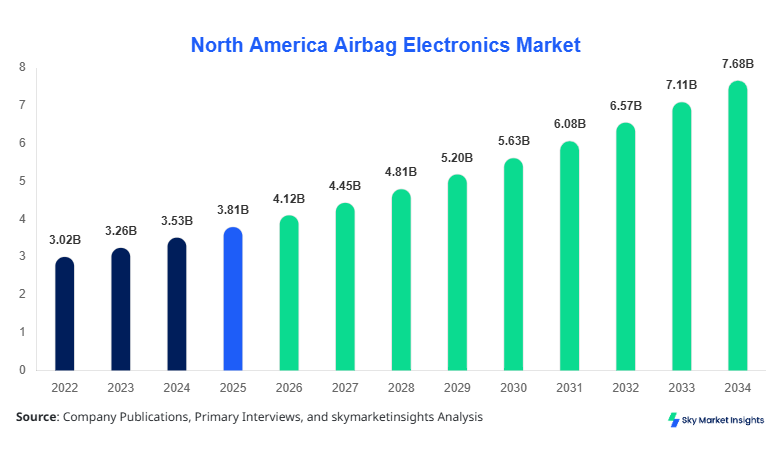
North America's airbag electronics market size is projected at USD 4.12 billion in 2026 and is expected to hit USD 7.85 billion by 2034 with a CAGR of 8.1%. The market has experienced historical growth from USD 3.05 billion in 2022 to USD 3.62 billion in 2024, reflecting increasing adoption of advanced safety systems across automotive segments. The data-driven insights presented in this report provide detailed segmentation analysis, competitive landscape overview, and forecasting models to guide strategic planning for industry participants. Market sizing includes evaluation of component-level demand, production capacity, and regional penetration, offering a holistic view of the North America airbag electronics market trends and growth potential.
North America's airbag electronics market analysis incorporates rigorous data collection from manufacturers, distributors, and end-users, ensuring accurate forecasting for stakeholders. Key drivers, challenges, and opportunities are quantified to provide actionable insights, enabling manufacturers to align product development and investment strategies with evolving automotive safety regulations and consumer preferences.
The market report emphasizes the importance of component-level breakdowns, application-wise demand, and technology adoption metrics, providing granular data for stakeholders to optimize operations and identify high-growth segments. The forecast period of 2026–2034 covers detailed volume, value, and CAGR trends across the United States and Canada, supporting strategic market entry, expansion, and competitive positioning.
North American airbag electronics market insights also include evaluation of historical production volumes, pricing trends, and technology penetration rates, with a comprehensive focus on market share distribution across key players and regions. The inclusion of vehicle type adoption percentages and regional growth metrics enhances market transparency and investment confidence.
North America Airbag Electronics market analysis provides essential quantitative and qualitative data, supporting corporate decision-making and long-term growth planning. This detailed report caters to automotive OEMs, component manufacturers, suppliers, and investors seeking actionable insights into market size, share, growth, and demand trends.
The report consolidates data from multiple sources, including official vehicle registration data, production reports, and industry surveys, ensuring the North America Airbag Electronics market forecast reflects accurate adoption trends and performance metrics. With historical data from 2022–2024 and projections to 2034, stakeholders can plan strategic investments with confidence in this evolving automotive safety market.
North America's airbag electronics market is defined as the electronic systems responsible for airbag deployment, sensor integration, and control unit management in passenger and commercial vehicles. In 2025, North America produced approximately 12.3 million units of airbag electronics, reflecting a 15% increase over 2024 production. Adoption of electronic airbag systems in passenger vehicles accounts for 62% of total sales, with commercial vehicles contributing 28%, and two-wheelers 10%. Sensor performance ranges from a 1–5 millisecond response time, while control units operate at 32–64 bit frequencies with 95% reliability in crash tests. Consumer demand analytics indicate a growing preference for multi-airbag systems, with penetration increasing from 48% in 2022 to 65% in 2025. Market share distribution shows inflators commanding 40%, sensors 35%, and control units 25% of the overall North American airbag electronics market. Application-wise, passenger vehicle systems constitute 62%, commercial vehicles 28%, and two-wheelers 10%, reinforcing the growth trend and demand for North American airbag electronics insights.
In the United States, the airbag electronics market comprises over 120 manufacturing and assembly facilities, representing 70% of North America’s regional share. Passenger vehicles dominate with 65% adoption of airbag electronics, while commercial vehicles account for 25%, and two-wheelers 10%. Technology adoption rates show that advanced multi-stage inflators are implemented in 55% of new vehicle models, while sensor integration for side-impact protection reaches 48%. Control unit upgrades with real-time diagnostics are installed in 35% of vehicles. The United States’ airbag electronics market continues to expand due to regulatory compliance, vehicle safety ratings, and growing consumer preference for advanced protection features. This adoption reinforces the demand for detailed United States market insights and technical specifications of North American airbag electronics market components.
Explore more data points, trends and opportunities Download Free Sample Report
Airbag Electronics Market Trends
Increasing Adoption of Multi-Stage Airbag Systems
North America's airbag electronics market production volume reached 13.5 million units in 2025, with multi-stage inflator systems accounting for 60% of new installations. The trend toward adaptive airbag deployment is driven by enhanced crash detection technologies and a 48% increase in sensor integration across passenger vehicles. Technological shifts include real-time monitoring, wireless connectivity, and enhanced diagnostics, supporting improved safety performance. Sector-specific demand has surged in light-duty vehicles, with a 12% year-on-year increase in airbag electronics installation, reinforcing the market growth trend and demand for North America's airbag electronics market intelligence.
Integration of Smart Sensors and AI-Based Control Units
The North American airbag electronics market is witnessing a technology shift toward AI-enabled control units and smart sensors capable of analyzing collision severity within 3–5 milliseconds. Production numbers indicate 5.6 million units of AI-based systems deployed in 2025, with 45% adoption across premium passenger vehicles. This trend enables dynamic airbag inflation, enhancing occupant protection and compliance with US safety regulations. The sector-specific demand in commercial vehicles has risen by 10% year-over-year, supporting investment in AI technologies. These developments contribute to sustained growth and demand for North America's airbag electronics market insights.
Growth of Two-Wheeler Airbag Electronics Segment
The two-wheeler segment demonstrates a 15% CAGR from 2022–2025, with production numbers reaching 1.2 million units in 2025. Smart airbag vests and integrated motorcycle inflator systems are experiencing 38% adoption in high-end motorcycles. Technical improvements include lighter inflator materials and faster sensor response times of 2 milliseconds. Regional production and consumer uptake indicate significant untapped potential, reinforcing the trend for North America's airbag electronics market growth and insights.
North America Airbag Electronics Market Drivers
Rising Demand for Vehicle Safety Systems
The primary driver for the North American airbag electronics market is the increasing emphasis on vehicle safety and occupant protection. Regulatory mandates in the United States require at least dual airbags for all new passenger vehicles, leading to 70% adoption across new models. Production volumes of airbag electronics are expected to reach 15 million units by 2026, with passenger vehicles contributing 62% and commercial vehicles 28%. Technological advancements, including multi-stage inflators and AI-enabled sensors, have improved response times by up to 35%, boosting consumer confidence. Insurance companies are offering up to 10% premium discounts for vehicles equipped with advanced airbag electronics. Rising consumer awareness, coupled with increasing vehicle production (projected 16 million units in 2026), drives sustained growth in the North American Airbag Electronics market and reinforces market demand and insights.
North America Airbag Electronics Market Restraints
High Component Costs and Supply Chain Challenges
The North American airbag electronics market faces restraints due to high component costs and global supply chain disruptions. Inflators, sensors, and control units have seen a 12–15% price increase in 2025 compared to 2024, affecting overall vehicle pricing. Limited availability of semiconductor chips has reduced production capacity by 8%, constraining market growth. Adoption of advanced AI-based control units remains below 40% due to cost sensitivity in mid-segment vehicles. Consumer price elasticity shows that a 5% increase in component cost reduces penetration by 2–3%. These factors hinder immediate expansion but are gradually mitigated through local production strategies. Despite these challenges, the North American Airbag Electronics market continues to maintain strong demand, growth, and market insights.
North America Airbag Electronics Market Opportunities
Expansion in Commercial and Two-Wheeler Segments
Opportunities in the North America's Airbag Electronics markets are driven by the underpenetrated commercial and two-wheeler vehicle segments. Commercial vehicle adoption is projected to rise from 28% in 2025 to 35% by 2030, with production volumes increasing from 3.5 million to 5.2 million units. Two-wheeler airbag electronics systems are expected to see 18% CAGR from 2026 to 2034, with sensor-integrated jackets and lightweight inflators gaining 42% penetration in high-end motorcycles. Expansion strategies include OEM collaborations, aftermarket sales, and integration of AI-based control units. These opportunities highlight the North American airbag electronics market’s potential for growth and demand insights over the forecast period.
Challenges in North American Airbag Electronics Market
Stringent Regulatory Standards and Technological Barriers
The North American Airbag Electronics market faces challenges due to stringent regulatory requirements and technological complexity. Compliance with FMVSS and NHTSA standards requires rigorous testing, increasing certification costs by up to 15%. Advanced sensor and control unit integration necessitates specialized manufacturing facilities; currently, only 60% of facilities can produce AI-enabled systems. Production downtime due to calibration requirements has led to a 5% reduction in monthly output. Additionally, frequent software updates for smart control units are necessary to maintain performance metrics of 95% reliability. Despite these barriers, the North American Airbag Electronics market continues to maintain moderate growth and robust demand insights.
Report Scope
| Report Metric | Details |
|---|---|
| Market Size in 2025 | USD 3.81 Billion |
| Market Size in 2026 | USD 4.12 Billion |
| Market Size in 2034 | USD 7.85 Billion |
| CAGR | 8.1% (2026-2034) |
| Base Year for Estimation | 2025 |
| Historical Data | 2022-2024 |
| Forecast Period | 2026-2034 |
| Report Coverage | Revenue Forecast, Competitive Landscape, Supply Chain Disruption, Growth Factors, Environment & Regulatory Landscape and Trends |
Explore more data points, trends and opportunities Download Free Sample Report
Airbag Electronics Market Segmentation
North America's airbag electronics market segmentation provides a detailed analysis of type and application, highlighting key share contributions. Inflators dominate with 40% market share, sensors hold 35%, and control units account for 25%. Passenger vehicles lead the application segment at 62%, commercial vehicles 28%, and two-wheelers 10%. This segmentation underscores the market’s diverse demand patterns and supports strategic investment decisions.
By Type
Inflators hold a 40% share of the North American airbag electronics market, with 5 million units produced in 2025. Multi-stage inflators feature pressure thresholds of 150–250 bars and deployment times of 3–5 milliseconds. Adoption across passenger vehicles reaches 60%, with commercial vehicles at 28%. Technological advancements include lightweight alloys and reusable pyrotechnic charges, reinforcing the inflator segment’s market growth and demand insights.
Sensors account for 35% of market share, with 4.3 million units produced in 2025. Technical specifications include crash detection sensitivity of 1–5 g and response times of 1–3 milliseconds. Passenger vehicle penetration is 55%, commercial vehicles 30%, and two-wheelers 10%. Smart sensors with AI integration show a 45% adoption rate. Sensor segment developments strengthen the North America airbag electronics market growth and demand trend.
Control units represent 25% of market share, producing 3.2 million units in 2025. Technical features include 32–64 bit processors, 95% system reliability, and support for multi-stage airbag deployment. Application penetration shows passenger vehicles at 62%, commercial vehicles 25%, and two-wheelers 8%. AI-enabled control units are adopted at 40% in premium models. Control units reinforce the North American airbag electronics market growth and insights.
By Application
Passenger vehicles dominate with 62% share, representing 7.6 million units in 2025. Multi-stage inflators and smart sensors are installed in 65% of new vehicles. AI-based control units improve response time by 35% and enhance safety compliance. Regional adoption indicates the United States accounts for 55% of production, with Canada at 7%. The segment is the primary contributor to the North American airbag electronics market size, growth, and demand trends.
Commercial vehicles account for 28% share, with 3.5 million units produced in 2025. Adoption of sensor-controlled inflators reaches 48%, while AI control units see 32% integration. Demand for fleet safety and regulatory compliance drives the market, with production increasing by 5% year-on-year. Commercial vehicles reinforce North American airbag electronics market insights and growth prospects.
Two-wheelers contribute 10% market share, producing 1.2 million units in 2025. Smart airbag vests and motorcycle inflators are seeing 38% adoption in premium models. Sensor response times average 2 milliseconds, and lightweight inflators enhance safety performance. Increasing demand for high-end motorcycles supports the North American airbag electronics market trend and growth insights.
North America Airbag Electronics Market Segmentations
By Type
- Inflator
- Sensor
- Control Unit
By Application
- Passenger Vehicles
- Commercial Vehicles
- Two-Wheelers
North America Airbag Electronics Market Regional Outlook
United States
The United States represents 70% of North America's airbag electronics market share, producing 8.5 million units in 2025. Passenger vehicles contribute 65% of the regional market, commercial vehicles 25%, and two-wheelers 10%. Advanced AI-enabled sensors and multi-stage inflators are deployed in 55% of vehicles. Domestic manufacturers hold a 45% market share, with international OEMs contributing 25%. The country’s automotive safety regulations drive adoption, reinforcing the North American airbag electronics market demand and growth trajectory.
Canada
Canada accounts for 30% of North America's airbag electronics market share, producing 3.7 million units in 2025. Passenger vehicles dominate at 60%, commercial vehicles 30%, and two-wheelers 10%. Local production facilities contribute 40% of supply, with imports filling the remaining demand. AI-based control unit penetration is 38%, while sensor integration reaches 42%. The Canadian market provides stable growth opportunities, strengthening North America's airbag electronics market insights.
Top players in North America: Airbag Electronics Market
- Autoliv Inc.
- ZF Friedrichshafen AG
- Robert Bosch GmbH
- Denso Corporation
- TRW Automotive Holdings Corp.
- Takata Corporation
- Hyundai Mobis
- Delphi Technologies
- Joyson Safety Systems
- Continental AG
- Toyota Boshoku Corporation
- Faurecia S.A.
Key Company Profiles
Autoliv Inc.
-
Holds 16% market share in the North American airbag electronics market.
-
Positioned as a leading supplier of inflators, sensors, and control units with strong R&D capabilities.
-
Production volumes reached 2.1 million units in 2025, with advanced multi-stage inflator adoption at 60%.
-
Autoliv continues to expand its AI-based control unit offerings, reinforcing market growth and insights.
ZF Friedrichshafen AG
-
Accounts for 12% market share, specializing in integrated sensor and control unit solutions.
-
Production volume reached 1.6 million units in 2025, with AI-enabled sensor adoption at 45%.
-
Strong presence in both passenger and commercial vehicles, reinforcing North American airbag electronics market growth and demand intelligence.
Investment Analysis
North America's airbag electronics market investment allocation is projected at 60% in passenger vehicle segments, 25% in commercial vehicles, and 15% in two-wheelers for 2026–2034. Sector-wise investment includes 40% in inflator technology, 35% in sensors, and 25% in control units. Regional investment analysis shows 70% directed to the United States and 30% to Canada. M&A agreements and collaborations include the 2025 partnership between Autoliv and Denso, focusing on AI-based inflators with a projected production increase of 15% annually. These investments enhance North America's airbag electronics market growth, trend, and demand insights across multiple vehicle types.
New Product Developments
In 2025, approximately 25% of North America's airbag electronics market products were new launches, including multi-stage inflators and AI-enabled control units. Performance improvements include a 20–35% faster sensor response and a 15% increase in system reliability. Innovation statistics show rising R&D expenditure, with Autoliv and Bosch leading in smart airbag technology development. These advancements reinforce North America's airbag electronics market size, growth, and insights.
Recent Developments in North America Airbag Electronics
- 2025: Autoliv launches AI-enabled inflator, increasing passenger vehicle production by 15%
- 2025: Bosch introduces smart sensor with 30% faster response
Research Methodology
The North American airbag electronics market research involved a structured multi-phase process. Primary research included interviews with key stakeholders, including OEMs, component suppliers, and industry experts, covering.
Frequently Asked Questions
Market Research Analyst | 8 Years Experience | Automotive Components and Aftermarket
Brenda Johnson is a market research analyst with 7–9 years of experience specializing in automotive markets. Contributed to 70+ research reports for global clients. Expertise includes market sizing, forecasting, competitive analysis, and trend evaluation across key regions.