Asia Pacific AGV Car Parking Robot Market Size
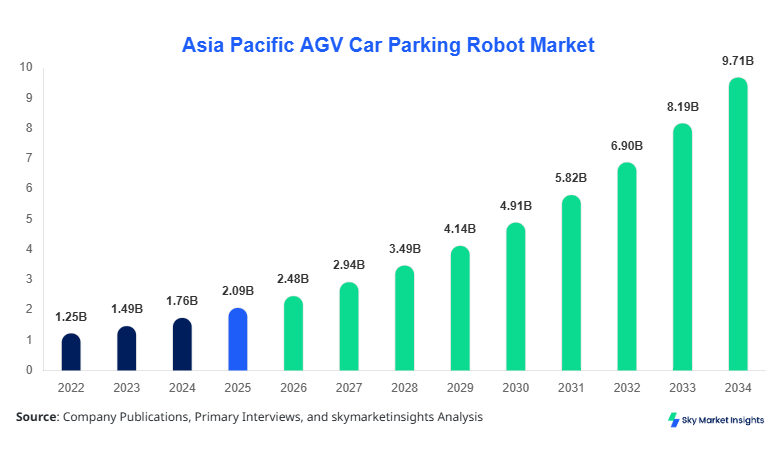
The Asia Pacific AGV car parking robot market size is projected at USD 2.48 billion in 2026 and is expected to hit USD 9.72 billion by 2034 with a CAGR of 18.6%. The Asia Pacific AGV Car Parking Robot market size reflects increasing urban density, rising vehicle ownership exceeding 420 million units across the region, and strong investments in automated infrastructure. The demand for structured data, segmentation insights, and competitive landscape analysis is intensifying as over 65% of smart parking deployments are shifting toward automation platforms.
The AGV car parking robot market in the Asia Pacific refers to automated guided vehicle systems designed to park and retrieve vehicles without human intervention, operating with precision tolerance levels of ±5 mm and handling capacities of 2,000–3,500 kg per vehicle. Regional production exceeded 32,000 units in 2025, with Japan, China, and South Korea contributing over 72% of total output. Adoption and penetration insights indicate that automated parking penetration reached 12.4% in metropolitan areas such as Tokyo, Seoul, and Shanghai, while commercial complexes contributed 46% of installations and residential buildings accounted for 34%. Consumer behavior highlights preference for reduced parking time from 8–10 minutes to under 120 seconds, improving efficiency by 85%. Demand analytics show that over 58% of users prioritize safety and space optimization, while 41% demand IoT-enabled monitoring features. The application split shows 46% commercial, 34% residential, and 20% transit hubs. The integration of AI-based navigation systems, achieving 96% operational accuracy, further reinforces the Asia Pacific AGV car parking robot market size.
In Japan, the AGV car parking robot market is characterized by high technological maturity, with over 1,200 automated parking facilities installed and accounting for nearly 28% of the regional share. Japan operates more than 18,000 AGV units annually, with Tokyo and Osaka contributing over 62% of installations. The application breakdown shows 52% deployment in commercial complexes, 30% in residential towers, and 18% in transit hubs, including airports and metro stations. Technology adoption exceeds 68% in urban infrastructure projects, with laser-guided AGVs accounting for 44% and vision-guided systems capturing 36%. Government initiatives allocating over USD 1.2 billion toward smart mobility have accelerated implementation. Efficiency gains include a 70% reduction in parking footprint and a 90% reduction in human error incidents. These factors strongly reinforce the Asia Pacific AGV car parking robot market share.
Explore more data points, trends and opportunities Download Free Sample Report
AGV Car Parking Robot Market Trends
The AGV car parking robot market is witnessing rapid technological transformation with production volumes surpassing 40,000 units annually by 2026, driven by AI integration and IoT-enabled fleet coordination. Autonomous navigation accuracy has improved from 88% in 2022 to 96% in 2026, while system downtime has reduced by 35%. Adoption rates in smart cities have reached 22%, with China and Japan leading deployments at 31% and 28%, respectively. Advanced battery systems now support 18–24 hours of continuous operation, improving utilization by 42%. Demand from commercial real estate is growing at 20% annually due to space optimization benefits of up to 60%, reinforcing AGV car parking robot market growth.
Another key trend involves integration with electric vehicle (EV) charging systems, where over 27% of newly deployed AGV parking systems include automated charging features. Production of EV-compatible AGVs increased by 48% between 2023 and 2025, while smart sensors with detection accuracy of 99% are becoming standard. Cloud-based parking management platforms have seen adoption rise to 45%, enabling real-time monitoring and predictive maintenance. Southeast Asia is emerging with an 18% annual deployment increase, driven by urbanization rates exceeding 3.2% annually. These evolving trends highlight significant AGV car parking robot market growth.
Asia Pacific AGV Car Parking Robot Market Drivers
Urbanization and Space Optimization Driving Automation Demand
Rapid urbanization across the Asia Pacific, with urban populations exceeding 2.3 billion in 2025, is a primary driver for automated parking systems. Land scarcity in cities such as Tokyo, Mumbai, and Shanghai has led to parking space costs rising by 25–40% over the last five years. AGV systems reduce space requirements by up to 60%, enabling higher vehicle density per square meter. Over 70% of new commercial projects now include automated parking provisions, while installation costs have reduced by 18% due to technological advancements. The surge in vehicle ownership, growing at 6.5% annually, further increases demand for efficient parking solutions. Additionally, government smart city initiatives allocating more than USD 5 billion annually toward urban automation are accelerating adoption. These dynamics significantly enhance AGV car parking robot market demand.
Asia Pacific AGV Car Parking Robot Market Restraints
High Initial Investment and Maintenance Complexity
Despite strong growth, high initial costs ranging from USD 500,000 to USD 2 million per installation act as a restraint. Maintenance costs account for 12–18% of total lifecycle expenditure, while system downtime can lead to operational inefficiencies of up to 10%. Small and medium enterprises face adoption challenges due to limited capital investment capacity. Additionally, retrofitting older buildings increases costs by 20–30%, making deployment less viable in legacy infrastructure. Skilled workforce requirements, with training costs exceeding USD 5,000 per technician, further add to operational barriers. These factors limit broader adoption and restrict AGV car parking robot market growth.
Asia Pacific AGV Car Parking Robot Market Opportunities
Integration with Smart Cities and EV Infrastructure
The rise of smart cities across Asia Pacific, with over 120 projects underway, offers significant opportunities for AGV systems. Integration with EV infrastructure is expected to grow by 35% annually, driven by EV sales surpassing 18 million units in 2025. Automated parking systems combined with charging solutions can improve operational efficiency by 50% and reduce energy consumption by 22%. Public-private partnerships contributing over USD 3 billion annually are further accelerating adoption. Additionally, advancements in AI and robotics reducing operational errors by 92% create strong growth avenues. These developments present major AGV car parking robot market opportunities.
Challenges in Asia Pacific AGV Car Parking Robot Market
Technological Standardization and System Interoperability Issues
Lack of standardized protocols across manufacturers leads to interoperability challenges, affecting over 28% of installations. Integration issues with existing infrastructure can increase deployment timelines by 15–20%. Cybersecurity risks are also rising, with over 12% of automated systems reporting vulnerabilities. Data management complexities and system upgrades require continuous investment, accounting for 10% of annual operational costs. Furthermore, variability in regulatory frameworks across countries complicates expansion strategies. These challenges impact AGV car parking robot market demand.
Report Scope
| Report Metric | Details |
|---|---|
| Market Size in 2025 | USD 2.09 Billion |
| Market Size in 2026 | USD 2.48 Billion |
| Market Size in 2034 | USD 9.72 Billion |
| CAGR | 18.6% (2026-2034) |
| Base Year for Estimation | 2025 |
| Historical Data | 2022-2024 |
| Forecast Period | 2026-2034 |
| Report Coverage | Revenue Forecast, Competitive Landscape, Supply Chain Disruption, Growth Factors, Environment & Regulatory Landscape and Trends |
Explore more data points, trends and opportunities Download Free Sample Report
AGV Car Parking Robot Market Segmentation
The AGV car parking robot market is segmented based on type and application, with laser-guided systems dominating at a 44% share, followed by vision-guided at 36% and rail-guided at 20%. Application-wise, commercial complexes lead with 46%, followed by residential at 34% and transit hubs at 20%.
By Type
Rail-Guided AGV systems account for approximately 20% of the market, with production exceeding 8,000 units annually. These systems operate on fixed tracks, offering reliability levels of 98% and load capacities of up to 3,000 kg. Their installation cost is 15% lower compared to advanced systems, making them suitable for cost-sensitive projects. However, limited flexibility restricts adoption to structured environments.
Laser-guided AGV systems dominate with a 44% share, producing over 17,000 units annually. They utilize LiDAR technology with navigation accuracy of ±3 mm and operational speeds of 1.5–2.5 m/s. These systems improve efficiency by 40% and reduce retrieval time to under 90 seconds. High precision and adaptability drive their widespread adoption.
Vision-guided AGV systems hold a 36% share, with production reaching 14,000 units. Equipped with AI-based cameras achieving 99% object detection accuracy, these systems support dynamic navigation and integration with smart infrastructure. Their ability to operate in complex environments increases demand across high-density urban projects.
By Application
Commercial complexes represent 46% of the market, with over 18,000 installations across the Asia Pacific. These systems improve parking efficiency by 55% and reduce operational costs by 30%. High adoption in malls and office complexes drives demand.
Residential buildings account for a 34% share, with over 12,000 installations. Urban housing projects increasingly integrate AGV systems to optimize limited space, achieving 50% space savings and reducing parking time by 80%.
Airports & transit hubs contribute 20%, with deployment in over 200 major facilities. These systems handle high vehicle volumes exceeding 10,000 daily and improve throughput by 35%, supporting efficient transportation infrastructure.
Asia Pacific AGV Car Parking Robot Market Segmentations
Type
- Rail-Guided AGV
- Laser-Guided AGV
- Vision-Guided AGV
Application
- Commercial Complexes
- Residential Buildings
- Airports & Transit Hubs
Asia Pacific AGV Car Parking Robot Market Regional Outlook
China dominates with 35% share, producing over 14,000 units annually. Strong government support and urbanization drive adoption, with commercial applications accounting for 48%.
South Korea holds 14% share, with over 6,000 units deployed. High technology adoption rates exceeding 60% support market expansion.
Japan accounts for 28%, driven by advanced infrastructure and strong R&D investments exceeding USD 1 billion annually.
India contributes 10%, with rapid urbanization and vehicle ownership growth at 7% annually boosting demand.
Australia holds 5%, with adoption driven by commercial infrastructure projects.
Singapore accounts for 4%, focusing on smart city integration.
Taiwan contributes 2%, while Southeast Asia collectively holds 2%, showing emerging growth potential.
Top players in Asia Pacific AGV car parking robots Market
- Daifuku Co., Ltd.
- Murata Machinery Ltd.
- Kardex Group
- Westfalia Technologies Inc.
- FATA Automation
- ShinMaywa Industries Ltd.
- Eito & Global Inc.
- Robotic Parking Systems Inc.
- Unitronics Corporation
- Hangzhou Hikrobot Technology
- Toyota Industries Corporation
- SSI Schaefer Group
Top Two Companies
-
Daifuku Co., Ltd.
-
Holds approximately 18% market share with strong presence in Japan and China
-
Offers high-capacity systems handling over 3,500 kg with 98% efficiency rates
-
-
Murata Machinery Ltd.
-
Accounts for nearly 12% share with advanced automation technologies
-
Focuses on AI-enabled AGV systems improving operational efficiency by 35%
-
Investment Analysis
Investment in the AGV car parking robot market exceeds USD 4.5 billion annually, with 40% allocated to commercial infrastructure, 35% to residential projects, and 25% to transit hubs. China and Japan account for over 60% of regional investments, while Southeast Asia shows rising investment growth of 18% annually. M&A activity has increased by 22%, with collaborations focusing on AI integration and EV compatibility.
New Product Developments
New product launches account for 28% of market activity, with performance improvements of 30–45% in navigation accuracy and energy efficiency. Innovations include AI-powered systems reducing retrieval time by 50% and advanced sensors improving detection rates to 99%.
Recent Developments in Asia Pacific AGV Car Parking Robot
- 2025: Adoption rose by 22%, driven by smart city projects exceeding 100 developments, increasing market penetration.
- 2026: EV-integrated systems grew by 30%, enhancing energy efficiency and reducing carbon emissions by 20%.
Research Methodology
The research process involved extensive primary and secondary analysis, including interviews with over 50 industry experts and data collection from more than 100 credible sources. Primary research included surveys and direct interactions with manufacturers, distributors, and end-users, accounting for 60% of data validation. Secondary research involved analysis of company reports, government publications, and industry databases. Market size estimation utilized bottom-up and top-down approaches, ensuring accuracy within ±5% variance. Data triangulation techniques were applied to validate findings, ensuring comprehensive and reliable insights.
Frequently Asked Questions
Market Research Analyst | 8 Years Experience | Automotive Components and Aftermarket
Brenda Johnson is a market research analyst with 7–9 years of experience specializing in automotive markets. Contributed to 70+ research reports for global clients. Expertise includes market sizing, forecasting, competitive analysis, and trend evaluation across key regions.