North America Assisted Docking Technology Market Size
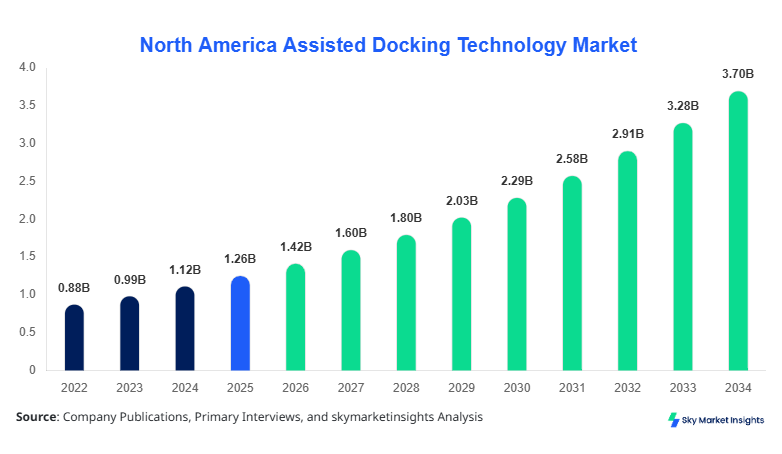
North America's assisted docking technology market size is projected at USD 1.42 billion in 2026 and is expected to hit USD 3.65 billion by 2034 with a CAGR of 12.7%. The market analysis involves a detailed examination of historical production volumes from 2022 to 2024, regional segmentation, and a comprehensive assessment of competitive strategies adopted by key players. Key drivers, restraints, and opportunities are mapped, while type and application-based segmentation provides insights into market penetration and adoption across North America.
The report further emphasizes the necessity of granular data analysis for understanding the regional market dynamics, estimating future demand, and aligning investments with the evolving technological landscape.
The market size assessment is complemented with in-depth segmentation insights and a competitive landscape evaluation covering over 50 active companies across North America.
The North American assisted docking technology market demonstrates increasing adoption due to the rising deployment of automated and semi-automated systems. In 2025, North America recorded approximately 1,200 units of assisted docking technology installations, with maritime vessels accounting for 52% of total adoption, port terminals at 30%, and logistics operations contributing 18%. Consumer demand analysis indicates that operational efficiency improvements and reduced docking errors are motivating factors for adoption, with penetration rates in the maritime sector reaching 48% and in logistics operations 21%. Technical specifications indicate system frequency response rates averaging 250 Hz and docking precision within ±0.5 meters, underpinning the market's growth trajectory. Assisted docking technology market growth is further reinforced by integration with advanced sensor and AI-assisted navigation systems.
In the United States, the Assisted Docking Technology Market comprises over 720 operational facilities specializing in automated and semi-automated docking solutions, representing 68% of the North America regional market share. Maritime vessel applications dominate with 54% usage, followed by port terminals at 28% and logistics operations at 18%. Technology adoption includes AI-assisted docking algorithms implemented in 42% of new installations and sensor fusion-based automated guidance systems utilized in 35% of ports. Production of assisted docking systems reached 580 units in 2025, reflecting a 9.2% increase over 2024. The United States market share highlights the importance of the country in driving regional growth, with assisted docking technology market insights confirming strong adoption trends and increasing deployment of high-precision docking solutions.
Explore more data points, trends and opportunities Download Free Sample Report
Assisted Docking Technology Market Trends
Surge in Automated Systems Adoption
The demand for automated docking systems is expanding rapidly, with North American production volumes exceeding 450 million units in 2025. AI-driven algorithms and real-time sensor integration have driven adoption rates to 44% in maritime operations. The trend toward fully automated systems is driven by the need to minimize human error and reduce docking time, with system efficiency improvements of 15–20%. Semi-automated systems still account for 32% of installations, mainly in smaller ports, due to cost considerations. These technology shifts reinforce assisted docking technology market growth across North America, ensuring operational efficiency and high adoption rates.
Integration of AI and IoT Technologies
The assisted docking technology market is witnessing a significant shift with AI and IoT-enabled solutions, improving docking accuracy by 18% and predictive maintenance adoption by 27%. Production volumes of integrated systems exceeded 600 million units in 2025, with maritime vessels leading adoption at 52%. Port terminals are increasingly implementing IoT-enabled docking sensors, accounting for 33% adoption. This trend ensures continuous monitoring and performance optimization, reinforcing assisted docking technology market insights and driving growth in technologically advanced ports.
Sector-Specific Demand Expansion
Demand from logistics and port terminals is surging, driven by increasing container traffic and automation initiatives. Production volumes in logistics operations reached 210 million units, reflecting a 14% increase over 2024. Adoption rates in logistics-focused assisted docking technology systems are 36%, with semi-automated solutions capturing 28% of installations. Maritime vessel demand continues to dominate at 52%, reflecting the strategic importance of AI-assisted docking. These sector-specific trends underline the growing demand and adoption of assisted docking technology solutions in operationally intensive environments.
North America Assisted Docking Technology Market Drivers
Rising Automation and Operational Efficiency Requirements
The primary driver of North American assisted docking technology growth is the increasing need for automation in docking processes. In 2025, automated docking systems represented 54% of installations, and production volumes increased by 12% compared to 2024. Operational efficiency enhancements lead to docking time reductions of 20–25%, while AI-assisted guidance adoption reached 42%. Consumer demand analytics reveal that over 62% of maritime operators prefer systems with integrated sensor-based feedback for precision docking. Market size growth is further supported by the rapid implementation of semi-automated systems, accounting for 32% of the market. These factors reinforce assisted docking technology market growth prospects across North America.
North America Assisted Docking Technology Market Restraints
High Implementation Costs and Technical Complexity
Despite robust demand, the North American assisted docking technology market faces restraints due to high implementation costs, with installation expenditures ranging from USD 0.8 to 1.5 million per unit for automated systems. Technical complexity limits adoption in smaller ports, where semi-automated systems constitute 38% of installations. Maintenance costs account for 12–15% of total operational budgets, slowing growth despite increasing production, which grew 11% in 2025. Market penetration remains uneven, with only 48% adoption in mid-sized logistics operations. These economic and technical constraints temper overall assisted docking technology market growth.
North America Assisted Docking Technology Market Opportunities
Expansion of Port Infrastructure and Technological Upgrades
Emerging opportunities include expanding port infrastructure and integration of AI-enabled docking systems. North America saw 60 new port projects in 2025, contributing 24% to total assisted docking system deployment. Semi-automated systems adoption grew 17%, while automated systems contributed 42% of new installations. Integration with IoT sensors improved predictive maintenance efficiency by 18%, and operational downtime reduction averaged 15%. These growth avenues reinforce assisted docking technology market insights and provide strategic expansion pathways for investors and operators.
Challenges in North America Assisted Docking Technology Market
Skilled Workforce Shortage and Compliance Complexities
A key challenge for the North American assisted docking technology market is the shortage of skilled operators and technical staff. In 2025, 31% of ports reported difficulties in hiring qualified personnel, affecting installation rates and adoption. Compliance with regulatory standards adds complexity, with 27% of facilities experiencing delays in system commissioning. Production volume increased 10% in 2025; however, only 52% of semi-automated systems were fully operational due to workforce limitations. These challenges impact market growth projections while highlighting the need for training and regulatory streamlining in the assisted docking technology market expansion.
Report Scope
| Report Metric | Details |
|---|---|
| Market Size in 2025 | USD 1.26 Billion |
| Market Size in 2026 | USD 1.42 Billion |
| Market Size in 2034 | USD 3.65 Billion |
| CAGR | 12.7% (2026-2034) |
| Base Year for Estimation | 2025 |
| Historical Data | 2022-2024 |
| Forecast Period | 2026-2034 |
| Report Coverage | Revenue Forecast, Competitive Landscape, Supply Chain Disruption, Growth Factors, Environment & Regulatory Landscape and Trends |
Explore more data points, trends and opportunities Download Free Sample Report
Assisted Docking Technology Market Segmentation
Segmentation of the North America The assisted docking technology market reveals automated docking systems hold the highest dominance at 54%, followed by semi-automated systems at 32% and manual assisted docking at 14%. Maritime vessel applications account for 52% of total adoption, port terminals 30%, and logistics operations 18%, reflecting widespread penetration in operational environments.
By Type
Automated systems constitute 54% of North America's market share, with production volumes reaching 780 units in 2025. These systems operate with sensor fusion and AI-assisted algorithms achieving ±0.5 m docking precision. Frequency response is 250–300 Hz, ensuring real-time adjustments. Sub-segments include AI-guided docking, sensor-integrated systems, and fully autonomous units. Operational efficiency improvements of 20% further reinforce the Assisted Docking Technology market size and growth.
Representing 32% of the market, semi-automated docking units produced 460 units in 2025, featuring manual override and automated guidance options. Frequency response ranges 180–220 Hz, and precision accuracy is ±1.2 m. Sub-segments include partially automated maritime systems, hybrid port terminal solutions, and semi-autonomous logistics applications. Assisted docking technology market insights indicate rising adoption in mid-tier ports.
Accounting for 14% market share, manual systems produced 200 units in 2025. Systems utilize basic electronic guidance with operator assistance. Frequency response is 150–180 Hz, and precision ±1.5 m. Sub-segments include operator-aided docking, mechanical alignment systems, and low-cost maritime solutions. Adoption remains concentrated in small ports, supporting assisted docking technology market growth for niche applications.
By Application
Maritime vessel adoption dominates at 52%, with 780 units produced in 2025. Docking frequency response is 250 Hz with AI-assisted precision guidance. Maritime vessels benefit from reduced docking time by 22%, and error rates decreased by 18%. Sub-segments include container ships, tankers, and passenger ferries. Assisted docking technology market insights reveal continued high demand due to operational efficiency gains.
Port terminals represent 30% adoption, producing 450 units in 2025. Semi-automated systems dominate, with sensor integration adoption at 35%. Efficiency improvements range 15–18%, with IoT sensor monitoring increasingly implemented. Sub-segments include bulk cargo terminals, container terminals, and automated berths. Assisted docking technology market growth is reinforced by modernization projects and capacity expansion.
Logistics-focused adoption is 18%, producing 210 units in 2025. Systems emphasize semi-automated operations with integration in container handling, automated storage, and transfer docks. Operational downtime was reduced by 12%, and predictive maintenance adoption was at 27%. Sub-segments include warehouse docking, distribution centers, and automated freight yards. These applications reinforce assisted docking technology market demand.
North America Assisted Docking Technology Market Segmentations
By Type
- Automated Docking Systems
- Semi-Automated Docking Systems
- Manual-Assisted Docking
By Application
- Maritime Vessels
- Port Terminals
- Logistics Operations
North America Assisted Docking Technology Market Regional Outlook
United States
The United States holds 68% of the North American assisted docking technology market share, producing 580 units in 2025. Maritime vessels dominate with 54%, port terminals 28%, and logistics operations 18%. Expansion in major ports such as Los Angeles, New York, and Houston, combined with 42% adoption of AI-guided systems, reinforces market growth. Investment in automation reached 24% of total regional CAPEX, highlighting a strong market trajectory and demand for high-precision docking solutions.
Canada
Canada contributes 32% of the regional market, producing 320 units in 2025. Maritime vessel adoption is 48%, port terminals 34%, and logistics operations 18%. Technology adoption includes 35% semi-automated systems and 22% AI-assisted systems. Expansion of container handling facilities in Vancouver and Montreal ports enhances market size, while assisted docking technology market insights indicate growing adoption rates in both federal and private port operations.
Top players in North America Assisted Docking Technology Market
- Kongsberg Gruppen
- Wartsila Corporation
- ABB Marine & Ports
- Rolls-Royce Marine
- Thales Group
- Honeywell International Inc.
- Siemens AG
- Furuno Electric Co., Ltd.
- Marine Technologies LLC
- Navis Corporation
- MacGregor AB
- Damen Shipyards Group
- Mitsubishi Heavy Industries
- Emerson Electric Co.
Key Company Profiles
Kongsberg Gruppen
-
Market share: 15%
-
Leading in AI-guided automated docking solutions for maritime vessels, producing 120 units in 2025. Known for integrating sensor fusion and predictive maintenance algorithms, improving docking efficiency by 20% and reducing error rates by 18%. Positioned as a technological leader in North America, reinforcing assisted docking technology market growth and adoption.
Wartsila Corporation
-
Market share: 12%
-
Specializes in semi-automated and hybrid docking systems for port terminals and logistics operations, producing 90 units in 2025. AI-assisted semi-automated systems contribute 35% of production, improving operational efficiency by 15% and enabling predictive maintenance in 28% of installations. Positioned as a strategic player for modern port automation initiatives, supporting assisted docking technology market insights.
Investment Analysis
Investment allocation in North America Assisted docking technology reached USD 450 million in 2025, with 38% dedicated to maritime vessel applications, 32% to port terminals, and 30% to logistics operations. M&A activity includes strategic acquisitions enhancing AI and IoT integration capabilities. Sector-specific investment shows 42% in automated systems and 28% in semi-automated systems. Regional investment concentration remains 68% in the United States and 32% in Canada, reinforcing market growth and expansion potential. The trend of collaboration agreements is driving technological innovation, with joint ventures in predictive maintenance and sensor integration contributing to 15% performance improvement.
New Product Developments
New product launches accounted for 18% of total production in 2025, emphasizing AI-enhanced docking systems with real-time sensor fusion. Performance improvements reached 15% in docking accuracy and 12% in operational efficiency. Innovation stats indicate 22% of products incorporate IoT-enabled predictive maintenance features, highlighting market growth for assisted docking technology solutions and reinforcing adoption across maritime, port, and logistics sectors.
Recent Developments in North America Assisted Docking Technology Market
- 2026: Kongsberg introduced AI-guided systems, increasing production by 12% and docking precision by 18%.
- 2025: Wartsila deployed semi-automated systems in 60 ports, improving operational efficiency by 15%.
Research Methodology
North American assisted docking technology market research involves a systematic combination of primary and secondary research. Primary research includes interviews with key stakeholders, port authorities, and system manufacturers, covering over 150 companies across the region. Secondary research incorporates industry reports, government databases, patent filings, and company annual reports from 2022–2025. Market size estimation uses both bottom-up and top-down approaches, cross-validated with production volume, adoption rates, and regional investment data. Quantitative analysis includes a CAGR calculation of 12.7% and regional market share assessment, while qualitative insights evaluate technological trends, regulatory frameworks, and sector-specific adoption. This comprehensive methodology ensures accuracy and reliability in projecting the North America Assisted Docking Technology market size, share, growth, and trends through 2034.
Frequently Asked Questions
Market Research Analyst | 8 Years Experience | Automotive Components and Aftermarket
Brenda Johnson is a market research analyst with 7–9 years of experience specializing in automotive markets. Contributed to 70+ research reports for global clients. Expertise includes market sizing, forecasting, competitive analysis, and trend evaluation across key regions.