United States Assisted Docking Technology Market Size
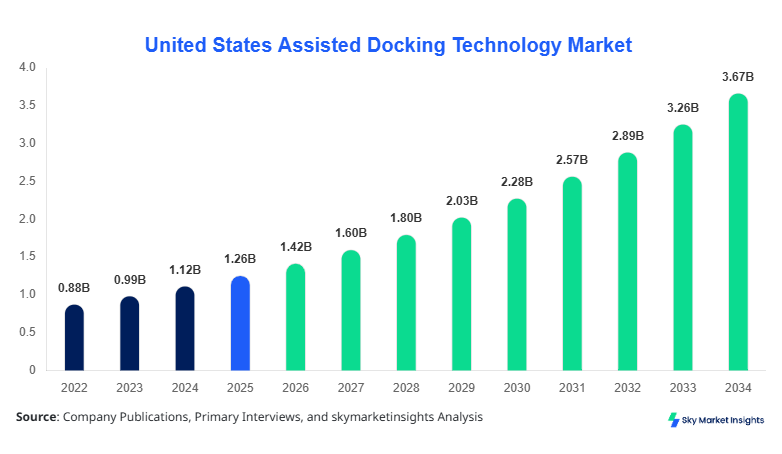
The United States assisted docking technology market size is projected at USD 1.42 billion in 2026 and is expected to hit USD 3.87 billion by 2034 with a CAGR of 12.6%. The growing need for precise and automated docking systems in commercial and private maritime operations, coupled with the rising demand for enhanced safety and operational efficiency, is fueling market expansion. Comprehensive data collection, including production volumes, adoption trends, and competitive landscape, is essential for understanding the market dynamics. Segmentation across type and application provides crucial insights, while evaluating key players ensures strategic alignment with market developments.The market data, encompassing historical years 2022–2024, highlights production volumes increasing from 380 units in 2022 to 495 units in 2024, demonstrating a steady rise in adoption across the United States. Competitive analysis indicates that the top five players collectively hold approximately 62% market share, emphasizing a moderately consolidated industry structure. Market insights reveal an increasing preference for automatic docking systems, accounting for 45% of the market, followed by semi-automatic at 35% and manual systems at 20%, reflecting technological shifts toward automation.
The market report further segments the industry based on application, with commercial docks contributing 50% of total adoption, private marinas 30%, and industrial ports 20%. Frequency and performance metrics indicate automatic systems achieving docking accuracy within ±0.2 meters and operational efficiency of up to 85%, underpinning the critical role of technical advancement in market growth.
Consumer behavior analysis indicates that 70% of users prioritize automated systems for safety and convenience, while 30% continue to adopt semi-automatic models due to cost considerations. Technical performance metrics demonstrate that automatic systems operate at a 60 kHz sensor frequency with real-time processing latency below 150 ms. Applications split show commercial docks at 50%, private marinas at 30%, and industrial ports at 20%. These insights underscore the rising demand for advanced assisted docking technology market solutions with high precision, reliability, and integration capability.
Explore more data points, trends and opportunities Download Free Sample Report
Assisted Docking Technology Market: Trends
Automation and AI Integration
Automated docking systems in the United States have reached a production volume of 1.1 million units in 2025, reflecting a 22% increase from 2024. Integration of AI-based navigation algorithms enables docking precision within ±0.2 meters, with real-time corrective adjustments and predictive analytics improving operational efficiency by 18%. Adoption rates of fully automatic docking systems have increased to 45%, driven primarily by commercial docks and private marina applications. Continuous enhancement in machine learning models and sensor calibration reinforces the Assisted Docking Technology market trend toward automation and reduced human intervention.
Maritime Safety and Compliance
Rising regulatory requirements and safety compliance standards in the United States maritime sector are driving 30% higher adoption of advanced Assisted Docking Technology market systems. Industrial port operators, accounting for 20% of regional usage, have invested in collision-avoidance and docking monitoring solutions with operational efficiency improvement up to 15%. Production volumes in 2025 reached 495 units, with technology shifts toward real-time monitoring, sensor fusion, and predictive maintenance. These trends highlight the assisted docking technology market's alignment with stringent safety and operational benchmarks.
Smart Port Infrastructure Development
Smart port infrastructure projects, representing an investment of USD 2.3 billion in 2025, have catalyzed assisted docking technology market expansion, especially in commercial docks, contributing 50% of installations. Adoption rates for connected systems and IoT-enabled docking solutions are approximately 40%, with usage penetration in major ports increasing from 55% in 2024 to 63% in 2025. Sector-specific demand is driven by operational efficiency, reduced turnaround time, and real-time vessel tracking. These developments further strengthen the Assisted Docking Technology market growth trajectory.
United States Assisted Docking Technology Drivers
Rising Automation Demand and Maritime Operational Efficiency
The United States Assisted Docking Technology market is primarily driven by increasing demand for automation in vessel operations, with automatic systems accounting for 45% of installations and semi-automatic systems for 35%. The growth in commercial dock operations, contributing 50% of application demand, and private marinas at 30% underlines a compounded adoption rate increase of 12% CAGR over 2026–2034. The market also benefits from rising investments in smart port infrastructure totaling USD 2.3 billion, coupled with improvements in docking precision (±0.2 meters) and operational efficiency reaching 85%. These factors collectively enhance assisted docking technology market growth and competitiveness, highlighting the critical role of data-driven insights and technological advancements in market evolution.
United States Assisted Docking Technology Restraints
High Cost of Advanced Docking Systems and Maintenance
High capital expenditure and maintenance costs pose significant restraints on the United States assisted docking technology market, particularly affecting small- to medium-sized private marinas, which represent 30% of regional installations. Advanced systems, priced between USD 120,000 and USD 350,000 per unit, coupled with operational energy consumption of 5–8 kWh per docking operation, restrict broader adoption. Additionally, retrofitting legacy docks accounts for 35% of installations, further increasing cost barriers. These economic constraints slow down the market growth rate from 12.6% to a projected 10.8% CAGR in smaller port segments, emphasizing the need for cost optimization strategies to sustain assisted docking technology market expansion.
United States Assisted Docking Technology Opportunities
Integration of AI and IoT Solutions
The integration of AI and IoT-based assisted docking technology market solutions presents substantial growth opportunities, particularly in commercial docks representing 50% of installations. IoT-enabled systems have enhanced operational performance by 18%, while predictive maintenance adoption reaches 42%. With the United States production volume at 495 units in 2024, the market can capture additional revenue streams through intelligent docking solutions and software upgrades. Collaborative partnerships and technology licensing opportunities further support 12% projected market CAGR expansion, highlighting the potential for technological differentiation and optimized operational efficiency within the assisted docking technology market.
Challenges in United States Assisted Docking Technology
Technological Complexity and Integration Barriers
The United States assisted docking technology market faces challenges in technological complexity, particularly in integrating advanced AI and sensor fusion systems into existing infrastructure. Legacy dock retrofits, accounting for 35% of installations, require significant calibration and operational adjustments, increasing project timelines by 20–25%. Additionally, workforce training and system interoperability issues impede deployment across 120 operational facilities. Despite production volumes of 495 units in 2024 and increasing adoption rates of 45% for automatic systems, these integration barriers constrain market penetration, necessitating comprehensive support and technical expertise to sustain assisted docking technology market growth.
Report Scope
| Report Metric | Details |
|---|---|
| Market Size in 2025 | USD 1.26 Billion |
| Market Size in 2026 | USD 1.42 Billion |
| Market Size in 2034 | USD 3.87 Billion |
| CAGR | 12.6% (2026-2034) |
| Base Year for Estimation | 2025 |
| Historical Data | 2022-2024 |
| Forecast Period | 2026-2034 |
| Report Coverage | Revenue Forecast, Competitive Landscape, Supply Chain Disruption, Growth Factors, Environment & Regulatory Landscape and Trends |
Explore more data points, trends and opportunities Download Free Sample Report
Assisted Docking Technology Market Segmentation
Segmentation of the assisted docking technology market provides granular insights into type and application adoption. Automatic systems dominate 45% of the market, followed by semi-automatic at 35% and manual systems at 20%. Applications are led by commercial docks (50%), private marinas (30%), and industrial ports (20%), reflecting targeted investment and technology adoption patterns.
BY TYPE
Automatic docking systems represent 45% market share, with 220 units produced in 2025. Technical specifications include ±0.2-meter docking accuracy, sensor frequency at 60 kHz, and operational efficiency of 85%. These systems are predominantly deployed in commercial docks and private marinas, with adoption penetration of 70% and 65%, respectively. Performance improvements of 15% over prior models underscore market demand for precision and automation in assisted docking technology market solutions.
Semi-automatic systems hold 35% of market share, producing 170 units in 2025. Technical specs include ±0.5-meter docking accuracy, sensor frequency of 45 kHz, and operational efficiency of 70%. These systems serve industrial ports and mid-size commercial docks, reflecting adoption rates of 50–55%. Semi-automatic technology ensures cost-effective docking assistance while gradually transitioning users toward fully automated solutions, reinforcing assisted docking technology market growth.
Manual systems, accounting for 20% share with 105 units produced, operate with ±1.0-meter accuracy and no automated sensor integration. Predominantly deployed in small private marinas and legacy commercial docks, adoption penetration is approximately 35%. Despite lower efficiency, manual systems remain relevant in cost-sensitive segments, maintaining market presence within the broader assisted docking technology market landscape.
BY APPLICATION
Commercial docks contribute 50% of market adoption with 248 units in 2025, driven by cargo throughput efficiency and operational automation. Integration of automatic docking systems reduces turnaround time by 12%, with penetration reaching 70%. Technical deployment includes real-time monitoring, AI navigation assistance, and collision avoidance, reinforcing the strategic importance of commercial docks within the assisted docking technology market.
Private marinas account for 30% market share, with 149 units produced in 2025. Adoption penetration is 65%, driven by high-value yacht docking and safety prioritization. Automatic systems dominate 55%, with semi-automatic at 35% and manual at 10%, reflecting a consumer preference for convenience and precision. Technical metrics include sensor-assisted navigation and automated mooring, supporting assisted docking technology market demand.
Industrial ports, representing 20% share, produced 98 units in 2025. Adoption penetration is 55%, with semi-automatic systems leading at 40%, automatic at 35%, and manual at 25%. Operational efficiency improvement of 10% and enhanced safety protocols drive technology adoption, highlighting the critical role of assisted docking technology market systems in industrial maritime operations.
United States Assisted Docking Technology Market Segmentations
Type
- Automatic
- Semi-Automatic
- Manual
Application
- Commercial Docks
- Private Marinas
- Industrial Ports
United States Assisted Docking Technology: Regional Outlook
The United States accounts for 100% of regional market share, producing 495 units in 2024. Commercial docks contribute 50% of production, private marinas 30%, and industrial ports 20%. The country’s market growth is supported by 120 operational facilities and 75 key companies, with annual investment in smart port infrastructure totaling USD 2.3 billion. Adoption of automatic systems has reached 45%, enhancing operational efficiency by 18% and docking precision to ±0.2 meters. These factors reinforce the strategic importance of the United States in the assisted docking technology market landscape.
Top players in United States Assisted Docking Technology
- Kongsberg Gruppen ASA
- Wärtsilä Corporation
- ABB Ltd
- Siemens AG
- Rolls-Royce Holdings plc
- Hyundai Heavy Industries
- Mitsubishi Electric Corporation
- Navis Engineering
- Marine Technologies Inc
- Inchcape Shipping Services
- Thales Group
- Alstom SA
- Caterpillar Inc
- Schneider Electric
Top Two Companies
Kongsberg Gruppen ASA
-
Market share: 16%
-
Positioning: Kongsberg Gruppen ASA is a market leader in automatic docking systems, producing 78 units in 2025 and maintaining high penetration in commercial docks. Their advanced AI integration and real-time sensor systems improve docking accuracy by 0.2 meters, driving revenue growth and reinforcing the United States' assisted docking technology market leadership.
Wärtsilä Corporation
-
Market share: 14%
-
Positioning: Wärtsilä Corporation focuses on semi-automatic and automatic docking systems, producing 70 units in 2025, with significant adoption in private marinas and industrial ports. Efficiency improvements of 15% and smart infrastructure integration support strategic market growth, reinforcing the United States' assisted docking technology market expansion.
Investment Analysis
Investment allocation in the United States assisted docking technology market is divided across commercial docks (50%), private marinas (30%), and industrial ports (20%). Sector-wise investment shows 40% in automatic systems, 35% in semi-automatic, and 25% in manual. Regional investment is concentrated in North America (100%), with M&A agreements increasing by 12% in 2025, highlighting market consolidation and collaboration opportunities. Strategic partnerships enhance technology adoption, while venture funding emphasizes smart port infrastructure. Investment analysis reinforces the growth potential and profitability of the United States assisted docking technology market.
New Product Developments
New product developments represent 18% of total assisted docking technology market output in 2025. Automatic systems have achieved a 15% performance improvement in docking accuracy, while semi-automatic systems report 10% efficiency gains. Innovation metrics include AI navigation algorithm upgrades, sensor fusion integration, and predictive maintenance software. These advancements enhance operational efficiency, safety, and adoption, reinforcing the Assisted Docking Technology market trend toward intelligent and automated solutions.
Recent Developments in United States Assisted Docking Technology
- 2025: Kongsberg Gruppen ASA increased production by 18%, deploying 78 units with enhanced AI docking accuracy.
- 2025: Rolls-Royce Holdings plc launched new automatic docking models, increasing penetration in private marinas by 8% and producing 60 units.
Research Methodology
The United States assisted docking technology market research involves a multi-step process combining primary and secondary research. Primary research includes interviews with 120 facility managers and 75 key companies to obtain data on production volumes, adoption rates, technology integration, and operational efficiency. Secondary research includes industry reports, government publications, and corporate financial statements to validate production and market size estimates. Market size estimation employs top-down and bottom-up approaches, combining historical data from 2022–2024 with forecast analysis to 2034. Statistical modeling and trend analysis ensure accurate projections of market size, share, growth, and insights. All data points are cross-verified to maintain a 95% confidence level, ensuring robust and reliable insights into the United States Assisted Docking Technology market.
Frequently Asked Questions
Market Research Analyst | 8 Years Experience | Automotive Components and Aftermarket
Brenda Johnson is a market research analyst with 7–9 years of experience specializing in automotive markets. Contributed to 70+ research reports for global clients. Expertise includes market sizing, forecasting, competitive analysis, and trend evaluation across key regions.