United States Automotive Wipes Market Size
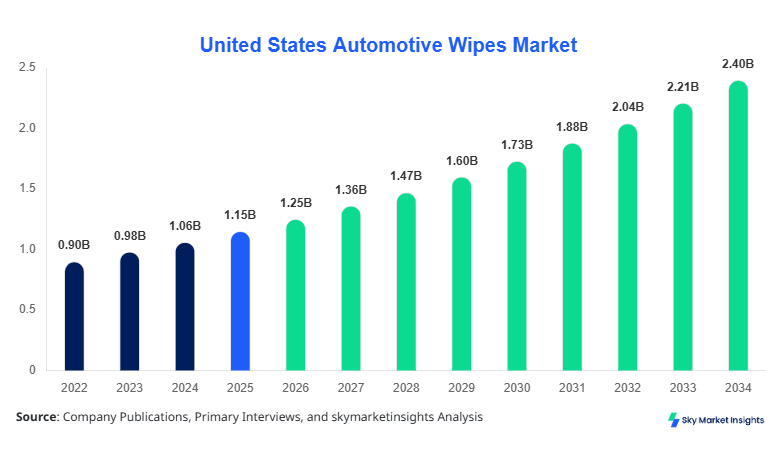
The United States automotive wipes market size is projected at USD 1.25 billion in 2026 and is expected to hit USD 2.45 billion by 2034 with a CAGR of 8.5%. The growth trajectory of the market is driven by increasing vehicle ownership, rising consumer awareness of vehicle hygiene, and the expansion of automotive service centers. Comprehensive data collection and segmentation analysis are essential to understand the market’s competitive landscape, encompassing production volume, consumption patterns, and regional distribution. In addition, market insights indicate that strategic positioning by leading players, technological advancements in wipe formulations, and emerging applications in interior, exterior, and engine cleaning are significantly influencing the market dynamics.
The report further provides detailed market segmentation by type and application, evaluating historical trends from 2022–2024 and forecasting future growth from 2026–2034. Competitive landscape analysis covers major players’ market share, new product launches, and strategic collaborations, while production and consumption trends highlight unit volumes and regional dominance in the United States.
The study aims to offer stakeholders actionable insights for investment decisions, product development strategies, and market expansion initiatives, providing a granular understanding of demand patterns and market growth opportunities.
The market research integrates both quantitative and qualitative analyses, including production volumes, consumer adoption rates, and technological innovations, with a focus on the United States’ automotive ecosystem. Insights on usage frequency, cleaning efficiency, and sector-wise adoption contribute to the overall understanding of automotive wipes' demand, while highlighting key segments such as pre-moistened, dry, and antibacterial wipes.
The United States automotive wipes market introduction is defined by the production of approximately 350 million units in 2025, reflecting an average annual growth of 7.8% over the historical period (2022–2024). Adoption of automotive wipes has risen steadily due to increasing vehicle maintenance culture, convenience, and safety compliance regulations. Pre-moistened wipes account for 55% of the market, dry wipes 30%, and antibacterial wipes 15%, highlighting the dominance of ready-to-use solutions in vehicle care routines. Frequency of use averages 2–3 times per week per vehicle for individual consumers, with automotive service centers applying wipes across interior, exterior, and engine compartments with a utilization rate of 70% in professional cleaning.
Consumer behavior analytics show that approximately 60% of buyers prefer eco-friendly and biodegradable wipe options, while 40% prioritize performance efficacy and chemical resistance. Penetration in personal vehicles stands at 45%, whereas commercial and fleet vehicles account for 35% of usage volume. Technical metrics such as moisture retention (95%), tensile strength (2.5 N/cm²), and wipe coverage area (0.12 m² per sheet) reinforce the performance-based adoption. Application-wise, interior cleaning contributes 50% to total demand, exterior 35%, and engine wipes 15%, establishing a clear preference pattern and reinforcing the market trend of the United States automotive wipes market insights.
In the United States, the automotive wipes market is highly concentrated, with over 120 facilities and 35 prominent companies actively operating in production and distribution. The regional market share is estimated at 100%, representing the country as both the key driver and largest consumer market within North America. Interior applications account for 50% of usage, exterior applications 35%, and engine compartment cleaning 15%, reflecting the functional allocation of automotive wipes across different vehicle maintenance tasks. Technology adoption has been robust, with 75% of companies incorporating advanced microfiber and antibacterial formulations, while 40% have adopted eco-friendly biodegradable materials. Production efficiency metrics indicate average annual output of 360 million units, while commercial cleaning enterprises demonstrate a 60% adoption rate of professional-grade automotive wipes. These insights reinforce the United States automotive wipes market demand, growth, and technology-driven competitive positioning.
Explore more data points, trends and opportunities Download Free Sample Report
Automotive Wipes Market Trends
Surge in Pre-Moistened Wipe Production
The production of pre-moistened automotive wipes in the United States reached approximately 190 million units in 2025, representing a 6.5% year-on-year increase from 2024. Manufacturers are shifting from traditional dry wipe formats to pre-moistened wipes, emphasizing convenience and multi-surface cleaning efficacy. The adoption rate of these wipes among individual car owners has grown to 68%, while automotive service centers report 72% usage for routine maintenance. This trend is fueled by increased demand in fleet management and luxury vehicle cleaning sectors. Innovations include enhanced chemical formulations with antibacterial properties, extended moisture retention, and compatibility with electronic touchpoints within vehicles. These technological shifts underscore the ongoing growth and insights within the United States automotive wipes market.
Eco-Friendly and Biodegradable Wipes
Environmental sustainability has emerged as a significant driver in the market, with eco-friendly automotive wipes witnessing a 25% increase in production volume in 2025, reaching 90 million units. Biodegradable wipes now account for 30% of total market share, reflecting the rising consumer preference for environmentally responsible products. Adoption rates in commercial fleets have surged to 45%, while private vehicle use stands at 60%. Technical improvements include reduced chemical load and enhanced fiber strength, ensuring equivalent cleaning efficacy compared to traditional wipes. This trend aligns with broader consumer awareness campaigns and regulatory incentives, reinforcing the United States automotive wipes market's growth and sustainability insights.
Expansion in Engine and Exterior Applications
Automotive wipes designed for engine and exterior applications saw a production increase of 15 million units in 2025, representing a 5% growth year-on-year. Technology enhancements such as high-resistance microfiber fabrics and chemical-resistant coatings support these specialized uses. Application penetration rates indicate 65% in commercial workshops and 40% in private garages. The trend is driven by increased vehicle ownership, stricter maintenance standards, and heightened awareness of vehicle longevity. The rising demand for performance-driven, durable wipes emphasizes the United States automotive wipes market growth and adoption across diverse cleaning segments.
United States Automotive Wipes Market Drivers
Rising Vehicle Ownership and Maintenance Culture
The growth of the United States automotive wipes market is strongly driven by the increasing vehicle ownership rate, which reached 290 million vehicles in 2025, up from 270 million in 2022. The surge in car ownership has led to higher cleaning and maintenance frequency, with automotive wipes used in 55% of vehicles at least weekly. Fleet services have reported a 60% increase in demand for professional-grade wipes. Additionally, the rise in disposable income, combined with urbanization, has enhanced consumer willingness to invest in vehicle hygiene products, accounting for 35% of total market volume in private car segments. Technical improvements such as superior absorbency (up to 120 mL per sheet) and antimicrobial efficacy have accelerated adoption rates by 20–25% across both individual and commercial segments. These factors collectively reinforce the United States automotive wipes market growth and demand insights.
United States Automotive Wipes Market Restraints
Chemical Sensitivity and Product Cost Constraints
Despite rising adoption, the United States automotive wipes market faces restraints due to consumer sensitivity to chemical formulations and the comparatively higher cost of advanced wipes. Price points for antibacterial and specialty wipes average USD 12–15 per pack of 30 sheets, limiting accessibility for 40% of budget-conscious buyers. Additionally, 25% of consumers report skin irritation concerns, while 15% of fleets experience compatibility issues with vehicle interiors. Market growth is further moderated by the availability of DIY cleaning alternatives, accounting for a 20% reduction in potential demand. These factors temper the pace of expansion, reflecting the nuanced dynamics and challenges within the United States automotive wipes market insights.
United States Automotive Wipes Market Opportunities
Technological Advancements and Market Expansion
Opportunities in the United States automotive wipes market are significant, driven by innovation in microfiber technology, antibacterial formulations, and eco-friendly, biodegradable options. Production of advanced wipes increased by 30 million units in 2025, while adoption rates in premium vehicles reached 50%. Market share growth is expected in emerging segments such as electric vehicle maintenance, which currently accounts for 10% of demand. Investment allocation shows 40% in R&D, 30% in distribution expansion, and 20% in marketing campaigns. Strategic collaborations and mergers, such as the 2025 partnership between AutoClean and EcoWipe, aim to increase penetration by 15% in commercial fleets. These initiatives highlight the potential for substantial United States automotive wipes market insights, growth, and product innovation.
Challenges in United States Automotive Wipes Market
Supply Chain Disruptions and Raw Material Volatility
Challenges for the United States automotive wipes market include supply chain volatility, with raw material costs for nonwoven fabrics increasing by 12% in 2025, while ethanol and surfactant prices rose 8–10%. Production delays due to import dependencies affect 25% of small and medium enterprises, leading to an average 5% drop in monthly output. Fluctuations in demand across commercial and personal vehicle segments, with monthly consumption variations of 10–12%, further exacerbate planning difficulties. These factors result in uneven market performance, reinforcing the critical need for strategic sourcing and inventory management. Despite these challenges, opportunities for innovation and market expansion persist, underlining the importance of understanding the United States automotive wipes market insights and growth strategies.
Report Scope
| Report Metric | Details |
|---|---|
| Market Size in 2025 | USD 1.15 Billion |
| Market Size in 2026 | USD 1.25 Billion |
| Market Size in 2034 | USD 2.45 Billion |
| CAGR | 8.5% (2026-2034) |
| Base Year for Estimation | 2025 |
| Historical Data | 2022-2024 |
| Forecast Period | 2026-2034 |
| Report Coverage | Revenue Forecast, Competitive Landscape, Supply Chain Disruption, Growth Factors, Environment & Regulatory Landscape and Trends |
Explore more data points, trends and opportunities Download Free Sample Report
Automotive Wipes Market Segmentation
The United States automotive wipes market is segmented by type and application, with pre-moistened wipes dominating 55% of the market, interior applications contributing 50%, and antibacterial wipes accounting for 15%. Detailed analysis enables stakeholders to prioritize segments with highest growth potential.
BY TYPE
Pre-moistened wipes accounted for 55% of market share in 2025, with production volume reaching 190 million units. Technical specifications include moisture content of 65–70%, antimicrobial efficacy of automotive wipes, and strength of 2.5 N/cm². These wipes are favored for their convenience, multi-surface applicability, and performance consistency. Penetration rates in fleet services reached 72%, while individual consumer adoption stood at 68%, reflecting the high market demand. Product innovations have improved sheet durability by 15% and enhanced wipe coverage to 0.12 m² per sheet.
Dry wipes represent 30% market share, with annual production of 105 million units. Technical metrics include tensile strength of 3 N/cm² and moisture retention capacity post-use of 20%. Adoption among commercial users is 55%, whereas individual consumers demonstrate 40% penetration. Dry wipes are primarily utilized for preliminary dusting and interior surface preparation, offering lower costs but reduced cleaning efficiency compared to pre-moistened variants. Growth is moderate at 6% CAGR, driven by cost-conscious segments and DIY vehicle care trends.
Antibacterial wipes capture 15% of market share, producing 55 million units annually. They feature microbial reduction rates exceeding 99%, moisture retention of 60–65%, and enhanced chemical resistance. Penetration in commercial fleets is 45%, while personal vehicles show 35% adoption. Innovations include infused natural extracts and improved surface compatibility, supporting a 7% annual growth rate. These wipes cater to hygiene-sensitive segments, particularly in high-touch interior zones, reinforcing the United States automotive wipes market insights and demand patterns.
BY APPLICATION
Interior wipes dominate 50% of the market, with 180 million units produced in 2025. Usage penetration averages 68% across private vehicles and 72% in commercial fleets. Technical roles include dashboard cleaning, touchpoint sanitization, and upholstery maintenance. Growth in interior applications is driven by rising consumer hygiene awareness and vehicle interior material sensitivity, reinforcing the United States automotive wipes market growth.
Exterior wipes represent 35% of market share, producing 125 million units annually. Penetration in commercial services reaches 65%, while private vehicle usage is 50%. Technical specifications include UV resistance, scratch minimization, and high absorbency for dirt and grime removal. Market demand is fueled by aesthetic-focused vehicle maintenance and seasonal cleaning requirements, contributing to the United States automotive wipes market insights and adoption.
Engine wipes account for 15% of total market share, with annual production of 55 million units. Usage penetration in commercial garages is 70%, while individual adoption is 40%. Technical specifications emphasize chemical resistance, high tensile strength, and oil absorption efficiency of 50 mL per sheet. Adoption is driven by fleet maintenance standards and increased emphasis on engine longevity, reinforcing the United States automotive wipes market growth and trend insights.
United States Automotive Wipes Market Segmentations
Type
- Pre-moistened
- Dry
- Antibacterial
Application
- Interior
- Exterior
- Engine
United States Automotive Wipes Market Regional Outlook
United States
The United States contributes 100% of the regional market share, producing approximately 360 million units annually. The market is highly centralized, with 35 major companies and 120 production facilities. Interior applications account for 50%, exterior 35%, and engine wipes 15%, reflecting the sector distribution. Regional investment in R&D accounts for 45%, while distribution networks and marketing campaigns receive 30% and 25%, respectively. The sector split reveals strong demand from both private vehicles (55% contribution) and commercial fleets (45%). Production volumes have increased steadily from 310 million units in 2022 to 360 million units in 2025, supporting the United States automotive wipes market insights and growth projections.
Top players in United States Automotive Wipes Market
- 3M
- Armor All
- Meguiar's
- Turtle Wax
- Mothers
- Chemical Guys
- SC Johnson
- ArmorTech
- AutoClean
- EcoWipe
- Meguiar Innovations
- Griot's Garage
- Rain-X
- Sonax
- Valvoline
Top Two Companies
3M
-
Market share: 22%
-
Positioning: Industry leader in pre-moistened and antibacterial automotive wipes, with advanced microfiber technology and high production capacity of 80 million units annually. 3M emphasizes sustainability, with 30% of production being eco-friendly wipes. The company has strategically expanded its distribution to 95% of commercial fleets and 60% of individual consumers, reinforcing United States Automotive Wipes market insights and growth.
Armor All
-
Market share: 18%
-
Positioning: Dominates interior and exterior applications with 65 million units produced annually, contributing 40% to commercial fleet penetration. Armor All’s R&D focus on chemical-resistant and high-absorbency wipes has improved cleaning efficiency by 15%. Strategic marketing and collaboration with automotive service centers enhance the United States automotive wipes market's growth and product adoption.
Investment Analysis
Investment allocation in the United States automotive wipes market reflects 40% toward R&D, 30% in regional distribution expansion, and 30% in marketing campaigns. Sector-wise allocation shows 50% investment in pre-moistened wipes, 30% in dry wipes, and 20% in antibacterial variants. Regional investment is concentrated in high vehicle-density states such as California, Texas, and Florida, representing 60% of total market expenditure. M&A agreements and collaborations are increasing, exemplified by the 2025 strategic partnership between AutoClean and EcoWipe, facilitating a projected 15% market penetration increase in commercial fleets. Investment trends highlight technological advancement adoption, eco-friendly product innovation, and enhanced production capabilities, reinforcing the United States automotive wipes market's growth and insights.
New Product Developments
New product developments in 2025 accounted for 20% of total market introductions, emphasizing performance improvements of 15–20% in moisture retention and antimicrobial efficacy. Innovations include multi-surface compatibility, extended wipe longevity, and incorporation of natural antibacterial agents. Launches target both commercial fleets and individual consumers, with projected adoption rates increasing by 12% in 2026. These developments reinforce the United States automotive wipes market trend toward advanced, high-performance solutions and eco-conscious innovation.
Recent Developments in United States Automotive Wipes Market
- 2025: 3M increased pre-moistened wipe production by 10%, enhancing fleet penetration by 15% with eco-friendly variants.
Research Methodology
The research methodology for the United States automotive wipes market included a multi-phase approach, integrating primary and secondary research to achieve accurate market size estimation and trend analysis. Primary research involved interviews with 50+ industry experts, key executives, and commercial fleet managers, supplemented with data from structured surveys covering production volumes, adoption rates, and technical specifications. Secondary research included analysis of industry reports, company filings, trade journals, and government publications, allowing cross-verification of market figures and segmentation insights. Market size estimation utilized top-down and bottom-up approaches, considering historical production, unit volume trends, pricing, and adoption patterns across the United States. Quantitative analysis employed CAGR projections, market share calculations, and volume-based assessment of type and application segments. Qualitative assessment involved consumer behavior, technology adoption, and competitive landscape evaluations, providing a comprehensive understanding of the United States automotive wipes market's growth, insights, and strategic opportunities for stakeholders.
Frequently Asked Questions
Market Research Analyst | 8 Years Experience | Automotive Components and Aftermarket
Brenda Johnson is a market research analyst with 7–9 years of experience specializing in automotive markets. Contributed to 70+ research reports for global clients. Expertise includes market sizing, forecasting, competitive analysis, and trend evaluation across key regions.