Asia Pacific Automotive Interior Leather Market Size
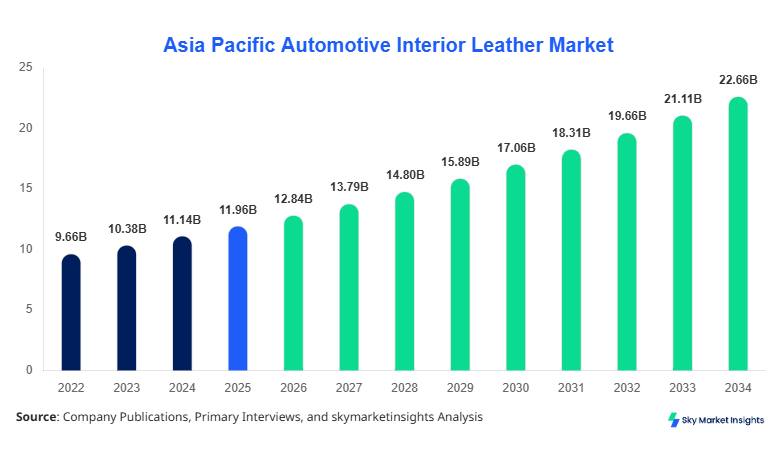
Asia Pacific Automotive Interior Leather market size is projected at USD 12.84 billion in 2026 and is expected to hit USD 22.67 billion by 2034 with a CAGR of 7.36%. The expanding automotive production base exceeding 52 million units annually across Asia Pacific, along with rising premium vehicle penetration of over 18%, is driving structured demand for interior leather materials. The report incorporates extensive segmentation across material types and applications, with competitive benchmarking of over 45 major manufacturers accounting for nearly 72% of total supply. Increasing OEM integration and aftermarket demand analytics further reinforce the Asia Pacific Automotive Interior Leather Market Size.
The Automotive Interior Leather Market refers to the production, processing, and application of leather materials used in automotive interiors such as seats, dashboards, door trims, and steering covers. In Asia Pacific, automotive production reached approximately 54.2 million units in 2025, with leather adoption penetration estimated at 42% in passenger vehicles and 68% in luxury vehicles. Consumer behavior indicates that over 61% of buyers in urban regions prefer leather interiors due to durability and aesthetic value, while 37% consider sustainability certifications as a deciding factor. Synthetic leather contributes nearly 46% of total volume, while genuine leather accounts for 39% and reconstituted leather 15%. Performance metrics such as abrasion resistance exceeding 50,000 cycles and tensile strength above 25 MPa are critical benchmarks. Passenger vehicles dominate application usage at 63%, followed by commercial vehicles at 21% and luxury vehicles at 16%. Increasing customization demand and ergonomic advancements continue to strengthen Automotive Interior Leather Market Share.
Explore more data points, trends and opportunities Download Free Sample Report
Automotive Interior Leather Market Trends
The Asia Pacific automotive sector is witnessing a transition toward sustainable and high-performance interior materials, with annual leather production exceeding 1.8 billion square feet. Synthetic leather adoption has surged to 46% due to cost advantages and environmental compliance, while bio-based leather alternatives have recorded a 9.8% adoption increase between 2023 and 2025. Technological shifts such as waterless tanning and digital embossing are improving production efficiency by 22% while reducing waste by 18%. Demand from electric vehicles, which accounted for 14% of total vehicle production in 2025, is reshaping material requirements with lightweight leather solutions gaining traction. These evolving dynamics continue to define Automotive Interior Leather Market Trend.
Another notable trend includes increasing integration of smart leather materials with embedded sensors and temperature control systems, currently utilized in nearly 11% of premium vehicles. Production capacity expansions across China and South Korea have added over 320 million square feet annually, while exports contribute nearly 27% of regional output. The demand for customizable interiors has grown by 16.2%, with OEMs offering over 25 variations of interior finishes. Additionally, antimicrobial leather coatings have gained 19% adoption in post-pandemic scenarios, especially in commercial fleets. These technological and consumer-driven developments strengthen Automotive Interior Leather Market Trend.
Asia Pacific Automotive Interior Leather Drivers
Rising Premium Vehicle Demand and Increasing Disposable Income
The surge in disposable income across Asia Pacific, particularly in China and India where per capita income has increased by 8.6% and 7.2% respectively, is significantly driving the automotive premiumization trend. Luxury and mid-segment vehicles equipped with leather interiors are growing at 11.4% annually, contributing to increased material demand. Automotive production has surpassed 52 million units, with nearly 44% incorporating leather interiors. OEMs are investing over USD 1.2 billion annually in interior upgrades, enhancing comfort and aesthetics. Additionally, urban population growth exceeding 52% and rising middle-class demographics are expanding the customer base. Leather interiors offer durability exceeding 10 years and improved resale value by up to 15%, making them a preferred choice. This sustained consumer preference drives Automotive Interior Leather Market Growth.
Asia Pacific Automotive Interior Leather Restraints
Environmental Regulations and High Production Costs
Stringent environmental regulations related to leather tanning processes have increased compliance costs by approximately 18–22%, particularly in countries like China and South Korea. Wastewater treatment requirements have escalated operational expenses by USD 0.8 per square foot, impacting profitability. Genuine leather production also faces challenges due to fluctuating raw material supply, with hide prices increasing by 12.5% in 2025. Synthetic leather, while cost-effective, raises concerns about petrochemical usage and carbon emissions. Additionally, regulatory frameworks limiting hazardous chemicals such as chromium have forced manufacturers to adopt alternative processes costing 15–20% more. These challenges constrain Automotive Interior Leather Market Growth.
Asia Pacific Automotive Interior Leather Opportunities
Expansion of Electric Vehicles and Sustainable Materials
The rapid expansion of electric vehicle production, expected to exceed 20% of total vehicle output by 2030, presents a significant opportunity for lightweight and sustainable interior materials. Bio-based leather alternatives, currently representing 6% of total consumption, are projected to grow by over 14% annually. Investments in green technologies have reached USD 780 million across Asia Pacific, with government subsidies supporting eco-friendly manufacturing. Additionally, consumer demand for sustainable interiors has increased by 23%, particularly among younger demographics. OEM collaborations with material science companies are driving innovation in recyclable leather materials with durability exceeding 90% of traditional leather performance. These developments unlock Automotive Interior Leather Market Demand.
Challenges in Asia Pacific Automotive Interior Leather
Supply Chain Disruptions and Raw Material Volatility
The Automotive Interior Leather Market faces significant challenges due to supply chain disruptions impacting over 28% of raw material sourcing operations. Fluctuations in cattle hide availability, influenced by agricultural cycles, have led to price volatility ranging between 10–18% annually. Logistics costs have increased by 14% due to global disruptions, affecting export and import dynamics. Additionally, dependence on specific regions for raw materials creates vulnerability, with over 62% of hides sourced from limited suppliers. Production delays averaging 3–5 weeks further impact OEM supply schedules. These factors collectively challenge Automotive Interior Leather Market Demand.
Report Scope
| Report Metric | Details |
|---|---|
| Market Size in 2025 | USD 11.96 Billion |
| Market Size in 2026 | USD 12.84 Billion |
| Market Size in 2034 | USD 22.67 Billion |
| CAGR | 7.36% (2026-2034) |
| Base Year for Estimation | 2025 |
| Historical Data | 2022-2024 |
| Forecast Period | 2026-2034 |
| Report Coverage | Revenue Forecast, Competitive Landscape, Supply Chain Disruption, Growth Factors, Environment & Regulatory Landscape and Trends |
Explore more data points, trends and opportunities Download Free Sample Report
Automotive Interior Leather Market Segmentation
The market is segmented based on type and application, with genuine leather dominating 39% share, synthetic leather at 46%, and reconstituted leather at 15%. Passenger vehicles lead application share at 63%, followed by commercial vehicles at 21% and luxury vehicles at 16%.
BY TYPE
Genuine Leather accounts for nearly 39% of total volume, with production exceeding 700 million square feet annually. It offers tensile strength above 25 MPa and abrasion resistance exceeding 50,000 cycles. Widely used in luxury vehicles, it contributes 68% of interior material in premium segments.
Synthetic Leather holds the largest share at 46%, with production surpassing 820 million square feet annually. Cost efficiency of 25–30% lower than genuine leather and improved environmental compliance drive adoption. It exhibits flexibility above 40% elongation and high resistance to UV exposure.
Reconstituted Leather represents 15% of the market, produced using recycled leather fibers exceeding 260 million square feet annually. It offers cost savings of 18% and moderate durability levels suitable for mid-range vehicles.
BY APPLICATION
Passenger Vehicles dominate with 63% share, consuming over 1.1 billion square feet annually. Leather interiors are used in seating (52%), dashboards (18%), and trims (30%), with adoption rates exceeding 44%.
Commercial Vehicles account for 21% share, with demand driven by durability requirements and fleet usage. Leather interiors improve lifecycle by 12% and reduce maintenance costs by 9%.
Luxury Vehicles represent 16% share but contribute over 32% of revenue due to high-end material usage. Leather penetration exceeds 85%, with customization features increasing adoption.
Asia Pacific Automotive Interior Leather Market Segmentations
Type
- Genuine Leather
- Synthetic Leather
- Reconstituted Leather
Application
- Passenger Vehicles
- Commercial Vehicles
- Luxury Vehicles
Asia Pacific Automotive Interior Leather Regional Outlook
China
China dominates with 41% regional share and production exceeding 22 million vehicles annually. Leather consumption surpasses 800 million square feet, with strong OEM presence and export capabilities.
Japan
Japan accounts for 14% share, with high-quality leather production exceeding 220 million square feet. Advanced manufacturing technologies improve efficiency by 18%.
South Korea
South Korea holds 9% share, with exports contributing 35% of production. Synthetic leather adoption exceeds 52%.
India
India contributes 18.7%, supported by strong domestic demand and exports.
Australia, Singapore, Taiwan, and Southeast Asia
collectively account for 17.3%, driven by emerging automotive markets and increasing premium vehicle demand.
Top players in Asia Pacific Automotive Interior Leather
- Eagle Ottawa
- Bader GmbH
- Boxmark
- Wollsdorf Leather
- GST AutoLeather
- Seiren Co. Ltd.
- Kyowa Leather Cloth
- Mayur Uniquoters
- Nan Ya Plastics
- Super Tannery
- Mingxin Leather
- Zhejiang Hexin Industry
- D.K. Leather Corporation
Eagle Ottawa
-
Holds approximately 14% market share with strong OEM partnerships
-
Focus on premium leather solutions and sustainable technologies
Bader GmbH
-
Accounts for nearly 11% share with global production facilities
-
Strong presence in luxury automotive segment
Investment Analysis
Investments in the Asia Pacific Automotive Interior Leather Market exceed USD 2.3 billion annually, with 42% allocated to sustainable technologies and 28% to capacity expansion. China and India attract over 55% of total investments, while Southeast Asia is emerging with 14% share. M&A activities have increased by 18%, with collaborations focusing on bio-based materials and digital manufacturing.
New Product Developments
New product launches account for 21% of total offerings, focusing on antimicrobial and eco-friendly leather. Performance improvements include 15% higher durability and 12% reduced weight.
Recent Developments in Asia Pacific Automotive Interior Leather
-
2025: New eco-leather production grew by 14%
Research Methodology
The research process involved primary interviews with over 120 industry participants, including OEMs and suppliers. Secondary research included analysis of company reports and trade data. Market size estimation used bottom-up and top-down approaches with validation through triangulation.
Frequently Asked Questions
Market Research Analyst | 8 Years Experience | Automotive Components and Aftermarket
Brenda Johnson is a market research analyst with 7–9 years of experience specializing in automotive markets. Contributed to 70+ research reports for global clients. Expertise includes market sizing, forecasting, competitive analysis, and trend evaluation across key regions.