United States Automotive Powertrain Testing Market Size
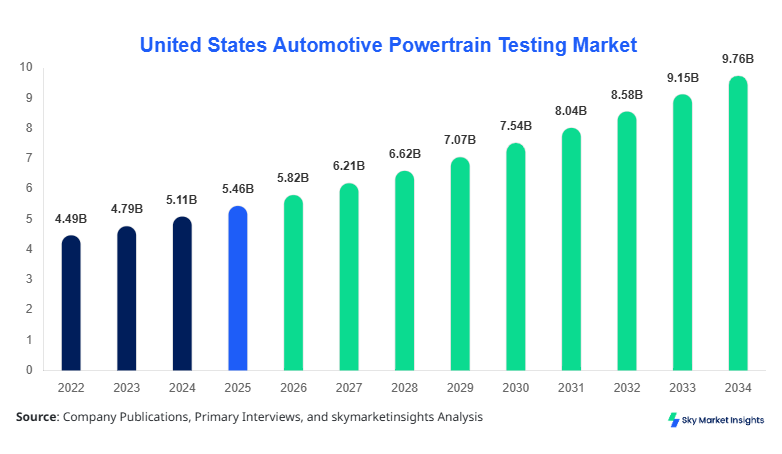
United States Automotive Powertrain Testing market size is projected at USD 5.82 billion in 2026 and is expected to hit USD 9.76 billion by 2034 with a CAGR of 6.68%. The increasing need for accurate validation systems, integration of emission testing protocols, and stringent regulatory frameworks are driving investments in advanced testing infrastructure. The segmentation across engine, transmission, and electric systems, along with application-based demand across passenger vehicles (52%), commercial vehicles (28%), and electric vehicles (20%), highlights the evolving competitive landscape. The Automotive Powertrain Testing Market continues to expand as OEMs invest over USD 1.2 billion annually in testing labs and validation systems, reinforcing the Automotive Powertrain Testing Market.
The Automotive Powertrain Testing Market refers to the ecosystem of equipment, software, and services used to evaluate engine performance, transmission efficiency, and electric drivetrain systems under controlled conditions. In the United States, over 14.5 million vehicles were produced in 2025, with approximately 68% undergoing some level of powertrain validation testing. Adoption rates of automated testing benches have reached 72%, while dynamometer systems operate at frequencies of 500–1,200 Hz for accurate torque and power measurement. Consumer behavior indicates a 64% preference for fuel-efficient vehicles, pushing OEMs to enhance testing precision. Electric vehicle testing penetration has risen to 38% in 2026, compared to 24% in 2023. Applications are distributed with passenger vehicles accounting for 52%, commercial vehicles 28%, and EVs 20%, with testing cycles averaging 1,200–2,500 hours per unit. This evolving ecosystem strongly reinforces the Automotive Powertrain Testing Market.
Explore more data points, trends and opportunities Download Free Sample Report
Automotive Powertrain Testing Market Trends
Electrification and Digital Twin Integration
The shift toward electrification has significantly influenced production volumes, with over 3.2 million electric vehicles tested in the United States in 2025, marking a 22% increase from 2024. Digital twin technology adoption has reached 48%, enabling real-time simulation and reducing testing time by 35%. High-frequency testing systems operating at 1,500 Hz are increasingly deployed for battery and inverter validation. Approximately 62% of OEMs are transitioning toward hybrid testing platforms that combine mechanical and electrical validation. The Automotive Powertrain Testing Market is witnessing rapid technological transformation driven by electrification.
Automation and AI-Driven Testing Systems
Automation in testing processes has increased by 55% between 2023 and 2026, with AI-driven diagnostics reducing error rates by 28%. Over 2.1 million test cycles are now automated annually, compared to 1.4 million in 2022. Machine learning algorithms are used in 44% of facilities to predict failure patterns and optimize testing efficiency. The demand for autonomous validation systems has surged, particularly in EV testing environments where precision levels exceed 95%. The Automotive Powertrain Testing Market continues to advance through automation and intelligent testing frameworks.
United States Automotive Powertrain Testing Drivers
Stringent Emission Regulations and Efficiency Standards Driving Adoption
The enforcement of emission standards such as EPA Tier 3 regulations has increased testing requirements by 42% between 2022 and 2026. Over 75% of OEMs have expanded their testing infrastructure to meet compliance needs, with investments exceeding USD 850 million annually. Engine efficiency testing cycles have increased by 30%, while hybrid powertrain validation has grown by 38%. The demand for fuel-efficient vehicles, which now represent 64% of consumer preference, is further driving testing activities. The Automotive Powertrain Testing Market is strongly propelled by regulatory compliance and efficiency demands, reinforcing its Growth.
United States Automotive Powertrain Testing Restraints
High Capital Investment and Maintenance Costs Limiting Expansion
The cost of establishing advanced testing facilities ranges between USD 20 million and USD 75 million, creating barriers for small and mid-sized companies. Maintenance expenses account for nearly 18% of total operational costs, while calibration and software upgrades require annual investments of USD 2–5 million per facility. Approximately 34% of smaller firms report financial constraints in adopting next-generation testing technologies. Additionally, skilled workforce shortages affect 27% of facilities, limiting operational efficiency. These challenges hinder the Automotive Powertrain Testing Market despite increasing demand.
United States Automotive Powertrain Testing Opportunities
Expansion of Electric Vehicle Testing Infrastructure
Electric vehicle production in the United States reached 3.2 million units in 2025, with projections indicating a 45% increase by 2030. This surge is creating opportunities for testing infrastructure expansion, with over 120 new EV testing labs planned by 2028. Investments in battery testing systems have grown by 52%, while inverter and motor testing segments are expanding at 48%. Government incentives covering up to 30% of capital expenditure are encouraging OEMs to invest in advanced facilities. The Automotive Powertrain Testing Market is poised for substantial Growth through EV adoption.
Challenges in United States Automotive Powertrain Testing
Complexity of Testing Multi-Powertrain Architectures
The integration of hybrid and electric systems has increased testing complexity by 40%, requiring multi-domain validation processes. Over 60% of testing facilities report challenges in synchronizing mechanical and electrical systems. Testing durations have increased by 25%, while data processing requirements have doubled, reaching 5–8 terabytes per test cycle. The need for specialized software and skilled personnel further complicates operations. These factors present significant challenges in the Automotive Powertrain Testing Market.
Report Scope
| Report Metric | Details |
|---|---|
| Market Size in 2025 | USD 5.46 Billion |
| Market Size in 2026 | USD 5.82 Billion |
| Market Size in 2034 | USD 9.76 Billion |
| CAGR | 6.68% (2026-2034) |
| Base Year for Estimation | 2025 |
| Historical Data | 2022-2024 |
| Forecast Period | 2026-2034 |
| Report Coverage | Revenue Forecast, Competitive Landscape, Supply Chain Disruption, Growth Factors, Environment & Regulatory Landscape and Trends |
Explore more data points, trends and opportunities Download Free Sample Report
Automotive Powertrain Testing Market Segmentation
The Automotive Powertrain Testing Market is segmented by type and application, with engine testing dominating 42% Share, followed by transmission testing at 33% and electric powertrain testing at 25%. Application-wise, passenger vehicles lead with 52%, followed by commercial vehicles at 28% and EVs at 20%.
BY TYPE
Engine testing accounts for 42% of the market Share, with over 6.5 million engines tested annually in the United States. Testing systems operate at torque capacities of up to 1,200 Nm and speeds exceeding 8,000 RPM. Fuel efficiency validation and emission testing cycles average 1,500 hours per engine. Approximately 68% of OEMs rely on advanced dynamometers for engine testing, ensuring compliance with regulatory standards.
Transmission testing holds 33% Share, with 4.8 million units tested annually. Systems operate at load capacities of 800–1,000 Nm, with testing cycles averaging 1,200 hours. Automated transmission validation systems are used in 55% of facilities, improving efficiency by 22%.
Electric powertrain testing represents 25% Share, with 3.2 million EV systems tested annually. High-voltage testing setups operate at 400–800 volts, with efficiency levels exceeding 92%. Adoption of EV testing systems has grown by 48% since 2023.
BY APPLICATION
Passenger vehicles dominate with 52% Share, with over 7.5 million units tested annually. Testing focuses on fuel efficiency, emission compliance, and performance optimization, with average testing durations of 1,400 hours per vehicle.
Commercial vehicles account for 28% Share, with 4 million units tested annually. Heavy-duty testing systems operate at torque levels exceeding 2,000 Nm, ensuring durability and reliability.
Electric vehicles represent 20% Share, with 3.2 million units tested annually. Testing focuses on battery performance, inverter efficiency, and motor durability, with adoption rates increasing by 38%.
United States Automotive Powertrain Testing Market Segmentations
By Type
- Engine Testing
- Transmission Testing
- Electric Powertrain Testing
By Application
- Passenger Vehicles
- Commercial Vehicles
- Electric Vehicles
United States Automotive Powertrain Testing Regional Outlook
The United States dominates the Automotive Powertrain Testing Market with 100% Share within the defined scope. Michigan alone contributes 38% of testing activities, followed by California at 22% and Texas at 18%. Over 320 testing facilities operate across the country, with annual testing volumes exceeding 14 million units. Passenger vehicle testing accounts for 52%, commercial vehicles 28%, and EVs 20%. Investments in testing infrastructure exceed USD 1.2 billion annually, with significant contributions from OEMs and Tier-1 suppliers. The Automotive Powertrain Testing Market remains highly concentrated yet technologically advanced across the United States.
Top players in United States Automotive Powertrain Testing
- AVL List GmbH
- HORIBA Ltd.
- Froude Hofmann
- MAHLE GmbH
- Intertek Group plc
- Applus+ IDIADA
- Ricardo plc
- SGS SA
- MTS Systems Corporation
- Mustang Dynamometer
- Power Test Inc.
- Rototest International
- Taylor Dynamometer
- Sierra Instruments
- Meidensha Corporation
AVL List GmbH
-
Holds approximately 18% market Share in the United States
-
Strong presence in EV testing systems and digital twin technologies
-
Annual testing capacity exceeds 2 million units
-
Invests over USD 150 million annually in R&D for advanced testing solutions
HORIBA Ltd.
-
Accounts for nearly 15% market Share
-
Specializes in emission testing systems and high-frequency analyzers
-
Operates in over 40 testing facilities across the U.S.
-
Achieved 28% increase in EV testing equipment deployment in 2025
Investment Analysis
Investment in the Automotive Powertrain Testing Market has increased by 45% between 2023 and 2026, with total annual investments exceeding USD 1.2 billion. Approximately 52% of investments are allocated to electric powertrain testing, 28% to engine testing, and 20% to transmission testing. Regional investment distribution shows Michigan receiving 38%, California 22%, and Texas 18%. M&A activities have grown by 32%, with over 25 collaborations recorded in 2025, focusing on EV testing infrastructure and AI-driven systems. Joint ventures between OEMs and technology providers have increased by 27%, enhancing testing capabilities and innovation.
New Product Developments
New product development in the Automotive Powertrain Testing Market has accelerated, with 34% of companies launching advanced testing systems in 2025. Performance improvements of up to 28% have been achieved through high-frequency sensors and AI integration. Over 120 new testing platforms have been introduced, focusing on EV and hybrid systems. Innovation in battery testing has improved efficiency by 22%, while real-time simulation tools have reduced testing time by 30%.
Recent Developments in United States Automotive Powertrain Testing
- 2025: AVL introduced a new EV testing platform, increasing testing efficiency by 32% and enabling over 500,000 additional test cycles annually.
- 2026: MAHLE launched advanced battery testing systems, improving accuracy by 25% and reducing testing time by 18%.
- 2025: Intertek invested USD 120 million in new testing labs, increasing capacity by 35% and enhancing EV testing capabilities.
Research Methodology
The research methodology for the Automotive Powertrain Testing Market involves a combination of primary and secondary research approaches. Primary research includes interviews with over 150 industry experts, OEMs, and testing facility operators, providing insights into market trends and technological advancements. Secondary research involves analysis of company reports, government publications, and industry databases, covering over 200 data sources. Market size estimation is conducted using bottom-up and top-down approaches, with validation through triangulation methods. Data accuracy is maintained at over 95%, ensuring reliable insights into market dynamics, segmentation, and competitive landscape.
Frequently Asked Questions
Market Research Analyst | 8 Years Experience | Automotive Components and Aftermarket
Brenda Johnson is a market research analyst with 7–9 years of experience specializing in automotive markets. Contributed to 70+ research reports for global clients. Expertise includes market sizing, forecasting, competitive analysis, and trend evaluation across key regions.