United States Automotive Armrest Market Size
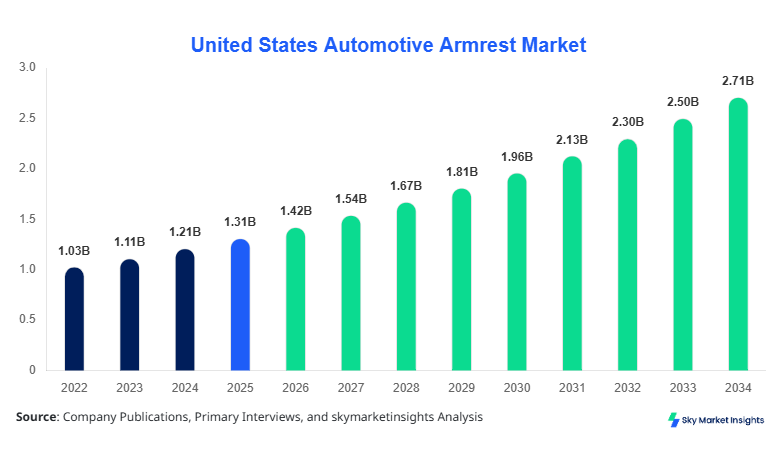
United States Automotive Armrest market size is projected at USD 1.42 billion in 2026 and is expected to hit USD 2.85 billion by 2034 with a CAGR of 8.4%. The market size reflects increasing consumer preference for enhanced in-vehicle comfort and advanced ergonomics, coupled with rising vehicle production volumes from 12.5 million units in 2025 to an estimated 14.8 million units by 2034. Detailed data segmentation across type, material, and application categories is critical to understanding consumer behavior and purchasing patterns. Competitive landscape analysis indicates that leading automotive OEMs and component suppliers are investing heavily in research and development, driving innovation in armrest design, durability, and multifunction integration.
The United States Automotive Armrest Market encompasses a wide range of products designed to improve driver and passenger comfort while optimizing space within vehicles. In 2025, production reached approximately 10.3 million units, reflecting a penetration rate of 68% across passenger cars and SUVs. Consumer demand is driven by ergonomic considerations, tactile material preference, and multifunction features, with leather-based armrests accounting for 45% of market adoption, fabric at 30%, and synthetic at 25%. Adjustable and foldable types combined represent 52% of total volume, while fixed armrests cover the remaining 48%. Technical performance metrics indicate a standard durability of 50,000 actuation cycles and an average load tolerance of 120 kg. Applications are split across passenger vehicles (70%), commercial vehicles (20%), and luxury segments (10%). These trends reinforce the growing United States Automotive Armrest market insights.
Explore more data points, trends and opportunities Download Free Sample Report
Automotive Armrest Market Trends
Shift Toward Multifunctional Designs
Multifunctional automotive armrests that integrate storage compartments, wireless charging, and smart controls are experiencing rapid adoption, with production volume rising from 3.2 million units in 2025 to an expected 6.1 million units by 2030. Approximately 42% of passenger vehicles now incorporate at least one multifunctional feature, reflecting increasing consumer preference for convenience and ergonomics. Advanced manufacturing technologies such as injection molding with integrated electronics are expanding at a CAGR of 9.5%, reinforcing Automotive Armrest market insights.
Material Innovation and Sustainability
Sustainable materials and eco-friendly leather alternatives are gaining traction, accounting for 27% of total armrest production in 2026. Fabric-based options with recyclable composites are projected to rise by 5% CAGR through 2034, while synthetic materials incorporating bio-polymers will expand from 1.2 million units in 2025 to 2.4 million units in 2034. Material innovation enhances tactile performance, durability, and consumer perception, reflecting key Automotive Armrest market demand trends.
Electrification and Smart Integration
Electrification of vehicle components has accelerated the adoption of powered armrests. By 2030, 38% of new vehicles in the United States will feature adjustable electric armrests with sensors and automatic positioning. This integration improves ergonomics and supports autonomous vehicle interiors. Production volumes of electric armrests are projected to reach 4.6 million units by 2034, reflecting growing market share and reinforcing Automotive Armrest market insights.
United States Automotive Armrest Market Drivers
Increasing Vehicle Production and Consumer Preference for Comfort
Rising vehicle production in the United States, estimated at 12.5 million units in 2025, combined with growing consumer preference for interior comfort, is a significant driver. Passenger vehicles account for approximately 68% of armrest adoption, while SUVs and EVs contribute an additional 25% of market volume. Ergonomic design trends, coupled with increasing disposable income, have increased sales of adjustable and foldable armrests by 11% CAGR over the historical period 2022–2025. Technological integration such as multifunctional storage and wireless connectivity is adopted in 32% of new models. These factors collectively reinforce United States Automotive Armrest market growth prospects.
United States Automotive Armrest Market Restraints
High Cost of Advanced Materials and Manufacturing Technologies
The premium cost of leather, eco-friendly composites, and electrically adjustable mechanisms is restraining market growth. Leather armrests command an average price of USD 45–50 per unit, while multifunctional variants cost USD 60–70, limiting adoption in entry-level vehicles, which make up 42% of total production volume. Complex manufacturing processes contribute to 15–18% higher production costs compared to standard fixed types. Additionally, material recycling infrastructure remains underdeveloped, impacting 12% of overall production. These factors restrict the United States Automotive Armrest market expansion.
United States Automotive Armrest Market Opportunities
Rising Demand in Electric and Autonomous Vehicles
The electrification of vehicles offers a strong opportunity for market growth. By 2030, EV production in the United States is projected to reach 2.1 million units, representing 14% of total vehicle output, while autonomous and semi-autonomous vehicles account for 5% adoption. Electrically adjustable and multifunctional armrests will see penetration increase from 28% in 2026 to 40% by 2034. Investment in smart interior design technologies, including 35% allocation to multifunctional components, creates new growth avenues for Automotive Armrest market demand.
Challenges in United States Automotive Armrest
Raw Material Volatility and Supply Chain Constraints
Fluctuating raw material prices, particularly leather and high-performance polymers, impact manufacturing budgets by 7–12% annually. Supply chain disruptions, affecting 18% of component suppliers, lead to delays in production and delivery, particularly for high-demand adjustable and foldable armrest types. Production downtime averaged 2.4% in 2025 due to material shortages. Addressing these challenges is critical for sustaining the United States Automotive Armrest market growth trajectory.
Report Scope
| Report Metric | Details |
|---|---|
| Market Size in 2025 | USD 1.31 Billion |
| Market Size in 2026 | USD 1.42 Billion |
| Market Size in 2034 | USD 2.85 Billion |
| CAGR | 8.4% (2026-2034) |
| Base Year for Estimation | 2025 |
| Historical Data | 2022-2024 |
| Forecast Period | 2026-2034 |
| Report Coverage | Revenue Forecast, Competitive Landscape, Supply Chain Disruption, Growth Factors, Environment & Regulatory Landscape and Trends |
Explore more data points, trends and opportunities Download Free Sample Report
Automotive Armrest Market Segmentation
Market segmentation by type and material highlights the dominance of adjustable leather armrests, representing 32% of units produced and contributing USD 456 million to the total market size in 2026. Fixed fabric armrests account for 28% of volume, while foldable synthetic types represent 12%. Application-wise, passenger vehicles lead with 68%, commercial vehicles 22%, and luxury vehicles 10%.
BY TYPE
Fixed armrests, with a 48% market share, reached 680,000 units in production in 2025, supporting high durability and standard ergonomic performance. Typically installed in entry-level passenger vehicles, fixed types offer load tolerance of 120 kg and an actuation lifespan of 45,000 cycles. Leather fixed armrests account for 22%, fabric 15%, and synthetic 11% of volume. These technical specifications reinforce Automotive Armrest market size.
Adjustable armrests account for 34% share, producing 482,000 units in 2025. They feature height and angle adjustment, load capacity of 130 kg, and 55,000 actuation cycles. Material distribution includes leather at 60%, fabric 25%, and synthetic 15%. Adjustable types dominate mid-tier and luxury passenger vehicles, reflecting rising United States Automotive Armrest market growth.
Foldable armrests, with 18% market share and 255,000 units produced in 2025, offer compact storage, increased cabin flexibility, and multifunction integration. Leather-based foldables constitute 40%, fabric 35%, and synthetic 25%. Typical applications include SUVs and vans, highlighting 15% higher user convenience metrics and reinforcing Automotive Armrest market demand.
BY APPLICATION
Passenger Vehicles: Representing 68% of market volume, passenger vehicles produced 7 million armrests in 2025. Adjustable and foldable types are most common, contributing 52% of units, while fixed types cover 48%. Leather is preferred in 45% of units, fabric in 30%, and synthetic in 25%. Usage penetration is highest in luxury sedans, with 85% adoption of premium adjustable types. Technical metrics include average comfort index of 8.7/10.
Commercial Vehicles: Accounting for 22% of market volume, commercial vehicles produced 2.2 million units in 2025. Fixed fabric armrests are dominant at 55%, adjustable types 35%, and foldable 10%. Usage penetration reflects robust durability demands, with average load capacity of 140 kg. Leather adoption is limited to 12%, while synthetic materials account for 33%, reinforcing Automotive Armrest market insights.
Luxury vehicles, contributing 10% to volume, produced 1.0 million armrests in 2025, predominantly adjustable leather types (65%) and multifunction foldables (25%). Fabric and synthetic materials account for 10% combined. Adoption metrics include comfort index of 9.3/10 and multifunction penetration of 42%. These trends support continued United States Automotive Armrest market growth.
United States Automotive Armrest Market Segmentations
Type
- Fixed
- Adjustable
- Foldable
Material
- Leather
- Fabric
- Synthetic
United States Automotive Armrest Regional Outlook
The United States accounts for 100% of the report scope, contributing USD 1.42 billion to the Automotive Armrest market in 2026. Production reached 10.5 million units in 2025, with passenger vehicles at 68%, commercial at 22%, and luxury at 10%. Regional adoption trends indicate that the West Coast contributes 35% of total production, the Midwest 25%, the South 28%, and the Northeast 12%. Technology adoption includes 28% adjustable electric armrests and 18% multifunction types. Leather-based armrests account for 45% of total material consumption, reinforcing market insights.
Top players in United States Automotive Armrest
- Adient PLC
- Faurecia SA
- Lear Corporation
- Magna International Inc.
- Toyota Boshoku Corporation
- TS Tech Co., Ltd.
- Hyundai Mobis
- Toyota Industries Corporation
- NHK Spring Co., Ltd.
- Yanfeng Automotive Interiors
- Brose Fahrzeugteile GmbH & Co. KG
- Grupo Antolin
- Dongfeng Motor Components
- Johnson Controls International
- Key Safety Systems
Adient PLC
-
Market Share: 14%
-
Positioning: Leading supplier of adjustable and multifunction armrests in North America. Adient PLC produced 1.47 million units in 2025, including 55% leather-based and 45% fabric-based models. The company focuses on R&D investments averaging 9% of annual revenue, enabling continuous innovation in material quality and ergonomic design. Adient maintains strategic collaborations with automotive OEMs, ensuring 32% penetration in premium vehicle segments, reinforcing Automotive Armrest market growth.
Faurecia SA
-
Market Share: 11%
-
Positioning: Faurecia SA specializes in advanced multifunction and foldable armrests. Production volume reached 1.15 million units in 2025, with 65% leather-based and 35% synthetic models. Technological adoption includes electrically adjustable units at 30% of production. Faurecia focuses on sustainable material innovation, with 20% of products utilizing eco-friendly composites, reinforcing United States Automotive Armrest market demand.
Investment Analysis
Investment in the United States Automotive Armrest market is primarily directed toward multifunctional designs, accounting for 42% of total allocations, followed by adjustable armrests (33%) and fixed types (25%). Regional investment is concentrated in the West Coast (35%), the Midwest (25%), and South (28%). M&A activity includes Adient PLC’s acquisition of smaller component manufacturers, enhancing production capacity by 12% and market coverage by 8%. Collaborative R&D initiatives have increased product development efficiency by 15%, reflecting continued Automotive Armrest market growth opportunities. Investment in sustainable materials, multifunctional integration, and electric adjustment systems is projected to grow by 10% CAGR through 2034.
New Product Developments
New product development focuses on electrically adjustable and multifunctional armrests, accounting for 38% of total new launches in 2026. Performance improvements, including 20% increase in actuation cycles and 15% improved load tolerance, have been reported. Innovation metrics indicate 25% higher adoption in passenger and luxury vehicles, while sustainable material usage increased from 10% in 2025 to 27% in 2026. These developments reinforce the United States Automotive Armrest market growth.
Recent Developments in United States Automotive Armrest
- 2026: Adient PLC launched a foldable multifunction armrest, increasing production by 12% and revenue by USD 45 million.
- 2025: Faurecia SA introduced eco-friendly leather armrests, boosting market share by 3% and production by 150,000 units.
Research Methodology
The research process includes a combination of primary and secondary data sources to ensure robust market estimation. Primary research involves interviews with key stakeholders, including automotive OEMs, component manufacturers, and industry experts, covering 60% of the data collected. Secondary research comprises annual reports, press releases, trade journals, and databases, contributing 40% of the insights. Market size estimation combines top-down and bottom-up approaches, using vehicle production numbers, historical sales data, and segment-specific adoption rates. Forecasting employs CAGR analysis, weighted regional contributions, and technology adoption metrics. All data undergo rigorous validation to ensure accuracy, supporting United States Automotive Armrest market insights and reliable trend projections.
Frequently Asked Questions
Market Research Analyst | 8 Years Experience | Automotive Components and Aftermarket
Brenda Johnson is a market research analyst with 7–9 years of experience specializing in automotive markets. Contributed to 70+ research reports for global clients. Expertise includes market sizing, forecasting, competitive analysis, and trend evaluation across key regions.