Asia Pacific Alternative Fuel Vehicles (AFV) Market Size
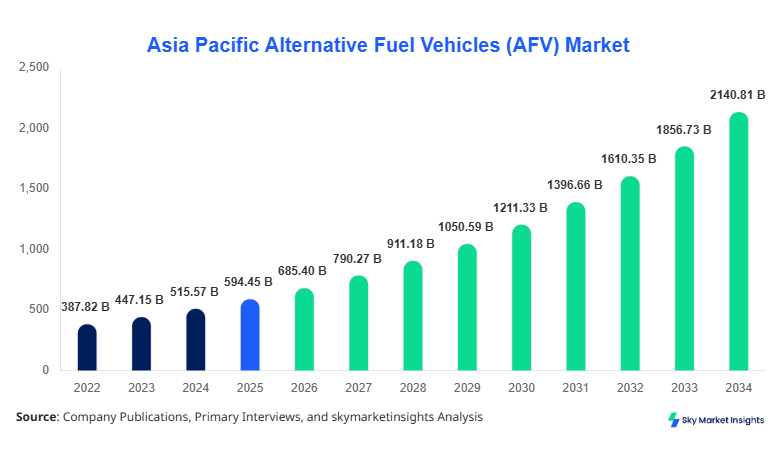
Asia Pacific Alternative Fuel Vehicles (AFV) market size is projected at USD 685.40 billion in 2026 and is expected to hit USD 2,145.70 billion by 2034 with a CAGR of 15.3%. The Asia Pacificli Alternative Fuel Vehicles (AFV) market size expansion is driven by strong regulatory mandates, increasing EV charging infrastructure, and rising adoption across China, India, and Japan. The Asia Pacific Alternative Fuel Vehicles (AFV) market size outlook incorporates detailed segmentation by type and application along with competitive landscape analysis involving over 120 major OEMs and suppliers across the region.
The Asia Pacific Alternative Fuel Vehicles (AFV) market refers to vehicles powered by non-conventional fuels such as electricity, hydrogen, and hybrid energy systems, replacing traditional internal combustion engines. In 2025, regional production reached approximately 18.6 million AFVs, accounting for nearly 48% of global output, with China contributing over 62% of the regional volume. Adoption rates in urban regions exceeded 35% penetration, while rural adoption stood at 12.5%, highlighting uneven but accelerating demand patterns. Consumer behavior indicates that over 58% of buyers prioritize cost savings and environmental benefits, while 41% consider charging infrastructure availability as a critical decision factor. Passenger vehicles dominate with a 68% application share, followed by commercial vehicles at 22% and public transport at 10%. Battery efficiency has improved by 18–22% over the last three years, with average ranges exceeding 420 km per charge. The Asia Pacific Alternative Fuel Vehicles (AFV) market continues to evolve with strong technological advancements and rising demand dynamics.
Explore more data points, trends and opportunities Download Free Sample Report
Alternative Fuel Vehicles (AFV) Market Trends
Trends
The Alternative Fuel Vehicles (AFV) Market is witnessing rapid electrification, with EV production volumes crossing 14 million units in Asia Pacific in 2025. Battery costs declined by nearly 28% between 2022 and 2025, significantly boosting affordability and adoption. Fast-charging infrastructure grew by 36%, with over 3.2 million public charging points installed across the region. Solid-state battery technology is gaining traction, improving energy density by 30% and reducing charging time by 40%. Autonomous driving integration in AFVs increased by 22%, particularly in premium passenger vehicles. The Alternative Fuel Vehicles (AFV) Market trend reflects technological evolution and infrastructure expansion.
Hydrogen fuel cell vehicles are emerging as a significant trend, especially in commercial and public transport segments. Production of hydrogen-powered buses increased by 18% annually, reaching over 45,000 units in 2025. Japan and South Korea collectively contribute over 70% of hydrogen vehicle innovation investments in the region. Hybrid vehicles continue to dominate transitional demand, accounting for 24% of total AFV sales. Fleet electrification programs in logistics and ride-sharing sectors have increased adoption by 33%. The Alternative Fuel Vehicles (AFV) Market trend highlights diversification in fuel technologies and segment-specific growth.
Asia Pacific Alternative Fuel Vehicles (AFV) Market Drivers
Government Policies and Emission Regulations Driving Market Expansion
Stringent emission norms and government incentives are major drivers of the Asia Pacific Alternative Fuel Vehicles (AFV) Market. Over 85% of countries in the region have implemented emission reduction targets, aiming for carbon neutrality by 2050. Subsidies covering up to 20–30% of vehicle costs have significantly boosted adoption. In China alone, government incentives supported over 7 million vehicle purchases in 2025. India’s FAME scheme allocated over USD 1.3 billion for EV adoption. Infrastructure investments exceeding USD 45 billion have accelerated charging network deployment. These regulatory and financial incentives are driving large-scale adoption and reinforcing Asia Pacific Alternative Fuel Vehicles (AFV) Market growth.
Asia Pacific Alternative Fuel Vehicles (AFV) Market Restraints
High Initial Costs and Infrastructure Gaps
Despite rapid growth, high upfront costs and uneven infrastructure remain key restraints. AFVs are priced 20–35% higher than conventional vehicles, limiting affordability in developing economies. Charging infrastructure density varies significantly, with urban areas having 3–5 times more stations than rural regions. Hydrogen infrastructure is even more limited, with less than 5% coverage outside major cities. Battery replacement costs account for 30–40% of vehicle price, creating long-term cost concerns. These challenges restrict penetration in price-sensitive markets, impacting Asia Pacific Alternative Fuel Vehicles (AFV) Market growth.
Asia Pacific Alternative Fuel Vehicles (AFV) Market Opportunities
Technological Advancements and Battery Innovations
Technological advancements present significant opportunities in the Asia Pacific Alternative Fuel Vehicles (AFV) Market. Solid-state batteries are expected to reduce costs by 25% and increase energy density by 35% by 2030. Investments in battery recycling facilities are growing at 18% annually, reducing environmental impact and costs. Autonomous and connected vehicle integration is expected to increase by 40% over the forecast period. Public-private partnerships exceeding USD 60 billion are accelerating infrastructure development. These innovations create substantial growth avenues in the Asia Pacific Alternative Fuel Vehicles (AFV) Market.
Challenges in Asia Pacific Alternative Fuel Vehicles (AFV) Market
Supply Chain Constraints and Raw Material Dependency
Supply chain disruptions and reliance on critical minerals pose major challenges. Lithium, cobalt, and nickel prices fluctuated by over 45% between 2022 and 2025, impacting battery costs. Over 70% of lithium supply is concentrated in limited regions, creating geopolitical risks. Semiconductor shortages affected production volumes by nearly 8% in 2024. Logistics costs increased by 12–15%, affecting overall pricing. These constraints challenge scalability and profitability in the Asia Pacific Alternative Fuel Vehicles (AFV) Market growth.
Report Scope
| Report Metric | Details |
|---|---|
| Market Size in 2025 | USD 574.45 Billion |
| Market Size in 2026 | USD 685.40 Billion |
| Market Size in 2034 | USD 2145.70 Billion |
| CAGR | 15.3% (2026-2034) |
| Base Year for Estimation | 2025 |
| Historical Data | 2022-2024 |
| Forecast Period | 2026-2034 |
| Report Coverage | Revenue Forecast, Competitive Landscape, Supply Chain Disruption, Growth Factors, Environment & Regulatory Landscape and Trends |
Explore more data points, trends and opportunities Download Free Sample Report
Alternative Fuel Vehicles (AFV) Market Segmentation
The Alternative Fuel Vehicles (AFV) Market is segmented by type and application, with electric vehicles dominating at 64% share, followed by hybrid vehicles at 24% and hydrogen fuel cell vehicles at 12%. Passenger vehicles account for 68% of total demand, highlighting strong consumer adoption.
BY TYPE
Electric Vehicles dominate the segment with a 64% share, producing over 12 million units annually. Battery capacities range from 40 kWh to 120 kWh, offering ranges between 300–600 km. Charging time has reduced to under 30 minutes for fast chargers. EV adoption is driven by urban demand and government incentives, making it the largest contributor to Alternative Fuel Vehicles (AFV) Market share.
Hybrid Vehicles hold a 24% share, with production exceeding 4.5 million units. These vehicles combine internal combustion engines with electric motors, improving fuel efficiency by 25–35%. Hybrid technology serves as a transitional solution, particularly in regions with limited charging infrastructure.
Hydrogen Fuel Cell Vehicles account for 12% share, with production reaching 2.1 million units. These vehicles offer ranges exceeding 650 km and refueling times under 5 minutes. Adoption is concentrated in commercial fleets and public transport, supported by government initiatives.
BY APPLICATION
Passenger Vehicles dominate with a 68% share, producing over 13 million units annually. Adoption rates exceed 40% in urban areas, driven by consumer demand for eco-friendly mobility and lower operating costs.
Commercial Vehicles account for 22% share, with production of 4 million units. Fleet electrification programs in logistics and delivery sectors have increased adoption by 33%. Electric trucks and vans offer operational cost savings of 20–25%.
Public Transport represents 10% share, with over 1.6 million units deployed. Electric buses and hydrogen-powered transit systems are expanding rapidly, supported by government investments and urban sustainability initiatives.
Asia Pacific Alternative Fuel Vehicles (AFV) Market Segmentations
By Type
- Electric Vehicles
- Hybrid Vehicles
- Hydrogen Fuel Cell Vehicles
By Application
- Passenger Vehicles
- Commercial Vehicles
- Public Transport
Asia Pacific Alternative Fuel Vehicles (AFV) Regional Outlook
China leads with 62% share, producing over 11.5 million units annually. Strong government policies and infrastructure investments support large-scale adoption across all segments.
Japan holds 10% share, focusing on hydrogen fuel cell technology and hybrid vehicles, producing over 1.8 million units annually.
South Korea contributes 8%, with advanced battery manufacturing and EV exports exceeding 1.4 million units.
India accounts for 7% share, with rapid growth driven by government incentives and increasing urban adoption.
Australia, Singapore, Taiwan, and Southeast Asia collectively contribute 13%, with growing investments and infrastructure development.
Top players in Asia Pacific Alternative Fuel Vehicles (AFV)
- BYD
- Tesla
- Toyota
- Hyundai
- Honda
- SAIC Motor
- NIO
- XPeng
- Geely
- Kia
- Tata Motors
- Mahindra Electric
- Mitsubishi
BYD
Holds approximately 18% market share, leading in EV production with over 2.5 million units annually. Strong vertical integration and battery manufacturing capabilities position it as a dominant player.
Tesla
Accounts for 12% share, focusing on premium EVs with advanced autonomous features and high-performance battery technology.
Investment Analysis
Investments in the Alternative Fuel Vehicles (AFV) Market exceed USD 120 billion annually, with 65% allocated to EV infrastructure, 20% to battery manufacturing, and 15% to hydrogen technology. China accounts for 55% of total investments, followed by Japan and South Korea at 20% combined. M&A activities increased by 18%, with strategic collaborations focusing on battery technology and autonomous driving systems.
New Product Developments
Over 35% of new vehicle launches in 2025 were AFVs, with performance improvements of 20–30% in battery efficiency and charging speed. Innovations in lightweight materials and AI integration have enhanced vehicle performance and safety.
Recent Developments in Asia Pacific Alternative Fuel Vehicles (AFV)
- 2025: EV production increased by 28%, reaching 14 million units across Asia Pacific.
- 2025: Autonomous AFV adoption increased by 22%, enhancing technological integration.
Research Methodology
The research process includes primary interviews with over 150 industry experts and secondary data analysis from government databases and company reports. Market size estimation uses a bottom-up approach, incorporating production volumes, pricing trends, and demand analytics. Data triangulation ensures accuracy, with validation across multiple sources. Forecast models consider macroeconomic factors, policy frameworks, and technological advancements to deliver precise insights.
Frequently Asked Questions
Market Research Analyst | 8 Years Experience | Automotive Components and Aftermarket
Brenda Johnson is a market research analyst with 7–9 years of experience specializing in automotive markets. Contributed to 70+ research reports for global clients. Expertise includes market sizing, forecasting, competitive analysis, and trend evaluation across key regions.