Europe Alternative Fuel Vehicles (AFV) Market Size
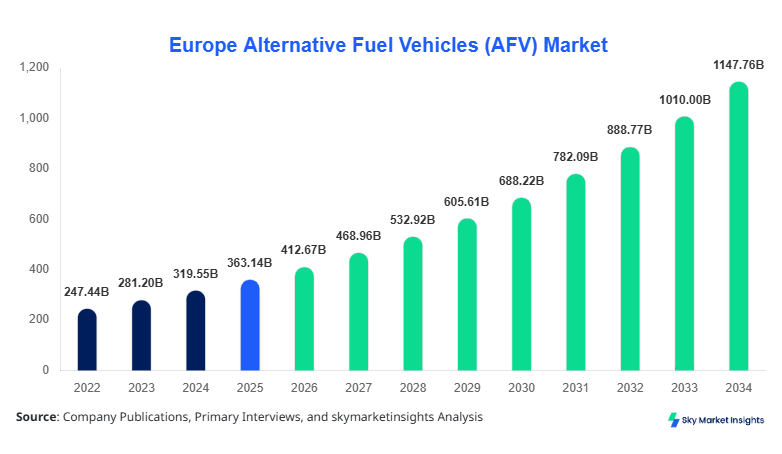
Europe Alternative Fuel Vehicles (AFV) market size is projected at USD 412.67 billion in 2026 and is expected to hit USD 1,146.82 billion by 2034 with a CAGR of 13.64%.
The Europe Alternative Fuel Vehicles (AFV) market is witnessing strong expansion due to rising electrification policies, decarbonization mandates, and large-scale investment in charging infrastructure across the automotive sector. The report evaluates fuel type segmentation, vehicle deployment patterns, regional manufacturing output, import-export analytics, and competitive positioning among leading manufacturers. Increasing government subsidies, battery localization strategies, and expansion of hydrogen mobility ecosystems are accelerating industry transformation across Europe.
The Alternative Fuel Vehicles (AFV) industry refers to automobiles powered through non-conventional energy systems including electricity, hydrogen fuel cells, compressed natural gas, and hybrid propulsion technologies. Europe produced more than 5.8 million AFVs in 2025, accounting for nearly 38% of total automotive production across the region. Battery electric vehicles represented approximately 56% of AFV registrations, while hybrid electric vehicles contributed 34% and hydrogen fuel cell vehicles accounted for nearly 4.8% of total deployments. Passenger vehicles dominated the application split with 71% contribution, followed by commercial vehicles at 21% and public transport fleets at 8%.
Adoption and penetration rates have accelerated significantly because of stringent emission targets under the European Green Deal and Euro 7 standards. More than 1.2 million public charging stations were operational across Europe in 2025, reflecting a 29% increase compared with 2024. Norway, Germany, and the Netherlands recorded EV penetration exceeding 31% of new vehicle registrations, while France and the United Kingdom crossed 24%. Consumer preference is shifting toward long-range battery electric platforms with average battery capacities increasing from 52 kWh in 2022 to 71 kWh in 2025. Hydrogen refueling infrastructure also expanded by 18%, supporting over 280 active hydrogen stations throughout Europe.
Consumer behavior trends indicate increasing preference for low-emission urban mobility, connected vehicle platforms, and energy-efficient transport systems. Fleet operators accounted for 44% of total AFV purchases in 2025, while private ownership contributed 56%. Range anxiety reduction, charging time improvements, and declining lithium-ion battery costs by nearly 17% since 2022 are strengthening adoption patterns. Urban mobility services, ride-sharing platforms, and logistics companies are increasingly integrating electric fleets, particularly in Germany, France, and the United Kingdom, reinforcing long-term Europe Alternative Fuel Vehicles (AFV) market expansion.
Explore more data points, trends and opportunities Download Free Sample Report
Europe Alternative Fuel Vehicles (AFV) Market Trends
Rising Electrification and Battery Localization
European automotive manufacturers are aggressively localizing battery production to reduce import dependency and stabilize supply chains. More than 38 battery gigafactories are currently under development across Europe, with combined production capacity expected to exceed 1.1 TWh by 2030. Lithium-ion battery prices declined from USD 151/kWh in 2022 to nearly USD 112/kWh in 2025, improving affordability for battery electric vehicles. In 2025 alone, Europe registered over 3.4 million battery electric vehicles, reflecting annual growth exceeding 26%. Automotive OEMs are integrating silicon-anode batteries and solid-state prototypes to improve energy density by 35% and reduce charging times below 18 minutes for 80% battery capacity. Increasing battery localization and fast-charging deployment continue to strengthen the Alternative Fuel Vehicles (AFV) market.
Expansion of Hydrogen Mobility Infrastructure
Hydrogen mobility ecosystems are emerging rapidly across Germany, France, Spain, and the Netherlands due to industrial decarbonization objectives. Europe added nearly 42 hydrogen refueling stations during 2025, bringing the regional total above 280 stations. Hydrogen-powered buses and heavy-duty trucks represented approximately 18,500 operational units across Europe by the end of 2025. Fuel cell stack efficiency improved from 52% in 2022 to nearly 63% in 2025, enabling longer operational ranges exceeding 650 kilometers per refueling cycle. Public transportation agencies increasingly prefer hydrogen buses for intercity operations where battery weight limitations remain a challenge. Large-scale renewable hydrogen projects and green energy integration are significantly contributing to Alternative Fuel Vehicles (AFV) market evolution.
Smart Mobility and Connected Vehicle Integration
Connected mobility technologies are becoming integral within the AFV ecosystem. More than 61% of newly sold electric vehicles in Europe during 2025 incorporated vehicle-to-grid compatibility and AI-driven battery management systems. Telematics-enabled fleet optimization solutions reduced fleet operational costs by approximately 14% and improved charging efficiency by 22%. Over-the-air software update adoption increased from 28% in 2022 to nearly 67% in 2025 across electric vehicle platforms. Automotive manufacturers are integrating predictive maintenance systems, autonomous driving assistance, and cloud-based energy optimization technologies into next-generation AFVs, further accelerating Alternative Fuel Vehicles (AFV) market modernization.
Europe Alternative Fuel Vehicles (AFV) Market Drivers
Stringent Emission Regulations and Government Incentives Accelerating Electrification
European governments are aggressively implementing emission reduction mandates and vehicle electrification targets to reduce carbon emissions across the transportation sector. The European Union aims to reduce transport-related greenhouse gas emissions by 55% before 2030, driving strong demand for electric and hydrogen-powered mobility solutions. More than USD 48 billion in government incentives, tax exemptions, and charging infrastructure subsidies were allocated across Europe between 2023 and 2025. Germany, France, and the United Kingdom collectively accounted for nearly 63% of these allocations. Consumer subsidies covering up to USD 9,000 per vehicle significantly improved affordability for electric passenger cars. Fleet operators also benefited from corporate tax deductions and accelerated depreciation programs for electric commercial vehicles. Public charging infrastructure grew by approximately 31% annually between 2022 and 2025, while battery production investments exceeded USD 95 billion across Europe. These policy-driven developments are substantially supporting Alternative Fuel Vehicles (AFV) market expansion.
Europe Alternative Fuel Vehicles (AFV) Market Restraints
High Battery Costs and Charging Infrastructure Gaps Restrict Market Penetration
Despite declining battery prices, the cost structure of AFVs remains considerably higher than internal combustion engine vehicles across several European economies. Average battery pack costs still represented nearly 34% of total vehicle manufacturing expenses in 2025. Supply chain volatility involving lithium, cobalt, and nickel caused raw material price fluctuations exceeding 22% during 2023–2025. Rural regions across Eastern and Southern Europe continue to face infrastructure limitations, with charging station density remaining below 8 chargers per 100 kilometers in several markets. Hydrogen infrastructure deployment is also capital-intensive, requiring investments exceeding USD 2 million per station. Consumer concerns regarding charging availability, battery replacement expenses, and limited resale value are slowing adoption among middle-income buyers. Additionally, electricity price volatility across Europe increased EV operating costs by approximately 12% during peak energy periods, constraining Alternative Fuel Vehicles (AFV) market adoption.
Europe Alternative Fuel Vehicles (AFV) Market Opportunities
Commercial Fleet Electrification and Renewable Hydrogen Expansion Creating New Revenue Streams
Commercial logistics electrification is emerging as one of the largest revenue opportunities within the European AFV ecosystem. More than 420,000 electric commercial vehicles are expected to enter operation across Europe by 2028, driven by e-commerce expansion and urban emission regulations. Fleet operators are investing heavily in depot charging infrastructure, with annual spending expected to exceed USD 18 billion by 2030. Renewable hydrogen production capacity across Europe is projected to surpass 20 million tons annually by 2034, supporting long-distance transport applications. Heavy-duty hydrogen trucks with ranges above 800 kilometers are gaining attention among logistics providers and industrial transportation firms. Public-private partnerships involving automotive OEMs, energy companies, and infrastructure developers are accelerating hydrogen corridor development throughout Germany, France, Spain, and Italy. These strategic investments are generating strong opportunities for Alternative Fuel Vehicles (AFV) market participants.
Challenges in Europe Alternative Fuel Vehicles (AFV) Market
Supply Chain Disruptions and Critical Mineral Dependency Impact Manufacturing Stability
The AFV ecosystem remains heavily dependent on imported critical minerals and semiconductor components, exposing manufacturers to geopolitical and supply chain disruptions. Europe imported nearly 79% of its lithium processing requirements and 68% of cobalt supply during 2025. Semiconductor shortages reduced vehicle production capacity by approximately 9% across selected European assembly facilities in 2024 and 2025. Battery recycling infrastructure remains underdeveloped, with less than 14% of end-of-life lithium-ion batteries fully recycled within Europe. Manufacturing lead times for high-capacity batteries extended beyond 28 weeks in 2025 due to raw material shortages. Hydrogen fuel production costs also remain relatively high at approximately USD 4.8–6.2 per kilogram compared with conventional fuels. Managing raw material security, localized supply chains, and energy-intensive battery manufacturing processes continues to challenge Alternative Fuel Vehicles (AFV) market sustainability.
Report Scope
| Report Metric | Details |
|---|---|
| Market Size in 2025 | USD 363.13 Billion |
| Market Size in 2026 | USD 412.67 Billion |
| Market Size in 2034 | USD 1146.82 Billion |
| CAGR | 13.64% (2026-2034) |
| Base Year for Estimation | 2025 |
| Historical Data | 2022-2024 |
| Forecast Period | 2026-2034 |
| Report Coverage | Revenue Forecast, Competitive Landscape, Supply Chain Disruption, Growth Factors, Environment & Regulatory Landscape and Trends |
Explore more data points, trends and opportunities Download Free Sample Report
Europe Alternative Fuel Vehicles (AFV) Market Segmentation
The Europe Alternative Fuel Vehicles (AFV) market is segmented by fuel type and vehicle type, with battery electric vehicles dominating nearly 56% of total market share during 2025. Passenger vehicles represented the largest application segment with 71% contribution, while commercial fleets demonstrated the fastest electrification rate at 24% annual growth
BY TYPE
Battery Electric Vehicles accounted for approximately 56% of total AFV deployments across Europe in 2025. More than 3.4 million battery electric vehicles were registered during the year, supported by expanding fast-charging networks and declining battery costs. Average battery range improved from 380 kilometers in 2022 to nearly 520 kilometers in 2025 due to advancements in high-density lithium-ion chemistry. Germany, France, and the United Kingdom collectively contributed over 62% of regional battery electric vehicle production. Passenger sedans and SUVs represented nearly 74% of battery electric vehicle demand, while light commercial delivery vans contributed 19%. Vehicle platforms utilizing 800-volt architectures increased charging efficiency and reduced charging durations below 20 minutes. Increasing integration of regenerative braking systems and AI-based battery optimization technologies continues to strengthen operational performance.
Hybrid Electric Vehicles represented nearly 34% of total AFV installations during 2025, driven by consumer preference for transitional low-emission technologies. Europe produced approximately 2 million hybrid vehicles during the year, including plug-in hybrids and conventional hybrid platforms. Hybrid propulsion systems achieved fuel efficiency improvements ranging between 28% and 42% compared with conventional combustion engines. Toyota, Renault, and Volvo remained among the leading hybrid vehicle suppliers throughout Europe. Plug-in hybrid vehicles with electric-only ranges above 90 kilometers gained significant popularity among urban commuters. Corporate fleet operators increasingly adopted hybrid commercial vans due to lower charging dependency and operational flexibility. Hybrid technologies remain particularly relevant across markets with limited charging infrastructure availability.
Hydrogen Fuel Cell Vehicles accounted for approximately 4.8% of the Europe AFV ecosystem during 2025, although adoption is expanding steadily within heavy-duty transport applications. More than 18,500 hydrogen-powered buses and trucks operated across Europe by the end of 2025. Fuel cell systems achieved energy conversion efficiency exceeding 60%, while hydrogen storage systems supported ranges above 700 kilometers. Germany and France collectively represented nearly 58% of Europe’s hydrogen vehicle deployments due to aggressive infrastructure investments. Hydrogen-powered commercial transport solutions are gaining traction in mining, logistics, and public transit applications where continuous long-distance operation is required. Increasing investments in green hydrogen production and cross-border hydrogen corridors are supporting long-term segment expansion.
BY APPLICATION
Passenger Vehicles dominated the European AFV ecosystem with approximately 71% share during 2025. Over 4.2 million passenger AFVs were sold across Europe, supported by rising urbanization, low-emission regulations, and favorable consumer financing programs. Compact SUVs and crossovers represented nearly 46% of passenger AFV demand, while premium sedans contributed 21%. Connected infotainment systems, autonomous driving support, and advanced driver assistance technologies significantly improved consumer adoption rates. Average passenger EV battery capacities increased to 71 kWh, enabling driving ranges exceeding 500 kilometers. Germany, France, and the United Kingdom remained the largest passenger AFV markets due to high disposable income levels and extensive charging networks. Residential charging installations exceeded 2.8 million units across Europe during 2025, further supporting passenger AFV deployment.
Commercial Vehicles represented nearly 21% of total AFV deployments and emerged as one of the fastest-growing applications across Europe. More than 980,000 electric and hybrid commercial vehicles operated throughout Europe in 2025, particularly in logistics, e-commerce, and municipal service sectors. Electric delivery vans achieved operational cost reductions of nearly 18% compared with diesel fleets. Fleet electrification mandates in major urban centers including London, Paris, and Berlin accelerated adoption among logistics operators. Commercial AFVs increasingly utilize telematics systems, predictive maintenance technologies, and depot-based charging infrastructure to optimize operational efficiency. Hydrogen-powered heavy-duty trucks are also expanding rapidly for long-distance transportation routes exceeding 500 kilometers.
Public Transport Vehicles accounted for nearly 8% of the AFV application landscape in Europe during 2025. More than 45,000 electric buses and 8,000 hydrogen buses were operational across European cities. Public transport agencies allocated over USD 14 billion toward electric bus procurement and charging infrastructure projects between 2023 and 2025. Electric buses achieved noise reduction levels of approximately 35% and maintenance cost reductions exceeding 22% compared with diesel-powered fleets. Countries including Germany, Spain, and France are increasingly transitioning municipal transportation fleets toward zero-emission platforms. Smart charging depots, battery-swapping technologies, and hydrogen fueling corridors are significantly improving operational viability for public transport electrification.
Europe Alternative Fuel Vehicles (AFV) Market Segmentations
Fuel Type
- Battery Electric Vehicles
- Hybrid Electric Vehicles
- Hydrogen Fuel Cell Vehicles
Vehicle Type
- Passenger Vehicles
- Commercial Vehicles
- Public Transport Vehicles
Europe Alternative Fuel Vehicles (AFV) Market Regional Outlook
United Kingdom
The United Kingdom accounted for approximately 18% of the Europe AFV industry during 2025. More than 820,000 AFVs were registered across the country, supported by extensive charging infrastructure exceeding 76,000 public charging points. Battery electric vehicles represented nearly 61% of UK AFV sales, while hybrids contributed 31%. Passenger vehicles dominated the domestic market with 74% share. London, Manchester, and Birmingham remained key deployment hubs due to urban low-emission zone policies. Fleet electrification within logistics and ride-sharing services expanded rapidly, contributing nearly 22% annual growth in commercial EV adoption.
Germany
Germany remained the leading European AFV producer with nearly 28% regional contribution during 2025. Domestic manufacturing exceeded 1.84 million AFVs, supported by strong OEM presence and battery gigafactory investments. Passenger vehicles represented 69% of Germany’s AFV demand, while commercial applications accounted for 23%. The country deployed over 145,000 public charging stations and invested more than USD 12.6 billion into localized battery manufacturing projects. Hydrogen mobility initiatives involving heavy-duty trucks and municipal transport systems are expanding rapidly across industrial corridors.
France
France contributed approximately 16% of the Europe AFV ecosystem in 2025. More than 730,000 AFVs were sold during the year, supported by government subsidies covering up to 20% of vehicle acquisition costs. Battery electric vehicles accounted for 58% of domestic AFV sales, while plug-in hybrids represented 27%. France expanded public charging infrastructure above 95,000 units and accelerated investments in renewable hydrogen production. Public transportation electrification projects in Paris and Lyon significantly increased electric bus deployments. Domestic manufacturers including Renault and Stellantis continue to strengthen local AFV production capabilities.
Spain
Spain represented nearly 9% of the regional AFV landscape during 2025, supported by increasing manufacturing localization and charging infrastructure development. More than 420,000 AFVs operated across Spain, while public charging stations exceeded 38,000 units. Commercial vehicle electrification grew by approximately 24% annually due to logistics sector expansion. Passenger electric vehicles contributed nearly 67% of domestic AFV demand. Spain is also investing aggressively in hydrogen transport corridors connecting industrial and logistics centers, particularly in Barcelona and Madrid.
Italy
Italy accounted for approximately 8% of Europe’s AFV ecosystem during 2025. Domestic AFV registrations surpassed 390,000 units, with hybrid electric vehicles representing nearly 48% of sales. Northern Italy dominated AFV deployment due to stronger industrialization and urban infrastructure availability. Public charging installations exceeded 42,000 units nationwide. Electric scooters, compact passenger vehicles, and municipal transportation fleets are emerging as key growth areas. Italy also invested significantly in localized battery recycling projects and smart mobility infrastructure development.
Russia
Russia represented approximately 5% of the regional AFV market during 2025. Domestic EV penetration remained relatively lower compared with Western Europe due to infrastructure limitations and economic volatility. However, more than 210,000 AFVs operated across major urban centers including Moscow and Saint Petersburg. Hybrid vehicles represented 52% of domestic AFV demand, while battery electric vehicles contributed 38%. Government initiatives involving local battery manufacturing and public charging infrastructure expansion are gradually supporting market adoption.
Top players in Europe Alternative Fuel Vehicles (AFV)
- Tesla Inc.
- Volkswagen AG
- BMW Group
- Mercedes-Benz Group AG
- Renault Group
- Stellantis N.V.
- Volvo Group
- Toyota Motor Corporation
- Hyundai Motor Company
- BYD Company Ltd.
- Nissan Motor Co. Ltd.
- Ford Motor Company
- Audi AG
- Kia Corporation
- MAN Truck & Bus
Tesla Inc.
- Tesla accounted for approximately 14% of Europe’s battery electric vehicle sales during 2025.
- The company expanded Gigafactory Berlin production capacity above 650,000 vehicles annually.
- Tesla dominated premium electric sedan and SUV categories with strong software integration capabilities.
- Supercharger infrastructure exceeded 13,000 operational charging points across Europe.
- The company invested heavily in autonomous driving technologies and localized battery supply chains to strengthen regional competitiveness.
Volkswagen AG
- Volkswagen held nearly 17% share of the European AFV ecosystem in 2025.
- The company produced more than 980,000 electric and hybrid vehicles across European facilities.
- Volkswagen invested over USD 20 billion into battery localization and EV platform development.
- The company expanded modular electric drive matrix (MEB) platform production for passenger and commercial applications.
- Strong dealership networks, fleet partnerships, and software-driven mobility solutions continue to support its competitive positioning.
Investment Analysis
The Europe AFV ecosystem attracted investments exceeding USD 118 billion between 2023 and 2025, with battery manufacturing accounting for approximately 42% of total allocations. Charging infrastructure projects represented 24% of investments, while hydrogen mobility initiatives contributed nearly 16%. Germany, France, and the United Kingdom collectively captured more than 63% of regional investments due to strong industrial ecosystems and policy support. Automotive OEMs are aggressively investing in solid-state batteries, renewable hydrogen facilities, and autonomous electric mobility solutions.
Private equity firms and sovereign investment funds are increasingly targeting commercial fleet electrification projects. Logistics operators allocated nearly USD 11 billion toward depot charging systems and electric fleet expansion during 2025. Public-private collaborations involving energy providers and automotive manufacturers accelerated the development of pan-European charging corridors. More than 75 cross-border charging infrastructure agreements were signed between 2023 and 2025.
Mergers, acquisitions, and strategic collaborations are reshaping the competitive landscape. Battery manufacturers entered long-term supply agreements with automotive OEMs to stabilize raw material procurement and production volumes. Hydrogen mobility partnerships involving industrial gas companies, fuel cell developers, and truck manufacturers increased significantly during 2025. Joint ventures focused on lithium recycling, battery software optimization, and smart charging infrastructure deployment are expected to expand further across Europe.
New Product Developments
Automotive manufacturers introduced more than 180 new AFV models across Europe during 2025, representing nearly 36% increase compared with 2023. New battery electric vehicles achieved energy efficiency improvements exceeding 22%, while charging times reduced by approximately 30%. Solid-state battery prototypes demonstrated energy density improvements above 40% compared with conventional lithium-ion systems.
Hydrogen fuel cell vehicle innovation also accelerated significantly. Heavy-duty hydrogen trucks with operational ranges above 800 kilometers entered pilot deployment phases across Germany and France. Advanced thermal management systems improved battery lifespan by nearly 18%, while AI-enabled energy optimization technologies enhanced vehicle performance and charging efficiency across next-generation AFV platforms.
Recent Developments in Europe Alternative Fuel Vehicles (AFV)
- In 2025, Volkswagen expanded electric vehicle production capacity in Germany by 28%, increasing annual EV output above 1 million units. The company also announced investments exceeding USD 6 billion into battery localization and software-defined mobility systems. The development significantly strengthened regional manufacturing capabilities and accelerated battery electric vehicle deployment across passenger and commercial vehicle categories.
- In 2025, Renault launched a next-generation electric compact SUV platform with battery efficiency improvements exceeding 20% and charging speeds above 200 kW. The company invested heavily in software-defined vehicle architecture and recyclable battery technologies. Renault’s EV production expansion supported France’s broader decarbonization initiatives and increased domestic AFV penetration.
- In 2025, Stellantis expanded battery recycling investments across Italy and France, targeting annual recycling capacity exceeding 85,000 metric tons. The company introduced closed-loop battery recovery systems capable of recovering nearly 92% of lithium, nickel, and cobalt materials. These initiatives strengthened supply chain sustainability and reduced dependence on imported critical minerals.
Research Methodology
The research methodology for the Europe Alternative Fuel Vehicles (AFV) market involved extensive primary and secondary research procedures to ensure data accuracy and analytical consistency. The research process included detailed analysis of automotive production statistics, government emission regulations, charging infrastructure deployment, battery manufacturing investments, and vehicle registration databases across Europe. Primary research involved interviews with automotive OEMs, battery manufacturers, hydrogen infrastructure providers, fleet operators, distributors, and transportation authorities. More than 120 industry participants contributed qualitative and quantitative insights regarding technology adoption, investment trends, and production capacity expansion.
Secondary research included evaluation of automotive association databases, government transport statistics, corporate annual reports, EV infrastructure reports, import-export records, and sustainability publications. Market size estimation utilized bottom-up and top-down analytical frameworks considering vehicle production volumes, average selling prices, infrastructure deployment rates, and regional adoption percentages. Forecast models incorporated macroeconomic indicators, energy transition policies, technological innovation rates, battery pricing trends, and fleet electrification targets across Europe. Data triangulation and validation techniques were used extensively to ensure the reliability and consistency of the Europe Alternative Fuel Vehicles (AFV) market assessment.
Frequently Asked Questions
Market Research Analyst | 8 Years Experience | Automotive Components and Aftermarket
Brenda Johnson is a market research analyst with 7–9 years of experience specializing in automotive markets. Contributed to 70+ research reports for global clients. Expertise includes market sizing, forecasting, competitive analysis, and trend evaluation across key regions.