North America Alternative Fuel Vehicles (AFV) Market Size
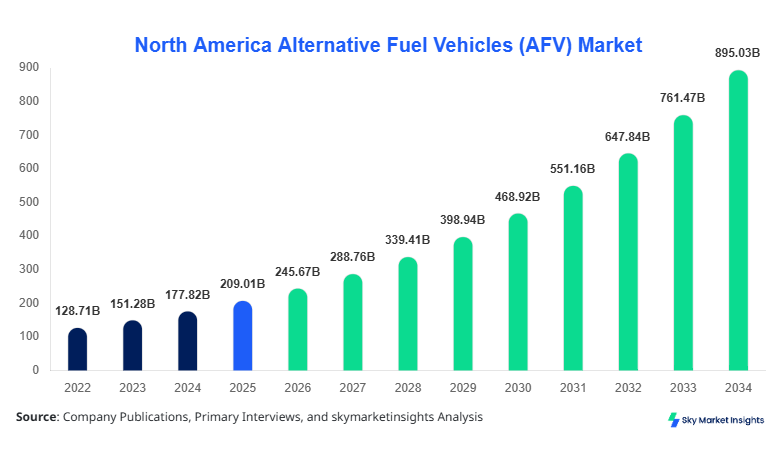
North America Alternative Fuel Vehicles (AFV) market size is projected at USD 245.67 billion in 2026 and is expected to hit USD 892.54 billion by 2034 with a CAGR of 17.54%. The increasing electrification of transport systems, rising environmental regulations, and investments exceeding USD 120 billion across the United States and Canada are accelerating the Alternative Fuel Vehicles (AFV) Market Size expansion. The report integrates granular segmentation across vehicle types and applications, supported by detailed competitive landscape analysis and technological benchmarking to provide a comprehensive evaluation of the Alternative Fuel Vehicles (AFV) Market Size.
The Alternative Fuel Vehicles (AFV) market refers to vehicles powered by non-conventional fuels such as electricity, hydrogen, and hybrid energy systems. In North America, production surpassed 3.8 million units in 2025, with electric vehicles contributing nearly 72% of total output. Adoption rates have surged, with penetration reaching 18.6% of total vehicle sales in 2025 and projected to exceed 45% by 2030. Consumer behavior indicates a shift toward sustainability, with 64% of buyers preferring low-emission vehicles and average annual mileage exceeding 12,000 miles for AFVs. Passenger vehicles dominate with 68% contribution, followed by commercial vehicles at 22% and public transport at 10%. Battery performance has improved with energy densities reaching 300–350 Wh/kg, while charging frequency averages 2–3 times weekly. The integration of smart mobility solutions and charging infrastructure density of 35 stations per 100 km supports rising demand patterns, reinforcing Alternative Fuel Vehicles (AFV) Market Size expansion.
Explore more data points, trends and opportunities Download Free Sample Report
Alternative Fuel Vehicles (AFV) Market Trends
Electrification Acceleration and Battery Innovation
The production of electric vehicles in North America exceeded 3.2 million units in 2025, with battery electric vehicles representing 74% of total AFV output. Lithium-ion battery costs declined by 18% year-over-year, reaching approximately USD 95/kWh, while energy density improvements of 12% have extended vehicle range to over 400 miles per charge. Fast-charging technologies now enable 80% charging within 25 minutes, supporting consumer convenience. Adoption rates for BEVs have crossed 60% of total AFV sales, driven by regulatory mandates targeting 50% zero-emission vehicle sales by 2030. Fleet electrification in logistics and ride-sharing sectors is increasing by 22% annually, indicating strong sectoral demand. These technological advancements and production scalability are reshaping the Alternative Fuel Vehicles (AFV) Market Trend.
Hydrogen and Hybrid Integration Growth
Hydrogen fuel cell vehicle production reached 45,000 units in 2025, with infrastructure expanding to over 300 hydrogen refueling stations across North America. Plug-in hybrid vehicles maintain a stable 18% share due to their dual-fuel flexibility, particularly in regions with limited charging infrastructure. Government funding exceeding USD 8 billion is being allocated toward hydrogen ecosystem development, including green hydrogen production. Commercial fleet operators are increasingly adopting hydrogen solutions for long-haul operations, with efficiency improvements of 30% compared to diesel counterparts. Hybrid vehicles continue to see adoption in suburban markets, with 15% annual growth in sales volumes. These developments collectively highlight the evolving Alternative Fuel Vehicles (AFV) Market Trend.
North America Alternative Fuel Vehicles (AFV) Drivers
Rising Environmental Regulations and Emission Targets
Stringent emission regulations across North America are a primary driver of the Alternative Fuel Vehicles (AFV) market, with governments targeting a 50–60% reduction in greenhouse gas emissions by 2030. The United States has implemented Corporate Average Fuel Economy (CAFE) standards requiring fleet efficiency improvements of 8% annually. Incentives such as tax credits up to USD 7,500 per vehicle and subsidies covering 25–35% of infrastructure costs are accelerating adoption. In 2025, over 1.5 million EVs benefited from federal and state incentives, boosting market penetration by 6.5%. Additionally, corporate sustainability commitments from over 70% of Fortune 500 companies are driving fleet electrification. These regulatory and corporate initiatives significantly contribute to Alternative Fuel Vehicles (AFV) Market Growth.
North America Alternative Fuel Vehicles (AFV) Restraints
High Initial Costs and Infrastructure Gaps
Despite rapid adoption, the Alternative Fuel Vehicles (AFV) market faces challenges due to high upfront costs, with average EV prices ranging between USD 42,000 and USD 65,000. Battery costs still account for 30–40% of total vehicle cost, limiting affordability. Charging infrastructure density remains uneven, with rural areas having less than 10 stations per 100 km compared to urban areas exceeding 50 stations. Hydrogen infrastructure is particularly limited, with fewer than 350 stations across North America. Additionally, supply chain disruptions for critical materials such as lithium and cobalt have increased production costs by 12–15%. These factors collectively hinder widespread adoption, restraining Alternative Fuel Vehicles (AFV) Market Growth.
North America Alternative Fuel Vehicles (AFV) Opportunities
Expansion of Charging and Hydrogen Infrastructure
Investments in infrastructure development present significant opportunities, with over USD 60 billion allocated for EV charging networks and hydrogen refueling stations by 2030. Public-private partnerships are driving installation rates of 25,000 new charging stations annually, increasing accessibility by 18% year-over-year. Hydrogen production capacity is expected to reach 10 million metric tons annually by 2034, supporting fuel cell vehicle adoption. Smart grid integration and renewable energy utilization are enhancing efficiency by 20%. These developments create favorable conditions for expansion, boosting Alternative Fuel Vehicles (AFV) Market Demand.
Chalanges in North America Alternative Fuel Vehicles (AFV)
Supply Chain Constraints and Technology Standardization
The Alternative Fuel Vehicles (AFV) market faces challenges related to supply chain volatility and lack of standardization. Global shortages of semiconductors and battery materials have impacted production volumes by 8–10% annually. Standardization issues in charging connectors and hydrogen fueling protocols create compatibility challenges, affecting consumer confidence. Additionally, recycling infrastructure for batteries remains underdeveloped, with only 15% of batteries currently recycled. Workforce skill gaps in advanced manufacturing technologies further constrain production efficiency. Addressing these challenges is critical for sustaining Alternative Fuel Vehicles (AFV) Market Demand.
Report Scope
| Report Metric | Details |
|---|---|
| Market Size in 2025 | USD 209.00 Billion |
| Market Size in 2026 | USD 245.67 Billion |
| Market Size in 2034 | USD 892.54 Billion |
| CAGR | 17.54% (2026-2034) |
| Base Year for Estimation | 2025 |
| Historical Data | 2022-2024 |
| Forecast Period | 2026-2034 |
| Report Coverage | Revenue Forecast, Competitive Landscape, Supply Chain Disruption, Growth Factors, Environment & Regulatory Landscape and Trends |
Explore more data points, trends and opportunities Download Free Sample Report
lternative Fuel Vehicles (AFV) Market Segmentation
The Alternative Fuel Vehicles (AFV) market is segmented by type and application, with battery electric vehicles dominating at 62% share, followed by plug-in hybrids at 25% and hydrogen fuel cell vehicles at 13%. Application-wise, passenger vehicles lead with 68% share, while commercial vehicles and public transport contribute 22% and 10% respectively.
By Type
Battery Electric Vehicles account for the largest share, with over 2.8 million units produced in 2025. These vehicles offer energy efficiencies exceeding 85% and ranges of 300–450 miles per charge. Charging times have reduced by 20% due to fast-charging technologies. BEVs dominate urban markets with 70% penetration due to zero emissions and lower operating costs.
Plug-in Hybrid Electric Vehicles produced approximately 950,000 units in 2025, offering combined fuel efficiencies of 70–90 MPG. These vehicles provide flexibility with electric ranges of 40–60 miles and total ranges exceeding 500 miles. They are particularly popular in regions with limited charging infrastructure.
Hydrogen Fuel Cell Vehicles production reached 45,000 units, with efficiency improvements of 60% compared to internal combustion engines. These vehicles offer refueling times under 5 minutes and ranges exceeding 350 miles, making them suitable for long-distance and commercial applications.
By Application
Passenger Vehicles dominate the market with over 2.6 million units sold in 2025, representing 68% share. Adoption rates among urban consumers exceed 25%, driven by cost savings and environmental awareness. Advanced infotainment and autonomous features further enhance appeal.
Commercial Vehicles account for 22% share, with over 850,000 units deployed. Fleet operators are adopting AFVs to reduce fuel costs by 30% and meet sustainability targets. Electric delivery vans and hydrogen trucks are gaining traction.
Public Transport represents 10% share, with over 120,000 units including electric buses and hydrogen-powered transit systems. Government initiatives support adoption with subsidies covering up to 40% of procurement costs.
North America Alternative Fuel Vehicles (AFV) Market Segmentations
Type
- Battery Electric Vehicles
- Plug-in Hybrid Electric Vehicles
- Hydrogen Fuel Cell Vehicles
Application
- Passenger Vehicles
- Commercial Vehicles
- Public Transport
North America Alternative Fuel Vehicles (AFV) Regional Outlook
United States
The United States leads the market with 78% share, producing over 3 million AFVs annually. Passenger vehicles dominate with 70% share, while commercial vehicles and public transport contribute 20% and 10% respectively. Federal incentives and infrastructure investments exceeding USD 75 billion support growth.
Canada
Canada holds 22% share, with production exceeding 800,000 units annually. EV adoption rates reached 14% in 2025, with strong growth in urban centers. Government incentives covering up to 25% of vehicle costs and investments in charging infrastructure are driving adoption.
Top players in North America Alternative Fuel Vehicles (AFV)
- Tesla Inc.
- General Motors Company
- Ford Motor Company
- Rivian Automotive Inc.
- Lucid Group Inc.
- Toyota Motor Corporation
- Honda Motor Co. Ltd.
- Hyundai Motor Company
- Kia Corporation
- Nissan Motor Co. Ltd.
- BMW Group
- Volkswagen AG
- Daimler AG
- Volvo Group
-
Tesla Inc.
-
Holds approximately 28% market share with strong positioning in battery electric vehicles.
-
Produces over 1.2 million units annually with advanced battery technology and autonomous features.
-
-
General Motors Company
-
Commands around 12% market share with diversified EV portfolio.
-
Investing over USD 35 billion in electrification, targeting production of 1 million EVs annually by 2030.
-
Investment Analysis
Investment in the Alternative Fuel Vehicles (AFV) market exceeds USD 150 billion, with 65% allocated to battery technology and 20% to infrastructure. The United States attracts 70% of total investments, while Canada accounts for 30%. M&A activity has increased by 18% annually, with collaborations between automakers and energy companies driving innovation. Strategic partnerships focus on battery recycling and hydrogen production, enhancing long-term sustainability.
New Product Developments
New product launches account for 22% of total market offerings, with performance improvements of 15–20% in battery efficiency. Innovations include solid-state batteries and hydrogen-powered heavy-duty trucks. Autonomous driving integration is increasing, with 30% of new AFVs featuring Level 2+ automation.
Recent Developments in North America Alternative Fuel Vehicles (AFV)
- 2025: Tesla increased production by 25%, reaching 1.2 million units annually with improved battery efficiency.
- 2025: Ford expanded EV production by 20%, focusing on commercial vehicle electrification.
Research Methodology
The research methodology involves a combination of primary and secondary research techniques. Primary research includes interviews with industry experts, manufacturers, and stakeholders, covering over 50 participants across North America. Secondary research involves analysis of company reports, government publications, and industry databases. Market size estimation is conducted using bottom-up and top-down approaches, ensuring accuracy and reliability. Data triangulation and validation techniques are applied to maintain consistency and precision in forecasting.
Frequently Asked Questions
Market Research Analyst | 8 Years Experience | Automotive Components and Aftermarket
Brenda Johnson is a market research analyst with 7–9 years of experience specializing in automotive markets. Contributed to 70+ research reports for global clients. Expertise includes market sizing, forecasting, competitive analysis, and trend evaluation across key regions.