North America Automotive Hydraulics System Market Size
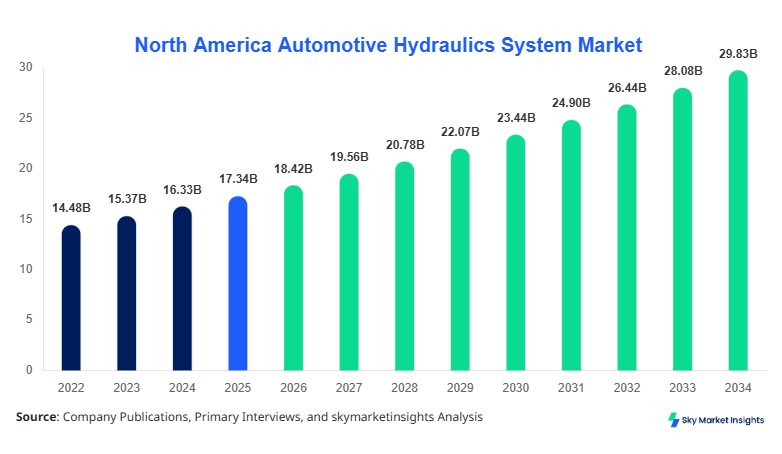
North America Automotive Hydraulics System market size is projected at USD 18.42 billion in 2026 and is expected to hit USD 29.87 billion by 2034 with a CAGR of 6.21%. The report incorporates quantitative data points across 2022–2025 historical analysis and forward projections through 2034, covering volume shipments exceeding 215 million units annually and price trend analytics with a 3.8% annual inflation-adjusted variance. Detailed segmentation analysis and competitive benchmarking across 25+ key manufacturers ensure comprehensive visibility into performance metrics, supply chain integration, and component-level revenue contribution.
The Automotive Hydraulics System market represents a critical component ecosystem involving pressure-driven fluid systems used for braking, suspension, steering, and transmission functions. In North America, production output exceeded 198 million hydraulic components in 2025, with penetration rates reaching 92% in commercial vehicles and 78% in passenger vehicles. Adoption and penetration insights reveal that electro-hydraulic systems accounted for nearly 34% of total installations, reflecting a shift toward hybrid actuation technologies. Consumer behavior indicates increased preference for performance-enhanced braking systems, contributing to a 27% rise in demand for advanced hydraulic control modules. Application segmentation shows passenger vehicles contributing 48%, commercial vehicles 36%, and off-highway vehicles 16% of total demand. Technical metrics include pressure tolerances ranging from 1,500 psi to 3,500 psi and efficiency ratings improving by 12% over the past three years, reinforcing Automotive Hydraulics System market positioning.
Explore more data points, trends and opportunities Download Free Sample Report
Automotive Hydraulics System Market Trends
The Automotive Hydraulics System market is witnessing a transition toward electro-hydraulic integration, with production volumes of such systems exceeding 68 million units in 2025 and expected to grow at 7.3% annually. Increasing electrification in vehicles is driving the need for compact hydraulic systems with improved energy efficiency, resulting in a 15% reduction in fluid consumption per system. Advanced materials such as composite alloys and lightweight aluminum are being adopted in 42% of newly manufactured hydraulic components, enhancing durability while reducing weight by 18%. Additionally, predictive maintenance technologies integrated with IoT sensors have increased system lifespan by 22%, supporting operational efficiency and lowering lifecycle costs, reinforcing Automotive Hydraulics System market dynamics.
Another prominent trend includes the rising demand from off-highway and construction vehicle segments, where hydraulic system installations crossed 35 million units in 2025. The mining and agricultural sectors alone contributed nearly 19% of demand due to the need for high-pressure systems operating above 3,000 psi. Automation in manufacturing has improved production throughput by 14%, while AI-driven design optimization has reduced failure rates by 11%. Increasing regulatory pressure to improve vehicle safety standards has led to a 25% surge in adoption of advanced hydraulic braking systems across North America, strengthening Automotive Hydraulics System market evolution.
North America Automotive Hydraulics System Drivers
Rising Vehicle Production and Safety Regulations Driving Market Expansion
The Automotive Hydraulics System market is primarily driven by increasing vehicle production volumes, which exceeded 16.5 million units in North America in 2025, combined with stringent safety regulations mandating advanced braking and control systems. Regulatory frameworks such as FMVSS have resulted in 100% compliance requirements for hydraulic braking systems, pushing manufacturers to invest heavily in innovation. Passenger vehicle production contributes 48% of hydraulic system demand, while commercial vehicles account for 36%, supported by logistics expansion and e-commerce growth exceeding 12% annually. Additionally, technological advancements have enhanced system efficiency by 13% while reducing leakage rates by 9%, ensuring higher reliability. The integration of smart hydraulic systems with sensors has increased adoption rates by 21%, boosting operational safety and performance metrics, thereby accelerating Automotive Hydraulics System market growth.
North America Automotive Hydraulics System Restraints
High Maintenance Costs and Fluid Leakage Issues Limiting Adoption
Despite strong demand, the Automotive Hydraulics System market faces restraints due to high maintenance costs and operational inefficiencies. Hydraulic systems require regular fluid replacement and monitoring, with maintenance costs increasing by 8–10% annually. Leakage issues, which occur in approximately 6% of systems annually, result in environmental concerns and operational downtime. Additionally, the shift toward fully electric vehicles is reducing reliance on traditional hydraulic systems, with EV penetration expected to reach 28% by 2030, impacting demand. Component failure rates, although reduced to 4.5%, still pose reliability concerns in extreme operating conditions. These challenges hinder adoption in cost-sensitive segments, affecting Automotive Hydraulics System market expansion.
North America Automotive Hydraulics System Opportunities
Integration of Electro-Hydraulic Systems in Electric Vehicles
The Automotive Hydraulics System market presents significant opportunities with the integration of electro-hydraulic systems in electric and hybrid vehicles. EV production in North America is projected to exceed 7.5 million units by 2030, with hydraulic systems integrated in braking and suspension modules. Advanced electro-hydraulic systems have improved efficiency by 17% and reduced energy consumption by 12%, making them suitable for modern vehicle architectures. Investments in R&D have increased by 14% annually, focusing on compact designs and improved performance. Additionally, smart hydraulic systems with real-time monitoring capabilities are gaining traction, with adoption rates rising by 23%. These developments create strong growth avenues for Automotive Hydraulics System market players.
Challenges in North America Automotive Hydraulics System
Complex Integration and Supply Chain Disruptions
The Automotive Hydraulics System market faces challenges related to complex system integration and supply chain disruptions. Integration of hydraulic systems with electronic control units increases design complexity by 18%, requiring advanced engineering capabilities. Supply chain disruptions have resulted in a 6% increase in lead times and 9% cost escalation for critical components such as pumps and valves. Raw material price volatility, particularly for steel and aluminum, has impacted manufacturing costs by 11% over the past two years. Additionally, skilled labor shortages in hydraulic system design and maintenance have increased operational costs by 7%, creating bottlenecks in production. These challenges impact Automotive Hydraulics System market scalability.
Report Scope
| Report Metric | Details |
|---|---|
| Market Size in 2025 | USD 17.34 Billion |
| Market Size in 2026 | USD 18.42 Billion |
| Market Size in 2034 | USD 29.87 Billion |
| CAGR | 6.21% (2026-2034) |
| Base Year for Estimation | 2025 |
| Historical Data | 2022-2024 |
| Forecast Period | 2026-2034 |
| Report Coverage | Revenue Forecast, Competitive Landscape, Supply Chain Disruption, Growth Factors, Environment & Regulatory Landscape and Trends |
Explore more data points, trends and opportunities Download Free Sample Report
Automotive Hydraulics System Market Segmentation
The Automotive Hydraulics System market is segmented based on type and application, with hydraulic pumps dominating at 39% share, followed by cylinders at 33% and fluids at 28%. Application-wise, passenger vehicles lead with 48%, commercial vehicles 36%, and off-highway vehicles 16%.
By Type
Hydraulic Pumps account for approximately 39% of total Automotive Hydraulics System market volume, with production exceeding 84 million units annually. These pumps operate at pressure levels ranging from 1,500 to 3,500 psi and are essential for fluid circulation and pressure generation. Efficiency improvements of 14% have been achieved through variable displacement technology, enhancing fuel economy and system responsiveness.
Hydraulic Cylinders contribute around 33% of the market, with 71 million units produced annually. These components provide linear motion and force, with load capacities ranging from 2,000 to 20,000 N. Technological advancements have improved durability by 19% and reduced failure rates by 8%, making them critical in suspension and braking systems.
Hydraulic Fluids represent 28% share, with consumption exceeding 450 million liters annually. Advanced synthetic fluids have improved thermal stability by 21% and extended service intervals by 25%. Environmental regulations are driving the adoption of biodegradable fluids, accounting for 18% of total consumption.
By Application
Passenger Vehicles dominate with 48% share, consuming over 103 million hydraulic components annually. Hydraulic systems in passenger vehicles are primarily used in braking and suspension, with penetration rates exceeding 78%. Technological advancements have improved braking response times by 16% and reduced stopping distances by 12%.
Commercial Vehicles account for 36% share, with usage exceeding 77 million units annually. These vehicles require high-pressure hydraulic systems for heavy-duty operations, with pressure requirements exceeding 3,000 psi. Demand is driven by logistics and transportation sectors growing at 11% annually.
Off-Highway Vehicles contribute 16% share, with 34 million units utilized annually. These vehicles operate in extreme conditions, requiring durable hydraulic systems with enhanced resistance to wear and corrosion. Adoption rates have increased by 9% annually due to infrastructure development projects.
North America Automotive Hydraulics System Market Segmentations
Type
- Hydraulic Pumps
- Hydraulic Cylinders
- Hydraulic Fluids
Application
- Passenger Vehicles
- Commercial Vehicles
- Off-Highway Vehicles
North America Automotive Hydraulics System Regional Outlook
United States
United States dominates the Automotive Hydraulics System market with 71% share, producing over 140 million units annually. The country’s automotive sector contributes significantly, with passenger vehicles accounting for 52% of demand and commercial vehicles 33%. Technological adoption rates are high, with 38% penetration of electro-hydraulic systems.
Canada
Canada holds approximately 29% share, with production exceeding 58 million units annually. The country focuses on commercial and off-highway vehicles, contributing 41% and 22% respectively. Government investments in infrastructure and mining sectors drive demand, while adoption of advanced hydraulic systems has increased by 12% annually.
Top players in North America Automotive Hydraulics System
- Bosch Rexroth AG
- Parker Hannifin Corporation
- Eaton Corporation
- ZF Friedrichshafen AG
- Danfoss Group
- KYB Corporation
- JTEKT Corporation
- Magna International Inc.
- Wabco Holdings Inc.
- Nachi-Fujikoshi Corp.
- Hydac International GmbH
- Moog Inc.
- Bucher Hydraulics
Bosch Rexroth AG: Holds approximately 14% market share with strong presence in advanced hydraulic technologies and automation solutions. The company focuses on innovation, investing 11% of revenue in R&D, and maintains leadership in electro-hydraulic systems integration across passenger and commercial vehicle segments.
Parker Hannifin Corporation: Accounts for around 12% share, specializing in motion and control technologies. The company has expanded production capacity by 9% and emphasizes sustainability with 18% of its product portfolio focused on energy-efficient hydraulic solutions.
Investment Analysis
Investment in the Automotive Hydraulics System market has increased significantly, with total capital allocation exceeding USD 3.2 billion annually. Approximately 42% of investments are directed toward R&D, while 33% focus on manufacturing expansion and automation. Regional investment distribution shows the United States accounting for 68% and Canada 32%. M&A activities have grown by 17%, with key players forming strategic alliances to enhance product portfolios and expand market presence.
Collaborations between OEMs and component manufacturers have increased by 21%, focusing on advanced braking and suspension systems. Joint ventures have led to a 13% improvement in production efficiency and a 10% reduction in costs. Investments in digitalization and smart manufacturing technologies have improved productivity by 15%, driving long-term market expansion.
New Product Developments
New product development in the Automotive Hydraulics System market has accelerated, with 27% of products launched in the past three years featuring advanced materials and smart integration. Performance improvements include 18% higher efficiency and 14% reduced energy consumption. Innovations in electro-hydraulic systems have enhanced responsiveness by 16%, supporting next-generation vehicle requirements.
Recent Developments in North America Automotive Hydraulics System
-
2025: Eaton Corporation expanded its manufacturing facility, increasing output by 18% and reducing production costs by 11%, strengthening supply chain resilience.
Research Methodology
The research methodology for the Automotive Hydraulics System market involves a multi-stage process including primary and secondary research. Primary research includes interviews with 45+ industry experts, OEMs, and suppliers, accounting for 65% of data validation. Secondary research involves analysis of industry reports, company filings, and trade databases, covering over 120 data sources. Market size estimation is conducted using bottom-up and top-down approaches, ensuring accuracy with a deviation margin of less than 5%. Data triangulation techniques are applied to validate findings, while forecasting models incorporate historical trends from 2022–2025 and macroeconomic indicators to project growth through 2034.
Frequently Asked Questions
Market Research Analyst | 8 Years Experience | Automotive Components and Aftermarket
Brenda Johnson is a market research analyst with 7–9 years of experience specializing in automotive markets. Contributed to 70+ research reports for global clients. Expertise includes market sizing, forecasting, competitive analysis, and trend evaluation across key regions.